Düben Castle: A Historic Defensive and Administrative Site in Germany


Site at a Glance
- Rating
- 4.6
- Popularity
- Low
- Country
- Germany
- Primary era
- Medieval
- External website
- Open
- Eras represented
- Medieval, Early Modern
- Civilizations
- Electorate of Saxony, Holy Roman Empire
- Site type
- Military
- Remains
- Castle
On this page11 sections
History
Düben Castle is a medieval castle in Bad Düben, Germany, whose origins date to around the tenth century beside a ford across the Mulde. Its position on an old trade route gave it strategic value for settlement, commerce, and military movement, while a Slavic community developed nearby. The castle was first mentioned in 981 by Thietmar of Merseburg, an eleventh-century bishop and chronicler, in an account connected with the dissolution of the Bishopric of Merseburg.
Origins and medieval development
In 1017 the castle belonged to Count Albi, who was followed soon afterward by Count Frederick of Eilenburg. During the conflict associated with the Battle of Welfesholz, the medieval nobleman Wiprecht of Groitzsch seized the castle in 1115 and used it as a base for taking several surrounding manors. Margrave Otto the Rich, a twelfth-century territorial ruler of Meissen, was also temporarily imprisoned there.
The settlement around the castle changed during the eastward German colonization. Flemish immigrants founded Neumark beside the castle around 1200. Frankish and Saxon settlers later took over older Slavic farmsteads and contributed to the formation of the town of Düben. An inheritance treaty transferred the castle in 1291 to the Landgraves of Thuringia, who granted it as a fief to their followers.
A noble feud between the brothers Frederick and William of Thuringia brought major destruction in 1450, when the castle was completely destroyed. Its later rebuilding supported a new administrative role rather than simply restoring the earlier medieval stronghold.
Electoral Saxon administration
From 1530, Düben Castle served as the Electoral Saxon administrative seat of the Düben office. An elector was a prince entitled to participate in choosing the Holy Roman Emperor. The office had functioned as an administrative centre from approximately the fourteenth century until 1815, and the castle remained associated with this role for much of the early modern period.
The castle gained wider regional fame through the Kohlhase disputes, a conflict that began in 1532 and continued until 1540. The parties included Hans Kohlhase, a German merchant, the nobleman von Zaschwitz, and the Elector of Saxony. Negotiations took place at Düben in 1533. Philipp Melanchthon the Younger, a sixteenth-century scholar and theologian, served as head of the castle office in 1554 and is regarded as its most prominent office holder.
Düben was also associated with one of the last witch trials in Germany. Local tradition connected the castle with a witches’ cellar, torture, a witches’ grave, and a witches’ dancing ground. Torture was prohibited in Saxony in 1783, placing the tradition within a period when judicial practice was changing.
Wartime headquarters and political change
During the Seven Years’ War, King Frederick II of Prussia stayed at the castle and established the largest supply depot for his army in Saxony there. Five thousand soldiers guarded the depot. The campaign was followed by the Battle of Torgau on 3 November 1760, where Frederick won despite heavy losses.
On 15 September 1631, during the Thirty Years’ War, King Gustav II Adolf of Sweden, Elector George William of Brandenburg, and Elector John George I of Saxony concluded an alliance at the castle against Emperor Ferdinand II. The war, fought from 1618 to 1648, combined religious, dynastic, and political rivalries. The allied forces later defeated the imperial army commanded by Field Marshal Tilly at the Battle of Breitenfeld. The alliance did not spare Düben itself from destruction, and passing mercenary armies destroyed the town in 1631, 1637, and 1641.
Napoleon established his headquarters at Düben Castle from 10 to 14 October 1813 during the Wars of Liberation, the campaigns of 1813 to 1815 against his domination of much of continental Europe. He reportedly described the uncertainty of the military and political situation at Düben as producing the worst days of his life. After 1815, the castle and the town became part of Prussia. A justice and revenue office operating at the castle in 1780 was dissolved in 1942.
Museum and later conservation
After the Second World War, the local historian Willy Winkler led the creation of a landscape and local-history museum, completed by 1953. Its displays addressed the history of the castle and town, the region’s economic development, and the Dübener Heath, a wooded area of central Germany. The museum later occupied the castle’s main building.
Extensive renovation of all the castle buildings took place between 1997 and 1999. In October 2017, repairs to the tower revealed a wall frieze by Paul Haffner behind loose paint in a timber-framed storey. Haffner lived from 1874 to 1965 and had helped design the museum exhibitions in the early 1950s. He also produced wall paintings and illustrations, prepared collection inventory cards and other drawings, and contributed to stage-set painting for the local theatre. During the renovation and remodelling, the landscape museum was closed, while the castle grounds and ship mill remained accessible.
Remains
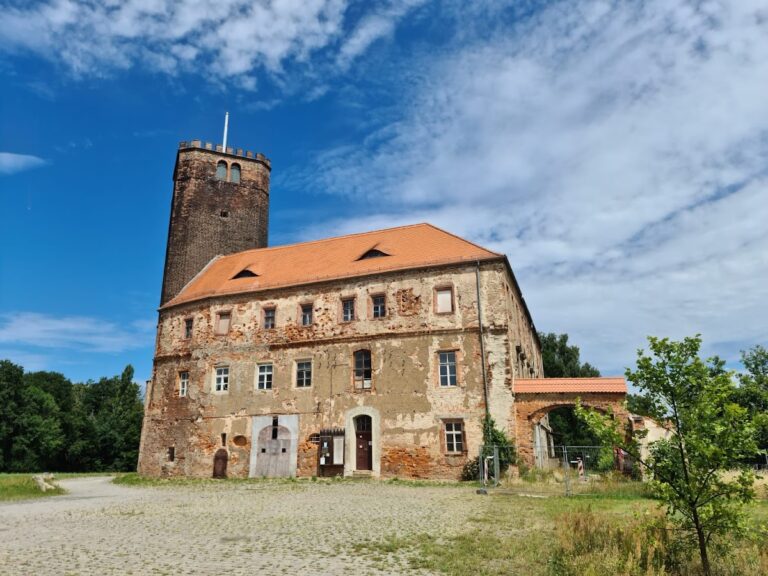
The castle complex stands on a small hill on the right bank of the Mulde, directly beside the river and near the bridge carrying the B 2 across it. Its surviving layout includes the main tower, the administrative main building, the castle warder’s house, a courtyard, a park, and the associated ship mill at the foot of the castle. The buildings combine medieval masonry with later timber-framed construction, and the entire group underwent extensive renovation between 1997 and 1999.
Castle buildings
Main tower
The bergfried, or principal defensive tower, is the oldest surviving building in the castle area and dates to 1206. A bergfried was primarily a stronghold rather than a permanent residence. The tower contains the feature known as the witches’ cellar. Its timber-framed upper storey also preserves the wall frieze discovered behind detached layers of paint during repairs in 2017. The frieze was made by Paul Haffner, whose work was closely connected with the early museum displays.
Administrative building
Behind the tower stands the main building, constructed to serve as the administrative seat of the Düben office. It now houses the local-history and landscape museums, whose collections cover Düben Castle, the town, and the economic development of the surrounding region. The building forms the principal later administrative element within the castle complex.
Castle warder’s house
The castle warder’s house stands beside the main building and is part of the surviving group of castle structures. It now contains a small café. Its position beside the administrative building places it within the central built area of the complex.
Courtyard, park, and ship mill
The castle grounds include a courtyard and a castle park. At the foot of the castle stands the associated bergschiffmühle, or ship mill, a mill mounted on or beside a floating vessel and driven by river current. The mill has been restored and uses the flow of the Mulde. A memorial at the castle commemorates Napoleon’s stay there in October 1813.