Allonnes Archaeological Site: An Iron Age Settlement and Gallo-Roman Sanctuary
Site at a Glance
- Popularity
- Low
- Country
- France
- Primary era
- Classical
- Eras represented
- Iron Age, Classical
- Civilizations
- Celtic, Roman
- Site type
- City
On this page22 sections
History
The Allonnes Archaeological Site lies in Allonnes, France, and preserves the history of a settlement occupied from the Iron Age into the Roman period. Known in antiquity as Alauna, it belonged to the territory of the Aulerci Cenomani, a Gaulish people whose lands broadly corresponded to the modern Sarthe region. Allonnes became a major religious center, with a sanctuary that continued in use from the pre-Roman era into Roman times.
Iron Age settlement and Roman sanctuary
Occupation began during the middle and later Hallstatt phases, successive periods of the European Iron Age, and continued through the La Tène period. A Gaulish presence is associated with La Tène A, while finds also relate to La Tène B2 and C1 and to middle and later La Tène phases. Allonnes was probably the Aulerci Cenomani’s second most important pre-Roman settlement after Vindinum, the ancient town at modern Le Mans. It may have served as their principal religious center, although its possible role as their political capital remains uncertain.
Roman occupation began in the early first century AD. In the Roman period, Vindinum was the territory’s capital, while Allonnes formed part of a network of secondary settlements and served as its principal sanctuary and a place of pilgrimage. The religious importance of the site continued as the Roman god Mars became associated with the local Celtic deity Mullo. This blending of traditions is reflected in the name Mars Mullo, used for the sanctuary’s cult.
Abandonment and changing name
Allonnes was abandoned during the fourth century. The sanctuary of Mars Mullo closed around AD 350, and portions of its religious building were taken down and reused elsewhere. The closure has not been established as a result of Roman laws against pagan worship. Population movement and a change in where people lived have instead been proposed as possible explanations.
The settlement’s name is probably connected with the Celtic divine name Alauna or Alaunos. Another suggested origin links it to Gaulish words for water and flowing water. Its recorded forms changed over time: Avlavna appears on a coin from 616, Alompte was used in the Middle Ages, and Alonne was current in the eighteenth century.
Archaeological investigation and protection
Remains were reported in the mid-eighteenth century, and the first archaeological investigations took place in 1774. Work directed by Charles Drouet from 1840 to 1843 identified further Roman-period structures and nine sarcophagus burials; Drouet described and inventoried the burials in an 1841 report. A Roman villa was also uncovered in 1840. In 1911, Camille Jullian investigated a wooded mound and interpreted its masonry as a Roman imperial-period funerary mausoleum. That identification was his interpretation.
Research in the Allonnes hills during the 1950s identified the sanctuary of Mars Mullo and an older, smaller sanctuary at Perrières. Excavations at La Tour-aux-Fées, also known as La Forêterie, included a campaign from 1954 to 1957, and further preventive investigations took place there in 1966. Public works prompted excavations at Argenton-le-Marin in 1972–1973 and investigations in areas AH 8 and AH 37 from 1974 to 1977. A rescue excavation of a Roman-period burial pit in the early to mid-1980s was reported in 1986.
A research program led by Katherine Gruel and Valérie Brouquié-Reddé began in 1994. Investigations continued in the 2000s, especially at La Forêterie and the Mars Mullo sanctuary, in partnership with the Allonnes archaeological research association. Test excavations in 1999 examined deposits beneath the sanctuary’s Augustan-period temple. The sanctuary received historic-monument protection in 1961, followed by protection for the wider archaeological site in 1979.
Remains
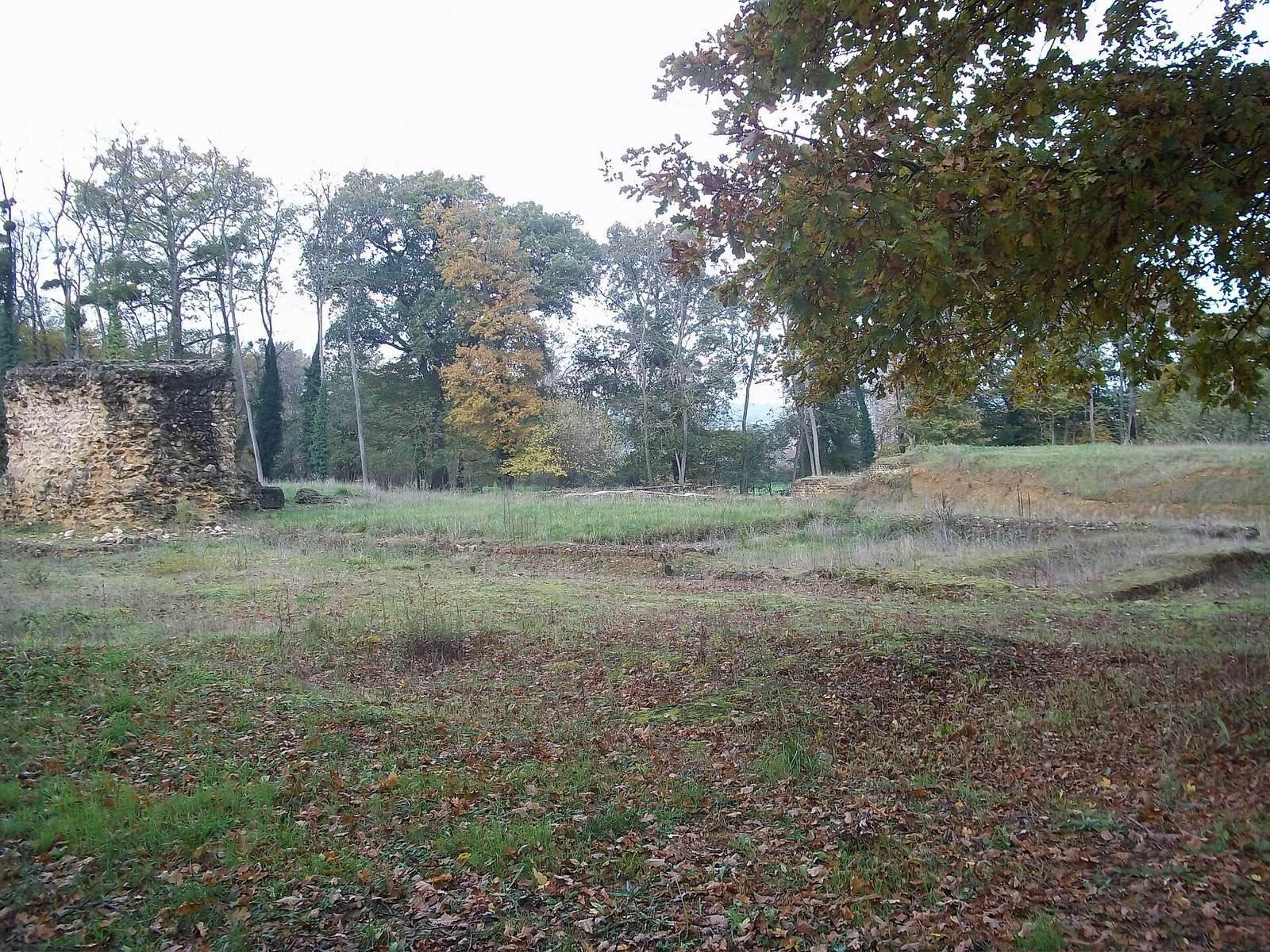
The archaeological complex extends across fields at Argenton and Marin, parts of central Allonnes, and the wooded La Forêterie area toward the Chaoué ford on the Sarthe. Its western reaches lie near the river. Remains also occur at Perrières and around the Pasteur baths. The site spans the river’s low-lying plain and a broad plateau overlooking the valley, at elevations between 38 and 82 metres. The Huisne depression and the Vieux-Mans and Fondues hills mark the eastern side of the pre-Roman remains. Gallo-Roman public buildings used grey limestone veined with pink and red, obtained mainly from a quarry at Sablé-sur-Sarthe.
Iron Age deposits and burial grounds
Cult deposits
Iron Age objects recovered from a sandy deposit or terraced feature include sword scabbards decorated with curved incisions, some showing fantastic animals, and unfinished metalwork such as handles for household vessels and cauldrons. More rarely, vessels survived intact. A separate cult deposit attributed to the middle and later La Tène period, phases B–D, contained swords, daggers, and domestic metal vessels, especially cauldrons. This kind of assemblage is rare in north-western Gaul. Excavations also revealed ceramic, metal-utensil, and weapon deposits associated with the Gaulish occupation.
Argenton-le-Marin burial pits
Excavations at Argenton-le-Marin uncovered twenty circular pits, also described as wells, interpreted as burials. Each was 2.50–3.75 metres deep and 0.8–1 metre across internally. Roughly cut stones set in clay formed concentric courses, changing to a square oak lining at the water table. The lining used beams about 0.80 metres long, stacked with notched joints. The fills typically formed three layers: rubble mixed with black soil, stones, tiles, pottery, and nails; greasy clay with charcoal, animal bones, and debris; and an upper grey layer containing small pottery fragments.
The pits contained mainly coarse pottery, as well as fine red-gloss Roman tableware known as terra sigillata; two vases had cut-out decoration. Other finds included coins bearing portraits of Vespasian, Domitian, Commodus, Julia Domna, Gordian III, and Tetricus I, a white terracotta figurine, fragments of a bronze basin, and part of a carved wooden bucket. The deliberate breaking of pottery has been interpreted as evidence that the pits received the dead.
Cemetery at AH 8 and AH 37
Excavations across more than a hectare in areas AH 8 and AH 37 revealed about fifty pits, including approximately forty wells and ten small structures arranged in rows to form a square. The excavations had square timber supports. Finds included pottery, coins, clothing fasteners, broken white terracotta figurines, an iron ring engraved with a phoenix, two inscriptions on lead sheets, and an item of children’s clothing. One pit contained two human skeletons. Coins and fine pottery place the burial complex in the first century AD.
Small buildings at AH 8 and AH 37
Two small rectangular buildings stood in this area. Building T measured 4.50 by 3.50 metres and had brick walls 0.40 metres thick. A three-metre corridor filled with unworked stones, earth, bone fragments, and pottery led into it. A coin bearing the portrait of Faustina the Younger was incorporated into a wall, and 22 other coins came from a side opening. A small stone installation at the center may have served as a hearth.
The second building had two rooms. Its first, almost square room measured 3.40 by 3.50 metres and showed evidence of reuse. The alteration added a second square room, 5.40 metres on each side. Gallo-Roman coins and probable roof-tile fragments were found inside.
Sanctuaries
Mars Mullo sanctuary
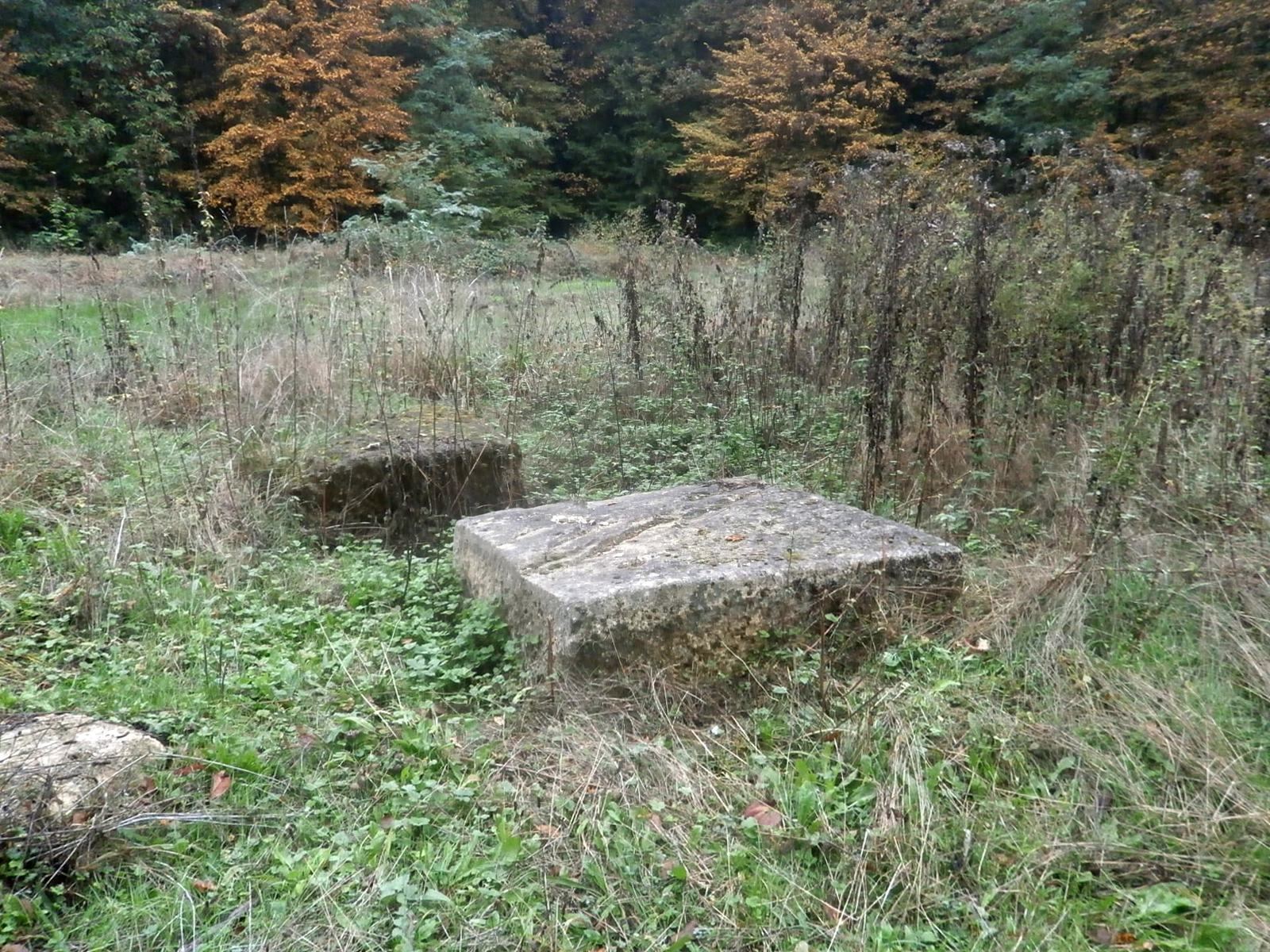
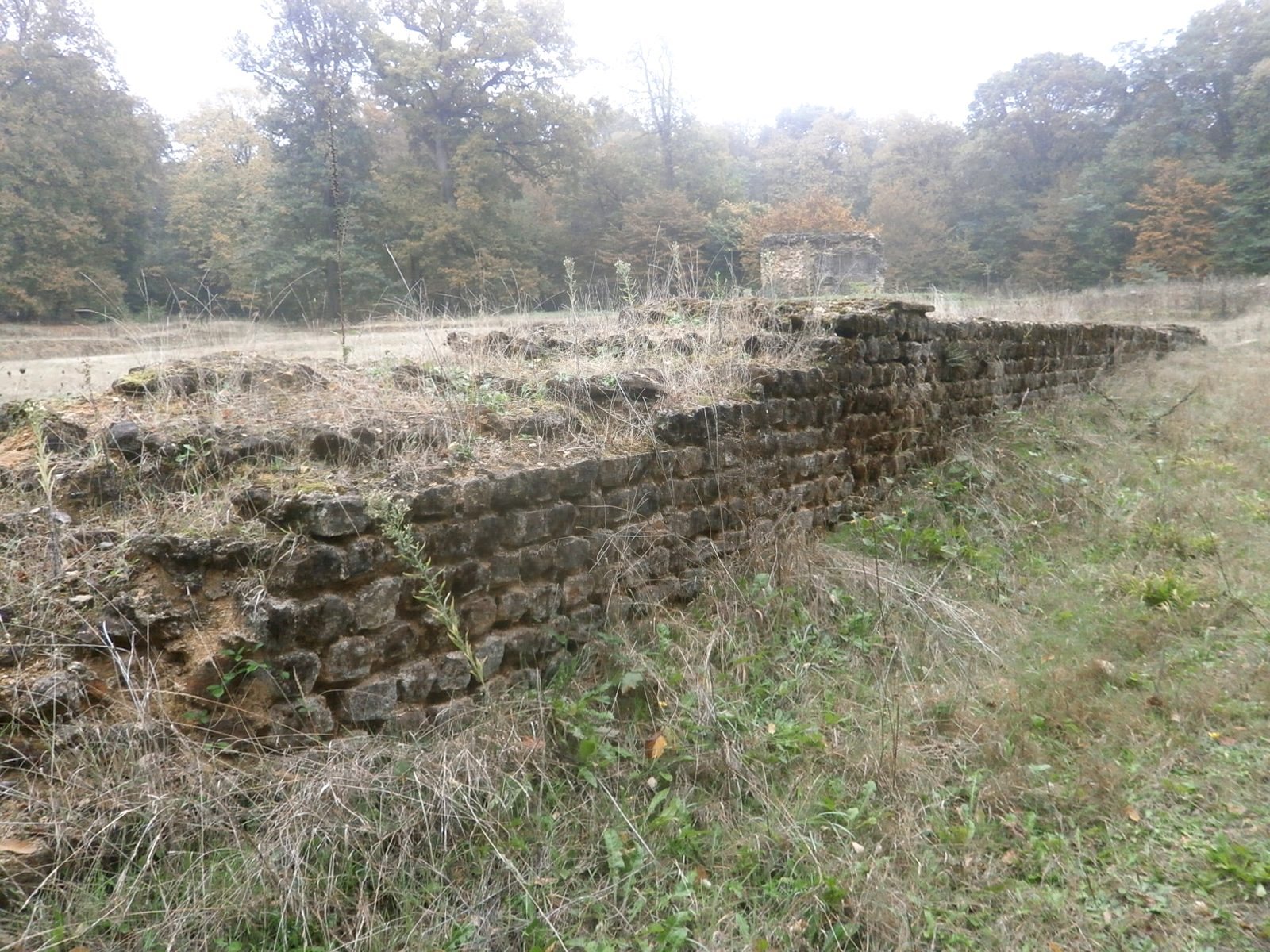
The civic Gallo-Roman sanctuary covered about 300 square metres. Its remains include an enclosed central room, or cella, an enclosing wall, and a gallery on the south side with column bases. The western stretch of the enclosure survives as a ruin. An inscription found at the altar dedicates the sanctuary to Mars Mullo and names Crescens, an enslaved person held by the civic authority, as the dedicator.
Excavations beneath the Augustan-period temple found two former positions for wooden posts. Associated objects included folded swords, corroded vessels, and 385 Gaulish-made coins bearing stamped designs.
Perrières temple and sacred enclosure
About 1,200 metres from the Mars Mullo sanctuary, Perrières contains the remains of a smaller temple with Corinthian features. Public works for a water-supply system exposed its ruins, which survive as foundations and lower wall structures. The sanctuary had a square sacred enclosure, with sides reported as 24 metres. An opening 2.50 metres wide in its eastern wall led to a gallery-like access passage. The square central room measured 14.20 metres on each side. Its foundations, about 0.60 metres high, raised the building above the sacred area; the open space was paved with tuffeau limestone and the central room with concrete.
A bust-shaped stone slab found lying in the sacred area in 1979 bears a dedication to Minerva. It measures 1.20 metres high and 1.40–1.50 metres wide.
Square building at Perrières
A separate square masonry building at Perrières had an upper structure measuring 3.67 metres on each side. Its elevations rose about 3.8 metres from a foundation slab 5.2 metres wide and 0.42 metres thick; the maximum recorded height was 5.2 metres. The four walls followed the cardinal directions. A partly damaged circular opening in the west wall was framed with sloping brickwork and flanked by two other openings. Similar brick-framed openings appeared on the other façades. Erosion of the south and east walls leaves the purpose of their circular features uncertain.
A limestone carved relief found near the building’s north-east corner came from beneath a layer about six metres deep. It measures 0.80 metres high and wide, and 0.40 metres thick. Five horizontal registers show, from bottom to top, a sea lion with a dolphin; dolphins crossed in X shapes with shells; birds with mythological appearance; plant-like decoration; and a twisted pattern. Coins from the building range from the early first to the middle third century AD and include issues bearing the portraits of Augustus and Severus Alexander. Other finds include pottery fragments, bronze objects, white terracotta offerings, and a graduated measuring object about 0.143 metres long, roughly half a foot.
Pits on parcel AH 17
A pit south-east of the Perrières sanctuary measured 2.50 metres across and 1.90 metres deep. Pebbles set in green-clay mortar lined its sides; its fill included black soil, broken stone, brick, and tile. Finds included about 400 nails, coarse and fine pottery, amphorae, around a dozen Gallo-Roman coins, a nine-centimetre gold wire, a lignite bead, and an iron hammer-axe. The coins include issues bearing portraits of Caracalla, Hadrian, Tetricus II, Faustina I, and Faustina II.
A second pit beneath it had a truncated-cone shape, reached 3.40 metres deep, and was lined with sandstone. A stone layer two metres thick covered it. Animal bones, a key, and a coin bearing the portrait of Sabinianus came from its lower fill.
Buildings near the Chaoué ford and at La Forêterie
Roman villa by the Chaoué ford
A villa dating to the first century AD stood beside a large rocky outcrop overlooking the Sarthe near the Chaoué ford. Pierre Térouanne and Dr. Guy resumed its excavation in the early 1950s.
Domestic building at La Forêterie
Test excavations at La Forêterie, on the northern edge of an outcrop overlooking the ford and villa, exposed a likely domestic building with well-preserved masonry. Some walls were joined with iron elements rather than brick bonding, while others used brick. Inside, adjoining terraces lay beneath a burnt layer 8–10 centimetres thick. Finds from the highest level included coins, small furnace fragments possibly used as crucibles, roof tiles of bronze and tin, a silver-surfaced fish-shaped clothing fastener with finely incised scales, nails, rings, and red-glazed pottery. Some pottery was brown, ochre, or black and carried decoration in the style of terra sigillata. A bronze nail and carved tuffeau blocks were also found. The structures date to the first century AD.
Long wall and carved column at La Forêterie
About 78 metres from the Mars Mullo sanctuary, excavators uncovered a masonry wall estimated to extend for 82 metres, perhaps farther originally. Its western section was 1.50 metres thick and met a second wall at a right angle; that wall extended 17.50 metres. Some original bricks survived in a brick-bonded structure beside the levelled edge.
A deposit of coins lay beneath a concrete floor where the walls joined. The coins are attributed to the fourth century AD and include issues bearing the portraits of Antoninus Pius, Probus, Constantine I, Constantius II, and Valentinian I. The deposit also contained inscription fragments and carved reliefs. A limestone column drum about 0.55 metres high bears three carved registers: a partly revealed goddess; a child with a whip beside a prisoner; and a woman’s head. The scene has been interpreted as religious and probably connected with Mars Mullo. Other finds nearby include sword blades dated to early La Tène A1, numerous bronze hooked clothing fasteners, and harness fittings.
Central Allonnes and Roman-period activity
Pasteur public baths
The public Gallo-Roman baths were uncovered beneath what is now Rue Pasteur toward the end of the nineteenth century. Their remains were destroyed in 1961. Later preventive test excavations over 40 square metres found circular pits about 150 metres from the baths.
Building and sunken feature near Rue Pasteur
On parcel AD 365, excavators found the foundations of a substantial building. Its sandstone footing extended 13 metres and was reinforced with flint fragments, with a facing of shell limestone laid at an angle. Postholes along the top of this facing indicate a timber fortification.
About ten metres to the north-east, a sunken feature contained a deposit of cult objects and may have been a funerary pit. Seven postholes lined each side. Its fill included soil, pottery, tile and masonry fragments, and pieces from a building’s underfloor heating system, bound with clay. The objects include coins attributed to the final La Tène period or the beginning of the first century AD, and hinged clothing fasteners dated AD 15–90.
Pottery from the Allonnes area includes drinking vessels, jugs, bowls, and amphorae, in both everyday fabrics and finer tableware. Much of it came from a pottery workshop at La Bosse, and the finds indicate commercial activity during the Roman Empire.