Minaret of Anah: A Medieval Islamic Tower in Iraq
Site at a Glance
- Rating
- 5
- Popularity
- Low
- Country
- Iraq
- Primary era
- Medieval
- Eras represented
- Medieval
- Civilizations
- Unclassified
- Site type
- Religious
- Remains
- Minaret
On this page4 sections
History
Uqaylid construction
The Minaret of Anah is a freestanding Islamic tower, originally built in old Anah, Al Anbar Governorate, Iraq, between 996 and 1096. A minaret is a tower associated with Islamic religious architecture, traditionally used to call worshippers to prayer. An unnamed ruler of the Uqaylid dynasty, a medieval Muslim dynasty that ruled parts of Mesopotamia, commissioned it during the late Abbasid period. The Abbasid period was the era of the Abbasid Caliphate, which ruled much of the Islamic world from the eighth to the thirteenth century.
Relocation and repeated destruction
In the mid-1980s, Iraqi president Saddam Hussein initiated dams on the Euphrates to secure the water supply. The reservoir created by the project threatened to submerge the minaret. Iraqi archaeological experts and an Emirati mission from Sharjah’s Department of Culture and Information dismantled it into at least 28 pieces and moved it to a safer nearby location.
An explosion on 18 June 2006 damaged the tower; those responsible were never identified. The attack came amid a wider series of assaults on Iraqi cultural heritage. The Iraqi Accord Front, a political coalition, accused Shiite militias of targeting heritage associated with Sunni dynasties, citing an attack on a statue of Abu Ja’afar al-Mansur, an Abbasid caliph associated with the founding of Baghdad, and damage to the upper part of the Malwiya, the distinctive minaret of the Great Mosque of Samarra. The coalition’s accusation did not identify the perpetrators of the Anah explosion.
In 2013, Iraqi engineers, artists, and heritage conservators rebuilt the minaret using an architectural plan kept by the Ministry of Tourism. The Islamic State of Iraq and the Levant, a militant organization active in Iraq and Syria, destroyed it again in late 2016 during its campaign against Iraqi cultural heritage. Iraq’s Ministry of Culture oversaw another reconstruction in 2022, and fragments of the ruined tower were sampled.
Remains
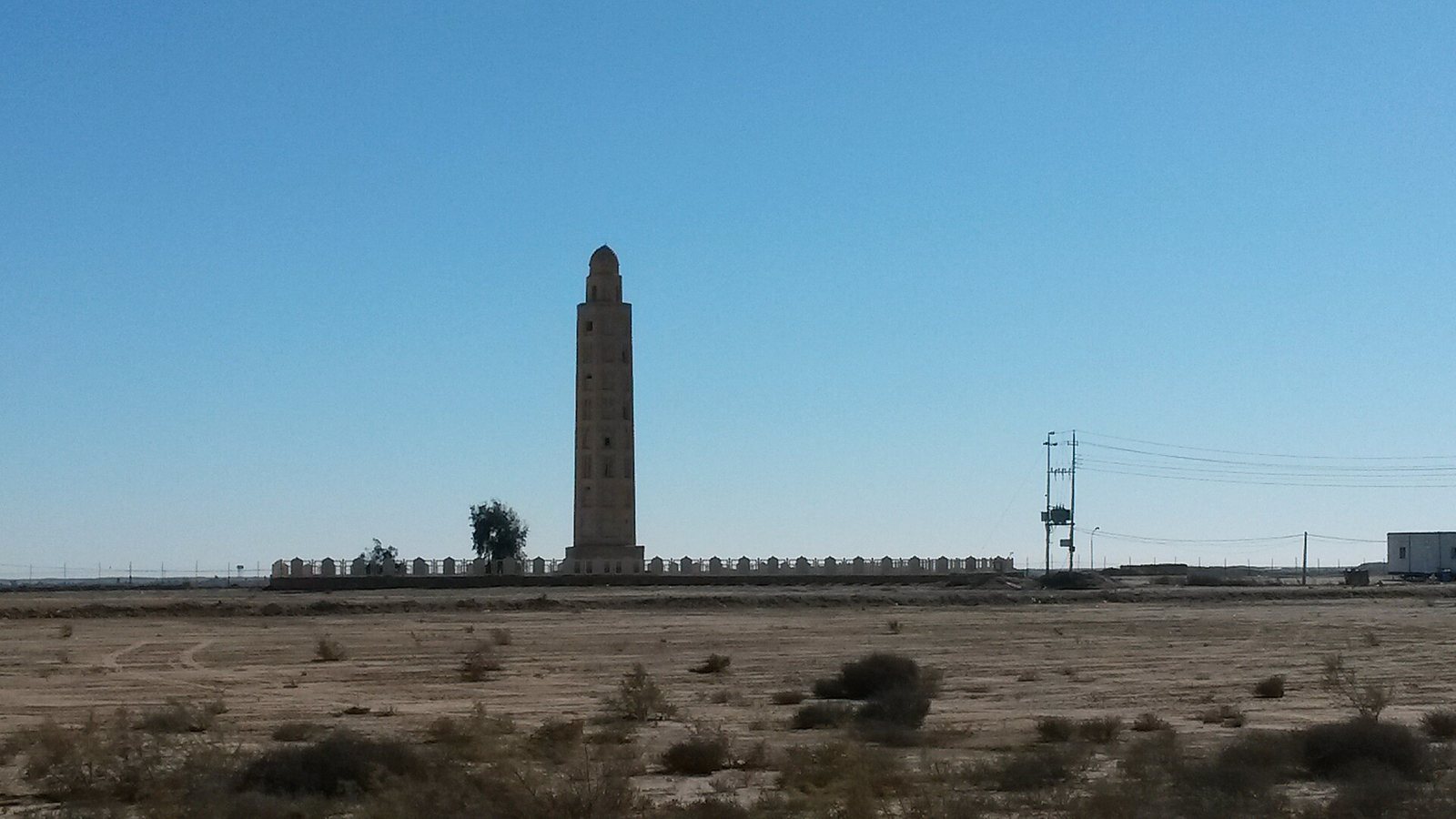
The reconstructed minaret stands near New Rawa. It originally stood in old Anah, west of the Euphrates. The freestanding tower is about 28 metres high and divided into eight levels. Its octagonal structure is made of rubble stone covered with gypsum, and it leans slightly.
An arched doorway on the north side of the base opens into the tower, where a staircase rises to a balcony. The shaft ends in a recessed, eight-sided spire beneath a low dome. Four arched openings in the spire provide access to the balcony, which sits within the tower’s outer profile. The spire has 64 niches, while 72 ornamental bands decorate the tower.