Gray’s Almshouses, Taunton: A Jacobean Charitable Residence
Site at a Glance
- Popularity
- Low
- Country
- United Kingdom
- Primary era
- Early Modern
- Eras represented
- Early Modern
- Civilizations
- English
- Site type
- Domestic
- Remains
- House
On this page7 sections
History
Gray’s Almshouses is a charitable residence in Taunton, United Kingdom, founded by cloth merchant Robert Gray in 1635 to house people in need and support education. Its Jacobean design reflects a style associated with the reign of James I (1603–1625).
Foundation and charitable provision
Gray was born in Taunton and made his fortune as a cloth merchant in London. He established the almshouses in the parish of St Mary Magdalene, on East Street beside his birthplace, intending them first for ten poor women. His plan also included a chapel, a schoolroom and quarters for a reader who would act as chaplain and schoolmaster. The reader was to teach ten local children to read and write.
Gray endowed the charity with freehold land valued at £2,000, whose income was meant to support its residents. Each was to receive eight shillings a month. Gray wanted the Worshipful Company of Merchant Taylors, a London livery company historically linked to the cloth trade, to administer the almshouses. The company declined because Taunton was far from London and the bequest did not cover travel expenses, so selected Taunton townsmen became trustees instead.
War and completion of the plan
Gray also intended to provide accommodation for six poor men, but his death in 1638, the English Civil War and legal difficulties delayed that part of the scheme. The war, fought between Royalists and Parliamentarians from 1642 to 1651, brought a siege to Taunton. During it, Royalist troops burned the neighbouring wooden Pope’s Almshouses, while Gray’s brick building was protected from the fire. Trustees completed the men’s building in 1696, in accordance with Gray’s will.
Donations from John Noble and John Coles in the eighteenth century increased the support available to residents. By then, the allowance was paid weekly and had risen to three shillings a week.
Later use and care
Gray’s Almshouses received Grade I listed status on 4 June 1952, a designation for buildings of exceptional interest. Taunton Heritage Trust took control in the 1960s and carried out a complete refurbishment in 1989. The buildings subsequently served as sheltered housing for pensioners. In 2004, changes to interior decoration and lighting followed proposals by students intended to brighten the flats.
Remains
Brick terrace and facade
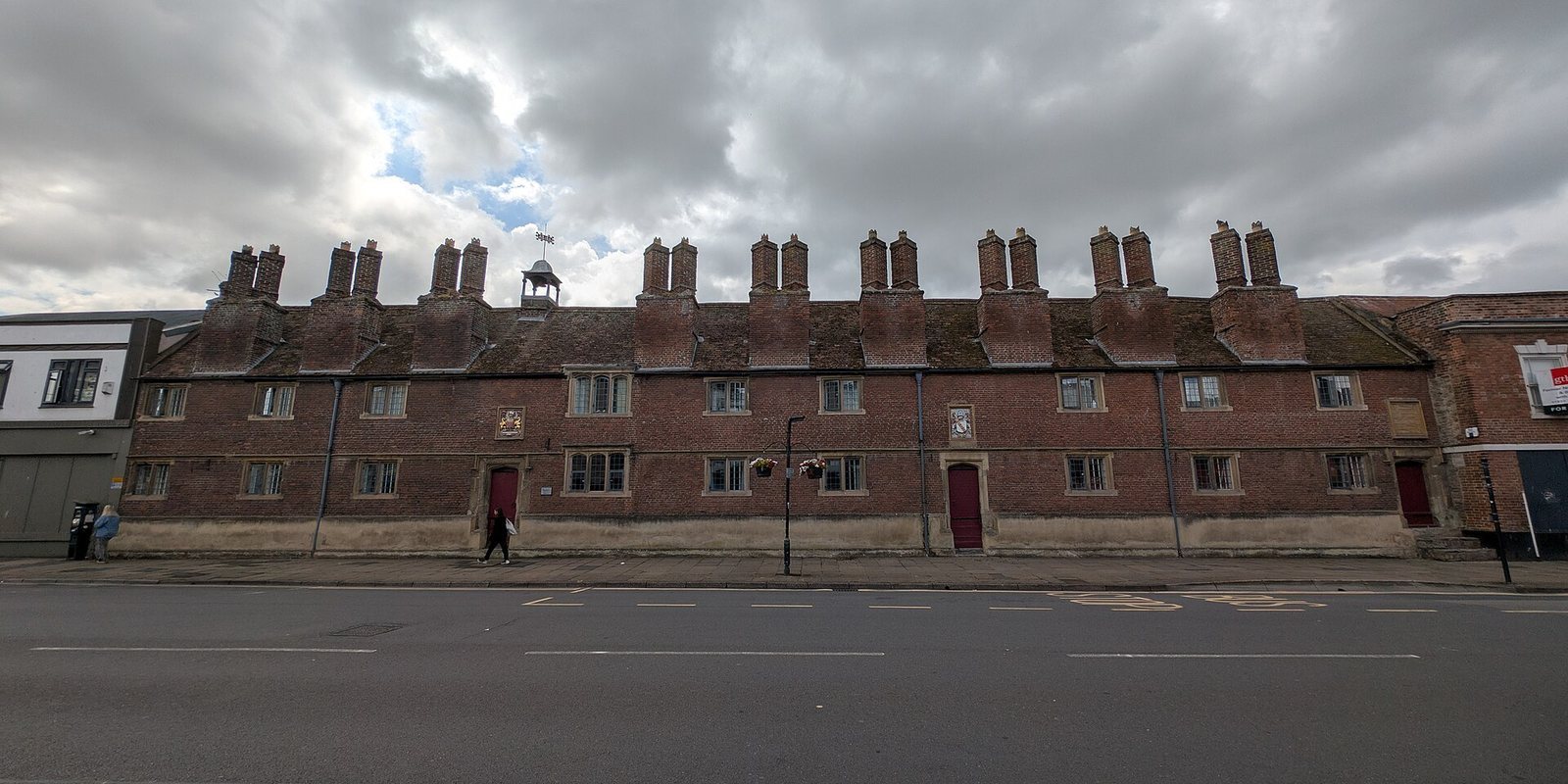
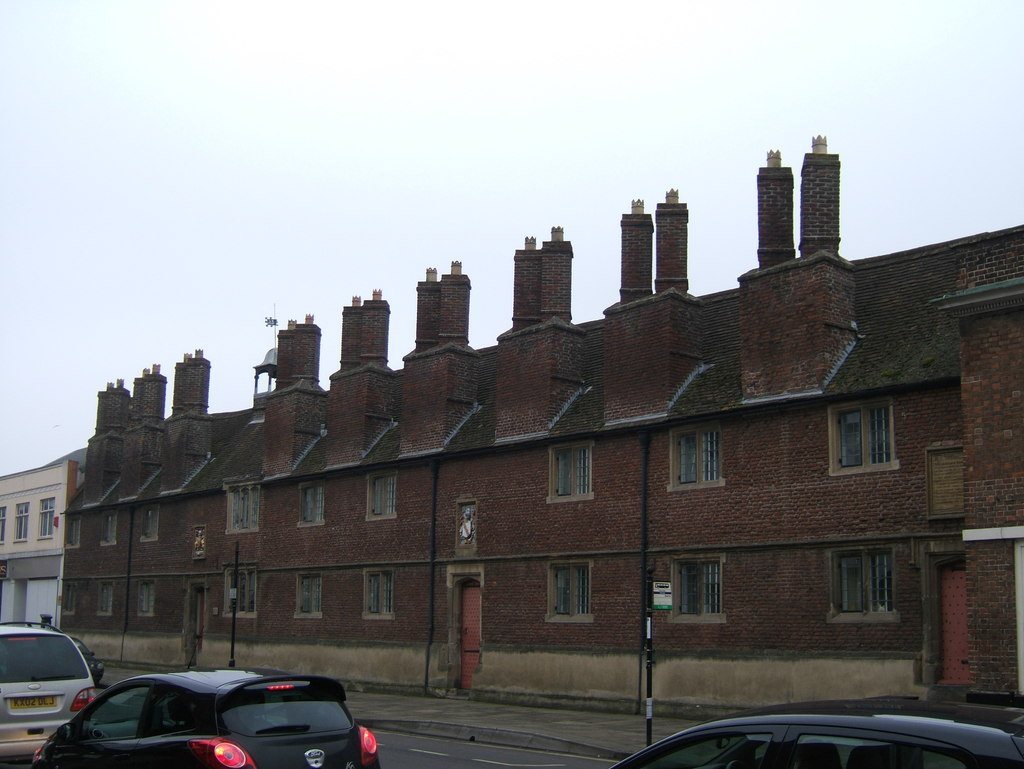
The almshouses form a 130-foot (40-metre) terrace, two storeys high, built of red brick beneath a clay-tiled roof. Matching windows on both floors are divided by vertical supports called mullions, and the building has three entrances. Nine chimney stacks rise from the roof, each with two diagonally set chimneys. A straight seam marks the join between the older and newer parts; their brickwork is alike. The austere facade is relieved by two sculpted coats of arms, above two entrances, associated with the Merchant Taylors’ Company and Robert Gray. Gray’s arms adapt those of the Anglo-Norman House of Grey. A stone tablet from the period is fixed to the facade. The terrace is among Somerset’s earliest surviving brick buildings and may be the county’s oldest; it is also among Taunton’s oldest surviving buildings.
Accommodation and memorial
The almshouses now contain nine sheltered flats for pensioners, as well as a laundry and a communal room. Gray’s monument survives in the Church of St Mary Magdalene.