The National Gallery: A Public Art Museum in London
Site at a Glance
- Popularity
- Very High
- Country
- United Kingdom
- Primary era
- Early Modern
- Eras represented
- Medieval, Early Modern, Modern
- Civilizations
- Unclassified
- Site type
- Museum
On this page17 sections
History
The National Gallery is a public art museum in London, United Kingdom, founded in 1824. Its collection, now numbering more than 2,300 paintings, spans from the mid-thirteenth century to 1900. Unlike many European national galleries, it did not begin with a royal or aristocratic collection: its first works came from the collection of the London insurance broker and art patron John Julius Angerstein, while gifts and purchases by early directors and other supporters shaped its growth.
Proposals and the founding collection
Several earlier efforts to create a public gallery in Britain came to nothing. In 1777, politician John Wilkes urged the government to acquire statesman Robert Walpole’s collection for a gallery in the British Museum gardens. Catherine II of Russia later bought the collection for the Hermitage. After the Orleans Collection arrived in London in 1798, King George III and Prime Minister William Pitt considered purchasing it but did not proceed. Twenty-five of its paintings eventually reached the National Gallery by other means.
In 1799, the government also declined a collection assembled by Francis Bourgeois for the Polish king Stanisław II August. Bourgeois left it to Dulwich College, and it formed the basis of Dulwich Picture Gallery, which opened in 1814. Offers from William Buchanan and Count Joseph Truchsess were rejected in 1803, although both collections later contributed to the National Gallery. Artists such as James Barry and John Flaxman argued that British artists needed access to outstanding paintings from across Europe. The British Institution for Promoting the Fine Arts in the United Kingdom, founded in 1805, lent works for annual exhibitions during art schools’ summer breaks, though the quality of some exhibits drew criticism. One of its founders, George Beaumont, offered 16 paintings to help establish a national gallery.
When Angerstein’s collection came up for sale in 1823, George Agar-Ellis proposed its purchase in the House of Commons on 1 July. Beaumont’s offer helped advance the plan, and the government agreed to pay £57,000 for Angerstein’s paintings. An unexpected repayment by Austria of wartime bonds helped make the purchase possible. The gallery opened on 10 May 1824 in Angerstein’s former townhouse at 100 Pall Mall, with about 38 paintings. Painter and art dealer William Seguier initially managed both the pictures and the institution. A board of trustees was formed in July to share responsibility. Beaumont’s promised works joined the collection in 1826, followed by 35 paintings bequeathed by William Holwell Carr in 1831.
A new home and a changing collection
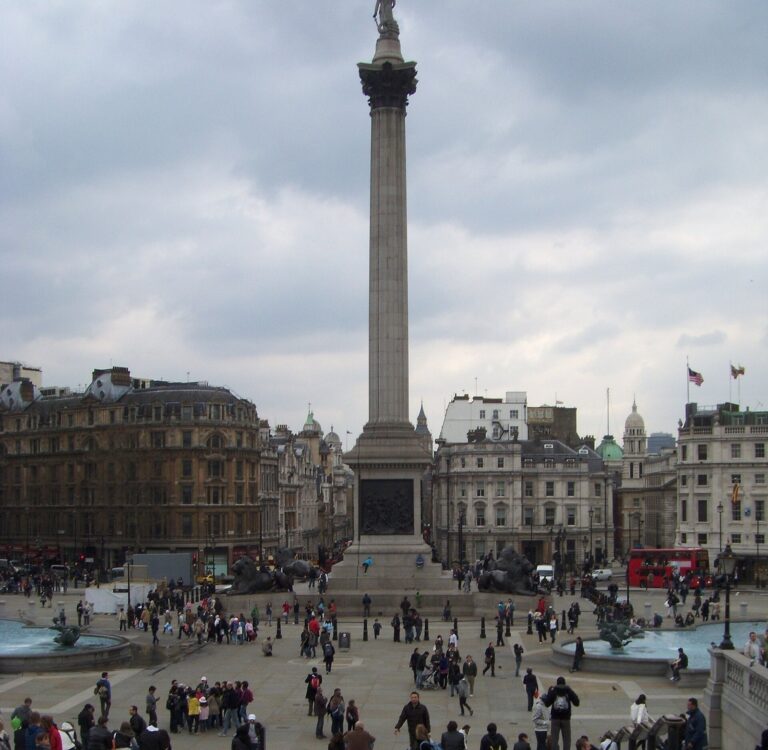
The Pall Mall premises soon proved crowded and unsuitable. Subsidence at No. 100 led to a temporary move to No. 105; both houses were later demolished to make way for a road to Carlton House Terrace. The replacement site, on the former royal stables at Charing Cross, was selected partly because it lay between the wealthy West End and poorer districts to the east. William Wilkins’s new gallery was built there from 1832 to 1838. In 1857, Parliament affirmed that collecting paintings was not an end in itself, but a means of giving the public access to elevated enjoyment.
For its first three decades, the trustees focused much of their buying on Italian painting from the Renaissance, a period of major artistic and intellectual change that began in Italy and spread across Europe. Their preferences contributed to missed opportunities, and the gallery bought no paintings between 1847 and 1850. A parliamentary report in 1851 called for a director with greater authority than the trustees. Charles Lock Eastlake, a painter and art historian who had managed the collection, was appointed to the post.
Eastlake broadened the collection’s focus to include early Renaissance and early Flemish painting. He travelled each year to continental Europe, especially Italy, buying 148 paintings abroad and 46 in Britain. His own collection was intended for the National Gallery; after his death, his successor William Boxall and his widow, Elizabeth Eastlake, helped bring it into the museum. Earlier gifts also created pressure on the gallery’s limited space. Robert Vernon’s 1845 bequest of British paintings was first shown at his house in Pall Mall and later at Marlborough House. After J. M. W. Turner died in 1851, more than 1,000 paintings he left could not be accommodated at Trafalgar Square, so they were displayed with Vernon’s collection at South Kensington.
These space constraints helped lead to the opening of the National Gallery of British Art at Millbank in 1897, now Tate Britain. Works by artists born after 1790 went to the new gallery, while paintings by artists including Hogarth, Turner, and Constable stayed at Trafalgar Square. Turner had stipulated that two of his paintings should hang beside works by Claude Lorrain. The paintings are now divided between the National Gallery and Tate Britain’s Clore Gallery.
Under its third director, Frederick William Burton, the National Gallery strengthened its eighteenth-century holdings. In 1885 it bought Raphael’s Ansidei Madonna and Van Dyck’s Charles I on Horseback from Blenheim Palace for £87,500, then its most expensive purchase. In 1890, a private donor provided the funds for Hans Holbein’s The Ambassadors, the first painting the gallery acquired with this kind of support. The Art Fund was established to help secure paintings for Britain after works began leaving for American collections. With its assistance, the gallery bought Velázquez’s Rokeby Venus in 1906 and Holbein’s Christina of Denmark, Duchess of Milan in 1909. That year, industrialist Ludwig Mond gave the gallery 42 Italian Renaissance paintings, including Raphael’s Mond Crucifixion. Further important gifts came from George Salting in 1910, Austin Henry Layard in 1916, and Hugh Lane.
New collections, protest, and war
Lane offered 39 paintings, including Renoir’s The Umbrellas, in 1906, with a condition that they would go to Dublin if a suitable museum were built there. Director Charles Holroyd welcomed the offer, but the trustees opposed it. Lane later revised his will to leave the works to Ireland alone, but the document lacked witnesses’ signatures. He died in 1915 when the Lusitania was sunk in a German attack. Disputes over his conflicting intentions continued until 1959. Most of the collection is now displayed in Dublin, while some works alternate between Dublin and London.
In 1914, suffragette Mary Richardson damaged the Rokeby Venus in protest against the arrest of Emmeline Pankhurst, a leader in the campaign for women’s right to vote. That month, another suffragette damaged five paintings by Giovanni Bellini, arguing that the gallery should stay closed until the First World War began. An appeal by the Women’s Social and Political Union to end attacks on paintings was ignored. In 1923, Samuel Courtauld established a fund for buying modern paintings. One purchase, Georges Seurat’s Bathers at Asnières, was transferred from the National Gallery to the Tate Gallery in 1934.
Before the Second World War, the gallery’s paintings were dispersed to locations in Wales, including Penrhyn Castle, Bangor University, and Aberystwyth University. After Germany invaded France in 1940, the government considered sending the works to Canada. Prime Minister Winston Churchill rejected the plan and directed that they remain in the British Isles. The paintings were concealed in a quarry near Blaenau Ffestiniog in North Wales. Martin Davies, then responsible for the paintings and later a gallery director, began compiling a scholarly catalogue of the collection and library books stored there. The paintings returned to Trafalgar Square in 1945.
The empty gallery hosted daily concerts by pianist Myra Hess while London’s concert halls were closed, helping sustain public morale during the war. From 1940, it also showed war paintings by artists including Paul Nash, Henry Moore, and Stanley Spencer. The War Artists’ Advisory Committee urged director Kenneth Clark to keep artists producing work on the conflict. In 1941, after a member of the public asked to see a Rembrandt portrait, the gallery began its Picture of the Month scheme, bringing one painting back from the quarry each month for display.
Postwar changes and continuing debates
After the paintings returned, chief restorer Helmut Ruhemann cleaned them and removed varnish that had yellowed and obscured their colours. Their 1946 re-display prompted objections that the treatment had disturbed the paintings’ tonal unity and intended finish. Art historian Ernst Gombrich led opposition to the method. The dispute followed an earlier controversy: in 1844, Eastlake had overseen restoration work on paintings by Rubens, Aelbert Cuyp, and Velázquez. Their display in 1846 drew criticism, and a parliamentary subcommittee examined the methods in 1853.
Attributions of paintings have also been contested. In 1939, Clark attributed a group of Venetian paintings to Giorgione, partly because the artist’s works were then thought to be rare; that attribution was later found to be incorrect. Many art historians have also disputed the National Gallery’s attribution of Samson and Delilah, purchased in 1980 as a work by Rubens. In 1945, trustees had declined art historian Denis Mahon’s offer of a Guercino painting for £200. In 1999, Mahon gave the gallery 26 Italian Baroque paintings, in a style associated with dramatic movement and effects, on the conditions that they could not be sold and that visitors would not be charged to see them. By 2003, the Guercino painting was valued at £4 million.
As prices rose after the war, major purchases became harder to make. Public support helped secure Leonardo da Vinci’s The Virgin and Child with Saint Anne and Saint John the Baptist in 1962 and Titian’s The Death of Actaeon in 1972. In 1985, the year John Paul Getty gave the gallery £50 million, the government froze its grant for painting purchases. Neil MacGregor, appointed director in 1987, reorganized the collection in chronological order rather than retaining the established arrangement. The change emphasized connections among cultures as well as national traditions.
From 1989, the gallery began offering studio space to contemporary artists creating work intended for display there. Selected artists usually serve two-year terms as associate artists and may hold a solo exhibition at the end. In 1996, the National Gallery’s relationship with the Tate, originally established as its branch and independent from 1955, was clarified by defining the collection as paintings made before 1900. More than 60 paintings made after 1900 went to the Tate, while works including paintings by Paul Gauguin moved in the other direction.
Public fundraising helped the gallery acquire Raphael’s Madonna of the Pinks in 2004 and, jointly with the National Galleries of Scotland, Titian’s Diana and Actaeon in 2008. The two galleries bought its companion, Diana and Callisto, in 2012 for £45 million, £5 million below the asking price. Donations supplied £20 million, with the remaining £25 million coming from National Gallery reserves. In 1906, the gallery had also welcomed Lane’s offer of paintings, but the unresolved conditions surrounding his bequest continued to shape where those works were shown.
Remains
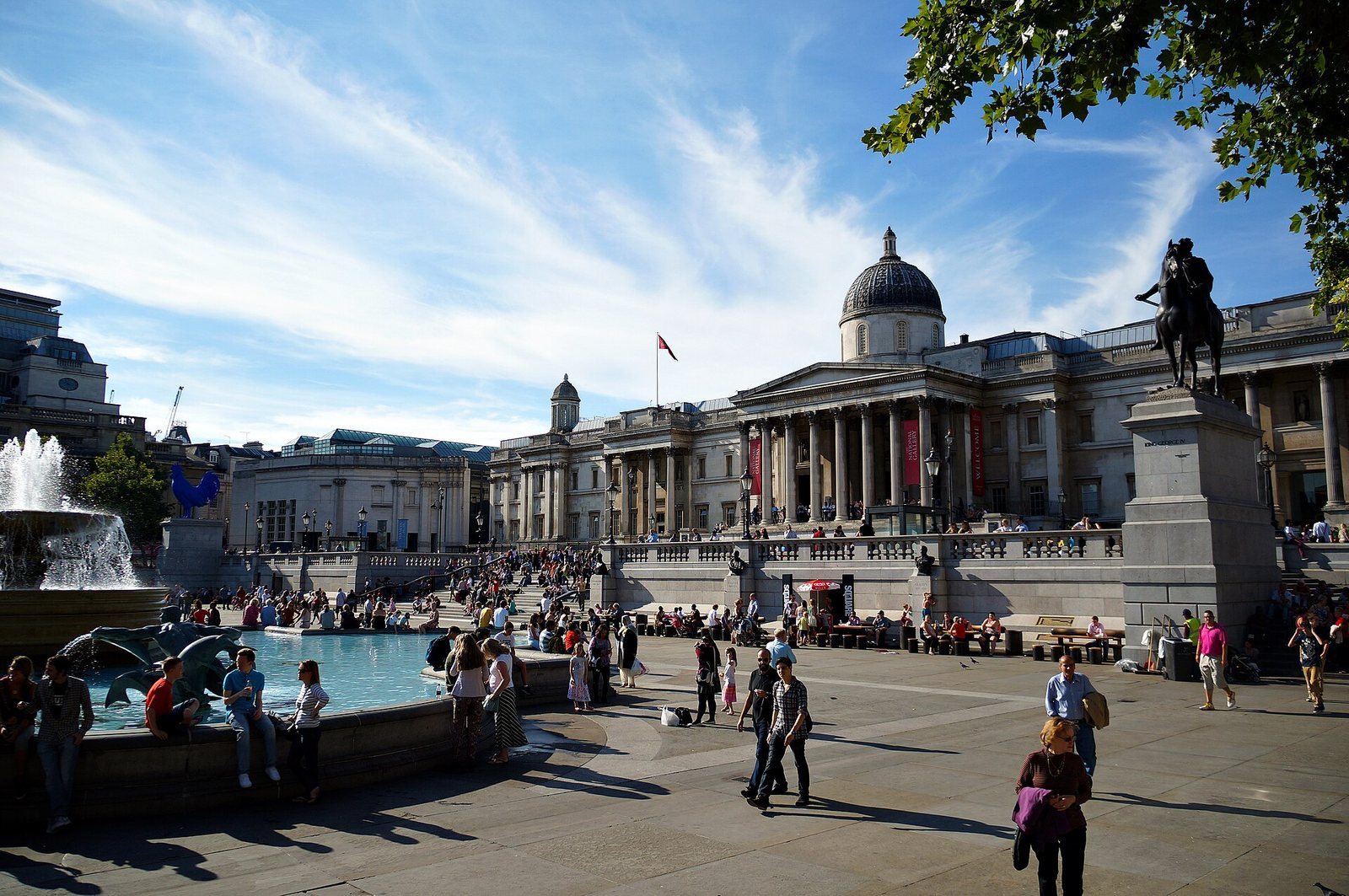
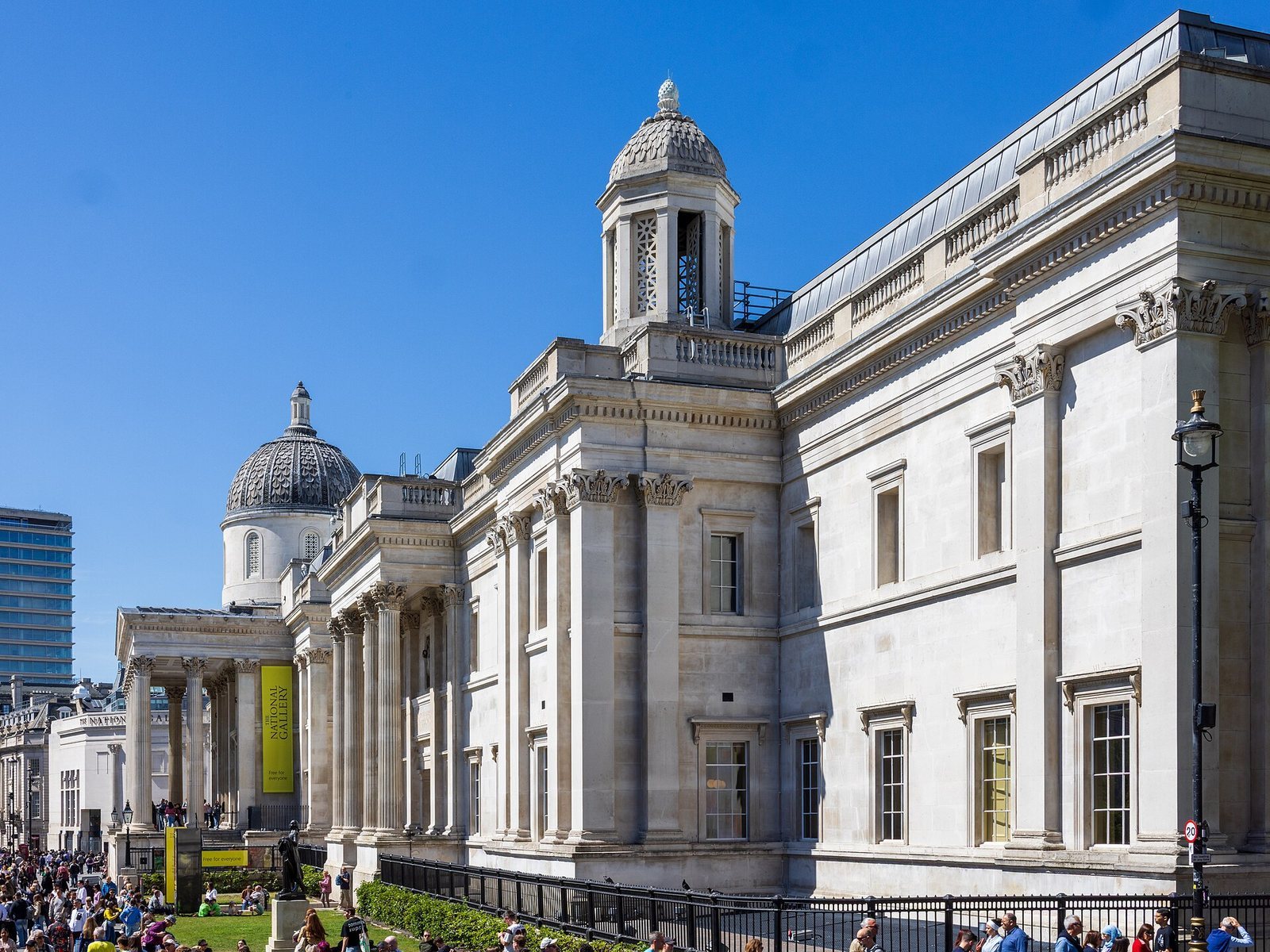
The gallery today combines Wilkins’s original building with later additions to its north, west, and east. Its original appearance survives in the façade facing Trafalgar Square, while successive extensions created new exhibition rooms and entrance spaces. The complex brings together designs ranging from the formal classical tradition to restrained Modernist and Postmodern approaches.
Wilkins’s building and early alterations
Façade and original plan
Wilkins’s design had to fit a restricted site and a limited budget, so it provided only a single row of exhibition rooms. A workhouse and army barracks stood immediately behind the gallery, and a public right of way crossed the grounds for people using those facilities. The route carried substantial foot traffic through the porticoes, roofed walkways supported by columns, on both sides of the façade. Columns reused from Carlton House separated gallery visitors from people using the route; their style differed from that of the portico columns. Sculptures originally intended for John Nash’s Marble Arch were also placed on the façade.
Changes to the original gallery
The Royal Academy of Arts occupied the western half of the building until 1868, further limiting the space available for the National Gallery’s collection. James Pennethorne altered the gallery in 1860–61, adding more elaborate decoration but making the entrance hall feel more cramped. Edward Middleton Barry proposed a replacement building with four domes in 1867, but the plan was rejected.
Nineteenth-century extensions
Barry Rooms
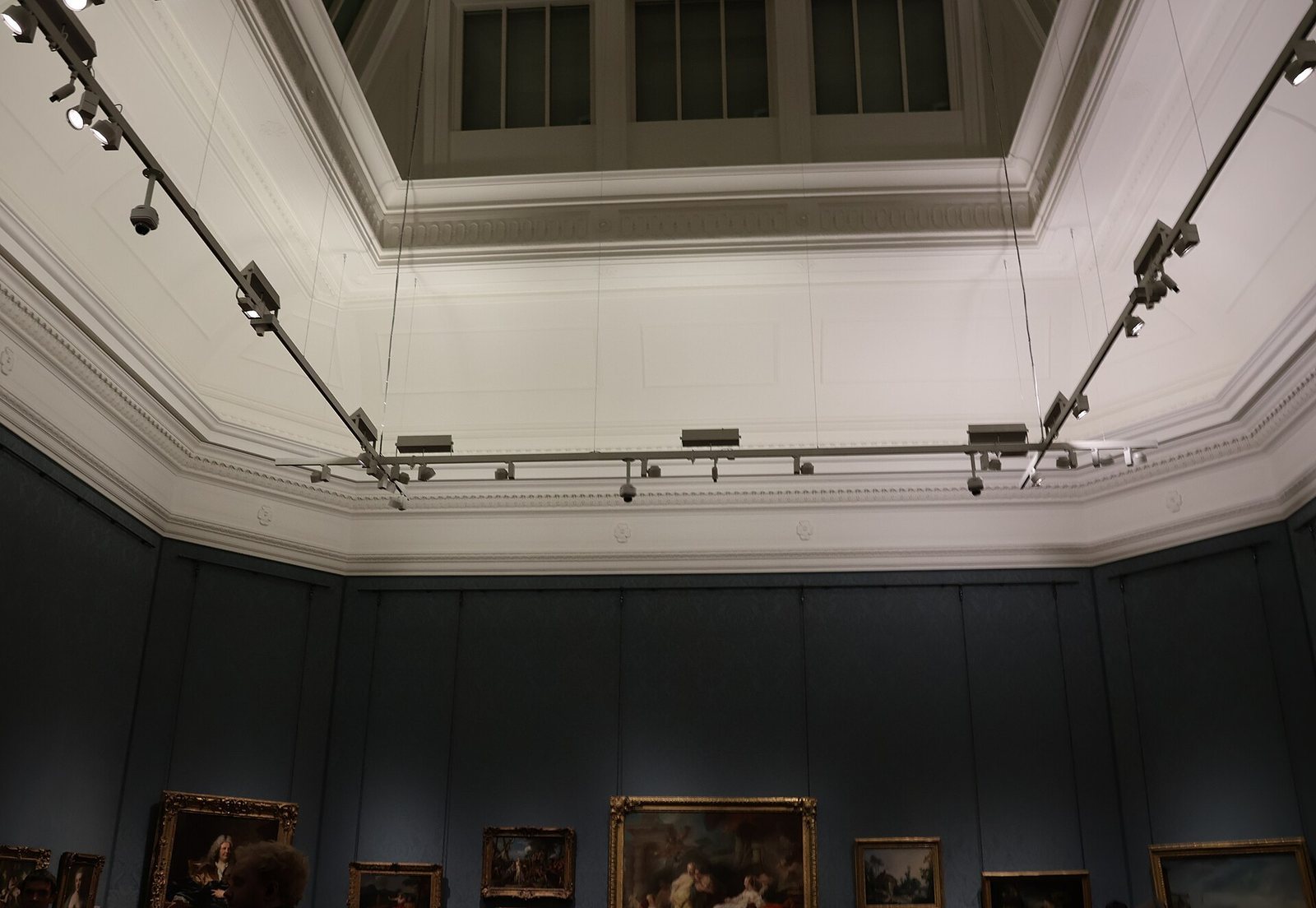
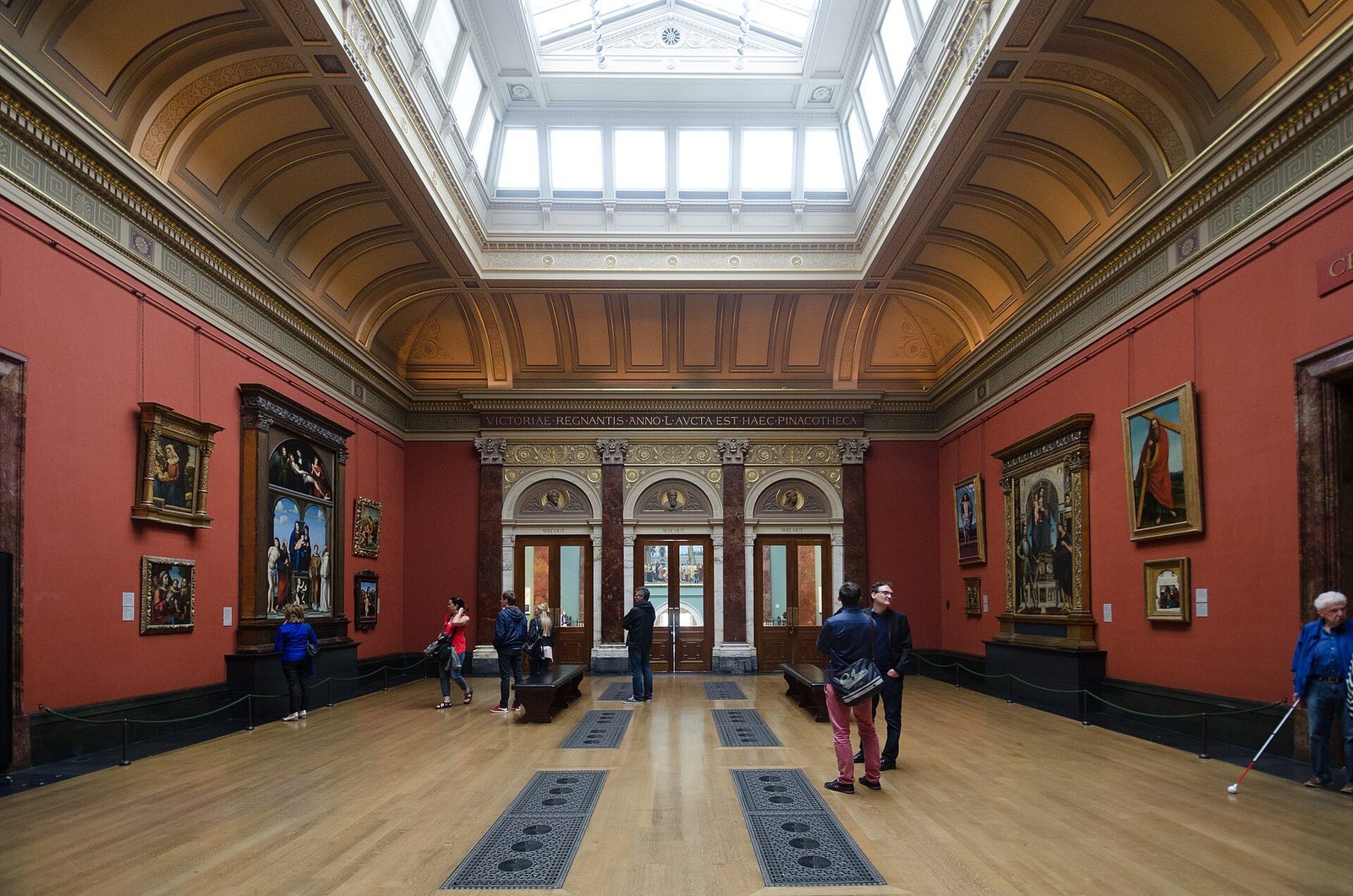
After the workhouse behind the gallery was demolished, Charles Barry added a large extension from 1872 to 1876. Its Neo-Renaissance design, a later revival of Renaissance forms, used a Greek-cross plan with four equal arms around a central crossing. A large octagonal room at the centre became known as the Barry Rooms. Staff criticized the scale and decoration as unsuitable for a picture gallery, but the rooms became central to the exhibition plan. Later additions followed Barry’s design, helping the successive parts of the building cohere.
Taylor extension and entrance hall
John Taylor’s northward extension replaced Pennethorne’s addition. Its entrance hall had a glass dome and a ceiling painted by John Dibblee Crace. Since the 1990s, a painting by Cimabue, on loan from the Royal Collection, has hung on the south wall. Between 1928 and 1952, artist Boris Anrep laid mosaics across the hall floor. Their central image represents the awakening of the muses; Virginia Woolf and Greta Garbo appear in the main composition. Portraits of Winston Churchill, Bertrand Russell, and T. S. Eliot represent modern virtues such as humour and open-mindedness in place of the Christian seven virtues. The ceiling painting was covered with white paint in 1916 and restored in 2005.
Western galleries
Later additions on the western side echoed Barry’s design, including dark marble door surrounds and interiors coordinated with the Barry Rooms. In the 1920s, a donation from Joseph Duveen funded more galleries in the Beaux-Arts style, based on formal classical design.
Modern interiors and new wings
North Gallery
Completed in 1975, the North Gallery was the institution’s first Modernist interior. Its deliberately plain decoration was intended to keep attention on the paintings. In earlier rooms, some classical decoration had been removed to make space for partitions, platforms, and suspended ceilings. Restoration of nineteenth- and twentieth-century interiors began in the 1980s: the Barry Rooms were refurbished in 1985–86, and the North Gallery was redesigned in a simplified classical style from 1996 to 1999.
Sainsbury Wing
The Sainsbury Wing, completed in 1991 on the gallery’s western side, was designed by Robert Venturi and Denise Scott Brown in a Postmodern style that reuses historical forms. It was intended for Renaissance paintings and has minimally decorated rooms, drawing on Dulwich Picture Gallery and church interiors designed by Filippo Brunelleschi. The site had been occupied by a department store destroyed during the Second World War. The northernmost room aligns with the Barry Rooms’ cross-shaped gallery, creating a view through the building from end to end.
A design competition in 1982 produced strong support for a proposal by Ahrends, Burton and Koralek, later revised to include a tower. A subsequent private competition selected the final design. A £50 million donation from John, Simon, and Tim Sainsbury in 1985 enabled the new wing to be devoted entirely to exhibition space, although the original competition brief had also called for offices.
East Wing and central entrance
The East Wing, designed by Jeremy Dixon and Edward Jones, was completed in 2004 using a previously unused courtyard and land transferred by the National Portrait Gallery in 2000. It created a new entrance facing Trafalgar Square, named after Paul Getty. The gallery’s central entrance was also restored.