Kattrup: A Danish Manor Estate
Site at a Glance
- Popularity
- Medium
- Country
- Denmark
- Primary era
- Modern
- Eras represented
- Modern
- Civilizations
- Danish
- Site type
- Domestic
- Remains
- Manor House
On this page9 sections
History
Kattrup is a manor estate south of Jyderup in Kalundborg Municipality, Denmark. It was made a manor, a large landed estate, in 1561, and its present main building was completed in 1925.
Medieval holdings and the manor
In the Middle Ages, Kattrup referred to both a village and a farm. Queen Margrethe I gave it to Sorø Abbey, a monastic community, in 1393. The abbey exchanged Kattrup with the Roskilde Bishopric, the church authority associated with Roskilde, in 1444. After the Reformation, the Crown took possession of it along with other Catholic Church lands.
Laurits Iversen Serlin acquired Kattrup in 1561 in exchange for property elsewhere and established it as a manor. In 1580, it passed to his son, Christoffer Lauridsen Serlin. Following Christoffer’s death, his son-in-law Rasmus Skade inherited it, and it later passed to Rasmus’s son, Christoffer Skade. In 1627, Christoffer’s brother Niels Skade held a property called Kuserup. A property called Kyserup was subsequently incorporated into Kattrup.
Seventeenth-century changes of ownership
Christoffer Skade’s heirs sold Kattrup to Axel Juul of Volstrup in 1655. Royal treasurer Henrik Müller acquired the estate in 1664 and later became one of Denmark’s largest landowners. In the 1680s, he passed Kattrup to his son Christian, who transferred it to his brother Frantz in 1689. Frantz died in 1705, and Kattrup was sold at auction that year to Christian Paludan.
Eighteenth-century owners
After Paludan, Kattrup passed to Bolle Luxdorph Rose and then, in 1718, to Hans Philip Bochenhoffer. Indebted to Marie Juul of Kragerupgaard, Bochenhoffer ceded the estate to her. In 1742, she transferred it to her son-in-law Anton Günther Ellbrecht. District judge Peder Kraft acquired Kattrup in 1751. After Kraft’s death, his widow sold it to Jørgen v. Hjelmcrone, who, facing financial difficulties, sold it to Major H. Focken in 1775. It passed to P. Gommesen Errebo in 1781 and to Peder Ole Borch Møller in 1793.
Nineteenth-century ownership and rebuilding
Johan Caspar Mylius bought Kattrup in 1800. After acquiring Estruplund and other estates, he placed Kattrup in the hands of his mother, Ulrika Cathrine de Mylius, who also owned Rønninge Søgård on Funen. Following her death in 1831, he regained Kattrup, sold it to J.F. Adeler in 1835, and took it back in 1836 after Adeler’s bankruptcy.
Mylius died in 1852, and Kattrup passed to his son-in-law Frederik Emil Herman Bernstorff. Ulrich Bernstorff-Mylius succeeded him in 1894 and demolished the old main building in 1896. A replacement was constructed in 1925. Ulrich’s son Andreas Peter Bernstorff-Mylius became owner that year; Ulrich died in 1930.
Twentieth-century ownership
Arnold Peter Møller, a Danish shipping entrepreneur who founded A.P. Møller–Mærsk, purchased Kattrup in 1949. After his death, it passed to his daughter Sally McKinney-Møller, and in 1972 to Peter Arnold Poul Møller. Peter Anders Møller has owned the estate since 2007.
Remains
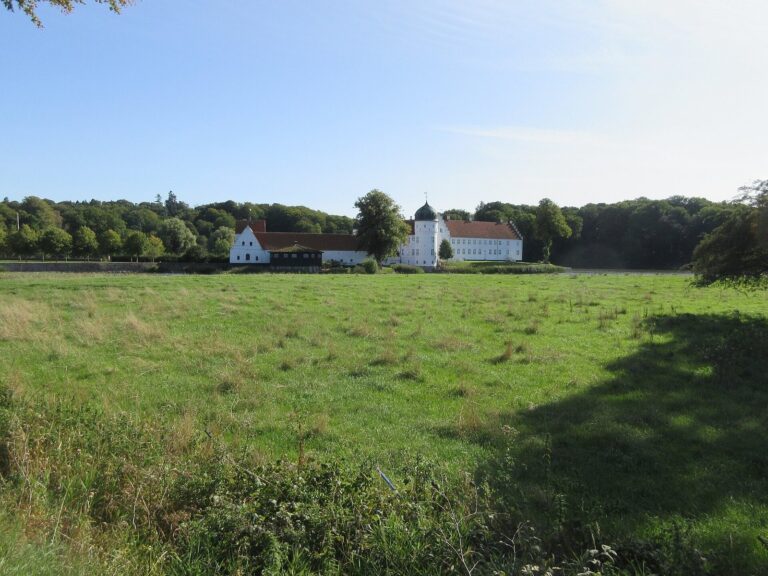
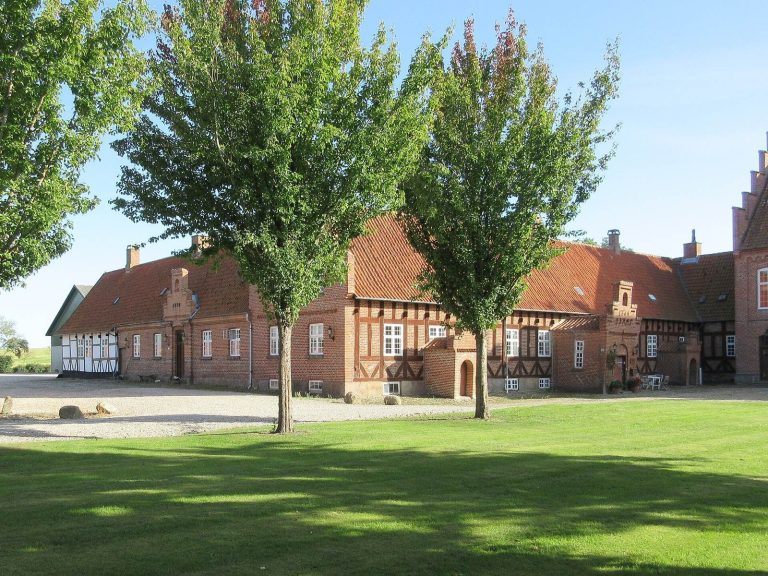
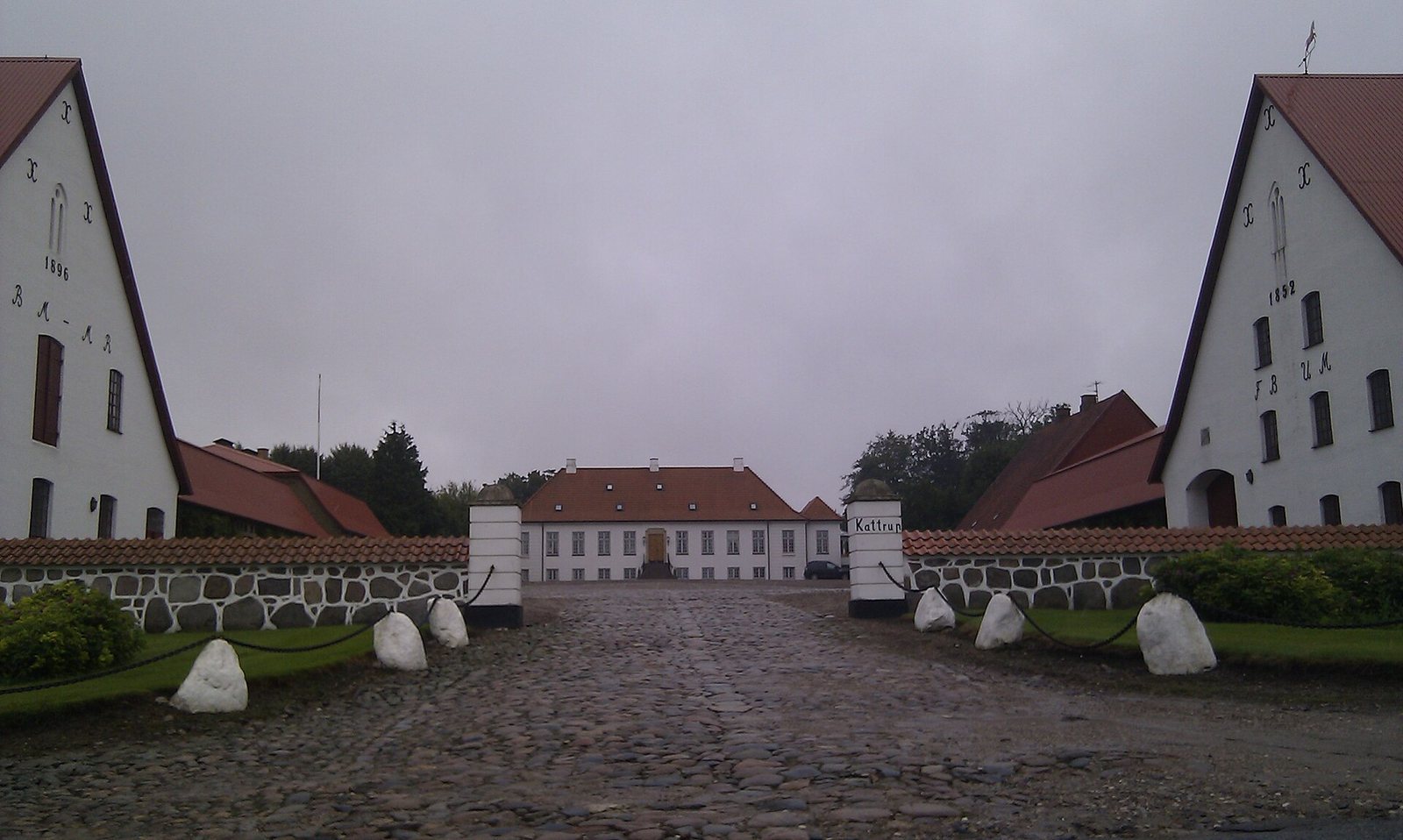
The estate covers 1,023 hectares south of Jyderup. Its main group is arranged around a large courtyard, with the principal residence on the south side and nineteenth-century farm buildings alongside it. A park with three ponds extends south of the residence.
Main building
Built in 1925, Kattrup’s main building is Neoclassical, a style drawing on ancient Greek and Roman design. The whitewashed building has projecting sections at its two corners and a red-tiled roof with four sloping sides.
Komtesseboligen
Komtesseboligen, meaning the Countess’s Residence, is another building on the estate.