Behistun Inscription: An Achaemenid Royal Monument and Key to Cuneiform Decipherment
Site at a Glance
- Popularity
- Very High
- Country
- Iran
- Primary era
- Iron Age
- Eras represented
- Iron Age, Classical
- Civilizations
- Achaemenid, Parthian, Seleucid
- Site type
- Civic
- Remains
- Monument
On this page10 sections
History
The Behistun inscription is an Achaemenid Persian royal monument carved into a limestone cliff on Mount Behistun in Iran. Its principal form dates to about 520 BC, when Darius the Great commissioned the relief and inscription. The Achaemenid dynasty ruled a large empire across western and central Asia and parts of northeast Africa. The monument became a key document in the decipherment of cuneiform, a writing system made with wedge-shaped signs.
Darius’s accession and campaigns
Darius presents the inscription as an account of his ancestry, accession, rule, and victories. He names Hystaspes as his father and traces his line through Arsames, Ariaramnes, Teispes, and Achaemenes. According to his account, eight members of his dynasty ruled before him, making him the ninth king in succession. He credits Ahura Mazda, a major deity of ancient Iranian religion and Zoroastrianism, with granting him the throne.
The inscription claims that Darius ruled twenty-three lands, including Persia, Elam, Babylonia, Assyria, Arabia, Egypt, the coastal lands, Lydia, the Greek lands, Media, Armenia, Cappadocia, Parthia, Drangiana, Aria, Chorasmia, Bactria, Sogdia, Gandhara, Scythia, Sattagydia, Arachosia, and Maka. It describes their submission, tribute, and administration, presenting his authority as divinely sanctioned.
Darius’s account says that Cambyses II secretly killed his brother Bardiya and later died in Egypt. Gaumata then claimed to be Bardiya and seized the throne. Darius says that he killed Gaumata and his supporters on 29 September 522 BC at the fortress of Sikayauvatis in Media, then recovered the kingship. He also claims to have restored temples and residences, returned confiscated property, and resettled people in their former homes.
The inscription recounts nineteen battles in one year, ending in December 521 BC, against people who challenged Darius’s rule or claimed royal identities. It names nine defeated rivals: Gaumata, who posed as Bardiya; ššina, claimant to Elam; Nidintu-Bêl, who claimed to be Nebuchadnezzar, son of Nabonidus; Martiya, who claimed to be the Elamite king Umanish; Phraortes, who claimed descent from Cyaxares and rebelled in Media; Ciçantakhma, claimant to Sagartia; Frada, leader of a revolt in Margiana; Vahyazdata, who again claimed to be Bardiya; and Arakha, who claimed to be Nebuchadnezzar in Babylonia.
Darius describes the defeat of Nidintu-Bêl’s forces at the Tigris and near Zazana, followed by the claimant’s capture and execution in Babylon. Phraortes was captured and executed at Ecbatana, while Hystaspes helped put down revolts in Parthia and Hyrcania. Darius’s commanders fought repeated campaigns in Armenia, and his forces suppressed rebellions in Sagartia, Margiana, Persia, Arachosia, and Babylonia. The account says that captured rebels were punished and credits Ahura Mazda with aiding the victories.
The narrative continues with an Elamite revolt led by Atamaita, defeated by Gobryas, and a campaign against the Scythians. Skunkha, a Scythian leader, was captured and another leader appointed. Darius presents these campaigns as the restoration of order. He warns later kings against false claims and urges them to preserve and circulate his account. He also names six supporters who helped him against Gaumata: Vīdāfarna, Utana, Gobryas, Vidarna, Bagabuxsha, and Ardumanish. Copies went throughout the empire, and a later Aramaic version, produced during the reign of Darius II, was found in Egypt.
Changing interpretations and decipherment
After the Achaemenid dynasty fell and the ability to read Old Persian cuneiform was lost, the inscription’s meaning became obscure. Diodorus Siculus, drawing on the account of Ctesias, attributed the carving to Semiramis, the legendary Assyrian queen. Later local traditions described nine dervishes on the mountain. Around 977, the geographer Ibn Hawqal interpreted the figures as a school scene and a kitchen.
European visitors also misread the relief. Robert Sherley and his party saw it in 1598 and thought it was Christian. General Gardanne interpreted the figures as Christ and the twelve apostles, while Robert Ker Porter linked them to Shalmaneser and the Lost Tribes of Israel. Pietro della Valle made preliminary drawings in 1604. Carsten Niebuhr visited around 1764 and published a copy in 1778. By 1802, Georg Friedrich Grotefend had deciphered ten of the thirty-seven Old Persian signs.
Henry Rawlinson began studying the inscription in 1835 and climbed the cliff with help from a local boy to copy the Old Persian text. The Elamite and Babylonian sections were harder to reach; in 1847 he sent a complete and accurate copy to Europe. Comparing the three-language text was crucial to deciphering cuneiform, in a role often likened to the Rosetta Stone’s contribution to reading Egyptian hieroglyphs.
Modern study and protection
A. V. Williams Jackson examined the site in 1903. A British Museum expedition led by Leonard William King and Reginald Campbell Thompson followed in 1904, and a 1948 expedition was led by George G. Cameron. These investigations produced photographs, casts, and improved transcriptions. In 1938, the Nazi research organization Ahnenerbe planned work at the monument, but the outbreak of the Second World War halted it.
The monument was damaged during the Second World War, including when Allied soldiers used it for target practice, and also during the Anglo-Soviet invasion of Iran. Iranian archaeologists began assessing and documenting twentieth-century damage in 1999, using photogrammetry, a method of creating three-dimensional images from photographs. Conservation has continued, and an international reassessment took place in 2012. The site is on Iran’s National Heritage List and was added to the UNESCO World Heritage List in 2006.
Remains
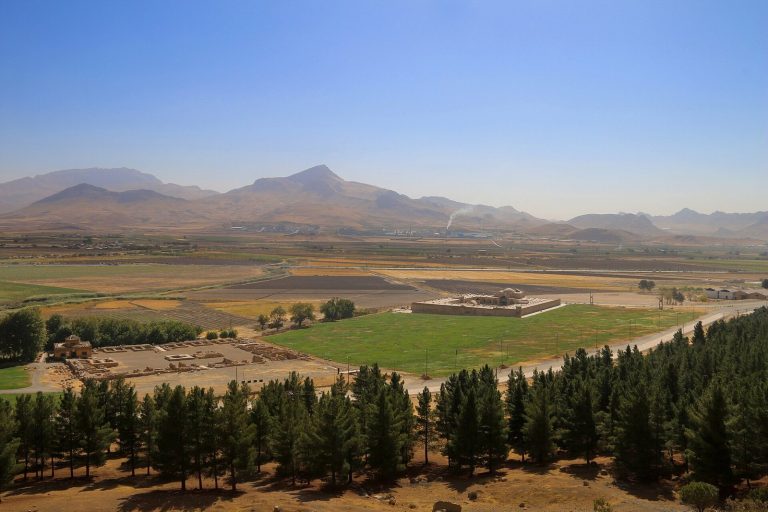
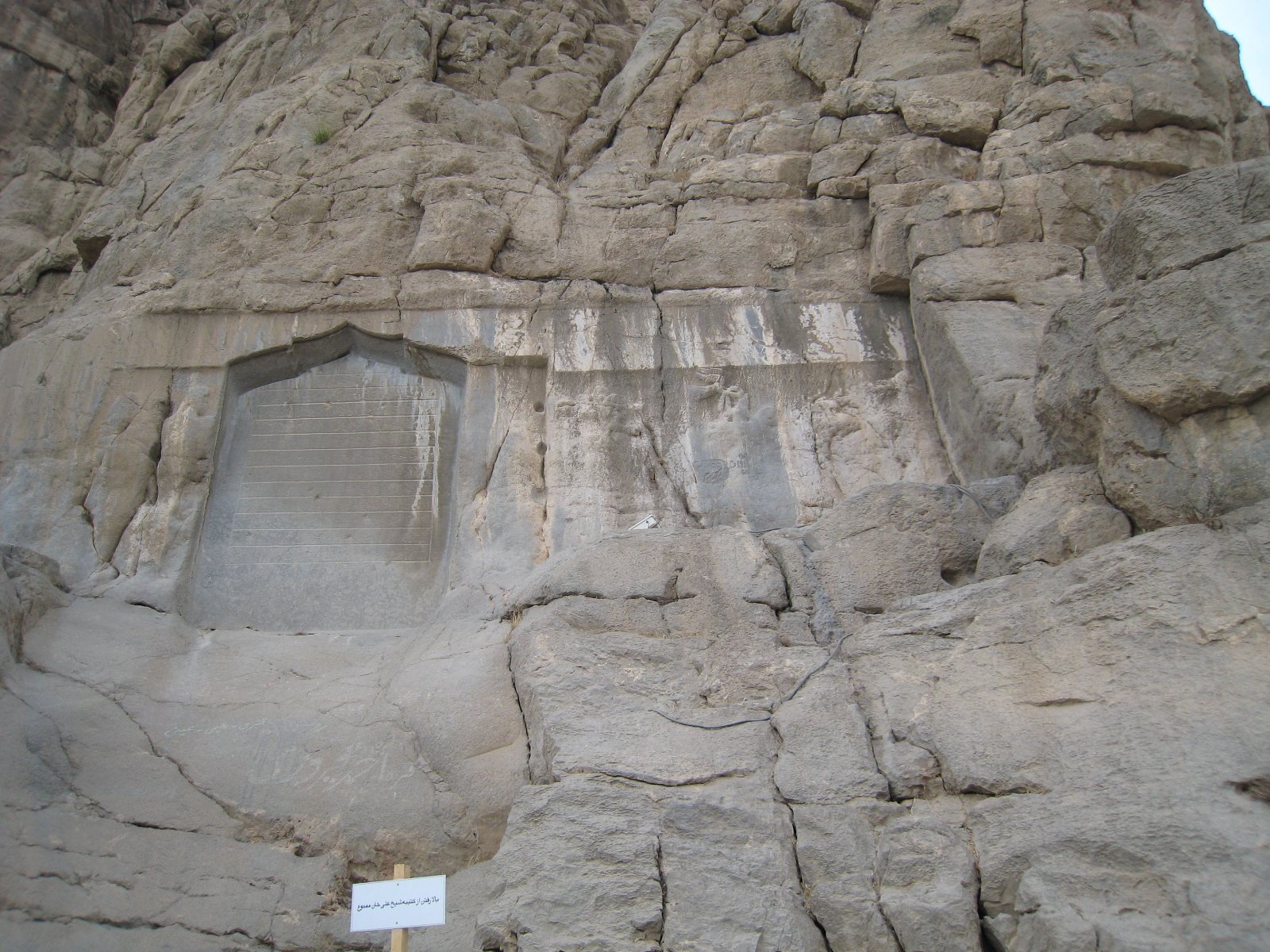
The complex is centred on a limestone cliff on Mount Behistun, above a fertile plain and beside an ancient route linking Babylon and Ecbatana. The elevated position and nearby caravan road may have influenced Darius’s choice of location, which may also have been regarded as sacred. The inscribed area measures about 15 metres high by 25 metres wide and lies roughly 100 metres above the ancient road; the carved relief measures about 6 by 3.2 metres. The wider complex also contains evidence of human shelter dating to about 40,000 years ago.
The cliff inscription and relief
Inscribed texts
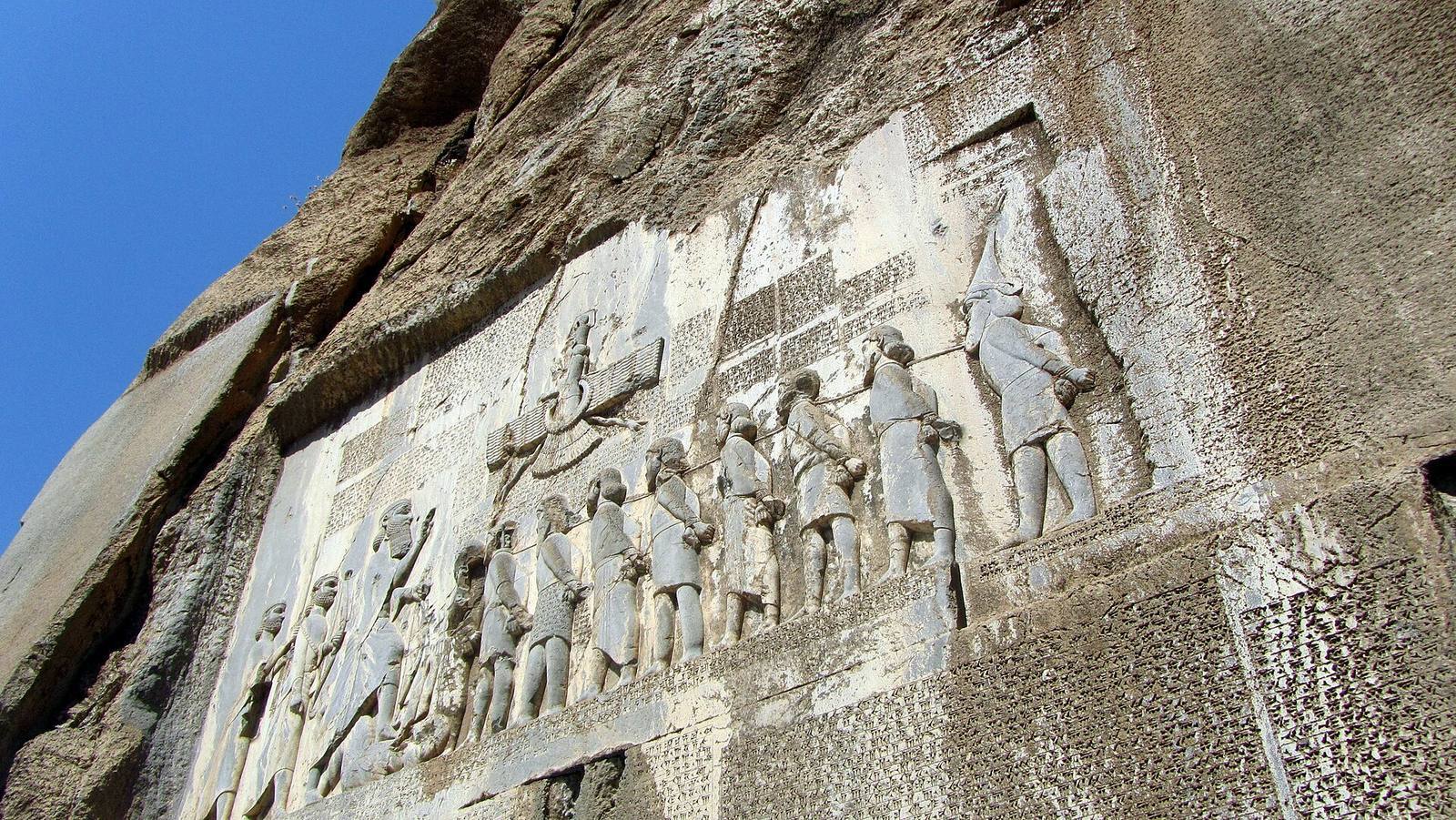
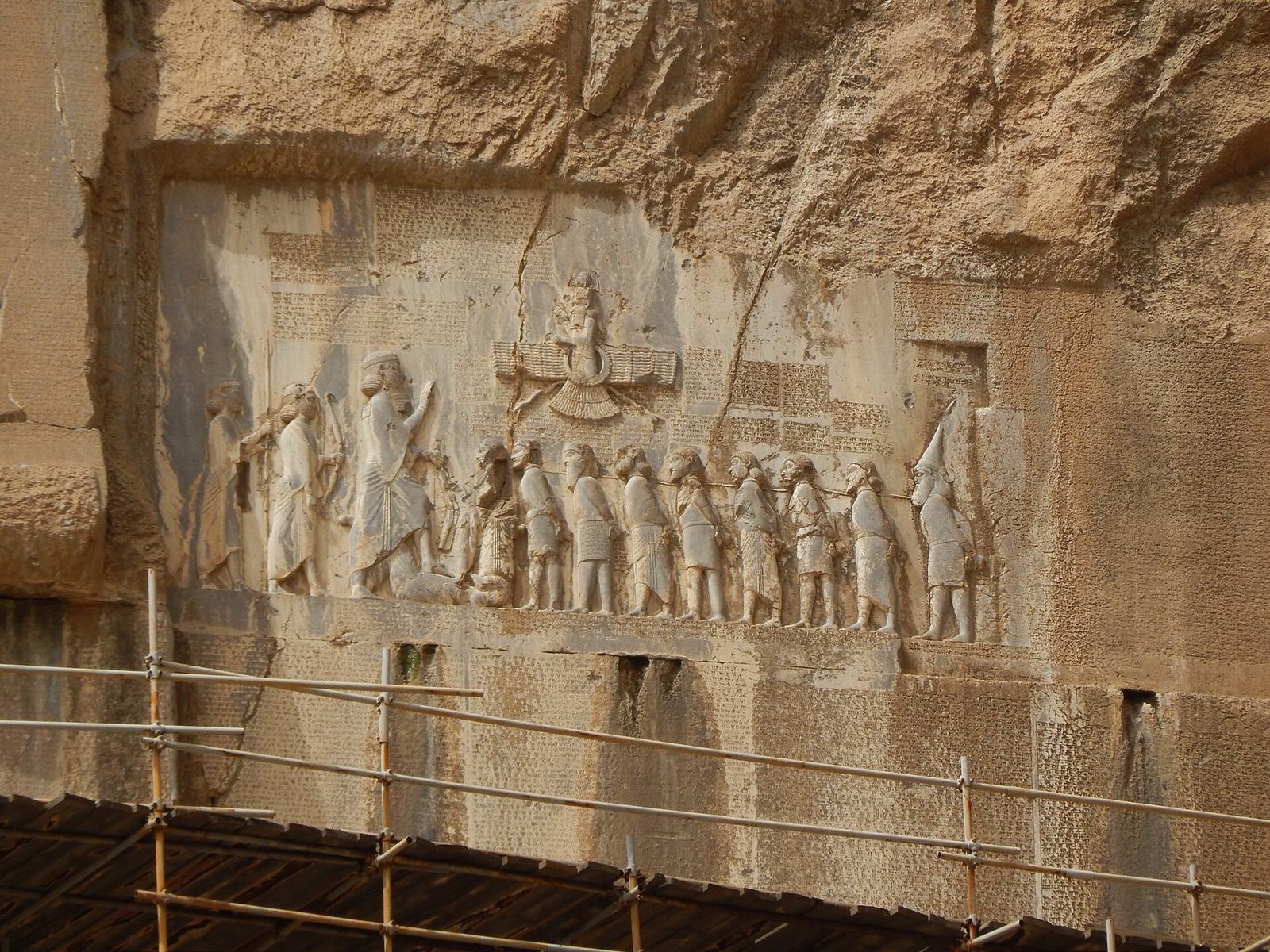
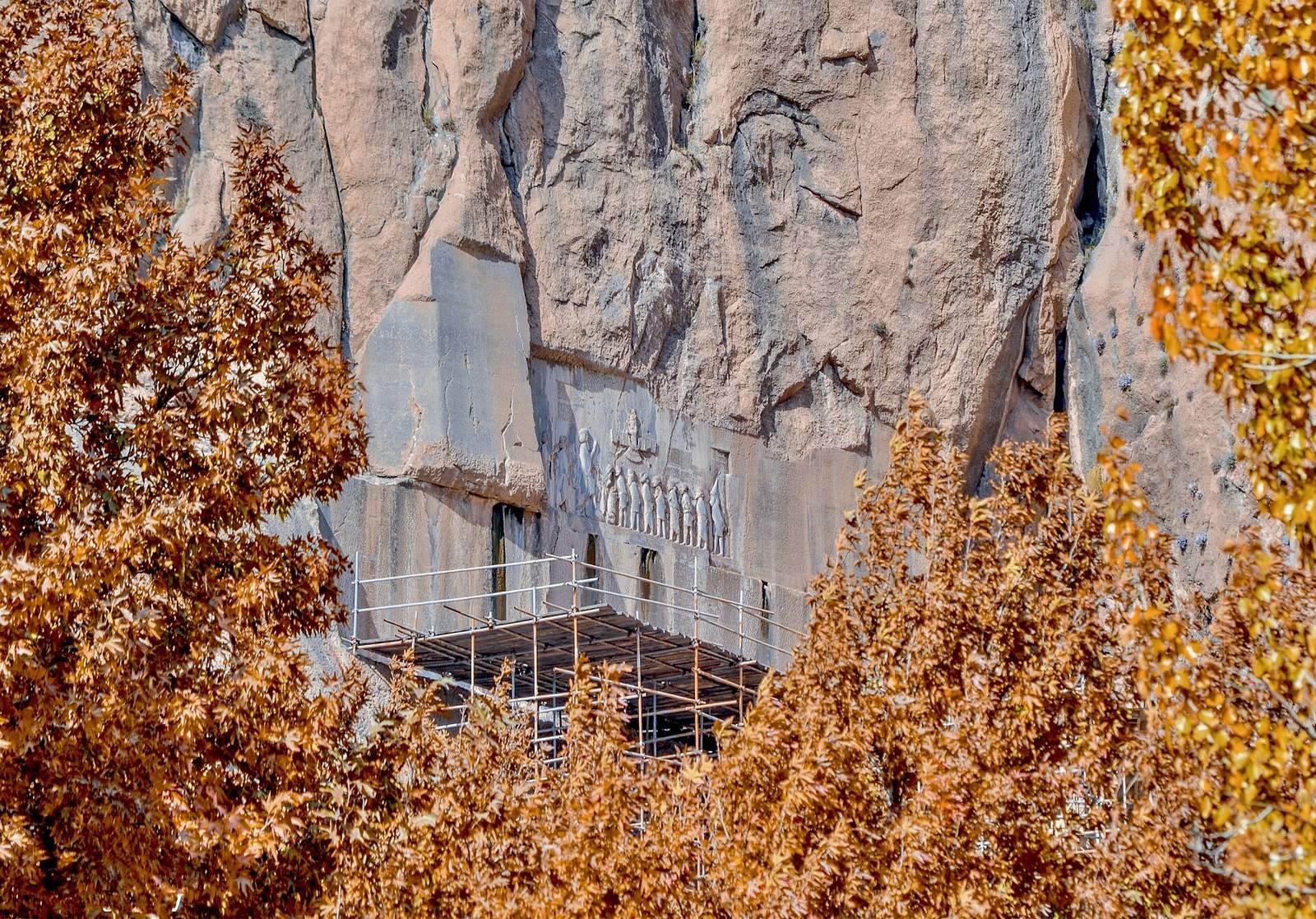
The royal text appears in Old Persian, Elamite, and Babylonian, all written in cuneiform. The Old Persian text is arranged in five columns, the Elamite version in eight columns, and the Babylonian text in 112 lines. The first Elamite text occupies four panels to the right of the relief, while the Babylonian version is cut into a tall slab to the left. The Old Persian text lies below the carved scene. A second Elamite version was added in 518 BC in three panels beneath the Babylonian text.
Adding the figure of Skunkha damaged part of the first Elamite text, and a fifth section of the Old Persian version was carved afterward. Remains of a staircase cut into the upper mountain suggest that workers used it to reach the worksite. It may have been partly removed after the carving was completed to make the monument harder to approach.
The royal relief
Darius stands in the relief wearing a crown and holding a bow, with his left foot on the chest of the prostrate Gaumata. Darius’s carved figure is about 1.8 metres tall; Gaumata lies beneath him with one foot and both hands raised. Two bearded attendants, a spearman and an archer carrying a quiver, stand behind the king. Each is about 1.5 metres tall. Before Darius, nine bound figures stand in a row with their hands tied behind them and ropes around their necks. They represent defeated peoples or claimants. Skunkha stands at the end, wearing Scythian clothing and a pointed hat.
Above the scene, Ahura Mazda appears as a bearded, human-faced figure emerging among rays from a large solar disk. The deity wears a radiant horned crown, extends a ring toward Darius, and raises the other hand in blessing; Darius raises his right hand toward the figure. The beard on Darius’s image was made as a separate stone piece and attached with iron pins and lead.
Surface and condition
Brown glaze remains on the limestone, and traces of lead are visible in several upper lines. These remnants may indicate that the finished surface once had a protective coating of unknown composition. Rain and wind erosion, geological processes, organic deposits, algae in cracks, and human activity have worn the carving and text. Rainwater dissolved some of the inscribed limestone, while new limestone deposits covered other areas.
Other monuments in the complex
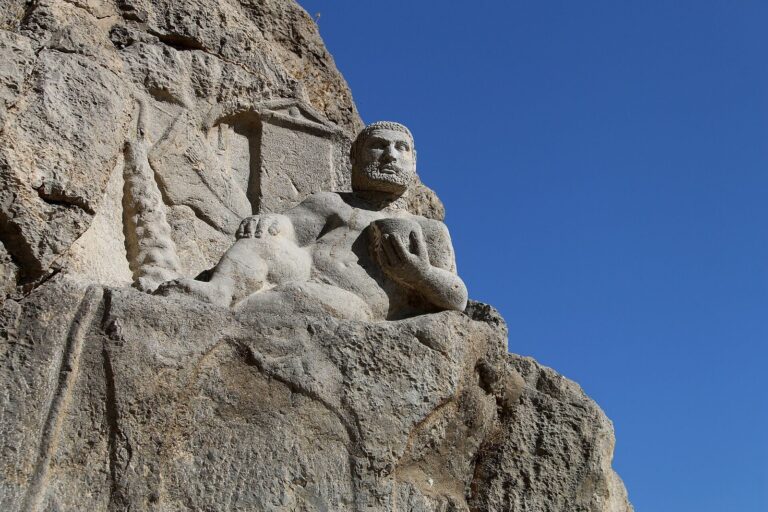
Eighteen other registered historical monuments form part of the complex. They include a statue of Herakles made for a Seleucid governor in 148 BC; reliefs of Mithridates II and Gotarzes II; an endowment inscription associated with Sheikh Ali Khan Zangeneh; a damaged equestrian relief of Gotarzes II; and a relief of Vologases.