Metropolis: An Ancient City in Türkiye
Site at a Glance
- Popularity
- High
- Country
- Turkey
- Primary era
- Classical
- Eras represented
- Iron Age, Classical, Medieval
- Civilizations
- Ancient Greek, Byzantine, Kingdom of Pergamon, Roman
- Site type
- City
On this page16 sections
History
Metropolis is an ancient city near Yeniköy in İzmir Province, western Türkiye, whose urban growth flourished under the Attalids during the 3rd and 2nd centuries BC. The Attalids, rulers of the Hellenistic kingdom of Pergamon, oversaw this period of expansion. The Hellenistic period followed Alexander the Great’s campaigns and preceded Roman rule across much of the eastern Mediterranean. Metropolis means “mother city” and its name is associated with a mother goddess; Torbalı derives its name from a Turkish adaptation of the ancient name.
Early occupation and Bronze Age
The area was inhabited during the Neolithic, the later part of the Stone Age associated with settled farming. A settlement about two kilometres west of Metropolis was occupied from the late 7th millennium to the first half of the 4th millennium BC. This occupation has been linked to contact with the coastal culture of Troy I, the earliest archaeological settlement phase at Troy. Activity on the acropolis also dates to the 3rd millennium BC and the late 2nd millennium BC.
A fortified Late Bronze Age settlement at Bademgediği Tepe may have been Puranda, a city associated with the Hittite campaigns against Arzawa, a kingdom in western Anatolia. In 1317 BC, after the Hittite king Mursili II captured Apasas, Arzawa’s capital, the Arzawan prince Tapalazunauli, son of the last king Uhha-ziti, led resistance from Puranda. Mursili besieged the city and cut its water supply, but Tapalazunauli escaped.
Archaic and Hellenistic development
Archaeologist Recep Meriç inferred that Metropolis was founded around 725 BC, drawing on Geometric and Archaic pottery from the acropolis dated to 725–500 BC. These names refer to successive phases of ancient Greek material culture.
The city grew under the Attalids in the 3rd and 2nd centuries BC. Urban development expanded, with religious and public buildings added to the city.
Roman period
Under Roman rule, Metropolis spread across a wider area. Agriculture and trade contributed to its revenues, and commerce increased along the main road between Smyrna and Ephesus. The regional festival Sebaste Kaisareia was established; its Greek name invoked equivalents of Augustus and Caesar and reflected the festival’s imperial associations. Metropolis also minted coins from the 2nd century BC to the 3rd century AD.
An earthquake in AD 17 damaged at least the Stoa. Ancient writers including Strabo and Ptolemy placed Metropolis in the Cayster plain of Lydia, an ancient region of western Anatolia, on the route between Smyrna and Ephesus. They gave its distance as 120 stadia from Ephesus and 180 from Smyrna; a stadion was an ancient unit of distance whose length varied by place and period. Strabo also praised the district’s wine.
Byzantine and Ottoman periods
Byzantine writers, from the eastern continuation of the Roman Empire, continued to mention the city. Stephanus of Byzantium and Hierocles were among them. Metropolis became smaller during the later Byzantine period, and a fortress was built around the 14th century between the acropolis and the Stoa. Following the Ottoman conquest in the 15th century, the city was abandoned and its inhabitants moved to Torbalı. The Ottoman Empire was centered in Anatolia.
Recep Meriç surveyed Metropolis from 1972 to 1975 and began directing excavations in 1989. Serdar Aybek led excavations from 2007, while the University of Oslo’s Museum of Cultural History participated from 2004 to 2008. Håkon Ingvaldsen examined the coins, and Boris Dreyer studied the inscriptions.
Remains
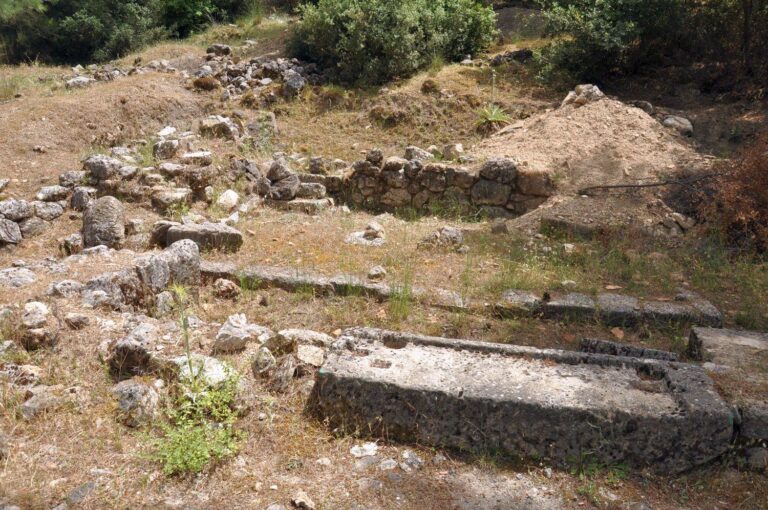
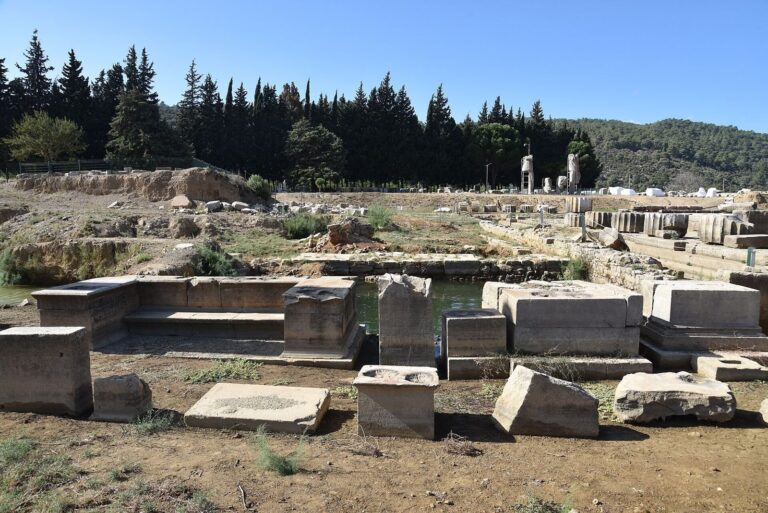
The ancient city occupies a hill, with remains chiefly from its Hellenistic development and later Roman alterations. Byzantine buildings and defenses overlie earlier remains. The acropolis and its defenses form one part of the site, while civic and Roman buildings lie on the slopes.
Early and Bronze Age remains
Acropolis finds
Finds from the acropolis include Early Bronze Age pottery, stone axes and obsidian fragments. A stamp seal, an engraved object pressed into a surface to leave a mark, dates to the late 2nd millennium BC. Its undeciphered signs resemble Hittite hieroglyphs.
Bademgediği Tepe settlement
The fortified Late Bronze Age settlement at Bademgediği Tepe has locally made Mycenaean pottery, from a Bronze Age Greek civilization, dating from the 14th to the 12th century BC and later. A fragment of a painted vessel showing a sea battle dates to the early 12th century BC. In the settlement’s 12th-century BC second layer, builders constructed a new defensive wall from very large, roughly fitted stones.
Hellenistic and Roman buildings
Acropolis and temple of Ares
The Hellenistic city had walls and other fortifications. Its temple to Ares, the Greek god of war, stood on the acropolis and is described as one of only two known temples of its kind.
Civic buildings and theatre
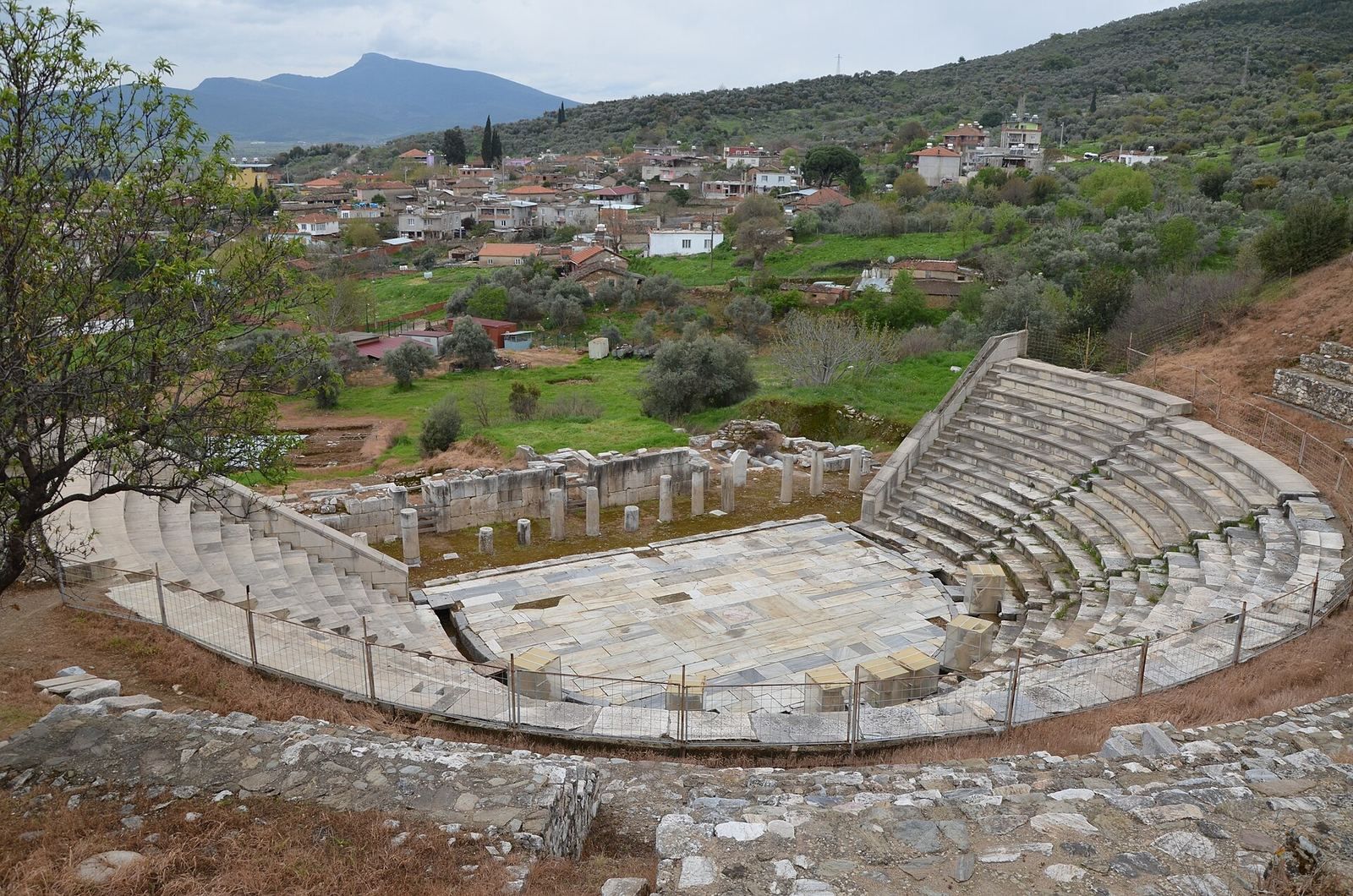
The Stoa, a covered colonnaded walkway, the council building and the theatre occupied the slopes. Altars in the theatre bore reliefs honoring Augustus, Rome’s first emperor, and Germanicus, a Roman general and member of the imperial family. A marble honorific seat, reserved to recognize a person or status, was found there in 1995. Decorated with griffins, lion-bodied creatures with eagle heads and wings, the original is displayed in the İzmir Archaeological Museum; a replica stands in the theatre. Mosaics were found in an annex to the theatre.
Bath and gymnasium
A Roman bath and gymnasium stood on the northern slope. The bath retains a hypocaust, a system that heated rooms through spaces beneath the floor. A staircase connects the bath with a fortification tower.
Byzantine structures and defenses
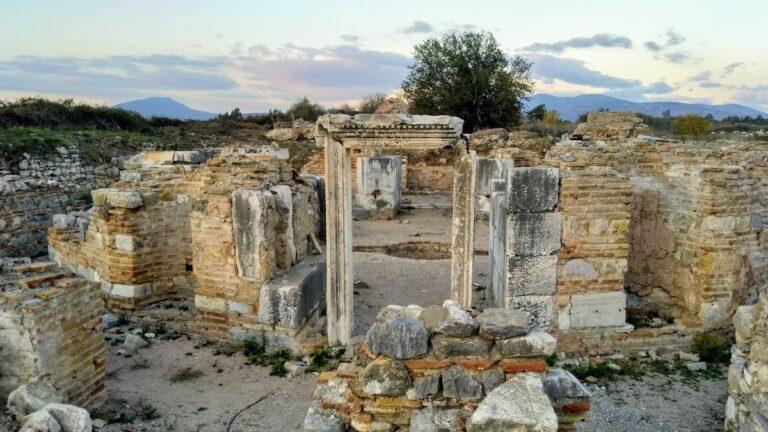
Byzantine walls cross the city and connect with the earlier Hellenistic defenses on the acropolis. A church lies east of the city, and the later fortress stands between the acropolis and the Stoa.
Agora on the southern slope
Excavators uncovered an agora, a public civic and commercial space, on the city’s southern slopes in 2025. It appears to have remained in use until the 5th or 6th century AD and may have lost its function after an earthquake.
Cult caves at Uyuzdere
Two small cult caves lie at Uyuzdere, at the foot of Mount Gallesion about 4.5 kilometres northwest of Metropolis. They are associated with Meter Gallesia, an Anatolian fertility goddess linked to a mother-goddess tradition.