Temple of Apollo Thermios: An Archaic Sanctuary in Greece
Site at a Glance
- Popularity
- Medium
- Country
- Greece
- Primary era
- Iron Age
- Eras represented
- Iron Age, Classical
- Civilizations
- Ancient Greek
- Site type
- Religious
- Remains
- Sanctuary
On this page19 sections
History
Early settlement and the temple
The Temple of Apollo Thermios was a Greek sanctuary at Thermos, Greece, whose large temple was built around 630–620 BC in the Archaic period, before Greece’s Classical age. The sanctuary later served as the regular meeting place and treasury of the Aetolian League, a confederation of communities in western Greece that was initially more loosely organized and tribally based than a union of independent city-states.
Thermos had been an important regional center from around 1500 BC, during Late Helladic IIA, a phase of the Mycenaean Late Bronze Age. The settlement flourished through the Mycenaean period and remained occupied after the destruction of the Mycenaean palaces around 1200–1100 BC. A megaron, an elongated hall, beneath the later temple is known as Megaron B. It probably dates to around 1000–900 BC and may have gone out of use around 850 BC. Its place in the development of Greek temples was once interpreted as a link with Mycenaean palace architecture, but that explanation relied on an earlier dating. Excavations led by archaeologist I. Papapostolou support a post-Mycenaean date and show no demonstrable architectural continuity between the hall and the later temple.
The large Archaic temple is traditionally identified as a sanctuary of Apollo Thermios, a Greek deity, and Hellenistic inscriptions support that association. The identity of the deity worshipped at the site in earlier periods is uncertain; Artemis, another Greek deity, has also been proposed. Thermos was not a built-up city. The sanctuary’s gathering place and treasury gave it a central role in the League.
Hellenistic sanctuary and attacks
The sanctuary’s boundary before the Hellenistic period, which followed the conquests of Alexander the Great, is uncertain. During the Hellenistic era, defensive walls, gates, and towers enclosed three sides of the precinct, while long covered porticoes expanded its built area. The treasury and valuable offerings helped make the sanctuary a target.
Macedonian king Philip V attacked Thermos in 218 BC. His forces seized the most valuable weapons displayed in the porticoes, burned thousands of the other weapons along with the porticoes, and toppled more than a thousand statues. They spared statues dedicated to gods or depicting them. In a second attack in 206 BC, Macedonian forces destroyed what had survived the earlier assault.
The temple was reconstructed during the second century BC, but its rebuilding remained incomplete and did not include a broad expansion. In 189 BC, the Romans sacked the sanctuary, effectively bringing its existence as a functioning center to an end.
Decline and later use
The sanctuary declined with the Aetolian League. By the first century BC, burials in the locations of major public buildings indicate that it no longer functioned as a sanctuary. It was later abandoned during the Roman period. In the early Christian period, a cemetery occupied part of one of the sanctuary’s principal areas.
Remains
Temple C
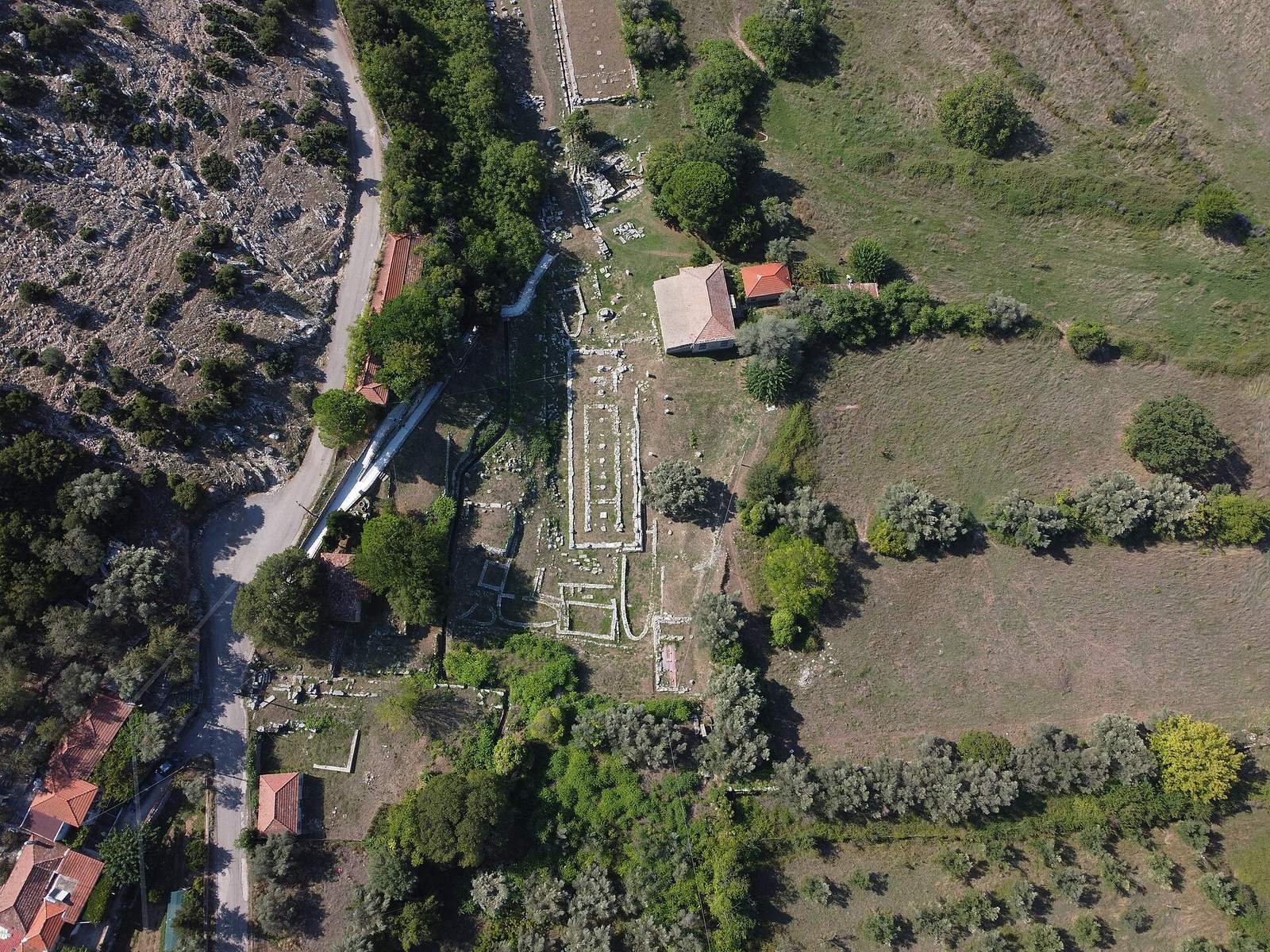
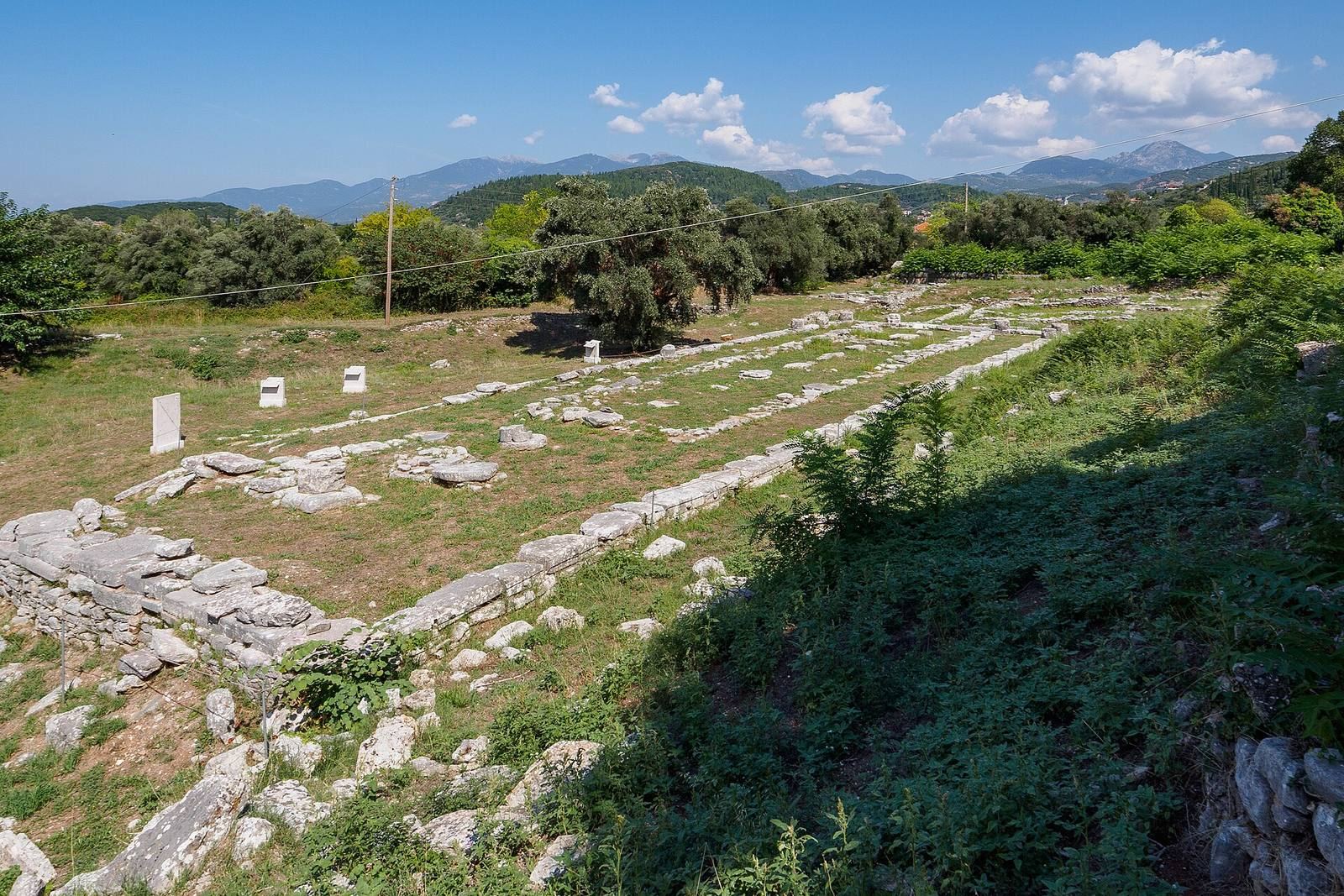
The sanctuary stood on rugged terrain, with the main temple in its southeastern corner and broad open areas used for offerings and processions. Known as Temple C, the Archaic building measured about 38.2 by 12.1 metres. Its unusually elongated plan was surrounded by wooden columns on simple stone bases: fifteen along each long side and five at each end, with the corner columns counted on both sides. Ten further columns ran through the main chamber, or cella, and probably supported the wooden roof.
Plan and construction
The temple had no front porch. Its entrance was on a side rather than centered on the front, and a deep rear chamber contained two columns along its center. The cella walls were made of mud brick. The columns and the upper structure were originally wooden, with the upper parts decorated in painted terracotta. During the Hellenistic period, stone columns replaced the wooden ones, while the upper structure appears to have remained in place.
Roof and terracotta decoration
The original terracotta roof had a gable at the front and sloped down toward the rear. Its tiles were large slabs, about 110 by 90 centimetres, with raised ends. A later arrangement added a gable at the rear. Other roof fittings included raised edges, a sphinx-shaped ornament, and at least two sets of ornaments covering the exposed ends of the roof tiles.
Female heads decorated the first set of tile-end ornaments above the metopes, the panels of the temple’s decorative frieze. Roof spouts bore male or Gorgon heads in black or dark red. A later set included male and silenus heads, indicating that the roof was partly renewed or remodeled around the mid-sixth century BC. Fragments of a second upper structure, dated to the second half of that century, preserve spouts alternating bearded male and satyr heads, with female heads between them. Its tiles carried black and red palmettes. Sculpted roof ornaments included crouching sphinxes at the sides and Nike, the goddess of victory, at the center.
Painted metopes
Ten fragmentary terracotta metopes, each about 90 centimetres high, were painted in black, white, brown, purple, and orange. Their scenes include Aëdon and Chelidon preparing Itys for a meal, a Gorgon’s head, Perseus carrying the Gorgon’s head, and three long-haired divine figures who may represent Apollo, Artemis, and Leto. Other panels show a bearded hunter with a bow and quiver and two women lowering their garments, perhaps the mythological Proetides. Further fragments depict a fantastic animal and two lion heads.
Some panels carry inscriptions in an alphabet that may be Aetolian. Their resemblance to Corinthian painted pottery from around the 630s BC helps date the temple; the clay is local, and the potters may have been local as well. These panels are commonly considered among the earliest known examples of their kind. Their size has also informed debate over whether the later stone panels of Doric temples imitated an earlier wooden form or were decorative from the outset. The metopes and other terracotta pieces were found around the temple. Most are held at the Thermos museum, with selected pieces in the National Archaeological Museum in Athens.
Earlier buildings and finds
Megaron A
Megaron A was an apsidal Mycenaean building among elliptical and square houses at the settlement. It was destroyed in the twelfth century BC. The building has been interpreted as the residence of a local leader. Ashes and amphorae arranged in a pattern associated with funerary worship have been taken to suggest a hero cult during its final phase.
Megaron B
Megaron B was a large rectangular building beneath Temple C, with a vestibule, a main hall, and a rear room. Finds associated with its use include Protogeometric and Geometric pottery, iron weapons, animal bones, and ashes, some stored in large jars. These pottery periods belong to the early Iron Age phases that followed Mycenaean palace society. The building’s deity is unknown and may have been a hero.
After the hall went out of use, a horseshoe-shaped arrangement of stone slabs was set around it. The slabs may have supported a wooden colonnade, perhaps forming part of a structure between the hall and the Archaic temple. A burnt layer containing Geometric-period offerings, dated to 800–700 BC, lay between the slabs and the temple foundations. Statuettes found beneath Megaron B date to about 700 BC.
Settlement finds
Pottery in the Middle Helladic tradition and imported, high-quality Mycenaean pottery from the settlement date to around 1500 BC. A finely decorated krater, or large bowl, brought to the site after the Mycenaean palaces were destroyed showed warriors in a style comparable to that of the Warrior Vase from Mycenae.
Other temples
Northwestern temple
A small Archaic temple stood northwest of Temple C. Its surviving or recovered pieces include an ornament from the roof edge, roof-tile ornaments shaped as bearded male heads and Gorgons, dog-headed waterspouts, a terracotta block from a temple frieze, and pottery. A dedication to Artemis has been proposed, but the identification remains uncertain.
Eastern temple
A second small Archaic temple stood east of Temple C. An inscription, perhaps from the third or second century BC, associates it with Apollo Lyseios, an epithet of Apollo linked here with deliberation. The wooden building had terracotta metopes and a raised roof edge. Its surviving decoration includes roof pottery, worn and sometimes inscribed panels, and a central roof ornament bearing a raised Gorgon’s head.
The panels depict the Charites, goddesses of charm and beauty, Iris, a Chimera, an embrace between unidentified figures, the centaur Pholus, and a seated woman who may represent Eileithyia, a goddess associated with childbirth. Other fragments preserve parts of animal figures.
Porticoes, fountain, and statues
Porticoes and spring
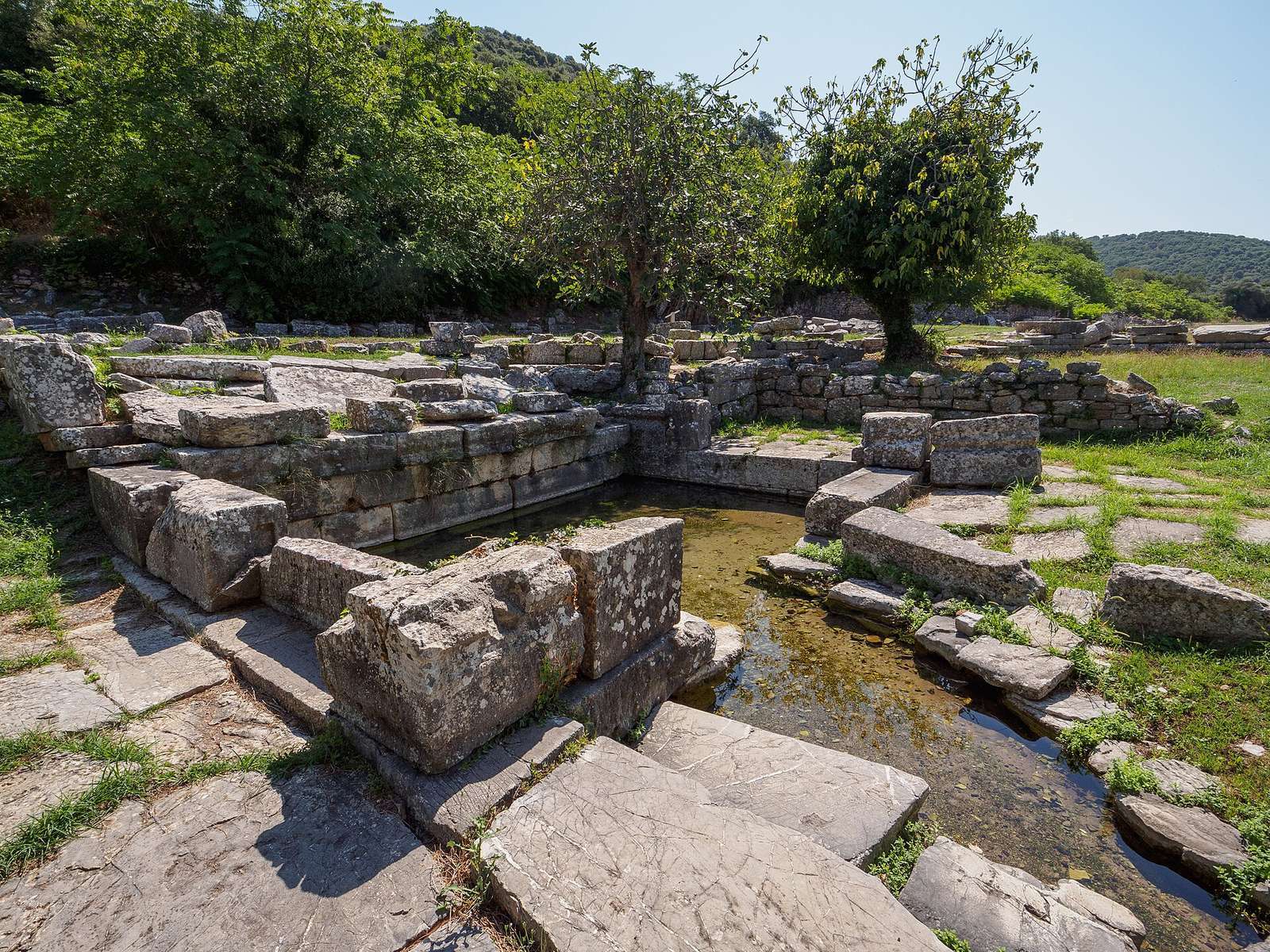
Three long covered porticoes occupied much of the precinct outside the temples. Built during the Hellenistic period, they were first made of wood and later reconstructed in stone. A spring immediately south of the main temple was enclosed to form a stone-lined fountain or pool.
Statue dedications
The Aetolians dedicated many bronze statues at the sanctuary. Surviving traces include small fragments of the figures, among them fingers, toes, and horses’ hooves, as well as the marble bases on which the statues stood.