Kumburk: A Gothic Castle Ruin in Czechia
Site at a Glance
- Rating
- 4.7
- Popularity
- Medium
- Country
- Czechia
- Primary era
- Medieval
- External website
- Open
- Eras represented
- Medieval, Modern
- Civilizations
- Holy Roman Empire, Kingdom of Bohemia
- Site type
- Military
- Remains
- Castle
On this page10 sections
History
Kumburk is a Gothic castle ruin in Czechia, near Syřenov in the Bohemian Paradise, established in the first half of the 14th century on the steep Kumburk hill. Its foundation is associated with 1325 and Markvart of Vartenberg, and the castle was initially known as Goldenburg. The site later became a fortified residence, prison, and military stronghold before its destruction in the 17th century.
Foundation and medieval expansion
Markvart of Vartenberg is associated with the castle’s foundation, while the name Goldenburg was also connected with Markvart of Goldenburg. His sons Beneš, Hynek, and Jan successively held the castle and used the names of Kolmburk and Vartenberg. In 1406, Kumburk was acquired by Johann Kruschina of Lichtenburg, who also held the Opočno domain and served as burgrave of Prague and captain of the Duchy of Schweidnitz in Silesia.
Johann’s son, Hynek Kruschina of Lichtenburg, became a Hussite leader during the Hussite Wars, the religious and political conflicts in Bohemia that followed the reform movement associated with Jan Hus. During this period he held Kumburk, strengthened its walls, added defensive works, and commissioned a palace. These changes reinforced the castle’s military role and shaped much of the surviving structure.
Ownership, imprisonment, and destruction
In the early 16th century, Kumburk passed to Johann Žehušický of Nestajov, who sold it in 1513 to Bartholomew of Münsterberg, the son of Duke Victorin. The Berka of Dubá family held the castle from 1517 to 1524, after which it passed to the Trčka of Lípa family. During the 16th century, Kumburk was used as a prison.
In 1607, the Trčka family sold Kumburk and the town of Jičín to Sigismund Smiřický of Smiřice. His possessions passed to his son Jaroslav and, after Jaroslav’s death in 1611, to his brother Albrecht Jan. Following the Battle of White Mountain, the emperor confiscated the Smiřický possessions and transferred them to their relative Albrecht Wallenstein, a Bohemian nobleman and imperial commander. After Wallenstein was assassinated in 1634, the emperor gave Kumburk to his commander Rudolf of Tiefenbach.
The castle had already been devastated by Swedish forces during the Thirty Years’ War, the European conflict fought from 1618 to 1648 amid religious and dynastic struggles. In 1658, it was demolished by imperial order because it was allegedly regarded as an enemy stronghold. Rudolf of Tiefenbach died without children, and his possessions passed in 1653 to his widow, Maria Eva Elisabeth, née von Sternberg. She bequeathed them in 1676 to her nephew Jan Norbert of Sternberg. The Sternbergs sold the Kumburk domain in 1710 to Johann Josef, Count Trauttmansdorff, whose descendants were dispossessed in 1945.
Legends and modern preservation
The ruins became associated with several legends. One tradition concerns Eliška Kateřina, the daughter of Zikmund Smiřický, who was said to have loved a common blacksmith. According to the story, her father imprisoned her at Kumburk for eleven years, and after his death her sister Markéta Salomena continued to hold her there until Ota of Vartenberg freed her. Other tales describe a treasure guarded by a rooster with fiery eyes, along with apparitions of the maiden Meluzína and a sorrowful huntsman.
The poet Karel Hynek Mácha visited the ruins in connection with these legends, and a memorial plaque commemorating him is installed in the upper tower. Restoration of the walls and towers took place between 1939 and 1941. The Kumburk Castle Rescue Association later undertook reconstruction work, including the construction of a lookout tower. Kumburk is now owned by the municipality of Syřenov and is protected as a cultural monument of the Czech Republic, a designation for heritage sites recognized for historical, architectural, or cultural value.
Remains
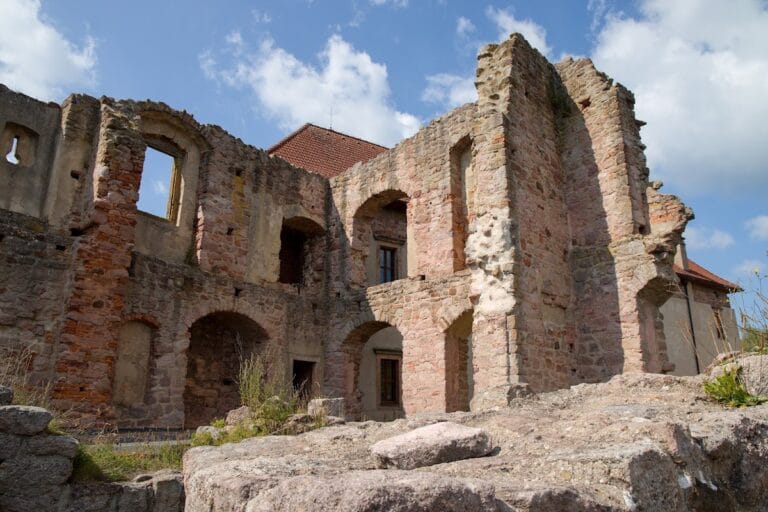
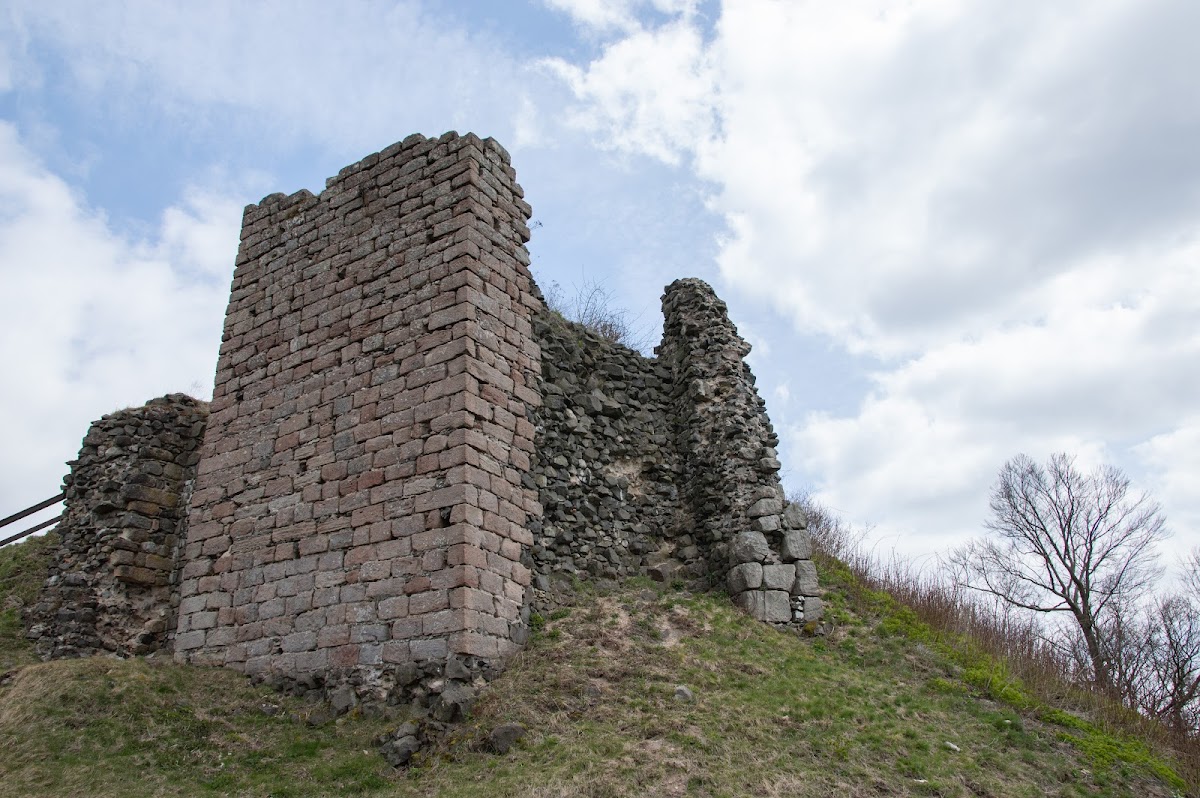
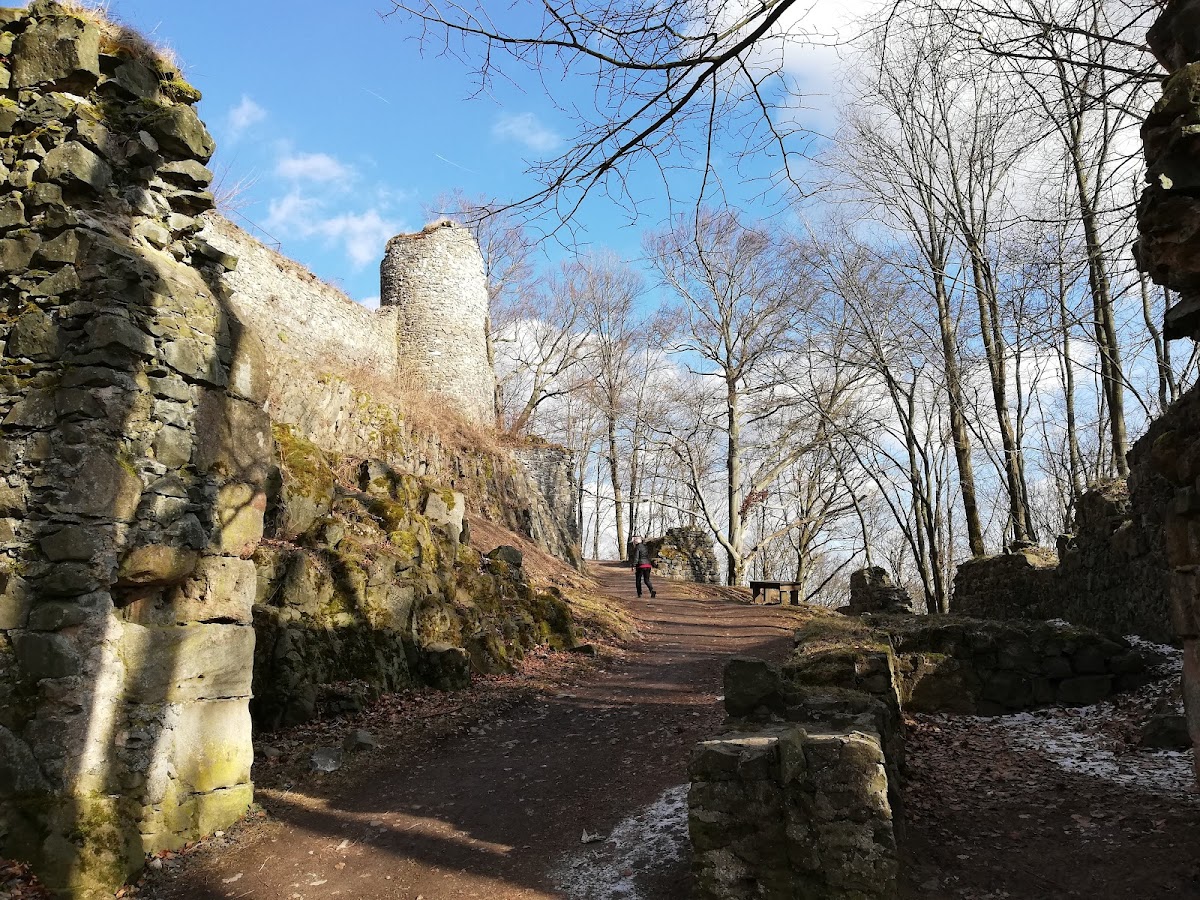
Kumburk occupies the summit of the steep Kumburk hill at approximately 600 metres above sea level. The castle’s individual parts were arranged in a spiral, one above another, adapting the fortified complex to the hilltop. The surviving fabric includes a substantial lower section of the palace, together with remains of towers and walls. The outer fortifications belong to the period of Hynek Kruschina of Lichtenburg, when the defenses were strengthened and additional works were added.
Palace and fortifications
Palace
The palace survives in a substantial lower section within the ruins. It was constructed during the Hussite-period strengthening associated with Hynek Kruschina of Lichtenburg and formed part of the castle’s expanded residential and defensive complex. Its surviving masonry remains integrated with the towers and walls arranged along the hilltop.
Towers and walls
The remains of the towers and enclosing walls preserve the castle’s fortified outline and reflect the defensive additions made in the early 15th century. Sections of the walls and towers were restored between 1939 and 1941. A memorial plaque to Karel Hynek Mácha is installed in the upper tower.
Lookout tower
A lookout tower was built within the ruins by the Kumburk Castle Rescue Association as part of later reconstruction work. Its views extend toward the villages of Úbislavice and Zboží, Nová Paka, the Bohemian Paradise, and the Krkonoše Mountains.
Earlier archaeological activity
The hill was used long before the medieval castle. Sparse pottery finds associated with the Stroke-Ornamented Ware culture, a Neolithic culture identified by impressions made with a pointed tool, indicate activity during the Neolithic period. Vessel fragments also point to settlement during the Late Bronze Age by the Lusatian culture, as well as activity in the Hallstatt period and during the later hillfort period of the Early Middle Ages.
Traces of a possible earlier settlement, or even a hillfort, were destroyed during construction of the high-medieval castle. A hillfort was a fortified settlement usually placed on elevated ground, and the evidence from Kumburk indicates that the hill had a history of use before the Gothic complex was built.