Šaunštejn Castle: A Medieval Rock Castle in Czechia


Site at a Glance
- Rating
- 4.8
- Popularity
- Medium
- Country
- Czechia
- Primary era
- Medieval
- External website
- Open
- Eras represented
- Medieval
- Civilizations
- Holy Roman Empire, Kingdom of Bohemia
- Site type
- Military
- Remains
- Castle
On this page8 sections
History
Foundation and administrative role
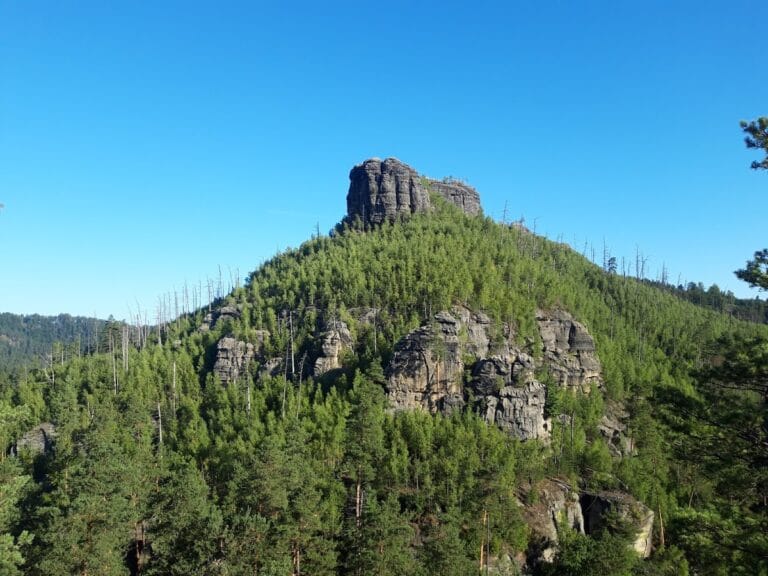
Šaunštejn Castle is a medieval sandstone rock castle in Czechia, founded in the late fourteenth century on an isolated rock formation. Archaeological evidence has been interpreted as suggesting that a castle may have existed there as early as the late thirteenth century, but its precise foundation date remains uncertain. Also known as Schauenstein and the “Robber Castle,” it served as the administrative center of a small estate and helped protect the Old Bohemian Road, a medieval trade route linking Bohemia with Lusatia.
The castle was initially held by the Berka of Dubá family, noble administrators and military figures in medieval northern Bohemia. Around 1428, it probably passed to the Vartenberg family as a pledge. The castle was first mentioned in 1431, when its garrison threatened the interests of the Lusatian Six-City League, an alliance of six major towns whose political and military interests were endangered by raiding or strategically placed castles. Adjacent parts of Saxony were also affected, and two scouts were sent from Dresden to investigate the garrison’s military intentions.
Sieges and political conflict
From 1435, the Vartenbergs used Šaunštejn as a base in their conflict with the Lusatian towns. A commander or administrator named Kašpar Laptic was recorded at the castle in 1443. Dresden forces besieged the stronghold for three weeks in 1431. The Six-City League mounted another siege in 1444, bringing about 9,000 soldiers and powerful firearms. Šaunštejn’s elevated position enabled it to withstand heavy bombardment, but the castle was captured in September of that year.
Decline and modern conservation
By about 1446, Šaunštejn was again in the possession of the Berka of Dubá family and formed part of the Vildštejn estate, a medieval territorial lordship. As political conditions stabilized, the castle lost its military importance and declined during the second half of the fifteenth century. The last recorded reference dates from 1490, and the castle had disappeared by the beginning of the sixteenth century.
Šaunštejn has been protected as a cultural monument since 1966. The surviving complex is now a ruin with limited remains. Erosion caused by foot traffic, together with the deterioration of former iron supports and tread plates, led to comprehensive repairs in 2021 and 2022. The work renewed ladders and railings, added raised walkways over the sandstone to reduce erosion, and permanently removed access to the southwesternmost summit group and its viewpoint.
Remains
Rock setting and access
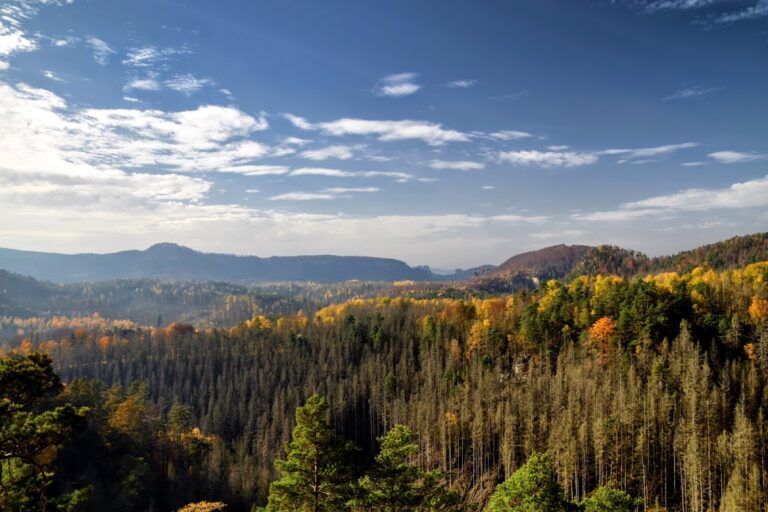
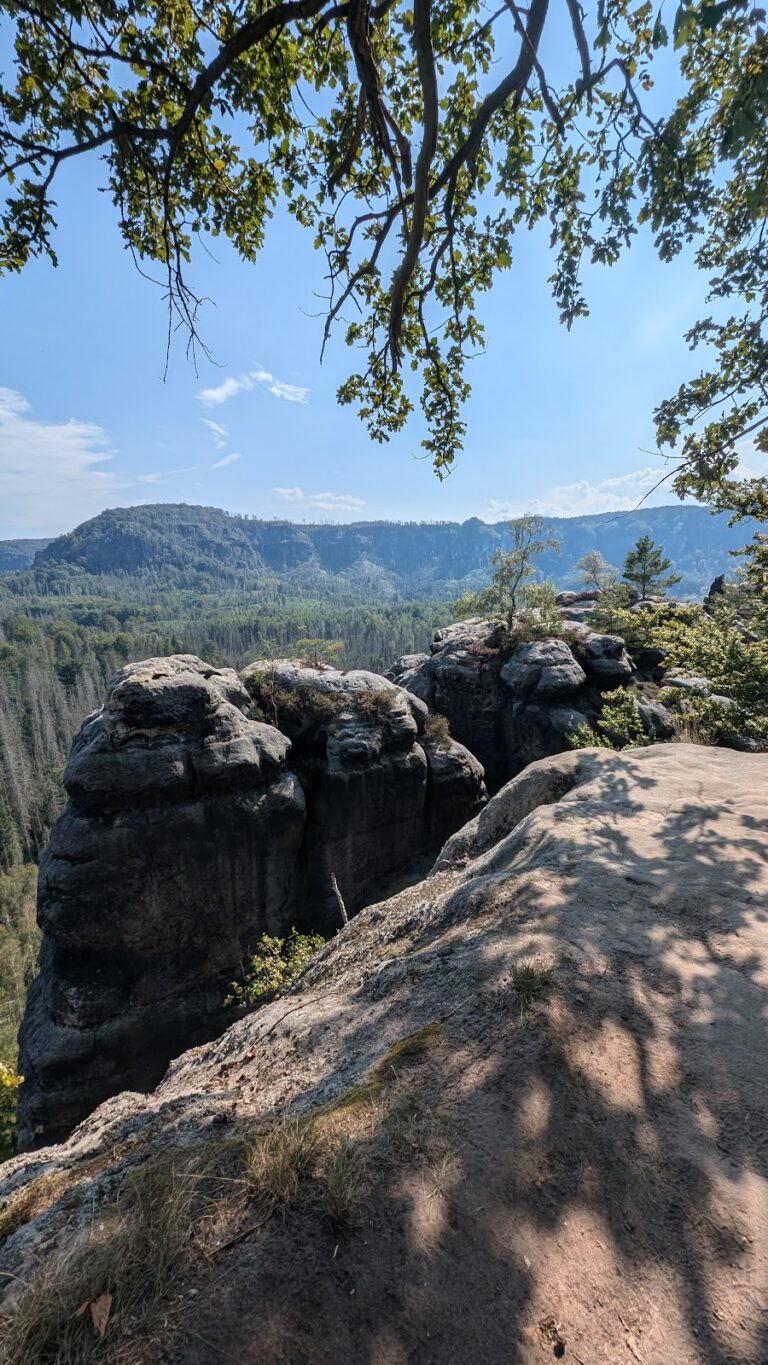
The castle occupied several sandstone rock towers and an adjoining sandstone outcrop at an elevation of about 340 metres, in the České Švýcarsko National Park approximately one kilometre north of Vysoká Lípa. Its buildings stood on the summits of the formations, while clefts between the rocks formed the route toward the upper level. At the foot of the rock known as Raubschloß, a forecourt contained operational buildings. The entrance to the rocky core was about four metres above ground level and was reached by a wooden square tower.
A system of stairs cut into the rock gave access to the upper part of the castle. The stairway began high above the ground, and ladders connected it with the lower approach. During an attack, the ladders could be pulled up to the higher part of the castle, making access more difficult.
Upper plateau and wooden structures
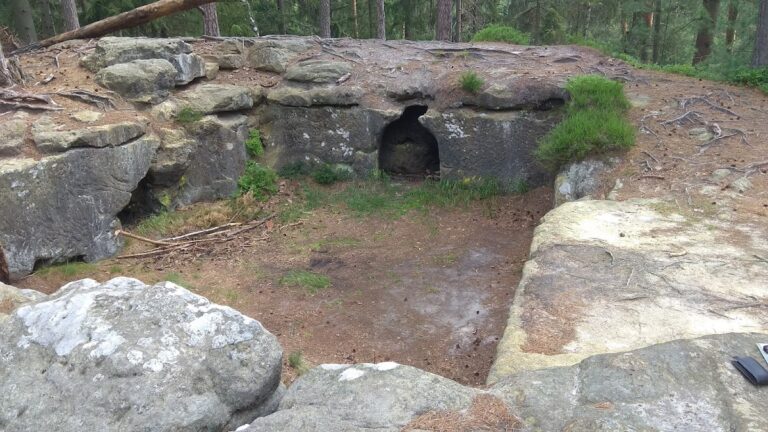
The upper plateau contains a chamber cut into the rock, the foundations or lower supports of a residential tower, and many beam holes used to anchor wooden buildings. Other timber structures rested on natural rock projections and on surfaces levelled in the sandstone. Together, the cuttings and sockets show how the builders combined the natural formations with wooden construction to create the fortified complex.
A large recess below the upper level contains a window cut toward the cleft leading to the castle’s upper part. Its original function is uncertain, although it probably served as a chapel. The surviving rock-cut rooms and stairs, foundations, beam sockets, and levelled surfaces preserve the physical arrangement of the castle’s built areas.
Storage, water, and carved marks
A prominent circular installation sunk into the rock, with a narrowed neck, served as a storage facility. The upper level also contains a circular rock-cut cistern, a reservoir designed to collect and store water. This cistern collected rainwater, providing a water supply within the elevated castle complex.
Numerous carved marks and images survive on the sandstone, including crosses, faces, and a deer bearing a crucifix. These carvings form part of the physical remains alongside the chambers, stairs, structural sockets, storage installation, and cistern.