Hajnáčka Castle: A Gothic Hilltop Fortress in Slovakia


Site at a Glance
- Rating
- 4.6
- Popularity
- Low
- Country
- Slovakia
- Primary era
- Medieval
- Eras represented
- Medieval, Early Modern
- Civilizations
- Habsburg, Hungarian
- Site type
- Military
- Remains
- Castle
On this page9 sections
History
Hajnáčka Castle is a Gothic hilltop castle ruin in Slovakia, built during the medieval period and first recorded in 1335. It stands above the village of Hajnáčka and originated in the defensive upheaval caused by the Mongol invasion of Hungary in 1241–1242, when Mongol armies attacked the Kingdom of Hungary and encouraged the construction or strengthening of refuge fortifications.
Origins and medieval development
During the invasion, jobagions associated with Beckov Castle built a fortification on Darmskó Hill. Jobagions were members of the medieval Hungarian castle-servitor class, connected with the defense and administration of royal or noble castles. The early fortification served as a refuge. A castle was completed around the middle of the fifteenth century, developing the site beyond its initial emergency role.
Ottoman-era defenses
Turkish forces captured Hajnáčka Castle in 1545 and held it for one year. From the end of the sixteenth century through the first third of the seventeenth century, the castle was reinforced as an important position in the anti-Turkish defensive line. Turkish forces briefly occupied it again in 1645. After their withdrawal, the castle was refortified in 1649.
Decline and destruction
By the seventeenth century, the castle was only partly inhabited. Alexander Vécsey is recorded as its castle captain in 1685. The castle burned in 1703 and was not rebuilt, leaving the fortified hilltop as a ruin.
Remains
Volcanic hilltop setting
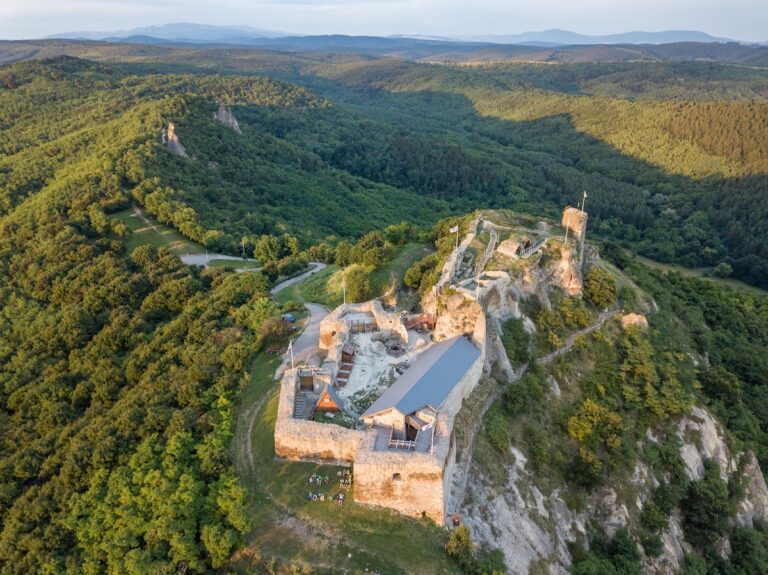
The ruins stand directly above Hajnáčka in the Gemer region of Slovakia, on a basalt rock approximately 295 metres above sea level. The rock is an exposed diatreme, a volcanic pipe or breccia-filled conduit formed during the final phase of Tertiary volcanism in the Western Carpathians. In many places, the natural rock itself became part of the fortifications and internal architecture. A staircase was cut directly into the stone, joining the built remains to the volcanic outcrop.
Upper fortifications
Palace and curtain walls
The highest part of the rock probably carried a small palace. Two lines of curtain wall, meaning enclosing defensive walls, protected this upper area. Surviving remains in the difficult-to-reach summit section include fragments of these walls and part of the palace structure.
Horseshoe-shaped bastion
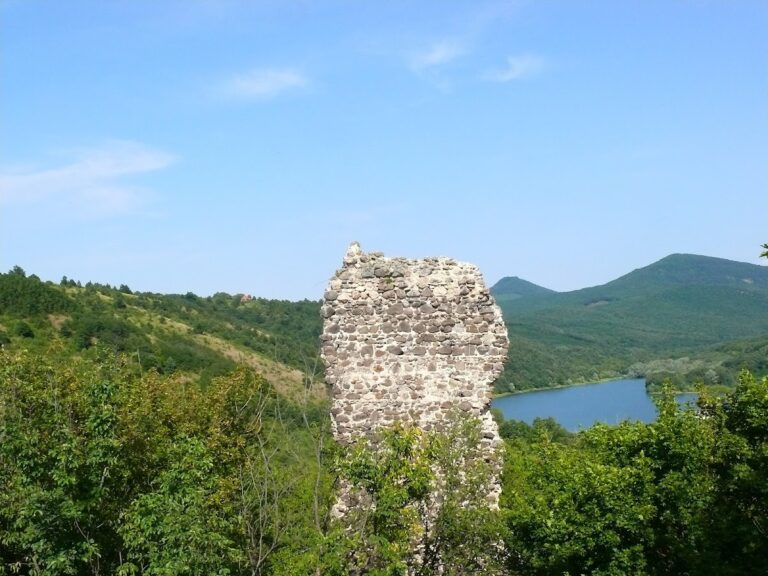
A horseshoe-shaped bastion formed part of the summit defenses. The remains of this projecting fortification survive alongside the wall fragments and palace structure in the upper section of the rock. From a distance, the ruins are so inconspicuous that the former castle is not readily visible.
Nearby sites