Vågå Church: A Norwegian Parish Church Rebuilt in the Seventeenth Century
Site at a Glance
- Popularity
- Medium
- Country
- Norway
- Primary era
- Early Modern
- Eras represented
- Medieval, Early Modern, Modern
- Civilizations
- Denmark–Norway, Norwegian
- Site type
- Religious
- Remains
- Church
On this page11 sections
History
Vågå Church, in Vågå, Norway, is a wooden parish church rebuilt as a timber-framed cruciform building in 1625–1627. It later served as an election church, a parish polling place in Norway’s 1814 electoral process. Local voters chose electors, who then selected representatives to the Constituent Assembly that drafted the Norwegian Constitution.
Medieval origins
A stave church, a medieval Norwegian wooden church built around upright timber posts, stood at Vågå during the Middle Ages. It is dated to 1150–1200 and may have been built around 1150. The name Ullinsyn, once used for the rectory, is understood to mean “Ullin’s pasture.” This place-name has been interpreted as a suggestion that worship took place here before Christianity.
Religious change and rebuilding
The church was originally dedicated to St Peter, one of Jesus’s apostles. Before the Reformation it belonged to the Catholic Church. A royal order in 1536 made Norway Lutheran, after which the church became part of the Lutheran church.
Changing needs among local people led to the predecessor being completely rebuilt on the same site as a cruciform church. The work was directed by Werner Olsen, also known as Werner Olsen Skurdal, a Norwegian builder of churches and towers. Materials from the earlier church were reused, and materials from other stave churches demolished in the valley may also have been incorporated. The rebuilt church was consecrated in 1627.
Vågå Church remains an active parish church of the Church of Norway. It belongs to Vågå parish, the Nord-Gudbrandsdal deanery, a grouping of parishes, and the Diocese of Hamar, a church district under a bishop.
Remains
Church structure and reused medieval fabric
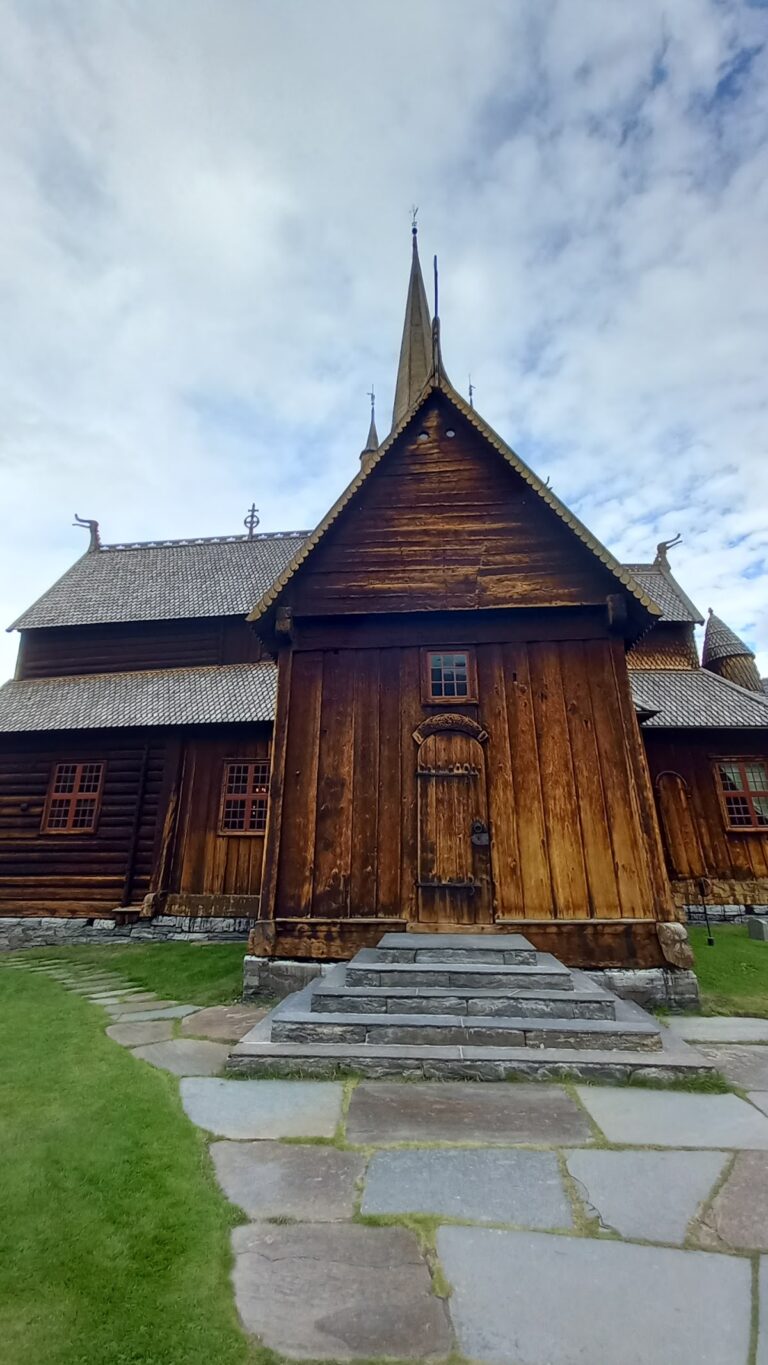
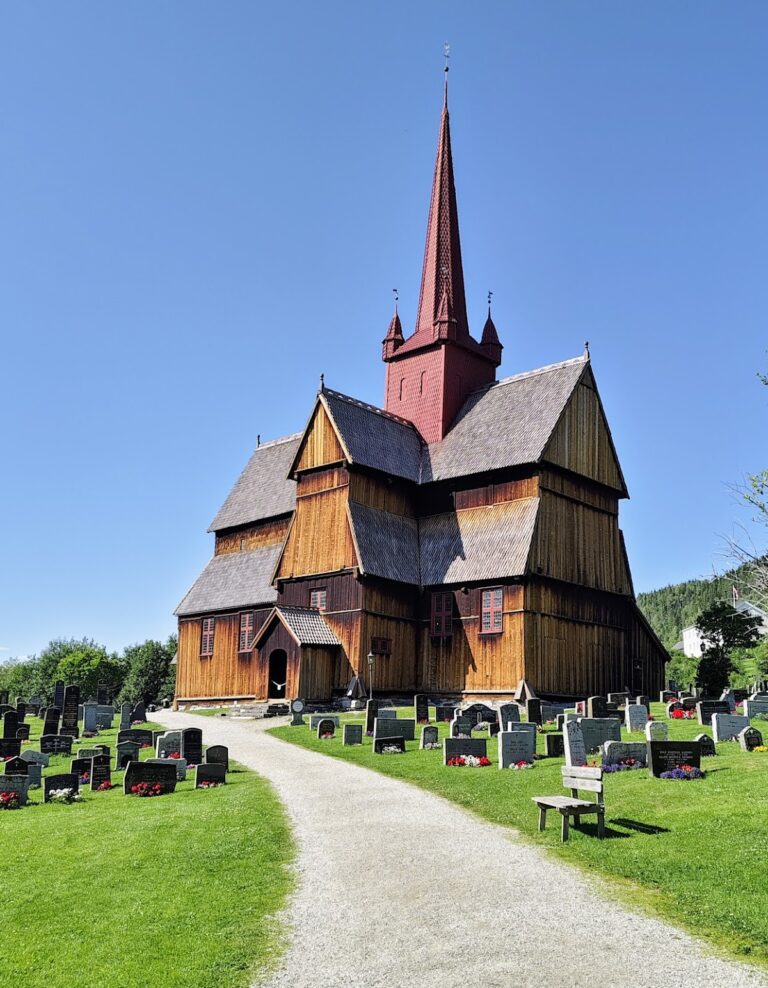
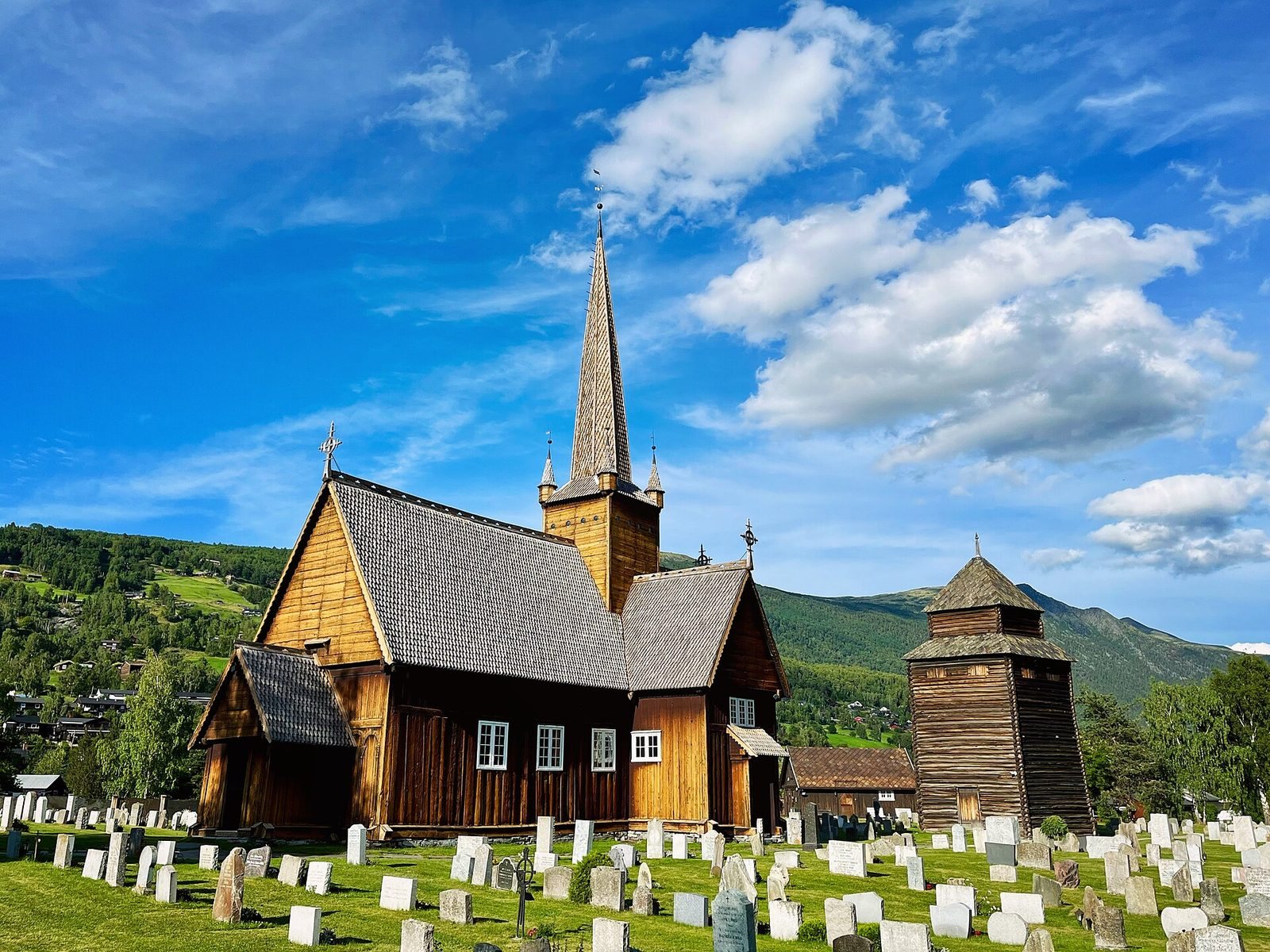
The wooden church has a Latin-cross plan, with a long nave intersected by a transept, or crosswise arm. Timber framing is combined with upright-post and log-building techniques, using pine and heartwood pine; the building has seating for about 250 people. A tower rises above the crossing. Its lower section is square, while its tall, slender roof is octagonal, with a small turret at each corner. The medieval predecessor had a rectangular nave and a narrower rectangular chancel. Its carved south doorway, other portals, wall panels, and decorative planks were incorporated into the rebuilt church. The building has been compared with the lost Hof stave church in Solør. Beside the church, a sacristy, a room for vestments and liturgical objects, dates to the 1660s and is made of shaped logs.
Furnishings and interior features
Medieval font and crucifix
The baptismal font dates from the twelfth century and is regarded as the church’s oldest furnishing. Its pattern resembles one on a chain found in a Viking ship. The decoration on the font’s base is thought to have originated in Ireland and may have reached Norway through contact with Viking Age Scandinavian seafarers. A 130-centimetre crucifix, made in the middle of the thirteenth century, is in the Gothic style, a medieval European artistic style.
Pulpit and altarpiece
The pulpit is generally dated to around 1630 and may have been made during or soon after the rebuilding. It bears acanthus carving, an ornamental leaf pattern based on a Mediterranean plant and used in Gudbrandsdal folk art; its images show scenes from the life of Jesus. Johannes Lauritsen Skraastad made the altarpiece in 1674–1675. Its acanthus carving was renewed in 1758.
Choir partition
The choir partition, a screen separating the choir from the nave, was carved and painted in 1758, probably by the woodcarver Østen Kjørren.
Organ
The church’s organ was installed in 2002 and has 1,200 pipes.
Churchyard
The churchyard beside the building contains graves dating from the eighteenth century. Jo Gjende (1794–1884), an outdoorsman and freethinker born in Vågå, is buried there. A small soapstone monument marks his grave, showing a fleeing herd of wild reindeer in a design based on a painting by the Norwegian artist Gerhard Munthe.