Hedvig Church: A German-Speaking Lutheran Parish in Norrköping
Site at a Glance
- Popularity
- Low
- Country
- Sweden
- Primary era
- Early Modern
- Eras represented
- Early Modern, Modern
- Civilizations
- Swedish
- Site type
- Religious
- Remains
- Church
On this page13 sections
History
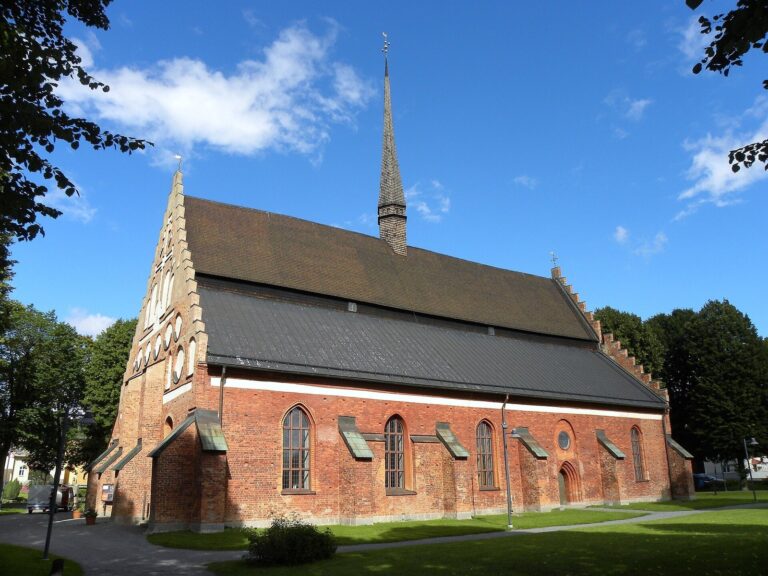
Hedvig Church in Norrköping, Sweden, was established as a Lutheran parish for the city’s German-speaking community. Also known as the German Church, it is a brick Baroque building, a style of European art and architecture that flourished from the late sixteenth to the eighteenth century. Construction began in 1670, and the church was completed and roofed by 1673.
Founding and construction
On 15 November 1613, the German residents of Norrköping received permission from Duke John of Östergötland to form their own congregation. The community was small and lacked the funds to build a church, so worship took place first at St John’s and St Olai churches, and later at the house of Louis De Geer, a Dutch-born Swedish merchant and industrialist. The Swedish city parish had previously used De Geer’s house while its own church was being built and repaired. A site for the German congregation’s church was granted before construction began.
Governor Anders Liljehök and German pastor Andreas Adam Hammerhelf laid the foundation stone on 27 April 1670. The architect is not established, although church records indicate that Nicodemus Tessin the Elder took part. Bishop Johannes Terserus consecrated the building on 1 November 1673, by order of King Charles XI. It was named for Queen Dowager Hedvig Eleonora, who contributed to the project and attended the ceremony with the king and members of the Council of the Realm.
Fire and rebuilding
Work on the tower began in 1693 and was complete by 1695. Authorities provided 10 skeppund, an old Swedish unit of weight, of roofing copper. Joachim Hansson Sivers, who supervised the work, had advanced 2,200 daler in copper money for the project and left that sum to the church.
In 1719, Russian troops burned Norrköping during the Great Northern War, a conflict fought from 1700 to 1721 between Sweden and a coalition that included Russia. Hedvig Church was almost entirely destroyed. Pastor Reinerus Reineri Broocman helped gather support from donors and authorities in Sweden and abroad, and the rebuilding was described as producing a more splendid church than before. The main rebuilding took place in 1723. Ground subsidence then caused the tower and part of the façade to collapse. A replacement tower also proved unstable; its lower part was demolished, and a wooden upper structure was completed in 1758.
Civic use and later changes
For the 1799–1800 Riksdag, Sweden’s national parliament, the church was renovated and adapted as an assembly hall. The session was convened in connection with the coronation of Gustaf IV Adolf on 3 April 1800; the coronation took place at St Olai Church.
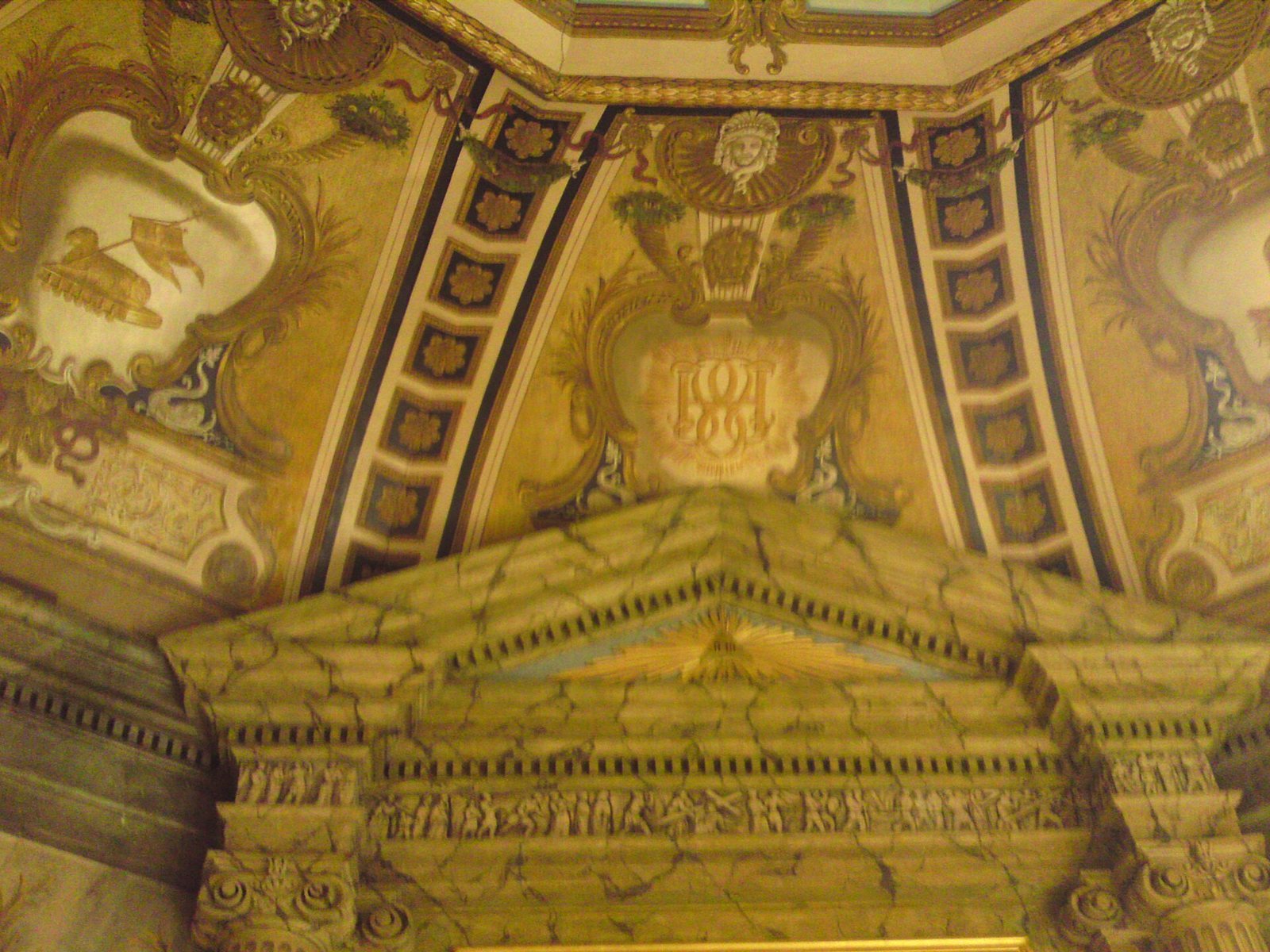
Renovations in 1860–1861 added a sacristy, new pews, an organ, and an organ gallery. Chancel windows and ceiling decoration followed in the 1890s. During a restoration in 1890, Agi Lindegren painted biblical quotations inside decorative frames on the ceiling.
The organ
The church’s known organ history began with an instrument bought in Hamburg in 1680 for 500 riksdaler, an older Swedish currency. It was destroyed in the 1719 fire. In 1792, Pehr Schiörlin of Linköping built a replacement following a simplification system devised by German composer and organ theorist Georg Joseph Vogler. It was probably the only organ to apply that system consistently. Its façade was a painted canvas by Pehr Hörberg.
Per Larsson Åkerman of Stockholm built a 22-stop organ with two hand-played keyboards and a foot-operated pedal in 1861, replacing Hörberg’s painted façade. In 1894, Åkerman & Lund installed a 30-stop instrument with three keyboards and pedal behind the existing façade. The church choir was founded that year on the initiative of music director Knut Dahlström. Mårtenssons organ factory added a smaller division behind the player in 1952. Later work altered the organ’s layout and mechanisms, added a console in the chancel, and revised its stops.
Restoration and memorial
A restoration in 1959 returned the façade to its original seventeenth-century appearance. In 1996, the communion rail and platform around the altar were removed to make communion easier to receive. Hedvig Church is protected under Chapter 4 of Sweden’s Cultural Heritage Act, which covers churches built before 1940.
A memorial to pastor Erik Perwe was established in the square beside the church on 30 May 1999. Perwe (1905–1944) served as chaplain to the Swedish Victoria congregation in Berlin during the Second World War. He provided humanitarian aid to people in need and to those facing persecution, especially Jews.
Remains
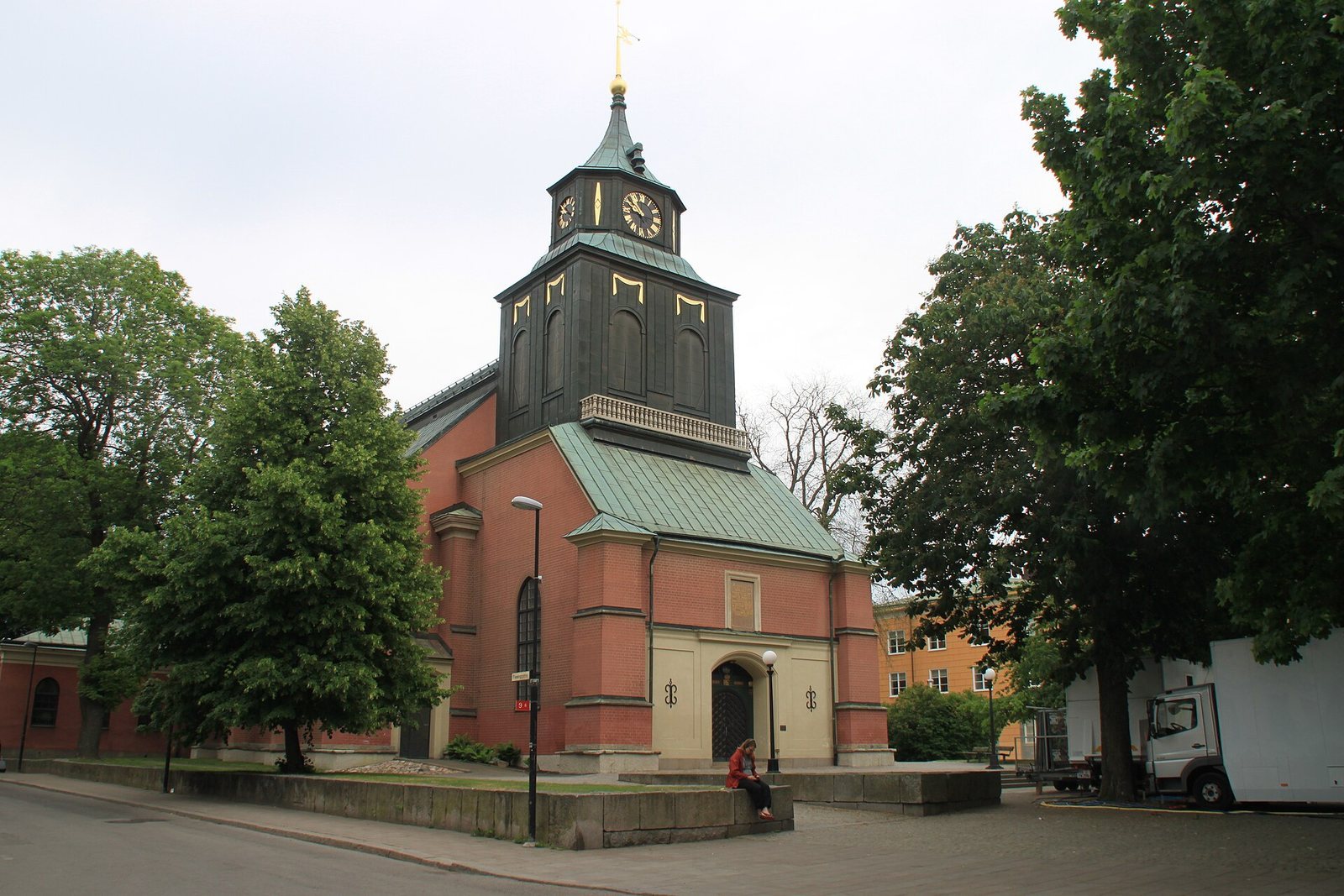
The surviving church has a rectangular plan, brick walls, and a single tower. Its five-bay nave, the main body of the church divided into interior sections, leads east to a chancel, the area around the altar, with a polygonal end. A sacristy, a room for clergy and church furnishings, adjoins the chancel on the north. At the west end, a low tower rises from a large vestibule, and its spire inclines slightly westward.
Interior furnishings
Pulpit and baptismal font
The carved pulpit was probably made in Germany in the 1720s. Andreas Spalding and Anna Bandholt gave it to the church in 1726; an inscription dates the gift to 1727 and spells the donor’s name “Bandtholt.” The pulpit has white oil paint and gilded mouldings. Its sun emblem contains JHWH, the four-letter form traditionally used for the biblical name of God.
The baptismal font dates to 1608 and originally stood in the church of Stegeborg Castle. Governor Erik Gammal Ehrenkrona gave it to Hedvig Church in 1733.
Paintings, windows, and altar furnishings
The church’s interior dimensions were described in 1760 as 53 Swedish alnar long and 30¼ alnar wide; an aln was a traditional Swedish unit of length. The same description notes 11 large windows and a panelled ceiling of three interlocking vaults, or curved ceiling sections. The two side sections support the central one without interior pillars. A small altarpiece depicted the institution of the Eucharist. Pehr Hörberg painted the Risen Christ meeting Doubting Thomas in 1791.
The vestibule contains stained-glass windows by Jan Brazda. Biblical quotations appear in painted frames on the ceiling, and the church has a portrait of provost Reinerus Reineri Broocman and two altar frontals, coverings hung at the front of an altar.
Tower and bells
The tower now holds three bells, all hung on angled yokes. From largest to smallest, their notes are C1, D-sharp1, and F1. The largest, cast in 1720, is 150 centimetres across and weighs about 2,100 kilograms. The middle bell was cast by Ohlsson’s bell foundry in Ystad in 1930; it measures 145 centimetres and weighs about 1,900 kilograms. Bergholtz bell foundry cast the smallest in 1965; it measures 130 centimetres and weighs about 1,400 kilograms. The clock mechanism was given by Stockholm’s German congregation after previously serving in that congregation’s church tower.
Organ
The organ has 53 stops, controls that bring groups of pipes into use, across main, positive, swell, and pedal divisions. Its connections link these divisions, and its controls include preset combinations for each division and for the instrument as a whole, as well as a system for increasing the sound gradually.
Memorial to Erik Perwe
Swedish artist Bianca Maria Barmen’s memorial is made up of two parts. Intertwined bronze hands, representing help, rest on a stone plinth; a granite house beside them represents shelter. A kneeling boy holding a plant, a symbol of life, stands by the plinth. Perwe’s motto, “All by grace,” is inscribed on it.