Church of the Nativity of Christ in Arbanasi: A Bulgarian Orthodox Church and Museum
Site at a Glance
- Popularity
- Medium
- Country
- Bulgaria
- Primary era
- Early Modern
- Eras represented
- Medieval, Early Modern
- Civilizations
- Ottoman
- Site type
- Religious
- Remains
- Church
On this page10 sections
History
The Church of the Nativity of Christ in Arbanasi is a Bulgarian Orthodox church in Bulgaria, on a site where an earlier church stood from the early fifteenth century. A building and painting phase recorded in 1597 marks the first clearly described stage in the present church’s development.
Early church and the 1597 campaign
The earlier church was built in the early fifteenth century. A ktitor inscription, naming a founder or donor who supported a church’s construction or decoration, associates the next documented building and painting phase with 1597. It credits two parish priests with supporting the building and its earliest murals.
Seventeenth-century enlargement and later use
During the 1620s to 1632, the church was enlarged with a narthex, the entrance vestibule of an Orthodox church, on the west and a chapel dedicated to St John the Baptist on the north. A gallery with a vaulted ceiling and an L-shaped plan connected the additions. The naos, or main worship space, served as the men’s prayer area, while women prayed in the narthex. After 1632 and before 1643, thin stone walls closed the spaces between the gallery and vestibule arcades, which had originally been open to the exterior.
Interior painting continued in successive campaigns during the seventeenth century, and the naos was repainted in 1681. The church may also have served as the residence of the Tarnovo metropolitan during that century. It belongs to the Bulgarian Orthodox Church and the Diocese of Veliko Tarnovo. Today it functions as a church museum and as a residence for the Veliko Tarnovo Metropolitanate. Restoration took place in the 1970s, after which the Regional History Museum of Veliko Tarnovo maintained the building.
Remains
Plan and exterior
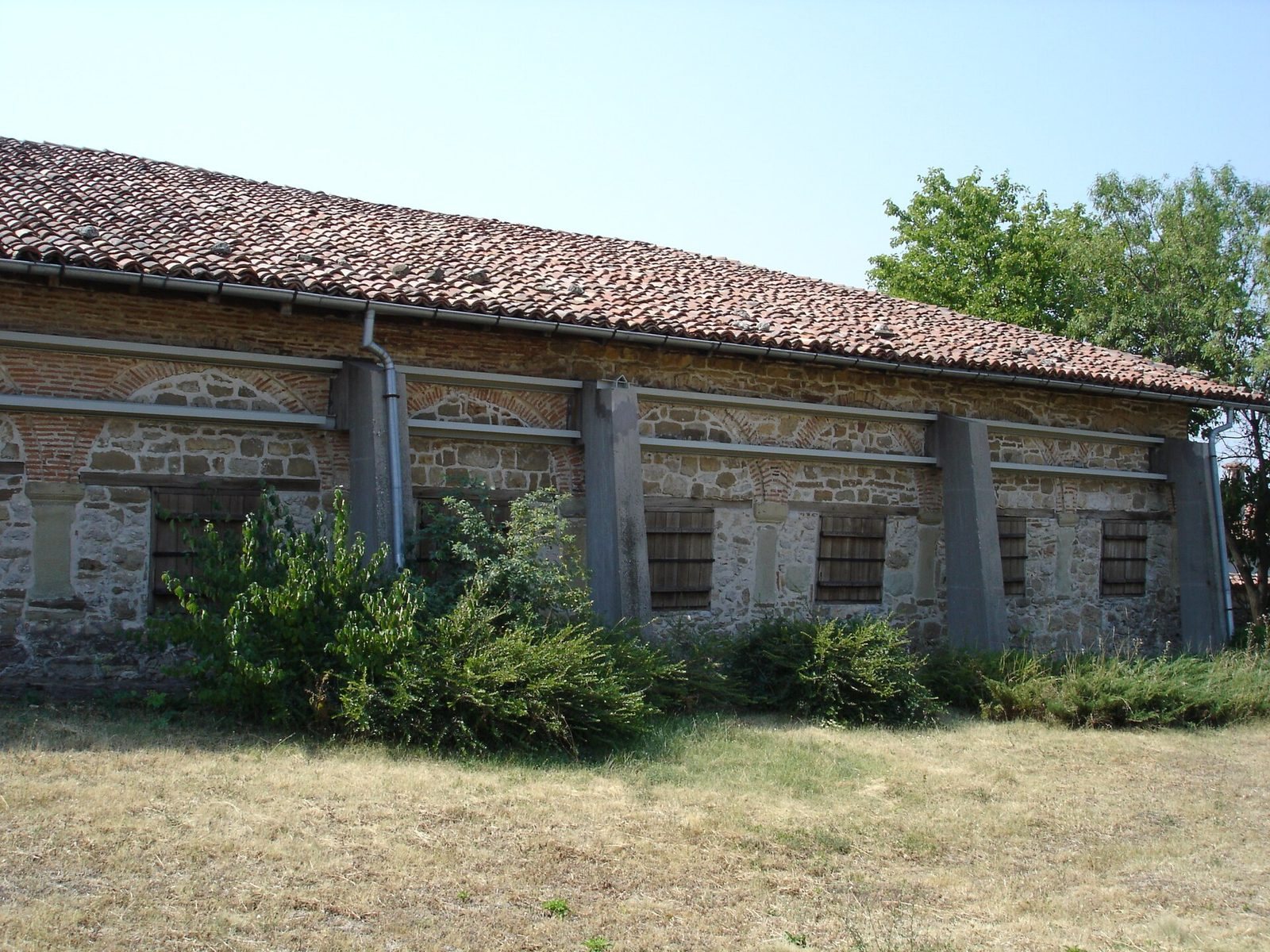
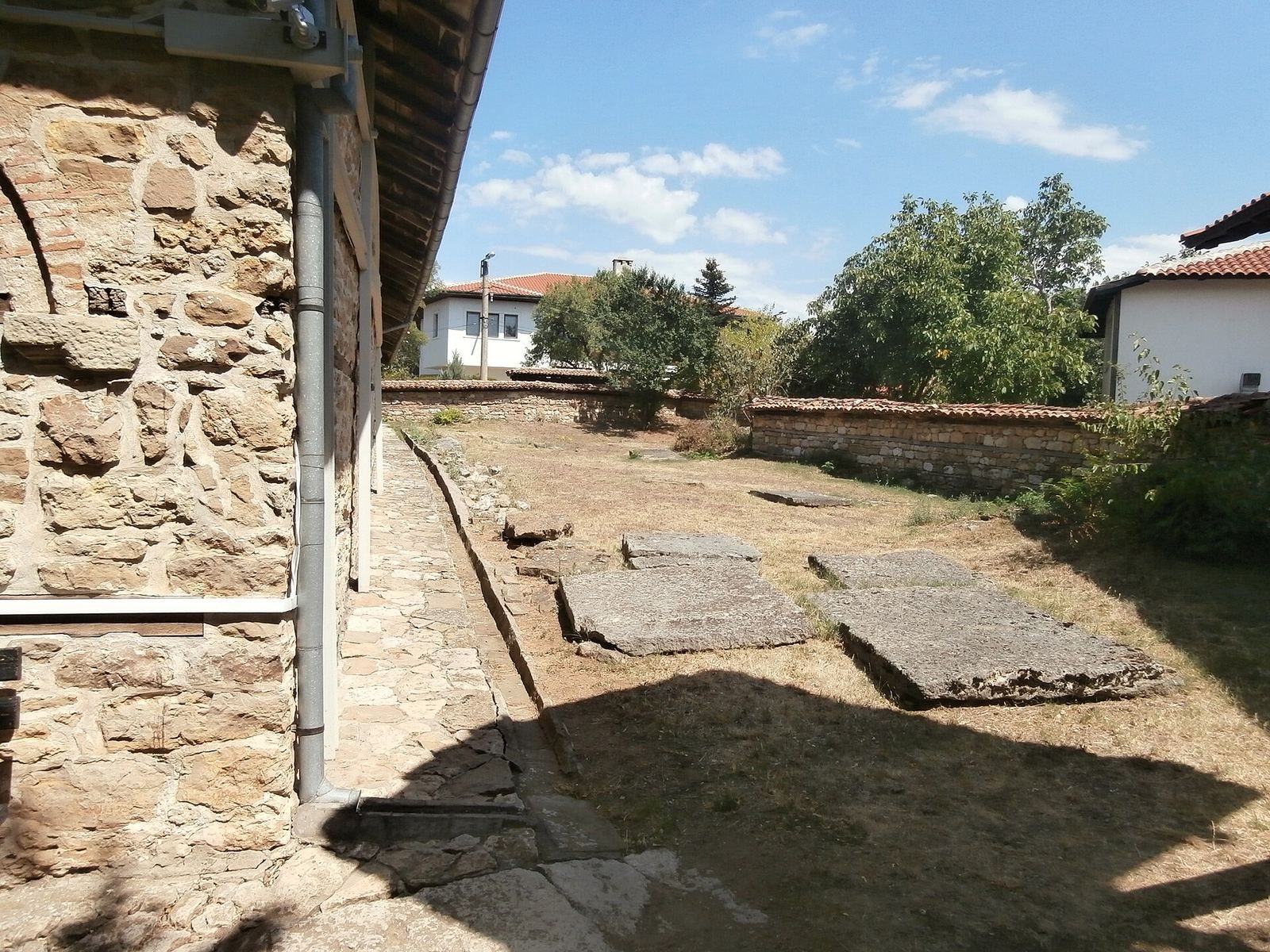
Situated in southwestern Arbanasi, the stone church measures 28.80 by 10.40 metres. Its altar, naos and narthex follow an east-west axis; the north chapel is joined to them by the L-shaped gallery. The earliest church was a single-nave building with a barrel vault, a curved ceiling shaped like a half-cylinder, and its footprint corresponds to the present naos. The current building has a tiled roof with three sloping planes. At the east end, a recessed apse rises to about half the height of the eastern facade and has its own roof. Four windows pierce the south wall. Decorative blind arcades, rows of arches that do not open through the wall, cover about two-thirds of the north wall and all of the west wall. The symmetrical west facade has a central entrance and a patronal niche above it. Reinforced-concrete supports and a metal tie strengthen the north wall, which had begun to lean outward.
Painted interiors
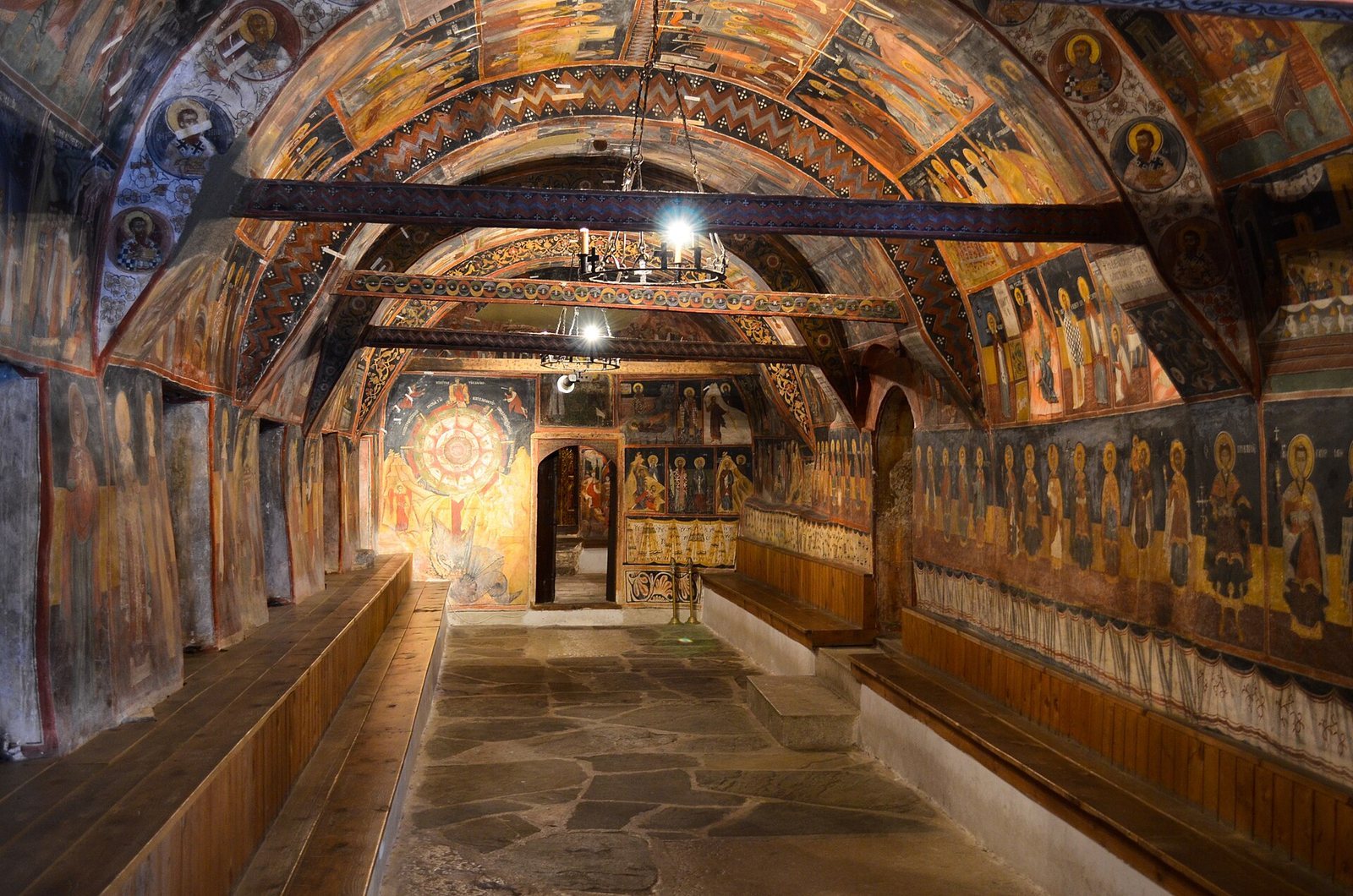
Frescoes cover the church’s interior, with more than 3,000 figures across the painted decoration. The surviving images span the naos, narthex, chapel and gallery, and include scenes from Christian scripture, saints’ lives and symbolic compositions.
Naos
Fragments of the earliest paintings in the naos include images of St Theodore Tiron and St Theodore Stratelates. In the apse, the painted program includes a half-length Virgin Mary in the Platytera type, an image of the Virgin, together with the Eucharist and the Melismos, a depiction of the Eucharistic offering. The north and south walls show warrior saints Demetrius, George and Nestor, as well as healing saints Cosmas and Damian, Panteleimon and Tryphon. Above them, medallions containing saints’ busts form a horizontal band, followed by two bands of scenes from Christ’s feasts, Passion and miracles.
The west wall presents the Transfiguration above a large Dormition of the Virgin, with the Nativity of Mary and her Presentation in the Temple alongside it. Constantine and Helena, St Kyriaki and St Paraskeva appear below. The curved ceiling depicts Christ Emmanuel, meaning “God with us,” Christ Pantokrator, or Christ as ruler of all, and the New Testament Trinity, a Christian image of the Trinity. The Dormition and scenes from Christ’s life on the south wall date to 1681. An elaborate carved wooden iconostasis, the screen separating the sanctuary from the main worship space, stands in the naos. The Kantakouzene family, a prominent Byzantine aristocratic family, commissioned it in the eighteenth century.
Narthex
The narthex’s north wall carries a Jesse tree, an image tracing Jesus’ genealogy through Jesse, the father of King David. Jesse appears at its roots, while branches bear Old Testament prophets and kings, episodes from the lives of Mary and Christ, and figures holding scrolls. The lower part also includes ancient rulers and thinkers: Solon, an Athenian lawgiver; the philosophers Pythagoras, Socrates, Aristotle, Plato and Plutarch; and Homer, an ancient Greek poet. Some figures have halos, and some are paired as if debating. The west wall shows scenes from Mary’s life. Both wall paintings date to 1638, and an inscription above the doorway leading to the gallery gives the date of the narthex paintings.
North chapel
The chapel’s 1632 frescoes depict St John the Baptist and episodes from his life, including the Visitation of Mary to St Anne, John’s birth and baptism, and his beheading. Its iconostasis, the screen separating the sanctuary from the main worship space, dates to 1649.
Gallery
Painted between 1643 and 1649, the gallery frescoes include scenes from Genesis, the creation of Adam and Eve, and imagery associated with the seven deadly sins. On the east wall between the gallery and chapel, a Wheel of Life completed in 1649 depicts human existence from birth to death and the fleeting nature of earthly life. Eight stages in a man’s life encircle the wheel; a ninth figure is consumed by a hellish creature, and twelve zodiac signs occupy an inner circle. The accompanying inscription reads, “I was not, I did not exist.” The fresco inscriptions are in Greek.