Seefin Passage Tomb: A Neolithic Burial Monument in County Wicklow
Site at a Glance
- Popularity
- Medium
- Country
- Ireland
- Primary era
- Stone Age
- Eras represented
- Stone Age
- Civilizations
- Unclassified
- Site type
- Burial
- Remains
- Tomb
On this page8 sections
History
Seefin Passage Tomb is a burial monument whose chamber is reached by a passage, on the summit of Seefin in Scurlocksleap, County Wicklow, Ireland. It was built around 3300 BC during the Neolithic, the later Stone Age associated with the spread of farming, and is Ireland’s southernmost passage tomb. The form is especially characteristic of Northern Ireland and the northern part of the Republic of Ireland, which together have 219 examples; passage tombs also occur in Leinster, Munster and, in smaller numbers, Britain.
Neolithic construction and upland landscape
Seefin and Seefingan cairns were built on the original ground surface before peat began to develop in the area, around three to four thousand years ago. Pollen from soil cores taken on a saddle between the hills shows a decline in elm and pine, followed by the appearance of plantain. This sequence has been interpreted as evidence of tree clearance and farming on upland ground before the present bogs formed. At the time, a milder climate and thin mountain soils supported sparse woodland that was easier to clear than the swampy, wooded lowlands.
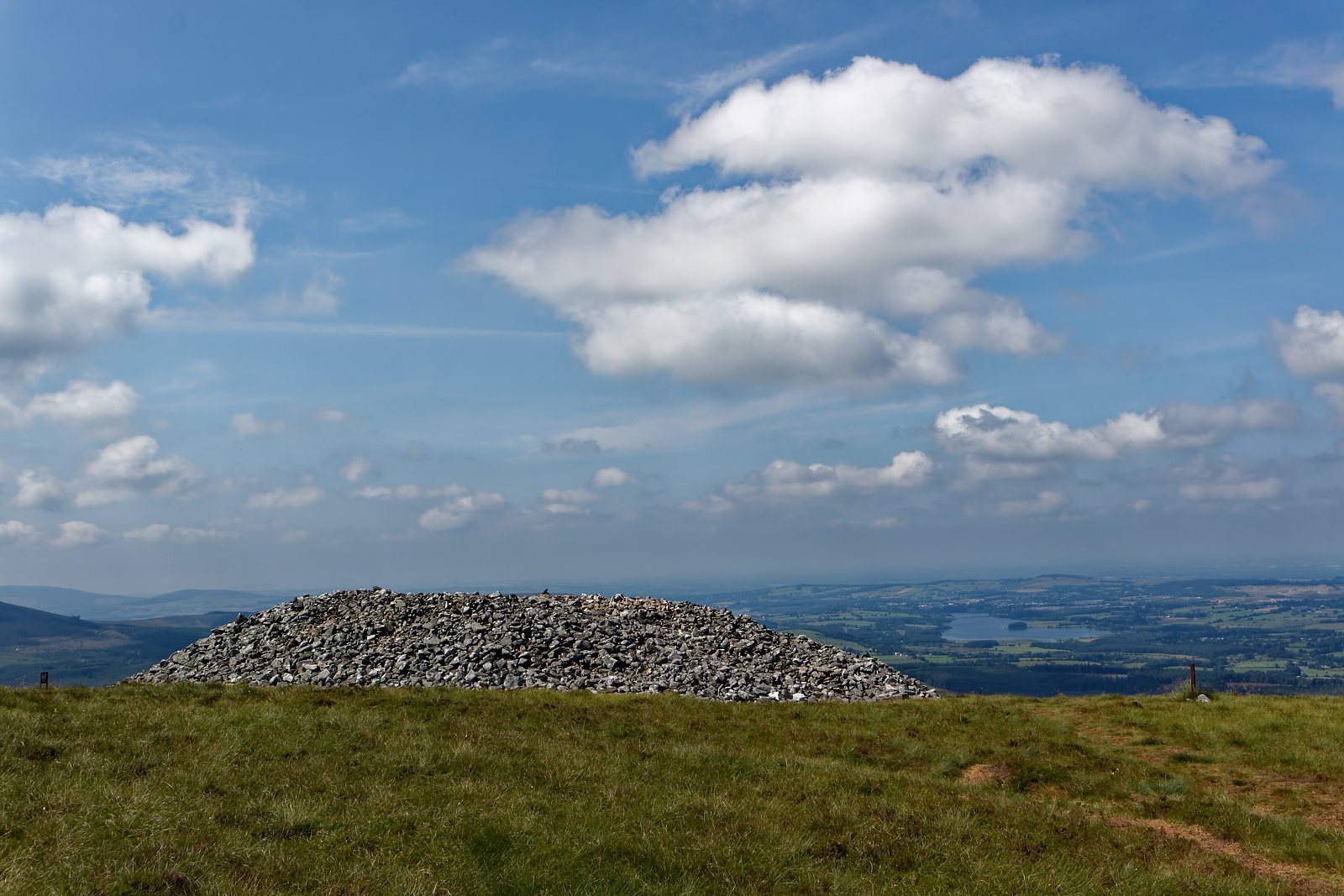
A spring just below Seahan’s summit and a further water source beneath peat near Seefin were considered possible supplies for Neolithic farmers living on the hills. The source near Seefin was identified through water divining. One interpretation proposes that communities lived on the mountaintops, with dwellings grouped around burial monuments. The tombs across the Dublin Mountains have also been interpreted as a widely spaced cemetery landscape. Their summit locations made them visible from the lowlands and other mountain tops, and Seefin’s summit offers a 360-degree view.
Excavation and protection
Irish archaeologist R. A. Stewart Macalister excavated the tomb in 1931, removing loose stones that blocked the original entrance passage. P. T. Walshe and L. Price were also involved in excavations during the 1930s, and the tomb was excavated again in the 1990s. Seefin is protected as an Irish National Monument, a monument safeguarded under national heritage law.
Remains
The tomb stands about 621 m above sea level on Seefin in the Wicklow Mountains. Its rubble-stone cairn contains a narrow passage running roughly north into a chamber. Cairns also crown nearby Seefingan and Seahan, while prehistoric monuments are grouped around Seefin Mountain and Sorrel Hill.
Stone structure and decoration
Cairn
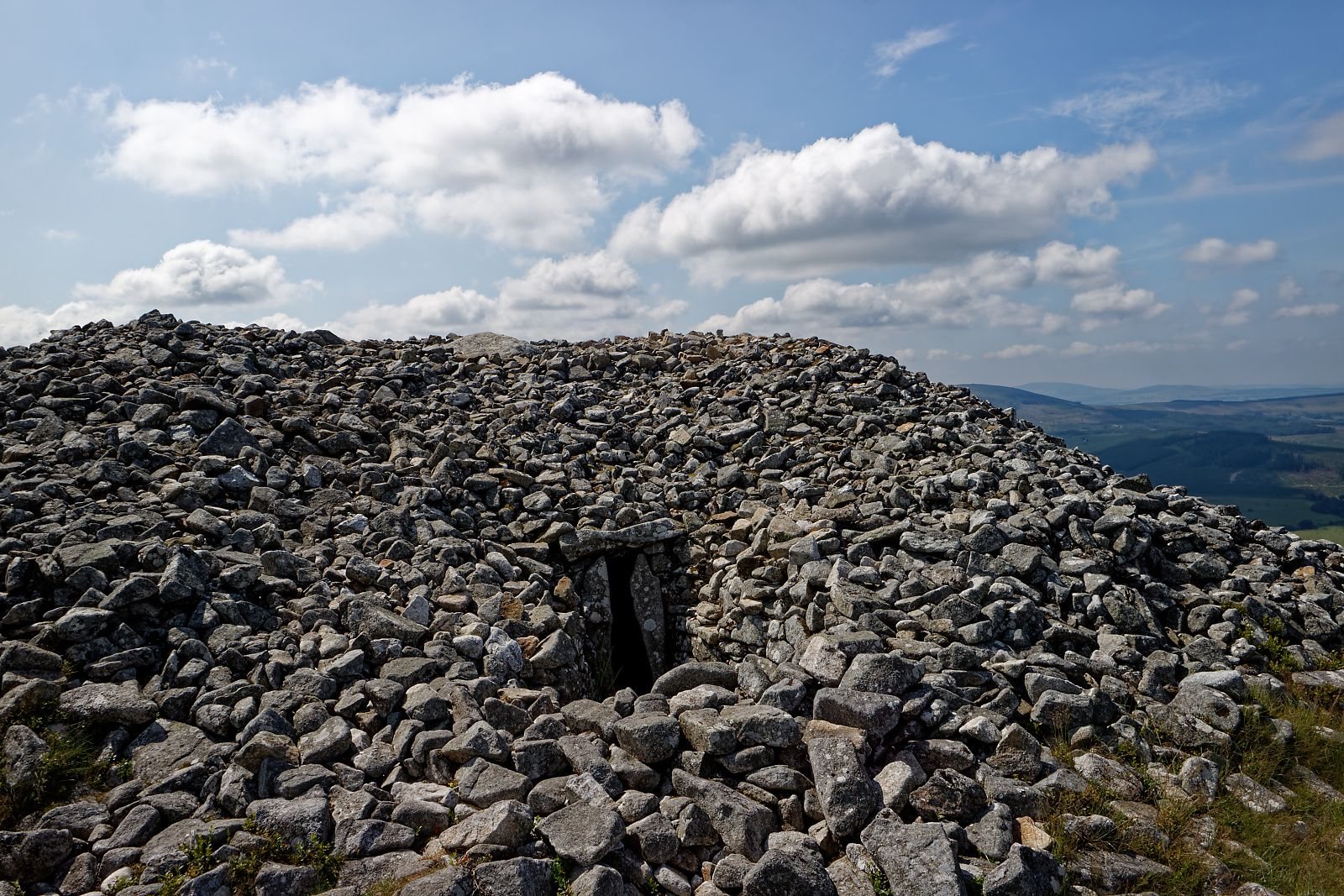
The cairn is about 24 m in diameter and 3 m high. Large kerb stones almost encircle its base. A description from 1877 gave the cairn’s circumference as about 100 yards and its height as roughly 20 feet, and noted a deep surrounding ditch, an outer circle of edge-set stones and smaller stones piled within.
Passage and chamber
The passage is about 7 m long and set at an angle as it leads roughly north into the chamber. The chamber measures about 4 m in length, widening beyond the passage before narrowing towards a niche at its far end. It has four side recesses; upright sill stones separate the western recesses from the main chamber. A triangular depression, about 2.15 m long and 1.2 m deep, lies where the passage meets the chamber. In 1877, the central opening was described as leading to a chamber about 12 feet long, roofed with overlapping flat stones. The large stones were roughly fitted together, and part of the roof had collapsed.
Roof and carved stones
The chamber’s corbelled roof is incomplete. This type of roof is formed by stones laid in courses that project inward towards the top, rather than by a true arch. Cairn material has partly fallen into the head niche. Two stones at the entrance carry concentric diamond-shaped designs, while two chamber stones have concentric motifs resembling human faces. A capstone near the entrance bears five lines. Other decoration includes lozenges and lines, as well as quartz; an early Christian cross is cut into one of the capstones.