Frösö Runestone: A Memorial to Jämtland’s Christianization and a Bridge
Site at a Glance
- Popularity
- Medium
- Country
- Sweden
- Primary era
- Medieval
- Eras represented
- Medieval
- Civilizations
- Norse
- Site type
- Civic
- Remains
- Monument
On this page5 sections
History
The Frösö Runestone is a Viking Age monument on Frösön in Sweden, dated to 1030–1050, that commemorates the Christianization of Jämtland and the construction of a bridge.
Christianization and inscription
The inscription makes Jamtaland, an early name for Jämtland, the land whose Christianization it commemorates. Its reference to the conversion of a territory differs from the Jelling Stone, a Danish runestone that refers to the Christianization of a people. The inscription provides the earliest known use of the name Jamtaland for Jämtland. The Frösö stone is Sweden’s northernmost erected runestone and Jämtland’s only surviving Viking Age runestone.
The text credits Austmaðr with having the stone raised, the bridge built, and Jamtaland Christianized. It identifies Austmaðr as Guðfastr’s son and separately names Ásbjörn as the bridge-builder. An alternative reading divides the sequence Guðfastar as “gode Faste,” giving the sense “Austmaðr gode, son of Faste.” Gode was a title for a pre-Christian Norse sacrificial priest, who could also lead legal proceedings.
The closing words are popularly understood as “Guard these runes.” That translation relies on a verb considered unattested in Viking Age Old Norse, a medieval North Germanic language, and probably borrowed from late medieval Low German. The native Old Norse verb for “guard” is varða.
Relocation
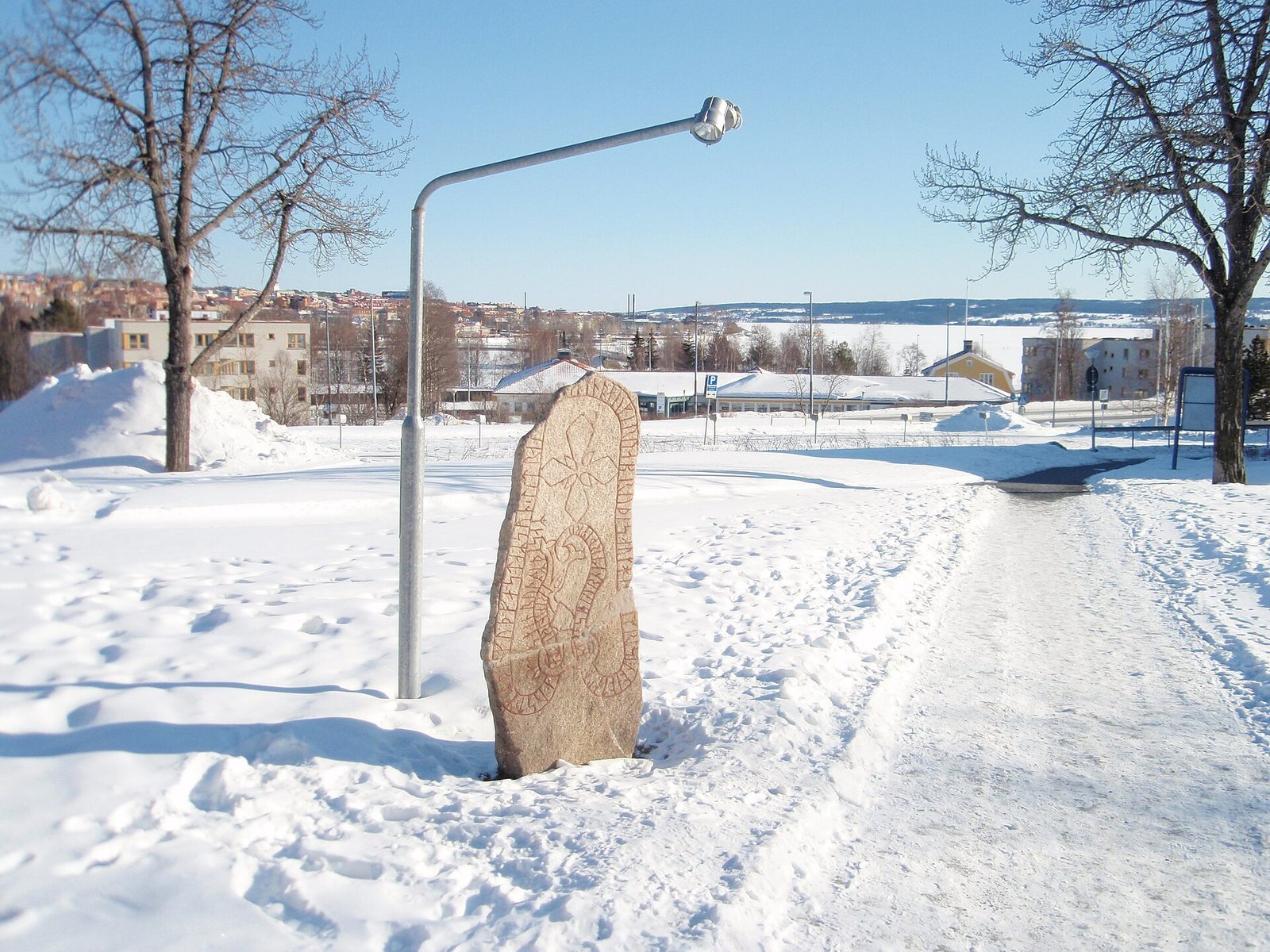
The stone originally stood at Frösön’s eastern tip, beside the waterway between the island and Östersund. Construction of a new bridge and traffic link led to its relocation, about 100 metres from its original position, between 1969 and 1971.
Remains
Inscription and carved stone
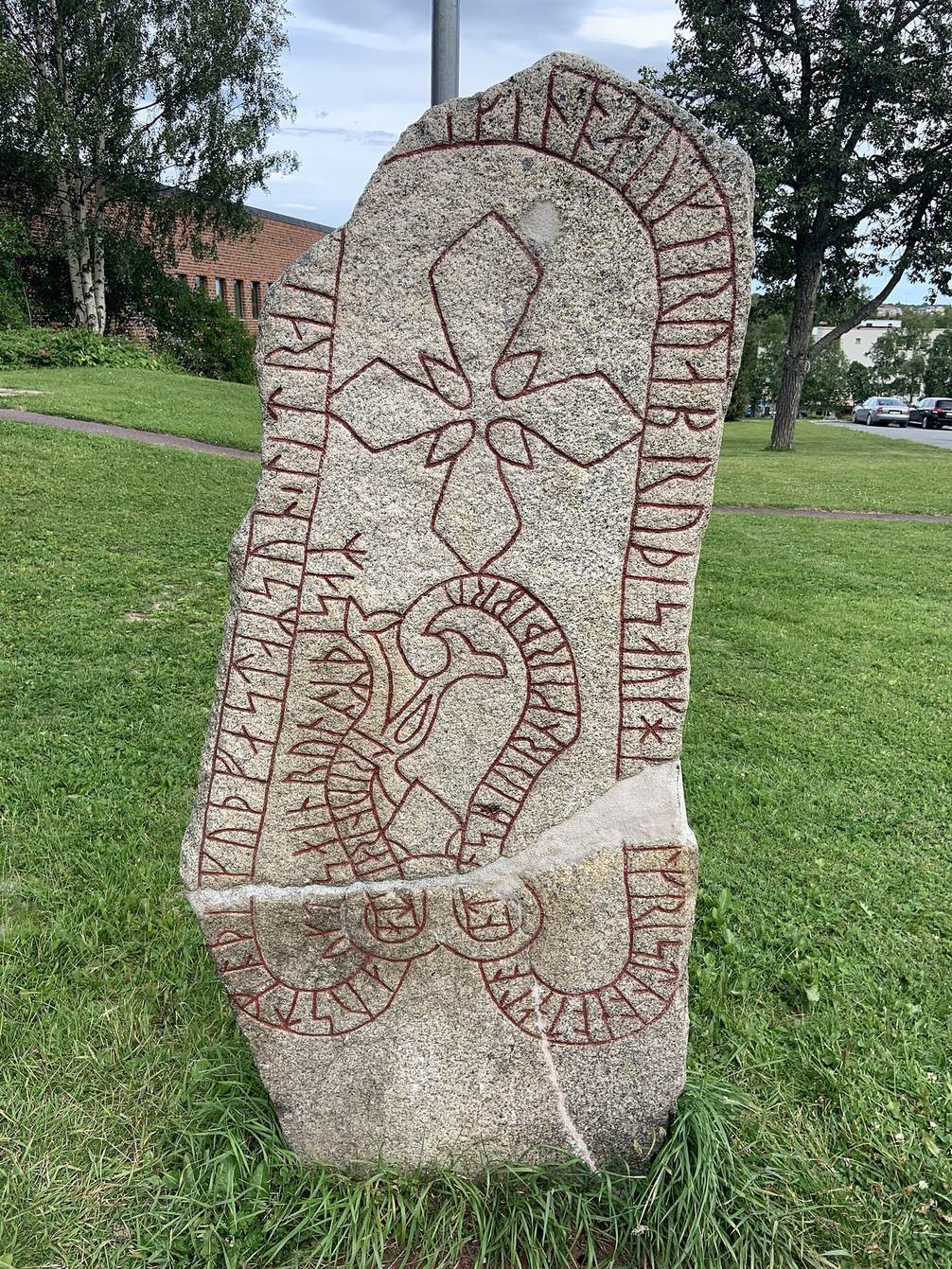
The inscription is arranged in a loop, with its beginning and end overlapping. The carving is classified as Urnes style, a late Viking Age Scandinavian style of animal ornament. Its runes follow Swedish tradition and include regional forms associated with Jämtland. The language combines West Norse and East Norse features; it has been classified as Old Norwegian or Old Swedish, historical regional varieties of Old Norse, and more recently as Old Jamtish or run-Jamtish, a regional form associated with Jämtland. Trjónn and Stainn are named as the carvers. Stainn’s runic spelling, tsain, has also been interpreted as Sven. The stone broke across the middle during its relocation, leaving a visible crack.