Holy Trinity Church in Prievidza: A Baroque Piarist Church
Site at a Glance
- Popularity
- Medium
- Country
- Slovakia
- Primary era
- Early Modern
- Eras represented
- Early Modern
- Civilizations
- Habsburg, Hungarian
- Site type
- Religious
- Remains
- Church
On this page14 sections
History
Piarist foundation and first church
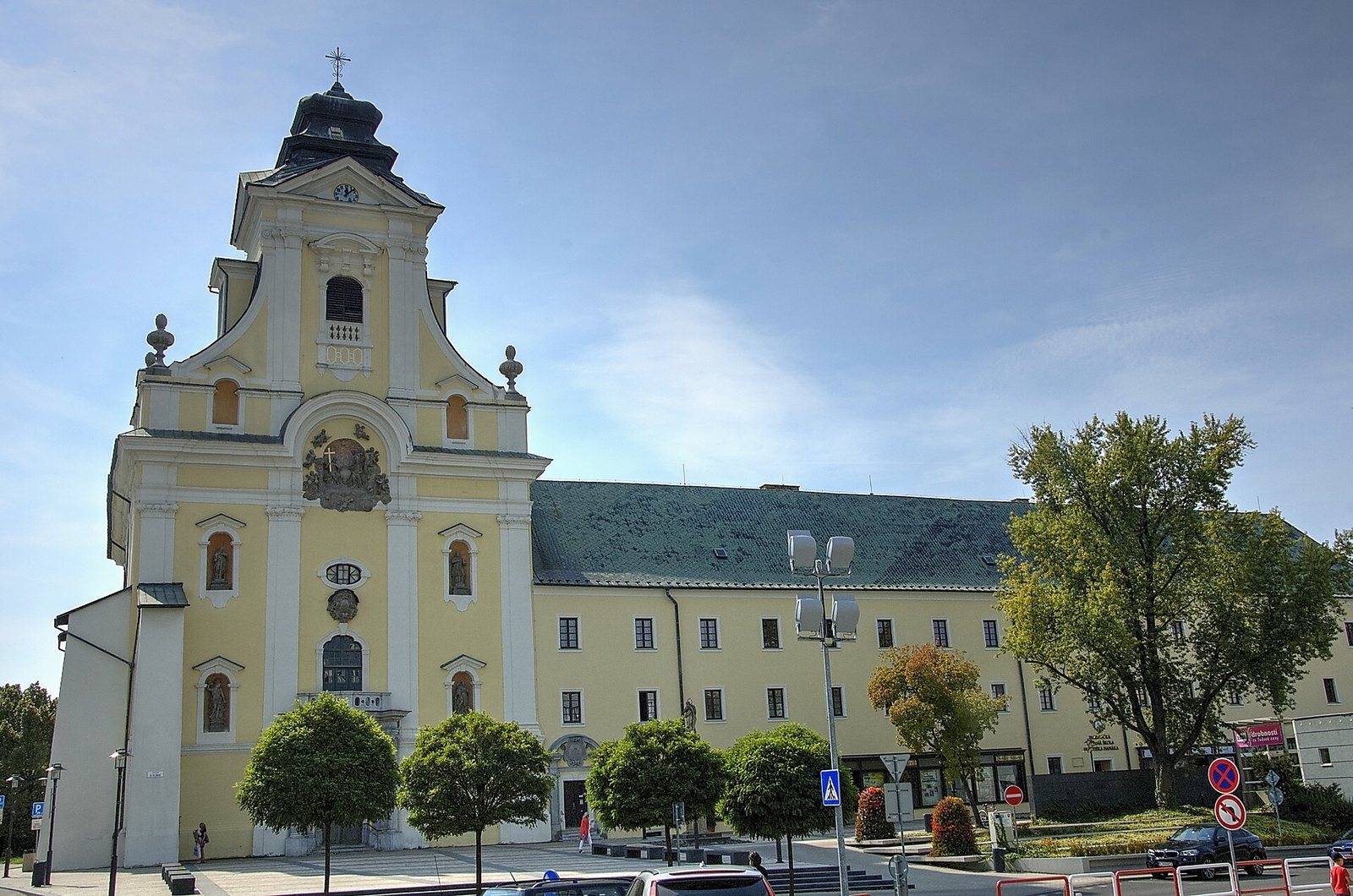
Holy Trinity Church in Prievidza is a Roman Catholic Piarist church in Slovakia, built in Baroque style between 1743 and 1750. It is the youngest of the town’s three historic churches. The Piarists, a Catholic order devoted to educating children and young people, dedicated it to the Holy Trinity, the Christian belief in one God as Father, Son, and Holy Spirit, and the Assumption of the Virgin Mary, the belief that Mary was taken into heaven. The church belongs to the Diocese of Banská Bystrica, the Prievidza deanery, and the Prievidza Town parish.
Piarists arrived from Poland in early 1666 at the invitation of Countess Franciszka Pálffy, a member of a prominent Hungarian noble family. Their foundation charter was drawn up on 17 February that year, and construction of their first church began in 1666. It was completed in 1676. As the building no longer suited the order’s needs and educational work, it was almost entirely demolished between 1740 and 1743. Its former main altar was transferred to the Piarist church in Kecskemét.
Rebuilding and completion
The Piarists replaced the earlier church with the present building. Piarist builder Hyacint Hangke directed the work and probably designed the church. Ignác Peter Götz set out the foundations and supervised the masons. Hangke sought funds by visiting Piarist provinces in Central Europe and noble residences. His building diary notes payments to workers and artists, as well as expenses for materials, transport, food, medicines, tools, and hospitality. Its entries also indicate that local worshippers contributed some labor without pay.
Paul Révay, an auxiliary bishop who assisted the principal bishop of Esztergom, consecrated the church on 19 August 1753, while its decoration was still incomplete. Work on the furnishings continued for another 18 years. The church became a Slovak National Cultural Monument on 31 October 1963.
Remains
The stone-built church stands in Prievidza’s Old Town, at the western end of Hviezdoslavova Street, with the former Piarist monastery adjoining it. Its long, single-nave plan has a narrower, south-facing sanctuary end, a polygonal termination, and shallow side chapels. The building combines a domed sanctuary with a three-bay main body and an elaborate Baroque exterior and interior.
Plan and exterior
Church plan
The main body has a curved ceiling divided into three bays, with crescent-shaped sections set into the vault. Massive square supports project into the interior and finish in prominent cornices. A dome covers the sanctuary, whose form and arrangement of side chapels draw on Il Gesù, a Jesuit church in Rome that became an influential model for church design.
Main façade and exterior sculpture
The main façade is arranged in three sections by shallow vertical strips resembling columns. A triangular gable crowns it, and a short, square tower rises above, capped by a low, flattened bulb-shaped roof. A sculpted group at the centre represents the Holy Trinity. Niches on either side hold figures of St Sebastian, St Roch, St Charles Borromeo, St Aloysius Gonzaga, St Glycerius, and St Ignatius of Loyola. The tower’s framed niches contain St Matthew and St John, two of the Gospel writers. A statue of Our Lady of Mount Carmel, a title of the Virgin Mary, stands above the former east entrance.
Interior decoration and altars
Sanctuary and painted decoration
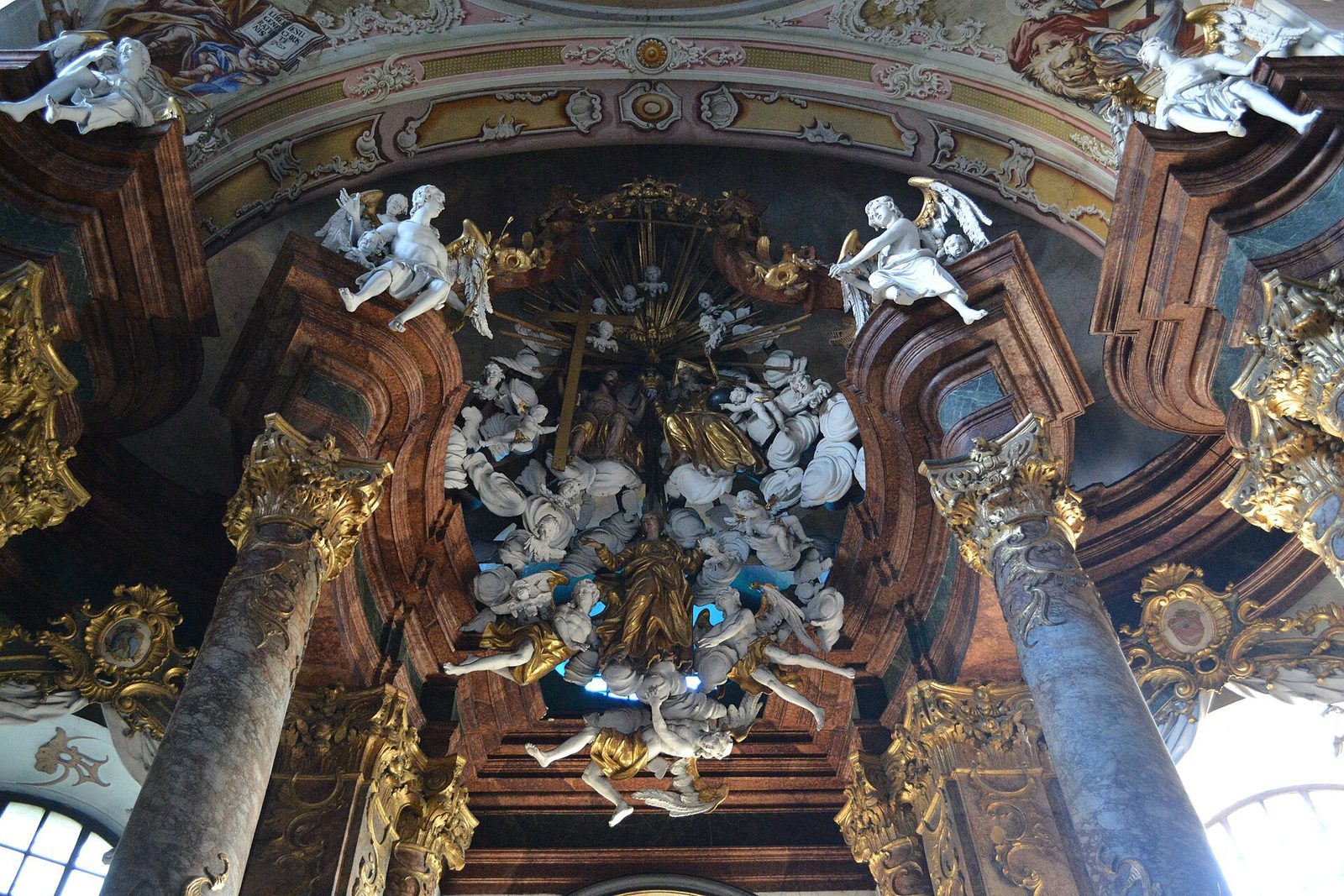
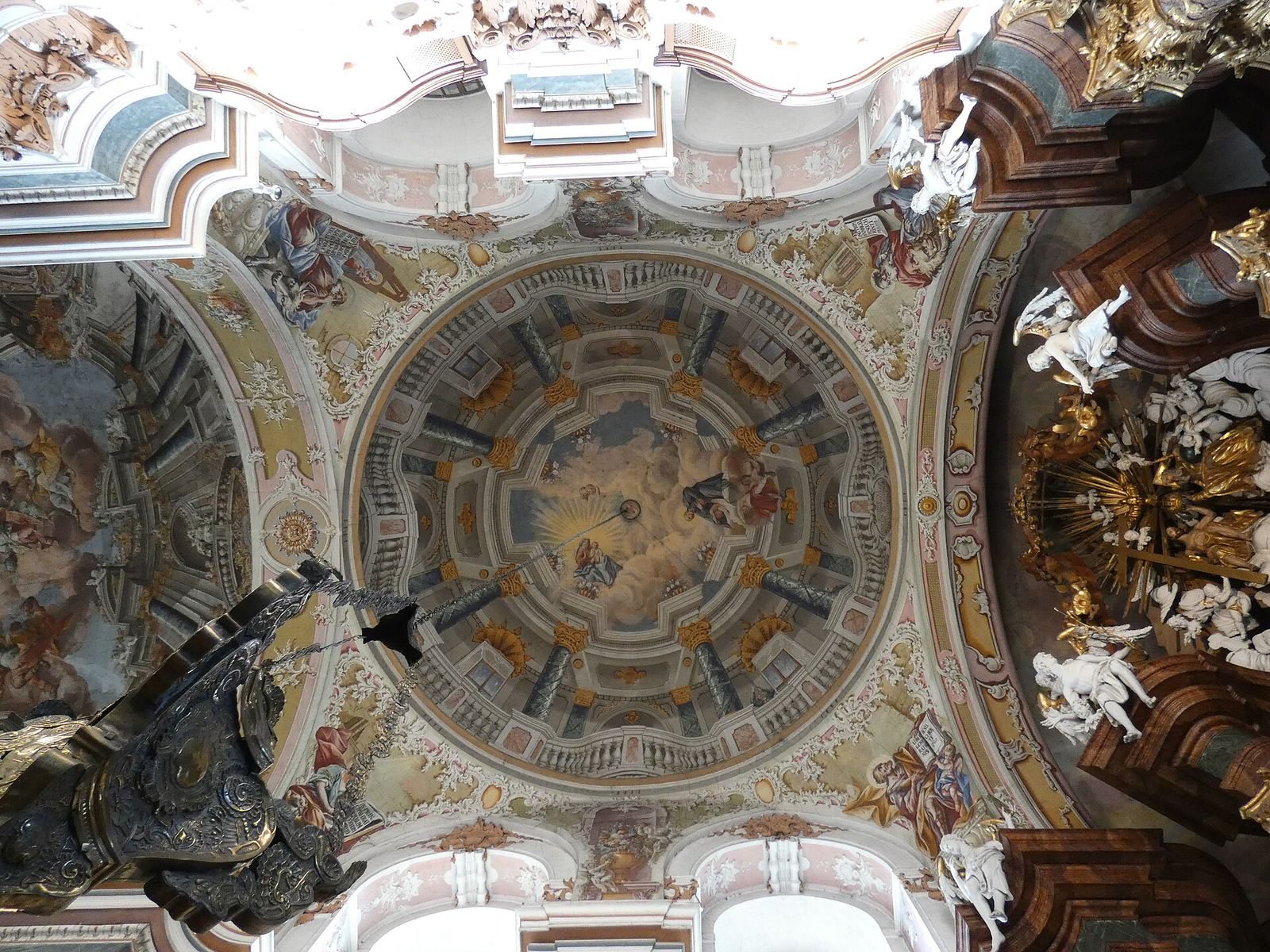
The main altar stands beneath the dome. Marble columns frame a painting of the Assumption, above which a sculptural group shows the apostles around Mary’s empty tomb as she is taken into heaven and crowned by the Trinity. The dome’s painting depicts St Joseph Calasanz exalted into heavenly glory. Its subject reflects his beatification by Pope Benedict XIV in 1748. Painted columns and a balustrade create an architectural setting, while an inscription gives the Piarist motto: “Those who teach many will shine like stars forever.” Figures beside the windows represent four early Christian theologians: St Gregory the Great with a papal tiara, St Ambrose with a bishop’s staff, St Jerome with a Bible, and St Augustine with a flaming heart.
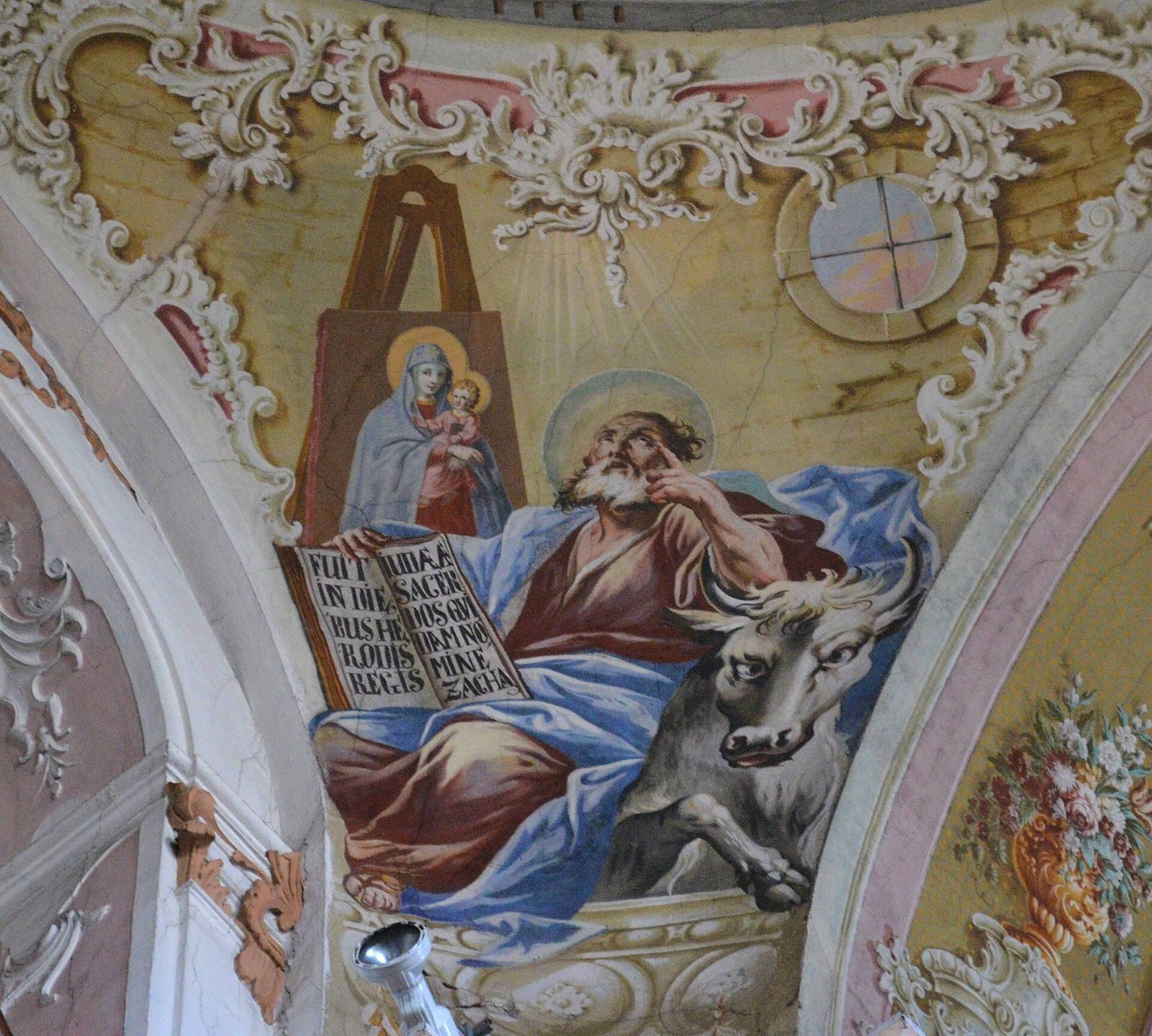
Elaborate plaster ornament in Rocaille, a style of decorative forms that are often asymmetrical, covers the interior. Painted decoration in the sanctuary vault, dated 1750–1765, is attributed to J. A. Schmidt. The painting over the nave is dated 1783 and attributed to the Viennese artist J. Š. Bopovský. The identification is uncertain because Ján Štefan Bopovský Bojack, named in connection with the church’s paintings, died in 1753. Bopovský is also credited with paintings on the side altars.
Nave ceiling
The nave ceiling depicts a scene from the Apocalypse of St John, the Book of Revelation. Twenty-four figures wearing golden wreaths and carrying censers adore a radiant lamb, representing Jesus Christ. Eight subtle ochre paintings where the vault rises from its supports show miracles in the life of Joseph Calasanz that were examined during his canonization process.
Side altars
The side altars combine paintings and sculpture. The altar of Our Lady of Mount Carmel was probably accompanied by a statue of St Simon Stock. At the Holy Family altar, the archangels Michael and Raphael appear with a sword and a small dog respectively. The altar of St John of Nepomuk includes St Paul holding a New Testament and St Matthew with a money bag. At the rear, the altar of the Fourteen Holy Helpers, a group of saints invoked for aid, especially in illness, has figures of St Agnes with a lamb and St Apollonia with pincers.
Other altars are dedicated to the Sacred Heart of Jesus, the Crucifixion, St Joseph Calasanz, and patrons invoked against plague. The Sacred Heart altar includes Ecclesia, an allegorical figure representing the Church, holding the Eucharist; angels accompany the Crucifixion altar. At the altar of Joseph Calasanz, St Dominic holds a Bible and St Joseph carries a lily. The altar associated with protection against plague has statues of St Cosmas and St Damian, ancient physician saints.
Sculpture, heraldry, and materials
Carving and commemorative details
Dionýz Ignác Stanetti produced the church’s sculptural decoration over more than twenty years. Above the stairs descending to the crypt, a crowned Piarist monogram means “Mary, Mother of God.” Opposite it, above the choir, the Pálffy family arms show a deer with a broken wheel, recalling the family’s support for the foundation. Coats of arms and inscriptions on marble cladding also identify benefactors who gave funds for side altars.
Building materials
Materials came from a wide area. Timber was obtained from Čausy, the Bojnice estate forests, Cigeľ, Topoľčianky, Brezno, and Moravia; stone came from Necpaly, Hradec, Hlboké, and Handlová. Marble was quarried near Nitrianske Sučany, bricks came from Cigeľ and Valaská Belá, and sand from Orava. Paint and painters’ supplies were brought from Kremnica and Vienna.