Bryn Celli Ddu Chambered Tomb: A Prehistoric Passage Tomb on Anglesey
Site at a Glance
- Popularity
- High
- Country
- United Kingdom
- Primary era
- Bronze Age
- Eras represented
- Stone Age, Bronze Age, Modern
- Civilizations
- Unclassified
- Site type
- Burial
- Remains
- Tomb
On this page14 sections
History
Bryn Celli Ddu Chambered Tomb is a prehistoric passage tomb near Llanddaniel Fab on Anglesey, Wales, United Kingdom, built around 2000 BC after an earlier henge occupied the site. A passage tomb is a burial monument with a chamber reached by a passage, usually beneath a mound. The site’s sequence includes an earlier enclosure, deliberate damage to its stones, and repeated burial use. Bryn Celli Ddu means “the mound in the dark grove.”
Early activity and the henge
Five postholes mark the earliest identified activity, around 4000 BC. Radiocarbon dating of pine charcoal from two of them, carried out in 2006, placed this phase about a thousand years before the next known activity. The purpose of the postholes is unknown.
Around 3000 BC, people built a henge, a prehistoric enclosure formed by a bank and ditch and often associated with ritual activity. About a thousand years later, the site was transformed into a passage tomb. All but one of the henge’s standing stones were deliberately damaged. Some were toppled, while six were smashed with heavy stones.
Passage tomb and burial
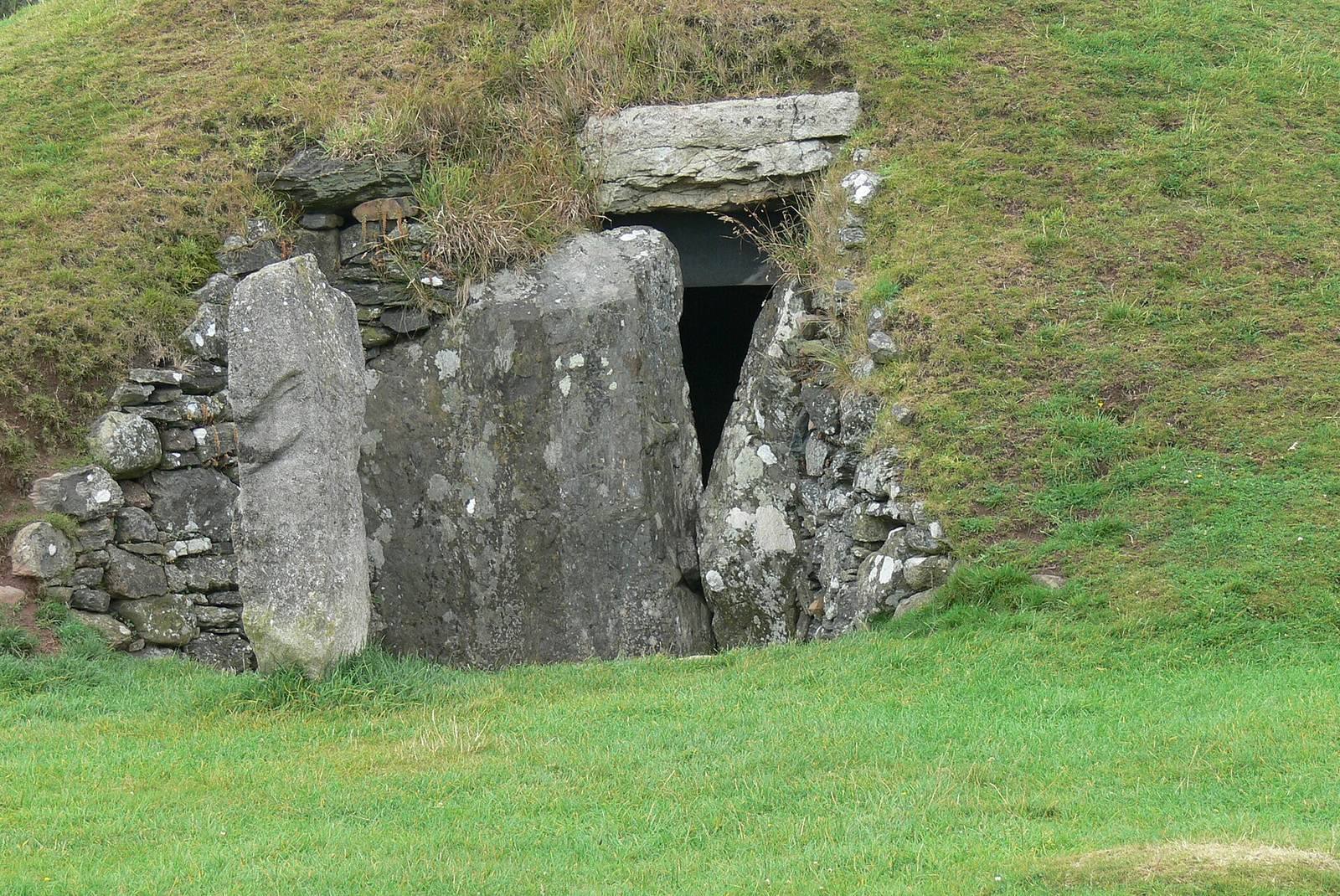
The tomb was used repeatedly for burials. As it was reused, human remains were moved aside within the chamber. When the tomb’s use ended, a large stone was placed across the entrance between the entrance stones, closing it.
Antiquarian records and excavation
The monument appeared on a list of Anglesey cromlechs, a Welsh term for prehistoric stone tombs or monuments, in 1796. John Skinner, an English clergyman and antiquarian, visited in 1802. He was told that a farmer had found the tomb a generation earlier while seeking stone for reuse. The farmer later returned in hopes of finding treasure and uprooted the pillar. Skinner’s account was published in 1908.
In 1906, the astronomer Norman Lockyer proposed that the passage marked the summer solstice. Wilfrid James Hemp excavated the tomb in 1928 and 1929, after movable stones had been taken away. His work revealed much of the site’s sequence of use. The pillar was re-erected and the mound reinstated; concrete supports for the roof were added later.
Modern interpretations and landscape research
Research by Christopher Knight and Robert Lomas in 1997 and 1998 supported the solstice interpretation. They also suggested that alignments at other times of year could have served as an agricultural calendar. Steve Burrow, curator of Neolithic archaeology at the National Museum of Wales, later supported the solstice interpretation.
From 2015 to 2020, Cadw and Manchester Metropolitan University worked together on the Bryn Celli Ddu Public Archaeology Project, with local-community involvement in investigations of the wider landscape. The Anglesey Druid Order also uses the site for ceremonies marking the eight festivals of the Wheel of the Year, a cycle of seasonal celebrations in modern pagan traditions, including the solstices. Bryn Celli Ddu is a Scheduled Monument, a historic or archaeological site protected under UK heritage law, and is in Cadw’s care, the Welsh Government’s historic-environment service.
Remains
The central monument brings together a passage tomb and the surviving traces of an earlier circular henge. Other prehistoric features extend across the nearby ridge and fields.
The passage tomb and mound
Passage and chamber
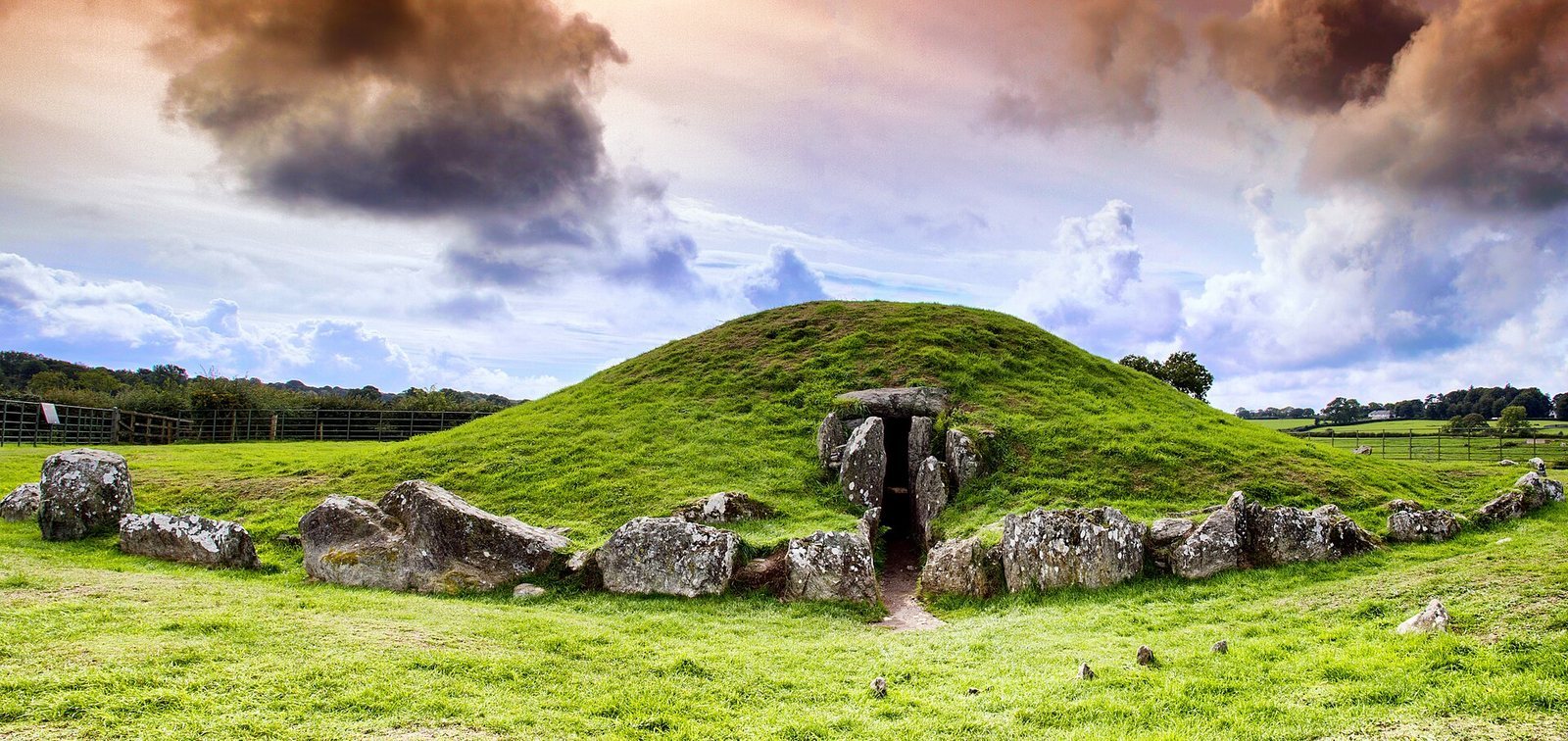
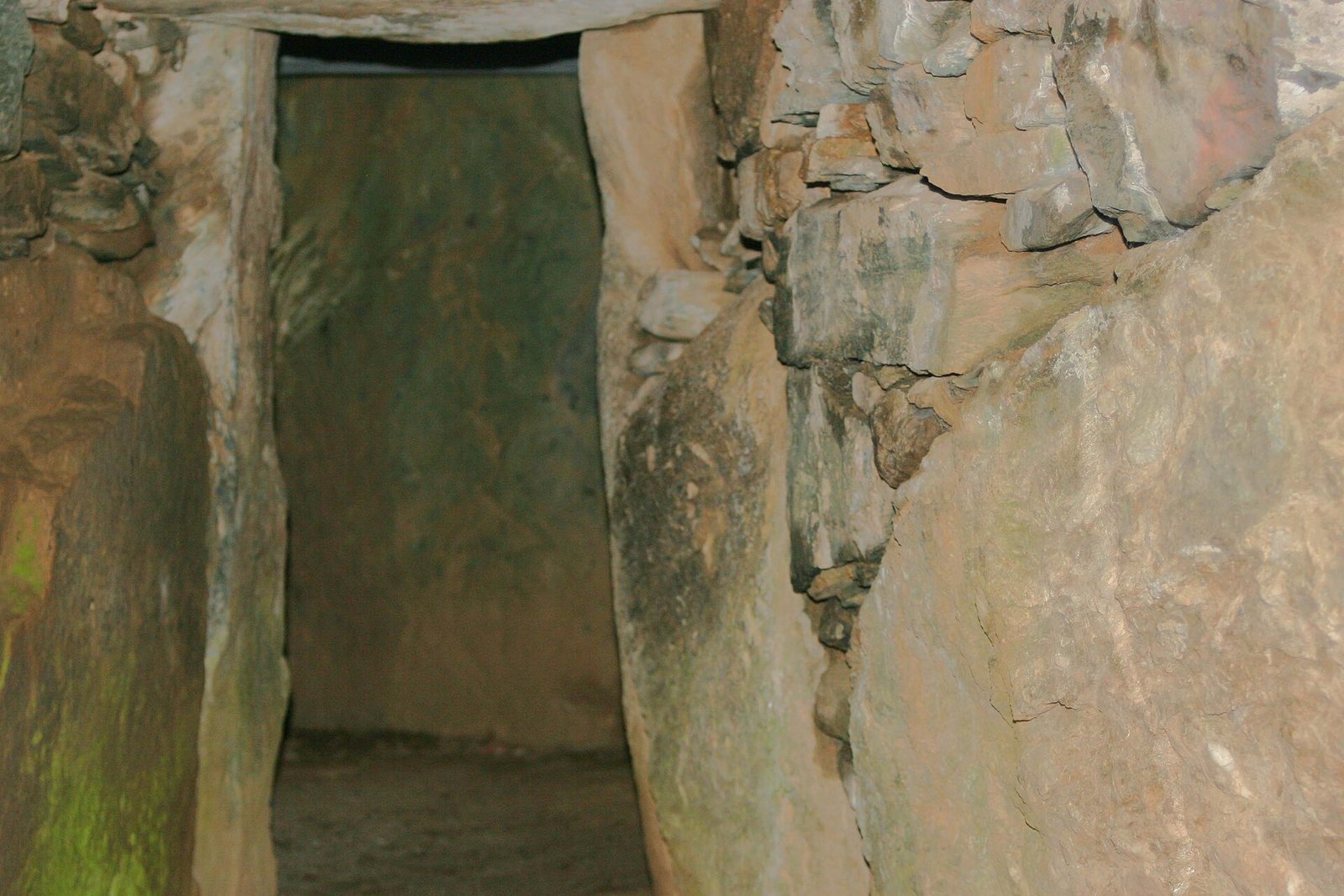
The passage is 8.4 metres long. Its first 3.4 metres are open to the sky and framed by two entrance stones. Beyond them, vertical stone slabs form the passage walls, with stone roof slabs above. The complete passage and burial chamber lie beneath a reconstructed mound, which leaves the chamber’s rear wall exposed. A smooth, rounded pillar about two metres high stands inside. It is made of blueschist, a metamorphic rock formed under high pressure and relatively low temperatures; the idea that it was a petrified tree trunk was superseded by this identification. Burnt and unburnt human bones were found in the passage and chamber. The passage roughly faces the summer-solstice sunrise, and for several weeks around that date sunlight can reach the chamber’s rear wall.
Mound and henge remains
The original stone mound, or cairn, was about 26 metres across. A complete ring of kerbstones, stones marking a mound’s perimeter, followed the line of the earlier henge ditch. The surviving stones indicate the mound’s original extent. Three stones now visible within it are thought to have come from the henge’s stone circle. The circular henge boundary measured about 21 metres across. Its ditch survives, and inside it stood an oval ring of 17 stones, many arranged in pairs on either side of the centre. Cremated human remains were placed at the base of some stones. A pit within the enclosure held a single human ear bone beneath a flat stone slab.
Carved stones
Pattern Stone and spiral carving
The Pattern Stone was found buried beneath the mound. Its flowing, snake-like designs cover both sides. The original is now at the National Museum of Wales, while a replica stands beyond the chamber’s rear wall, within the area of the original mound and near the reported findspot. Its position is thought to reflect where the stone stood when the site was a henge. A separate stone inside the tomb carries a small chipped spiral; its authenticity has been questioned.
Features of the wider landscape
Southern cairns and standing stone
Two further cairns have been identified just south of the monument. In 2016, work exposed a prehistoric cairn that had nearly disappeared from view. In 2019, excavation at a second burial chamber about 50 metres south revealed a large circular cairn dated to 1900 BC. A standing stone about 150 metres southwest of the tomb is roughly circular, 1.2 metres high and 18 centimetres thick. It has a shallow hole about five centimetres deep, with packing stones visible around its base. Generations of animals have polished its surface, and it aligns with the tomb passage.
Cup-marked outcrops and ridge
A rock outcrop in the field immediately west of the tomb bears cupmarks, small depressions in rock surfaces. Investigations found similar decoration on other nearby outcrops. Ground surveys in 2017 also indicated a cemetery on the ridge behind and around the main monument.