Xiaohe Cemetery: A Bronze Age Burial Ground in Xinjiang, China
Site at a Glance
- Popularity
- Very High
- Country
- China
- Primary era
- Bronze Age
- Eras represented
- Bronze Age
- Civilizations
- Unclassified
- Site type
- Burial
- Remains
- Necropolis
On this page9 sections
History
Xiaohe Cemetery is a burial ground west of Lop Nur in Xinjiang, western China, dating broadly to the Bronze Age, the archaeological period associated with the use of bronze, between 2000 and 1000 BCE. Its roughly 330 tombs form part of a cemetery complex that contains the largest number of mummies found at a single site to date.
A Bronze Age burial ground
Xiaohe is associated with the Xiaohe culture, a classification that also includes Gumugou Cemetery, slightly to the north. No settlement from the same period is known near Xiaohe, so the people buried there were probably brought from considerable distances. Roughly 160 of the cemetery’s tombs had been looted before archaeological research began.
Discovery and early excavation
A local hunter, Ördek, found the site around 1910. In 1934, Swedish explorer and archaeologist Folke Bergman reached it with Ördek’s help and named it Xiaohe, meaning “little river,” after a nearby tributary of the Kaidu River. Bergman excavated 12 burials and removed about 200 artifacts to Stockholm. He noted that the clothing, especially fringed loincloths, resembled some Bronze Age grave finds in Denmark, but did not consider the resemblance evidence of a direct connection.
Excavation and genetic research
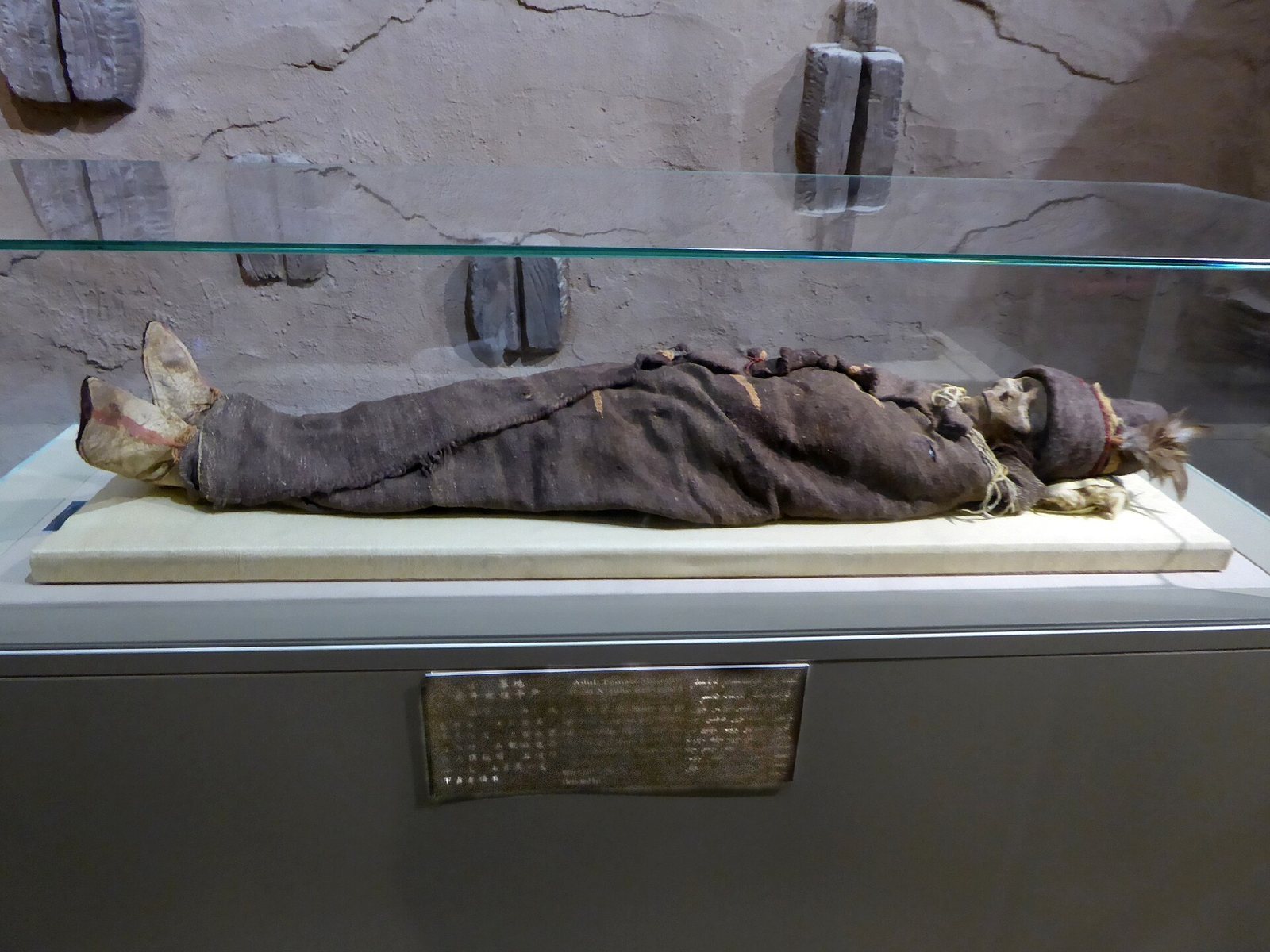
An excavation project organized by the Xinjiang Cultural Relics and Archaeology Institute began in October 2003. Work from late 2002 onward uncovered 167 tombs, as well as hundreds of smaller graves arranged in layers. In 2006, excavators found a remarkably intact young woman in a boat-shaped coffin wrapped in oxhide. She became known as the Beauty of Xiaohe, also called the Beauty of Loulan.
Human remains from the cemetery include more than 30 people, with the oldest dating to about 4,000 years ago. The well-preserved bodies are often called the Tarim mummies. Genetic research between 2009 and 2015 examined Y-DNA, which traces paternal lines, and mitochondrial DNA, which traces maternal lines, from 92 individuals. One analysis described the population as a genetic bottleneck, a sharp reduction in population size that can affect later genetic diversity, with ancestry largely from Ancient North Eurasians, a prehistoric population identified through genetic research.
The maternal lineages included West Eurasian groups H, K, U5, U7, U2e, T and R*; East Asian groups B5, D and G2a; C4 and C5, probably of Central or East Asian origin; and South Asian groups M5 and M*. Of the 12 paternal lineages surveyed, 11, about 92 percent, were R1a1, while one was the exceptionally rare K* lineage. The place where the population’s ancestry mixed remains unknown, although southern Siberia is considered a likely location. In 2014, study co-author Hui Zhou said that Xiaohe’s R1a1 belonged to a European branch rather than the more common Central Asian R-Z93 branch.
A later genomic study examined 13 people from the Tarim Basin dated to about 2100–1700 BCE. It found only local ancestry among these early-to-middle Bronze Age individuals. Xiaohe individuals in the study also had milk proteins in hardened deposits on their teeth, evidence consistent with dairy pastoralism from the cemetery’s founding. The findings did not support earlier proposals that the mummies were pastoralists speaking an ancestral form of Tocharian and descended from migrants of the Afanasievo culture, an early Bronze Age culture, or that they originated in societies associated with the Bactria–Margiana Archaeological Complex or the Inner Asian Mountain Corridor, a region of mountain routes across Inner Asia. Instead, the study proposed that early Tarim Basin cultures developed from a genetically isolated local population that adopted neighboring pastoral and agricultural practices.
Remains
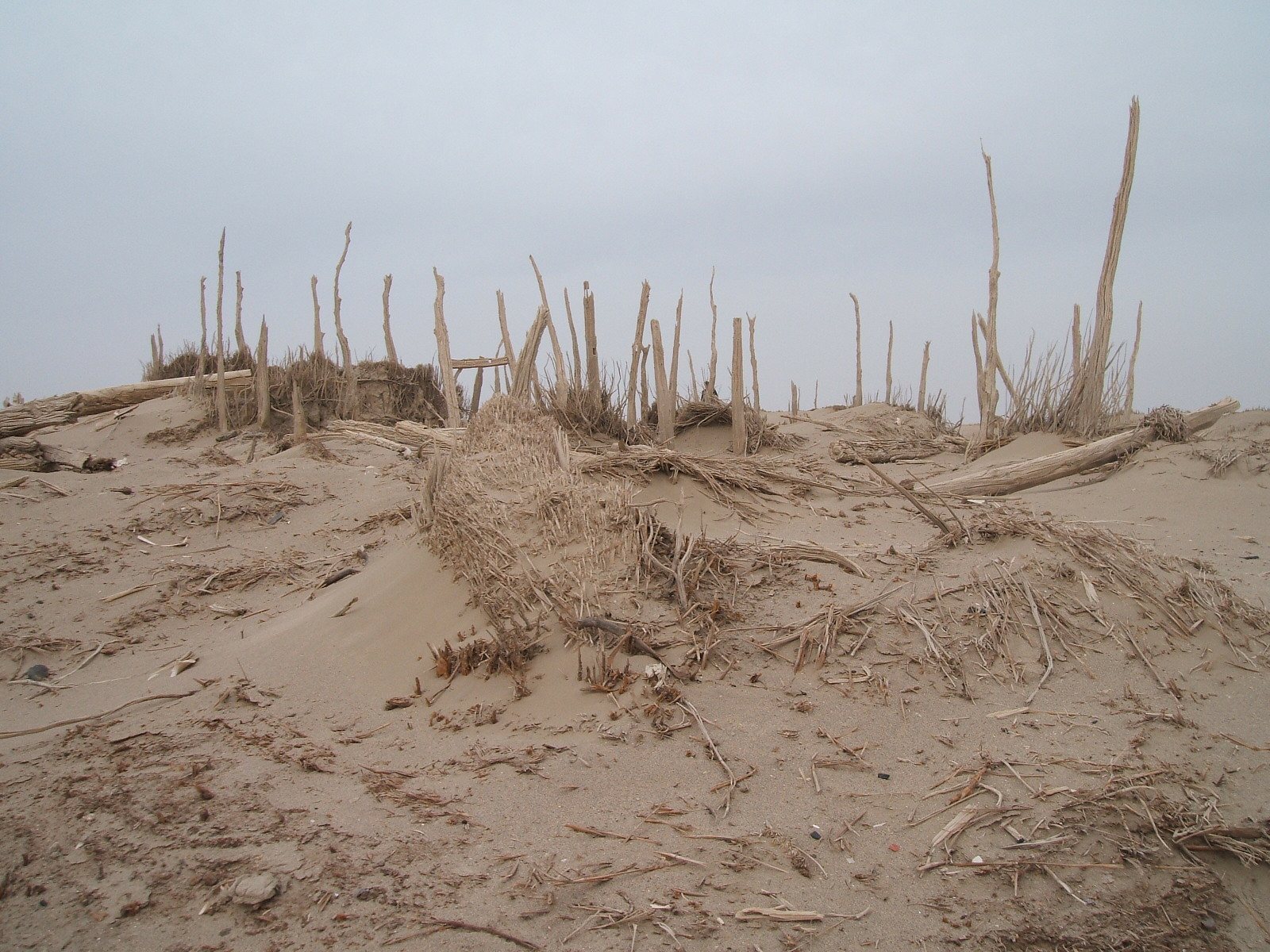
The cemetery occupies an elongated, dune-like landform, with a small oval burial mound at its summit. Upright wooden posts once stood there, and the graves were arranged in layers. The burials combine timber construction with oxhide coverings.
Grave construction and offerings
Coffins and grave markers
Bodies were placed in airtight oxhide bags. Each coffin was made from two large wooden planks set over the body to form an overturned boat shape, then covered with cattle hides. A vertical poplar post marked the grave near the upper end of the coffin; an ox skull or horn could be suspended from it. The post ends were sometimes torpedo-shaped or oar-shaped, forms associated respectively with the phallus and vulva. Male graves had oar-shaped posts, while female graves had phallic ones. Posts and coffins could be painted red.
Burial accompaniments
Bows and arrows accompanied male burials. Some special burials of women had a second rectangular coffin above the first, covered with layers of mud. Small masks shaped like human faces and wooden human figures could accompany the dead, while branches and sprigs of ephedra were placed beside bodies. Oar-shaped wooden monuments and wooden human figures were also found at the cemetery.
Mummified remains
The coffin from burial XHM66 was boat-shaped and held mummified remains dressed in woollen garments. The young woman known as the Beauty of Xiaohe was found in a boat-shaped coffin wrapped in oxhide. Another female mummy, the Princess of Xiaohe, is characterized by Western Eurasian features.