Skepptuna Church: A Medieval Parish Church in Sweden
Site at a Glance
- Popularity
- Low
- Country
- Sweden
- Primary era
- Medieval
- Eras represented
- Medieval, Early Modern, Modern
- Civilizations
- Swedish
- Site type
- Religious
- Remains
- Church
On this page19 sections
History
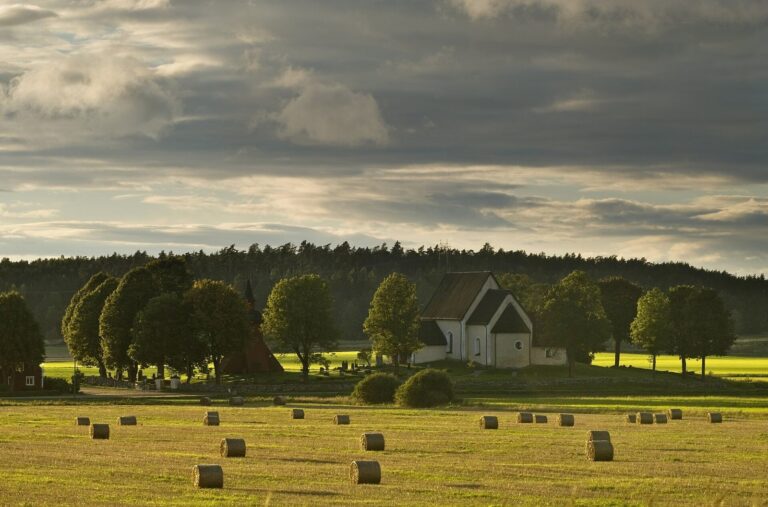
Skepptuna Church is a Lutheran parish church in Skepptuna, Sweden, consecrated in the 13th century and retaining building fabric from the early 13th century. It belongs to the Church of Sweden, a Lutheran church, and serves Skepptuna parish within Märsta pastorate, an administrative grouping of parishes, and the Archdiocese of Uppsala, a major church jurisdiction led by an archbishop.
Medieval beginnings and expansion
An inscription on runestone U 358, a stone bearing runic writing, indicates that Christians lived in the area by the early 11th century. Around 1300, a fire damaged the church. Its repair included an eastward enlargement that replaced a narrow choir with a straight-ended one. The change created a hall church, a unified space joining the nave, the main area for the congregation, and the choir, the area around the altar. A sacristy, a room for clergy to prepare and store liturgical items, was added north of the choir soon afterward.
Fifteenth-century rebuilding
The main building campaign took place in the 15th century, with Uppsala Cathedral as a model. Skepptuna Church acquired its present general appearance during this work.
Later alterations and conservation
Windows were added to the previously windowless north wall in 1732–1734, and an entrance was cut into the tower’s west wall in 1755. In 1776, workers removed the division between the choir and the rest of the church and replaced the tower’s decayed spire with a cap whose broken outline remains. The bells were transferred from a separate belfry into the tower in 1789. A gallery installed in 1812 took the place of an earlier one from 1678.
Restoration in 1907 included a heating chamber east of the sacristy, uncovered medieval choir paintings, and removal of the 1812 gallery. A larger restoration in 1946, involving artist John Österlund, added electric heating and lighting, cleaned the paintings, and repainted the wooden interior fittings. The tower roof received new slate in 2003.
Remains
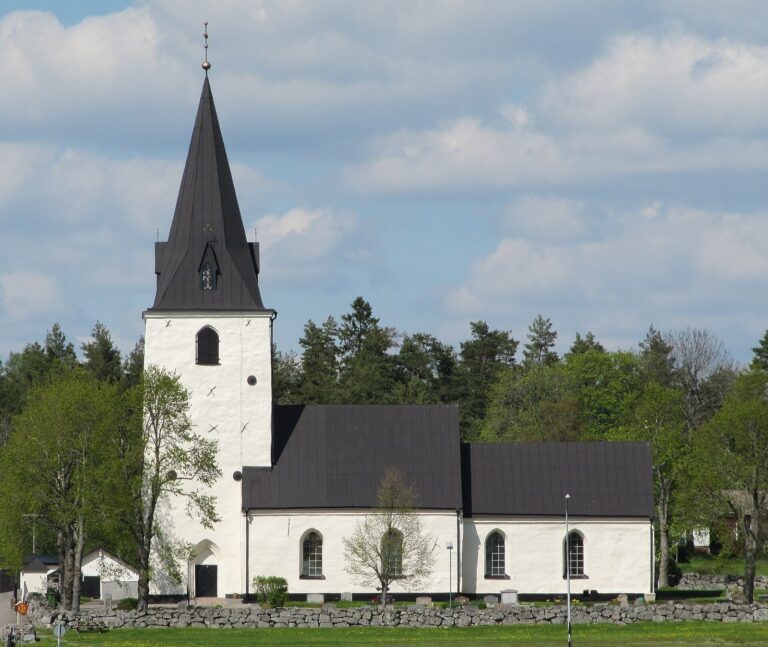
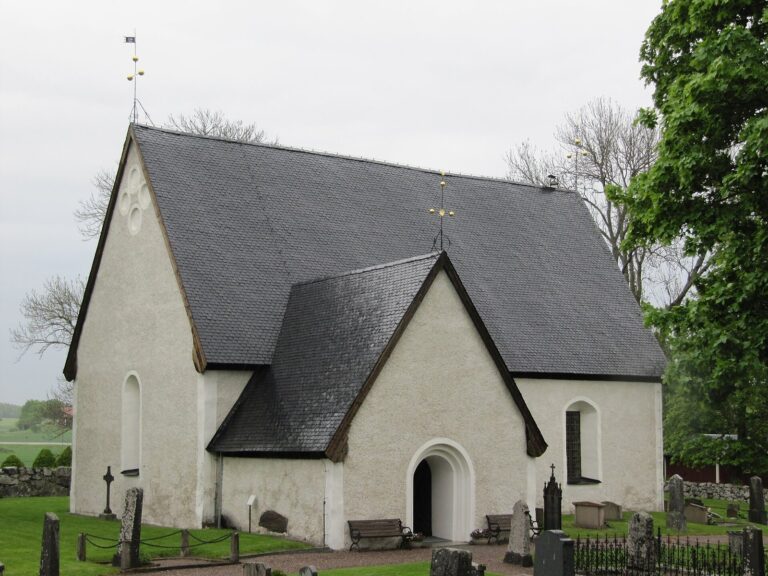
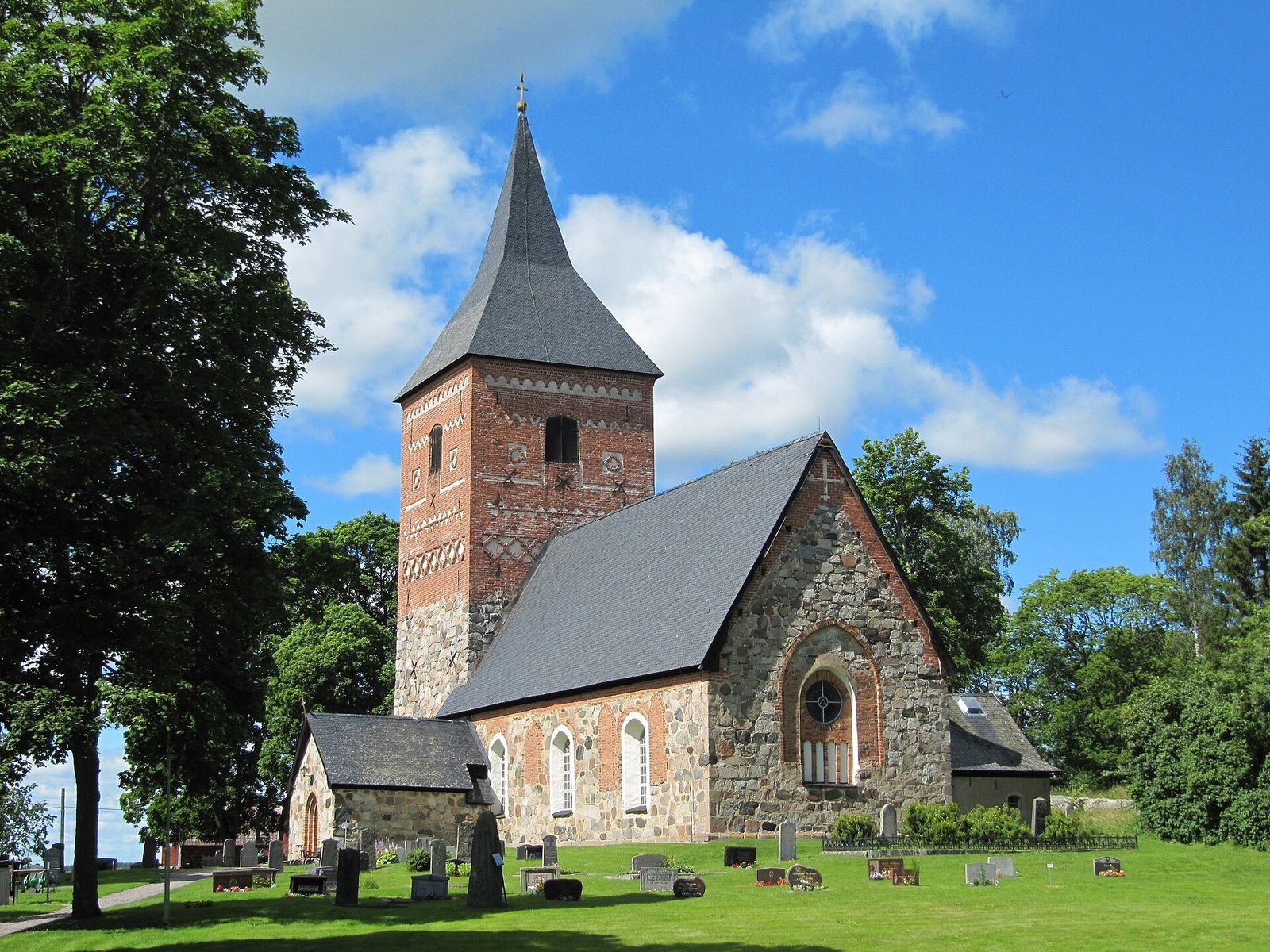
The church combines stone and brick in a plan with a rectangular nave and a straight-ended east choir of the same width. The sacristy adjoins the choir to the north, a substantial tower stands at the nave’s west end, and a porch projects from its southwest side.
Exterior and plan
Plan and masonry
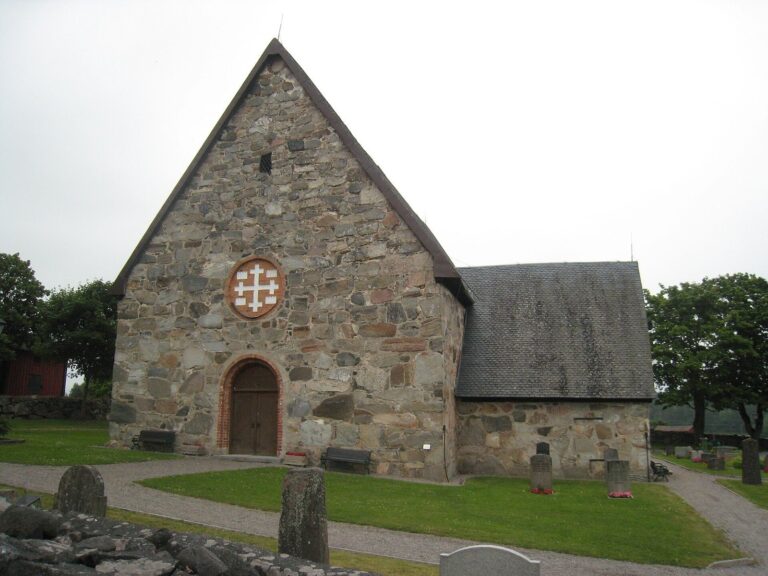
Roughly hewn stone blocks form part of the church’s mixed stone-and-brick fabric. The choir has a straight east end, while the southern entrance has a brick surround. The southwest porch and the portal connecting it to the nave are recognizable features of the building.
Tower
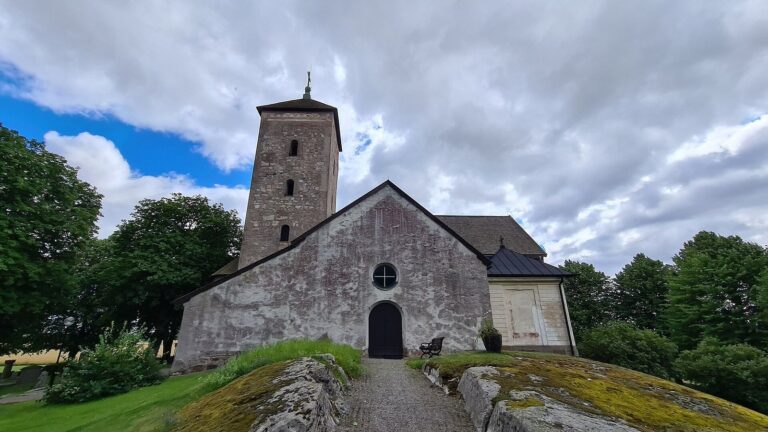
Large gray stone blocks make up the tower’s lower section, above which rises brickwork decorated with white-plastered blind niches, shallow recesses that do not open through the wall. The slate-covered roof has a broken profile. An entrance is set in the tower’s west wall.
Runestones
Runestone U 358 stands on the south side of the tower, and a second, smaller runestone is located in the porch.
Interior structure and surfaces
Vaults and former division
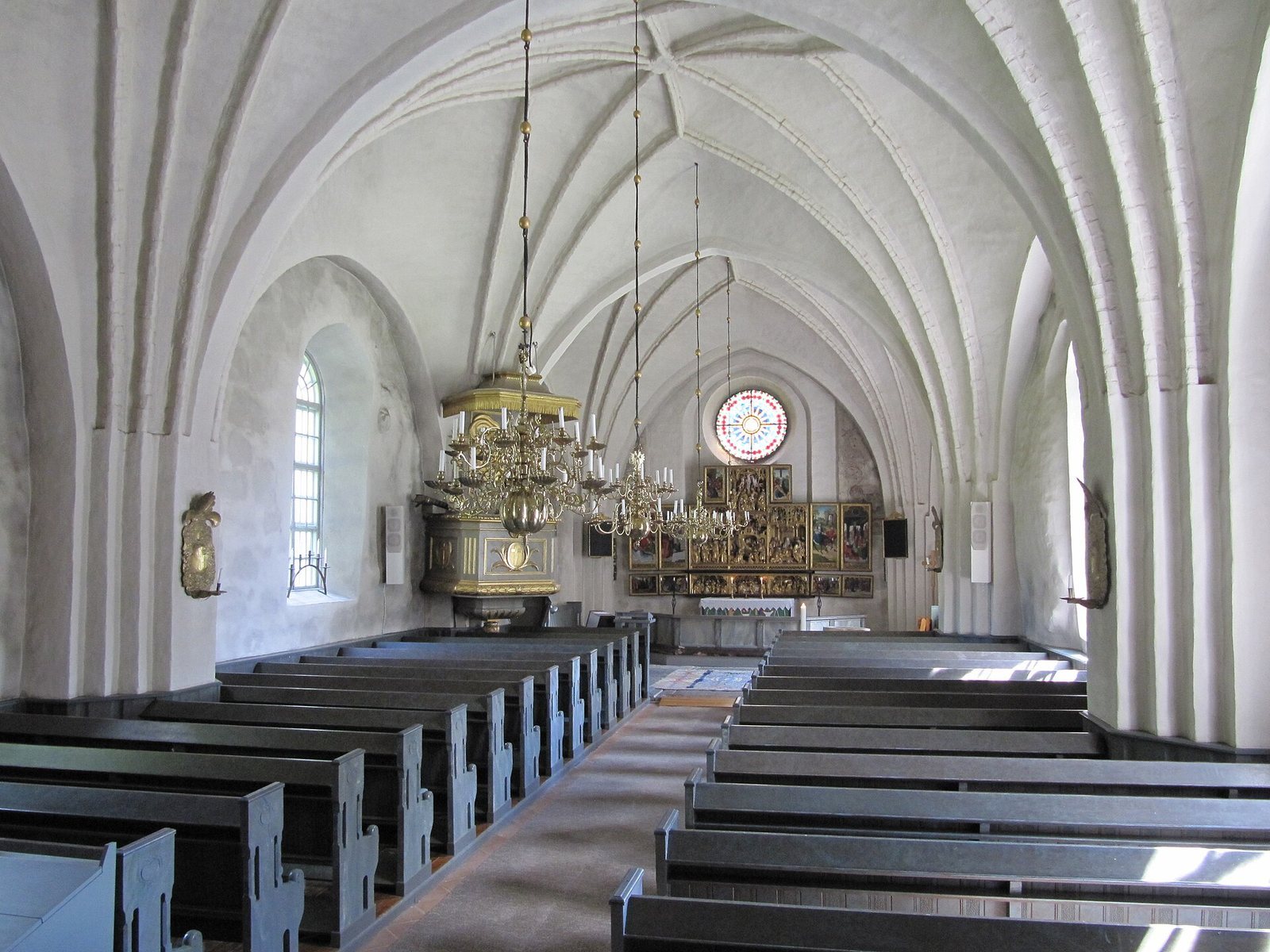
The church interior, or at least the choir, once had a wooden barrel vault, a ceiling shaped like a continuous half-cylinder. Traces of its outline remain in the plaster on the inside of the east gable. After the tower was built, the wooden vaulting was replaced by the present, considerably lower brick star vaults, whose ribs form star-like patterns. A brick wall formerly divided the choir from the rest of the church; an arch through it was closed by a rood screen, a screen separating the choir from the nave.
Windows and paintings
The interior is whitewashed, with fragments of medieval wall paintings remaining. Medieval paintings also survive on the choir walls, including the north wall. Two medieval windows are bricked up, and an eastern window is set along the south wall of the nave.
Furnishings and artworks
Altarpiece
The altarpiece, regarded as the church’s principal artistic treasure, retains medieval paintings in good condition. It was made in the Brussels workshop of Flemish sculptor Jan Borman and acquired sometime after 1500. The work belongs to the Northern Renaissance, the Renaissance art of northern Europe.
Baptismal furnishings
A limestone baptismal font dates to the early 16th century. A wooden baptismal stand replaced it in 1759. Above the font hangs a painted and gilded late-Baroque crucifix, donated in 1707.
Chandeliers
A brass chandelier with six arms hangs in the choir. Dating to the 16th century, it is topped by an image of Mary and the child Jesus surrounded by rays. Another chandelier, with ten arms and twisted spiral shafts, was probably donated in 1685. The two largest chandeliers each have sixteen lights in two rings and a double-eagle finial; they were donated in 1683 and 1686.
Pulpit and sacristy furniture
The pulpit was made in 1792 in Gustavian style, a Swedish late-18th-century decorative style influenced by neoclassicism. Its Rococo hourglass, bought in 1742, came from an earlier pulpit. The sacristy contains a late-medieval oak cabinet with wrought-iron fittings and chairs of 17th-century type.
Works now in the Swedish History Museum
A late-15th-century wooden sculpture of Thomas Becket, the 12th-century archbishop of Canterbury who was killed and later venerated as a martyr, formerly belonged to the church. It is now displayed at the Swedish History Museum and is thought to be by the late-medieval Lübeck artist Bernt Notke. The museum also holds a late-medieval cope, a long ceremonial cloak worn by clergy, richly embroidered in Flemish style.
Organs
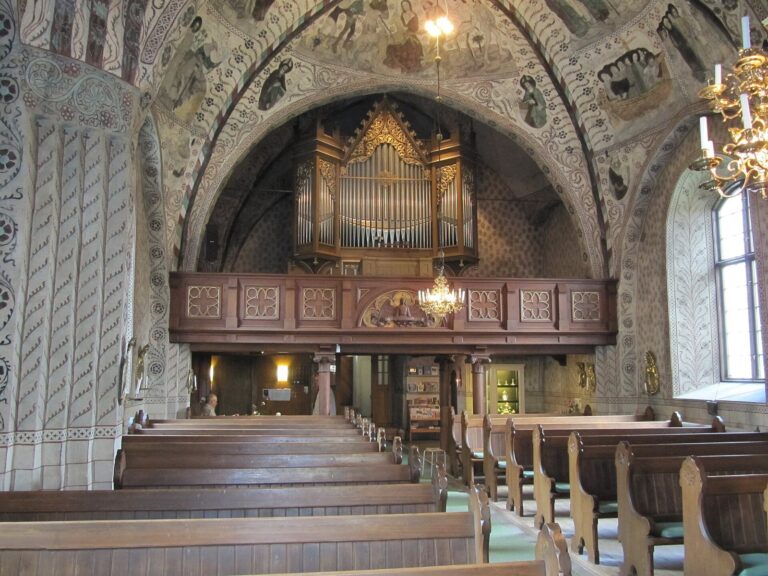
A small organ from the early 17th century was repaired in 1672. A replacement installed in 1679 had four stops, sets of pipes controlled together; it was repaired in 1745 and lost in 1773. Olof Schwan of Stockholm built an organ in 1812 with 8½ stops. Erik Henrik Eriksson of Gävle made the 1907 instrument, which had 11 stops, two manuals, or hand-operated keyboards, and a pedal keyboard. The present organ was made in 1956 by Åkerman & Lunds Nya Orgelfabriks AB in Knivsta. It has 20 stops, two manuals, and a pedal, with mechanical action that connects keys to valves through linkages. Its slider chests use sliding boards to direct air to selected pipe sets. The keyboard range is 56 notes on the manuals and 30 on the pedal.