Orihuela Walls: The Defensive Fortifications of Orihuela
Site at a Glance
- Popularity
- Very Low
- Country
- Spain
- Primary era
- Medieval
- Eras represented
- Classical, Medieval, Early Modern
- Civilizations
- Almohad, Ancient Greek, Carthaginian, Crown of Aragon, Spanish, Visigothic
- Site type
- Military
- Remains
- Wall
On this page18 sections
History
The Orihuela Walls are a defensive system in Orihuela, Alicante, Spain, built during the Visigothic period and later rebuilt under Almohad rule, a Muslim dynasty that governed parts of the Iberian Peninsula. Their history reflects the city’s changing defenses, from early strongholds to repeated medieval and early modern repairs.
Early fortifications and medieval rebuilding
Orihuela’s defensive tradition is associated with Greek and Carthaginian origins. Greeks founded the city, while its development as a fortified stronghold is linked to Hamilcar Barca, a Carthaginian military commander. He established a rear-defense fort on Mount San Miguel, whose height provided an almost complete view over the Segura Valley.
The city walls were built in the Visigothic period and reconstructed under the Almohads. During the war with Castile, a siege by the king of Castile lasted twelve years and damaged sections of the defenses. In the fourteenth century, Peter IV the Ceremonious, king of Aragon, ordered the damaged stretches rebuilt and the walls raised.
Sixteenth-century repairs
In the sixteenth century, Philip II sent architects to repair and alter the walls to strengthen their defensive capacity. At this time Orihuela was described as the leading city in its governorate, an administrative territory overseen by an appointed governor.
Demolition and later history
In the eighteenth century, Philip V ordered the city walls demolished through Cardinal Belluga, a senior Catholic cleric and political figure. The order punished Orihuela for not supporting Philip’s cause against Archduke Charles of Austria in the War of the Spanish Succession, a conflict over the Spanish monarchy between the Bourbon and Habsburg claimants. The demolition left the defenses in separate sections.
Several gates have histories tied to these changes. The Puerta de Murcia and Puerta del Puente belonged to the original fortified enclosure and were of Islamic origin. The Puerta Nueva was added after the walls were extended. The Puerta de Callosa, also known as the Puerta de la Olma, originated under the Almohads and was remodeled on Philip II’s orders. It was the only city gate to survive Philip V’s demolition; the nearby College of Santo Domingo may have helped preserve it. The Puerta de Almoradí was demolished and rebuilt for a second time in 1602, while the Puerta de San Agustín was built by stonemasons.
A local legend says that Armengola entered the castle through a supposed Puerta de la Traición, enabling Christians to take the castle and city from Muslim rule during the Reconquista, the centuries-long Christian expansion into Muslim-ruled territories in Iberia. A traditional ceremony continues at the Puerta de Callosa, where Orihuela’s prelates enter on a donkey from Castile.
In 1998, the wall complex and the Wall Museum, Puerta de Callosa, Monserrate towers, Passion Passage Tower, Embergoñes Tower, and Seminary towers received Spain’s protected cultural-property designation.
Remains
The defenses consisted of an outer circuit around the city and a separate inner ring around the castle on Mount San Miguel. The outer line used the Segura River and the mountain’s height as natural defenses. The inner wall protected the castle and Orihuela’s alcazaba, or fortified citadel, and was also called the Castle Wall. Today, discontinuous wall sections, several towers, and one gate survive.
City gates
Murcia and Bridge gates
The Puerta de Murcia stood on the route toward Murcia, in the Rabaloche area near the present-day Monserrate church. The Puerta del Puente was at the western, or Old, Bridge. It connected the city center with routes toward the San Miguel plateau, the seminary, and Orihuela Castle. Two defensive towers may have flanked it.
San Agustín suburb entrances
The Puerta de San Agustín opened toward the suburb of the same name, which now lies across the river following the city’s expansion. Its presumed location is near Jesús y María College. Two other gates served the suburb: the Puerta del Burdel, also called the Puerta de la Mancebería, stood at the end of Mancebería Street, while the Puerta de Magastre was near the area known as Riacho, around the midpoint of San Pascual Street. A popular brothel may have stood beside the former gate, providing a possible explanation for its name.
Elche, Nueva, and Crevillente gates
The Puerta de Elche connected Calle Mayor with Calle de los Hostales, now Ramón y Cajal Street and Alfonso XIII Street. Its presumed site is near Hotel Palacio Tudemir and the Passion Passage Tower. It may have had multiple flanking towers because the river did not protect this stretch. The east-facing Puerta Nueva opened onto Feria Street. The Puerta de Crevillente, nearest the mountain range, gave access to Calle de Arriba, also known as Calle de los Olmos; its possible location is near Orihuela’s new courthouse.
Puerta de Callosa
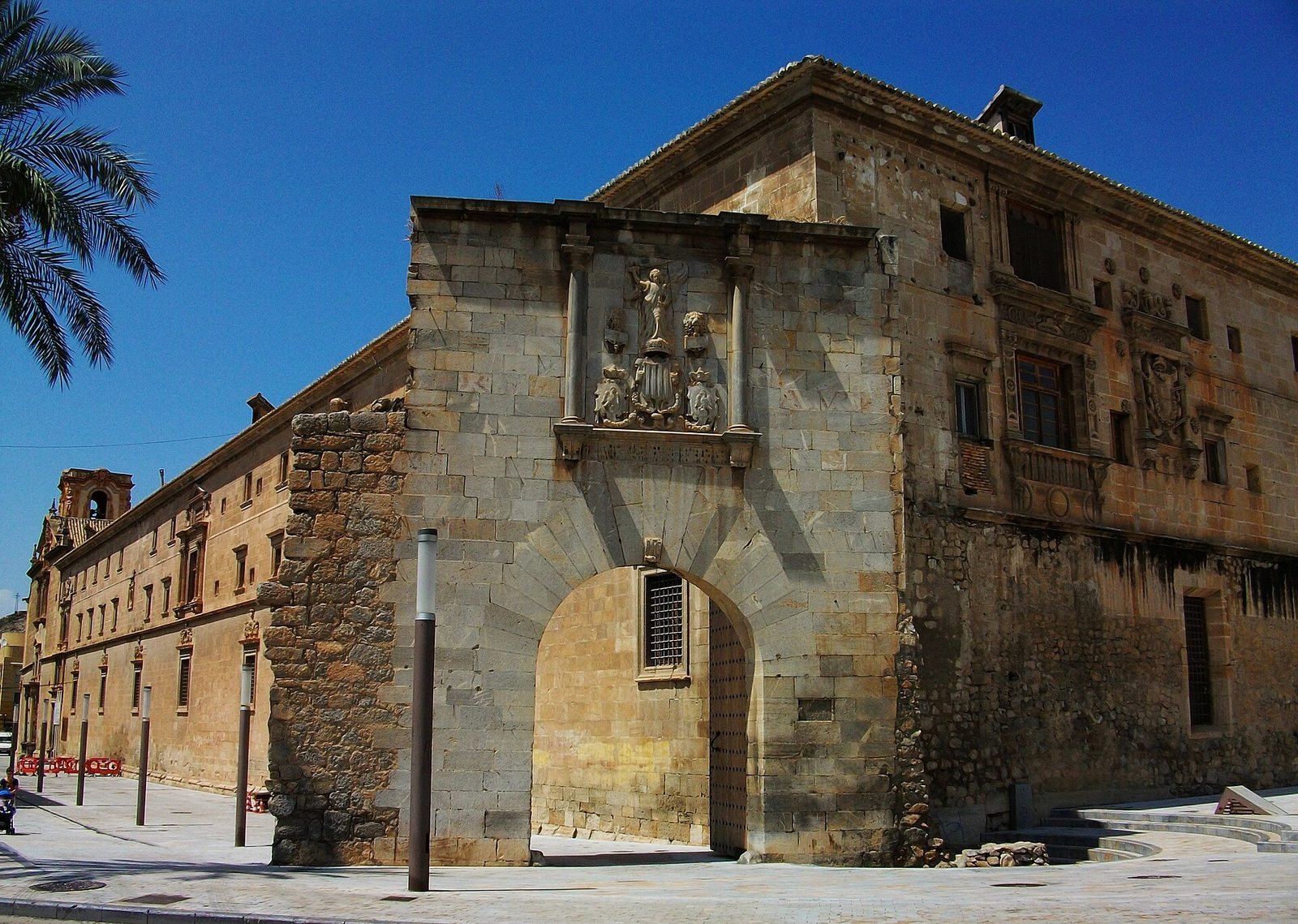
The Puerta de Callosa stands beside the Patriarch’s College, also called Santo Domingo College, on the route of the Old Callosa Road. It was one of two gates in the wall protecting the San Juan suburb. The city coat of arms appears on its upper section, with a high relief of Saint Michael above it. Marks left by masons include letters, tools, numbers, five-pointed stars, religious signs, and circular designs.
Puerta de Almoradí
Near the Puerta de Callosa, the Puerta de Almoradí stood at the end of Corredera Street, now Pintor Agrasot Street. It opened onto the road to Almoradí.
Wall sections and towers
Salesas wall stretch
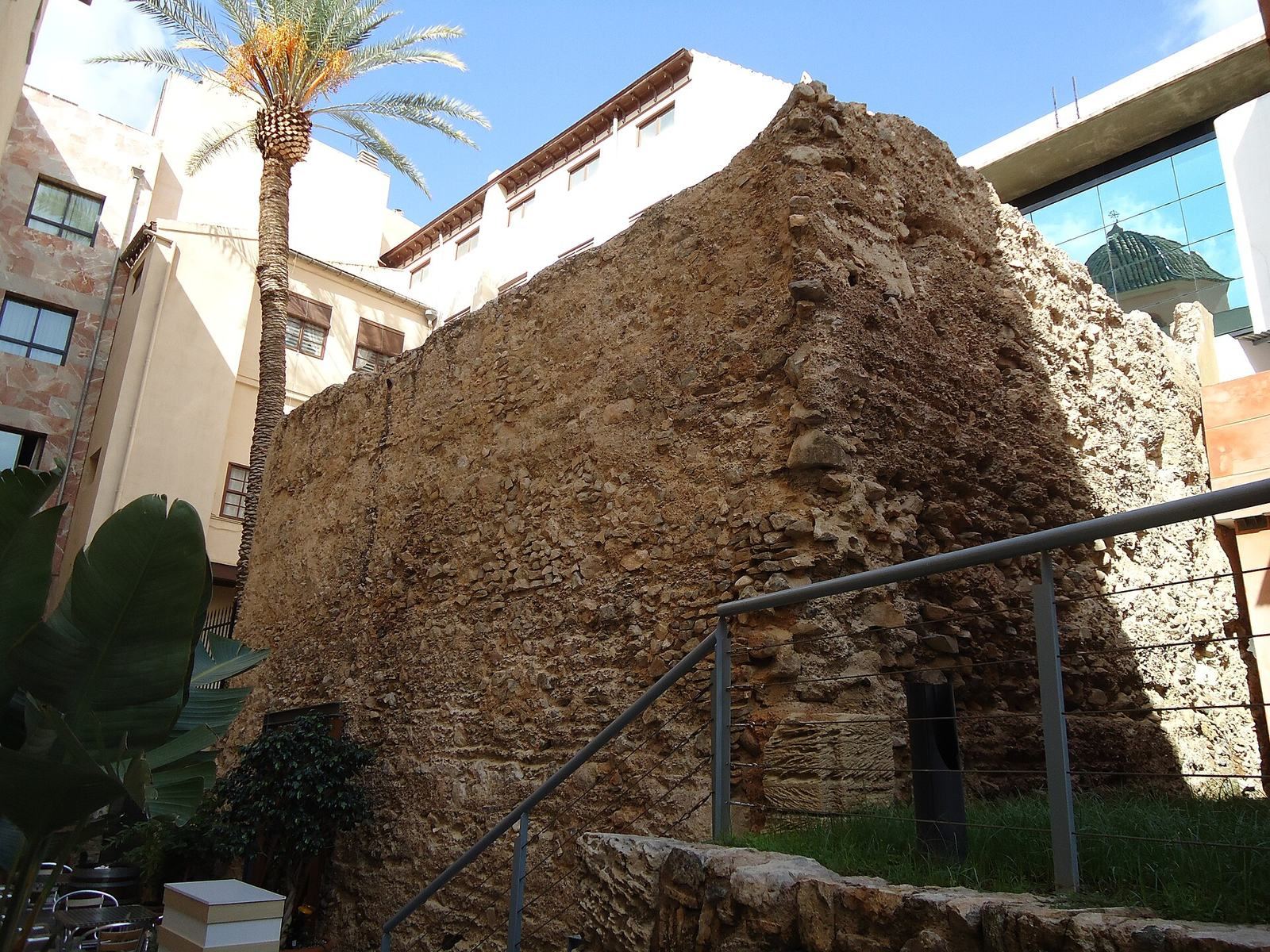
The Salesas wall stretch lies in the basement of the lecture building at Miguel Hernández University. It incorporates four Almohad towers that were modified in the fourteenth century. Nearby remains include Arab baths, Islamic dwellings, parts of Gothic and Baroque buildings, and the palace of Ferdinand of Antequera, a medieval king of Aragon. Household furnishings from Almohad dwellings have also been found in the area, and the Wall Museum contains these remains.
Monserrate towers
Two surviving towers of the city wall stand near the former Puerta de Murcia, beside the Monserrate sanctuary on Calle Torreta.
Passion Passage Tower
The square-planned Passion Passage Tower and associated wall remains are in the courtyard of the Casinello house and in Plaza de los Cantores de la Pasión. The tower was altered in the fourteenth century.
Callosa-area towers
The Tower of El Greco stood between the Puerta de Callosa and Puerta de Almoradí. The Torre Esquinera occupied the river side of the Puerta de Callosa, near the city’s southeastern corner and the Segura.
Embergoñes Tower
The Embergoñes Tower, also known as the Tower of Cantón or Don Ramón, has a hexagonal plan. Its walls combine rammed earth with lime mortar and sand, along with gravel and pieces of limestone in varied sizes. The tower was intended to watch for attackers approaching by way of the Segura River or the central Huerta, the irrigated agricultural land.
Seminary towers
Two towers belonging to the castle’s inner wall stand on the eastern side of the seminary building.