Goëren Dolmen: A Neolithic Passage Tomb in Gâvres, France
Site at a Glance
- Popularity
- Very Low
- Country
- France
- Primary era
- Stone Age
- Eras represented
- Stone Age
- Civilizations
- Unclassified
- Site type
- Burial
- Remains
- Tomb
On this page14 sections
History
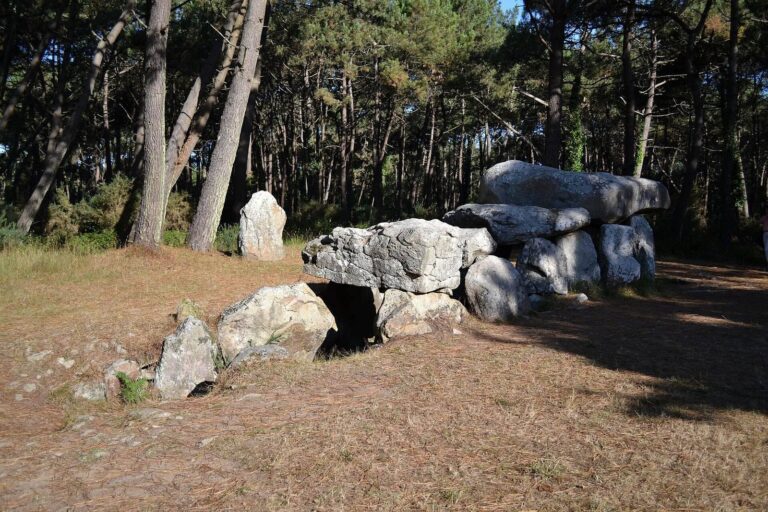
The Goëren Dolmen is a Final Neolithic passage tomb, a megalithic burial monument with a passage leading to a chamber, on the Gâvres peninsula in France. It was probably built during the Kerugou period, an archaeological tradition identified partly through its pottery. Five radiocarbon determinations, which estimate age from organic material, include an earliest result of about 3200 BC; another places the monument at about 2480 BC. Kerugou pottery found throughout the tomb and its mound supports the proposed construction period.
Prehistoric construction and use
The terminal chamber was probably closed during the original construction. Its length and narrowness would have made it difficult to install the two blocking slabs afterward. The two compartments before it allowed movement through the chamber until its doorway was shut and stones blocked the passage entrance.
Use took place in successive phases. Bell Beaker activity, associated with a pottery tradition, followed an earlier phase after an interval. It was brief and probably ended with a collapse, and appears to have been the tomb’s only reuse. Two displaced stones at the passage entrance indicate that a burial previously closed off there was breached.
Excavation yielded little material from the first three compartments. The prehistorian J. L’Helgouach proposed that the terminal chamber may have held the burial of an important person and that the tomb later served for periodic religious rites. He suggested this could explain the many engravings alongside the small quantity of finds. The monument was subsequently sealed before its brief Bell Beaker reuse.
Rediscovery and protection
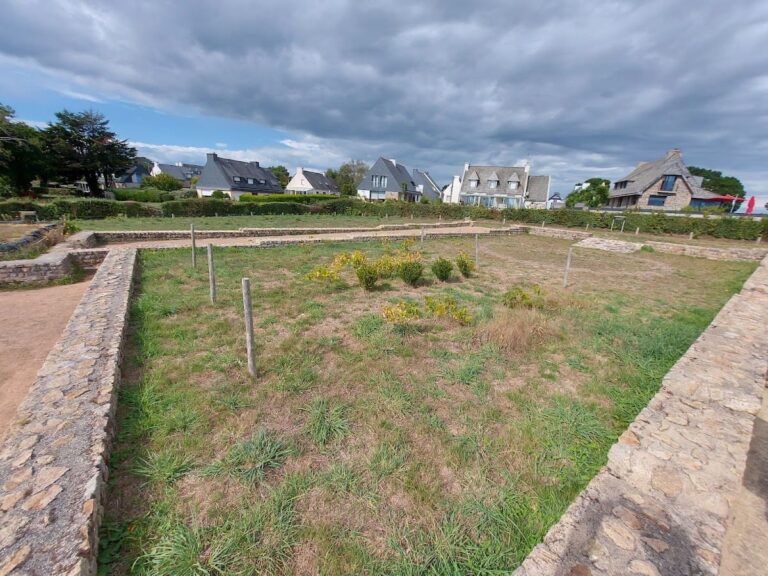
Housing development exposed the dolmen in 1963. Until then, a dune had completely covered its mound. J. L’Helgouach excavated the monument between 1964 and 1967. France classified it as a historical monument on 6 April 1965, a statutory heritage-protection status.
Remains
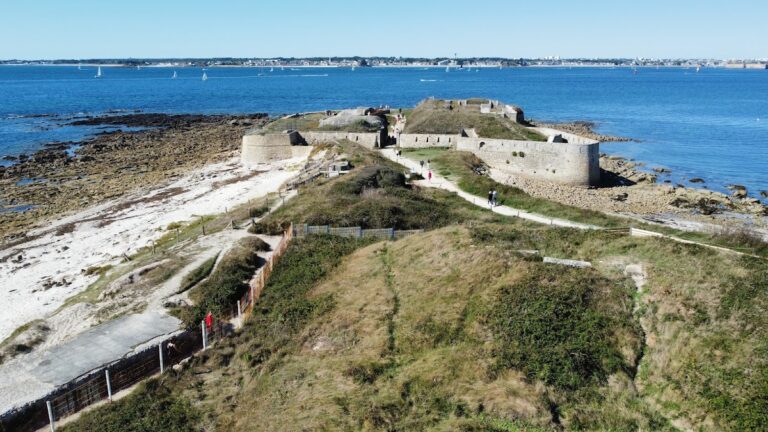
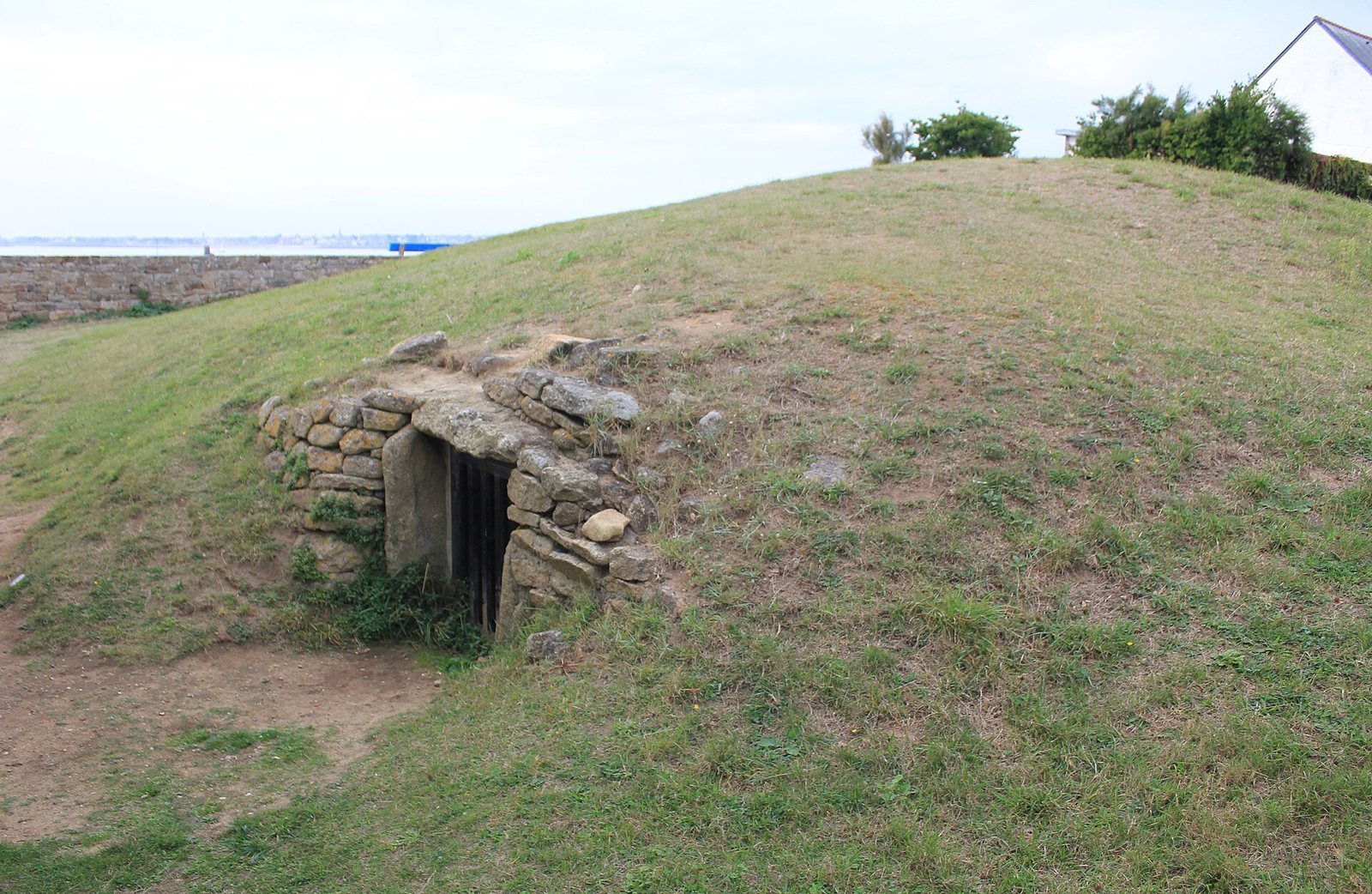
The granite tomb lies near the mouth of the Blavet, on the western side of the Gâvres peninsula and south of Port-Louis and the Petite mer de Gâvres. Its elongated mound covers a passage running north from a southern entrance; the chamber turns west at a right angle. The dolmen is the westernmost example in a group of roughly seven or eight angled passage tombs extending between the Pays de Retz and the Étel–Blavet area.
Mound and passage
Mound
A compact layer of black clay, which served as waterproofing, covers the tomb beneath a mound of medium-sized stones and earth. The mound follows the tomb’s shape, widens toward the west, and measures 28 metres long. Its maximum height at the centre is 2.20 metres.
Passage and entrance
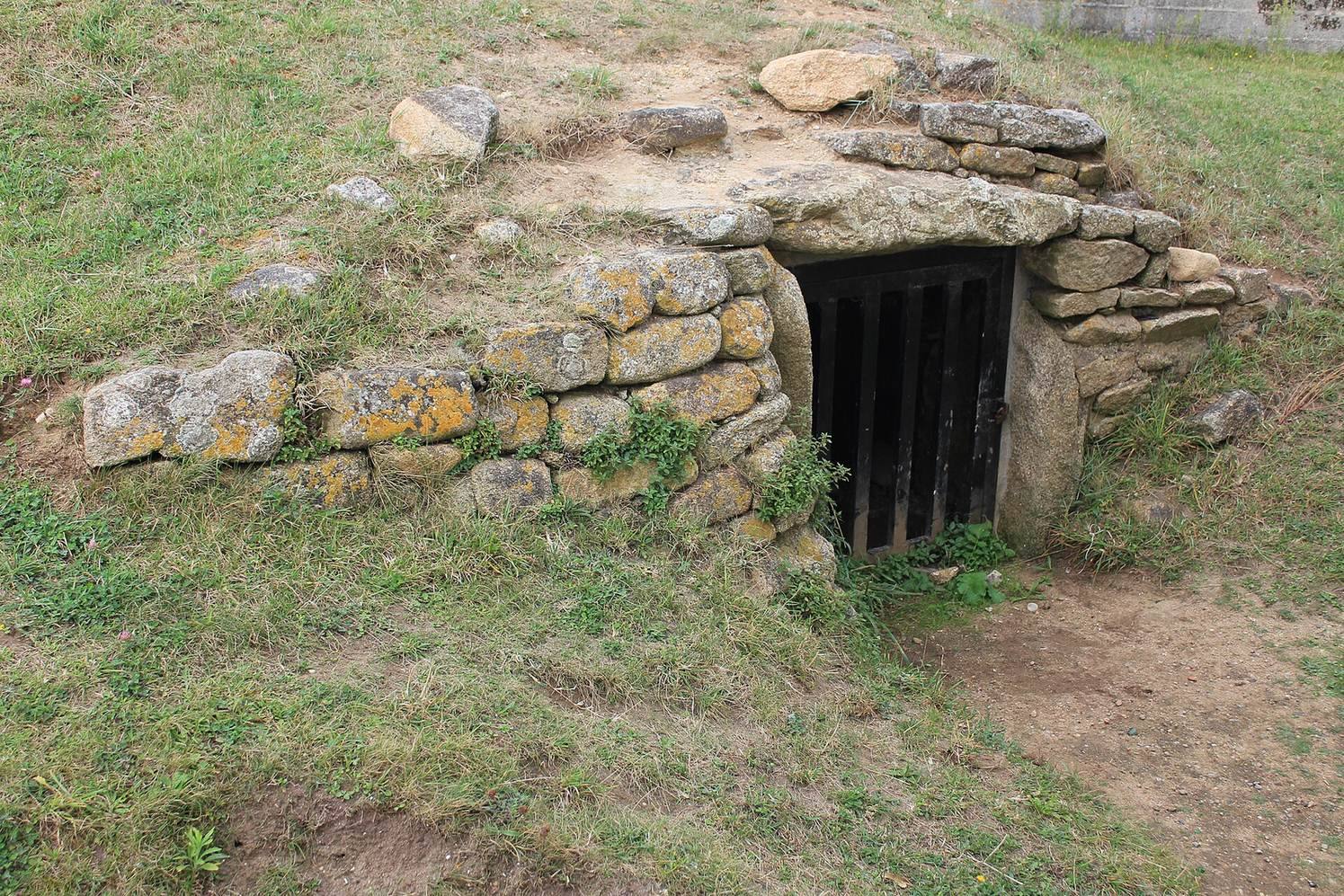
The passage measures 9.25 metres long, 1.20 to 1.25 metres wide and about 1.60 metres high. Nine upright stones line each side, joined by cobble walls built without mortar. Extra cobbles at the bases or tops of the uprights even out differences in height. Two roof slabs had been deliberately removed and thrown forward, causing a partial collapse at the entrance. At the passage’s northern end, a granite slab measuring 1.20 metres high, 0.95 metres wide and 0.20 metres thick closes the way into the chamber. Blocks filled the opening around it to a height of 1 to 1.10 metres, leaving a gap of about 0.40 metres between the slab and the roof.
Chamber and compartments
First compartment
The chamber extends 17 metres west from the passage and is about 1.60 to 1.70 metres wide. Crosswise slabs divide it into four compartments. The first, beside the doorway, is 2.70 metres long and 1.45 metres wide. The space beneath its roof ranges from 1.25 metres high on the east to 1.50 metres on the west. One roof slab covers it; the granite slab measures 3.50 by 1.80 by 0.50 metres and weighs an estimated eight tonnes. Its first partition is a 0.55-metre-wide slab set across the chamber, leaving a narrow opening beside the north wall that measures 0.85 metres across at the base and 0.40 metres at the top.
Middle compartments
The second compartment is 5.60 metres long and 1.50 to 1.60 metres wide. Three full roof slabs and part of a fourth cover it, with 1.40 metres of clearance beneath the roof; its floor is paved. Four wall slabs here carry partly eroded engravings. The third compartment is 4.60 metres long and 1.45 metres wide. It has three roof slabs and a floor that is almost entirely paved.
Terminal compartment
The final compartment is roughly rectangular, measuring 3 metres long, 1.60 to 1.70 metres wide and 1.50 metres high. Its paved floor is enclosed across the full width of the chamber by two parallel slabs. This arrangement forms a complete double closure. The purpose of the chamber’s extensive divisions is unknown and may relate to successive uses. Fully enclosed end cells also occur in Armorican-type covered galleries, long megalithic tombs of a regional form associated with Brittany and nearby northwestern France. The complete closure at Goëren suggests that its terminal cell was used only once.
Engravings and finds
Engravings
The chamber is more richly decorated than the passage, with engravings especially common in its later compartments toward the exit. Ten slabs bear rectangular framed designs with curved, V-shaped tops and a central vertical line. Some have double or triple borders, while others are incomplete; their interiors contain dots, circles or strokes. No two designs are identical. The second upright stone on the left side of the passage is also decorated. The motifs have been interpreted as representations of idols.
Pottery and other objects
Pottery from the tomb represents three archaeological traditions distinguished in part by characteristic vessels: Kerugou, Conguel and Bell Beaker. Kerugou material includes fragments from several vessels and bowls with rounded or flat bases, some decorated. A single intact Conguel-type vessel was found in the passage. Bell Beaker pottery includes a decorated goblet and two vessels recovered from the final compartment and passage. The goblet has a pattern made by pressing cord into the clay, while one vessel bears a less common Morbihan design generally found on large Bell Beaker vessels.
Other finds attributed to the Bell Beaker phase include a quartz pendant, arrowheads, gold sheets with folded edges and copper awls. A polished, wedge-shaped axe made of dark green, hard, black-speckled serpentine was found in 1888.