St. Laurentius, Leipzig-Leutzsch: A Village Parish Church
Site at a Glance
- Popularity
- Low
- Country
- Germany
- Primary era
- Medieval
- Eras represented
- Medieval, Early Modern, Modern
- Civilizations
- Electorate of Saxony, German, Holy Roman Empire, Kingdom of Saxony
- Site type
- Religious
- Remains
- Church
On this page12 sections
History
St. Laurentius is a village church in Leipzig’s Leutzsch district, Germany. A chapel on the site became a parish church in 1397 and was dedicated to Saint Lawrence, an early Christian martyr. The Leutzsch congregation became Protestant in the first half of the 16th century.
Nineteenth-century rebuilding
The nave underwent substantial renovation in 1852 and again in 1890. The interior was enlarged in 1900 to make room for a larger organ, continuing a period of change that reshaped the church’s fabric and furnishings.
Organs and later changes
An organ dating to 1620/1621 was repaired in 1671. In 1727, Leipzig’s city council paid for a replacement because the existing instrument could no longer be repaired. Organ builder David Apitzsch completed the new instrument in 1729, and Johann Gottlieb Görner, organist at the university, examined it on 30 November that year. A further organ was completed in 1830.
After later alterations, the 1830 instrument was assessed for possible repair, but a new organ was chosen. The Jehmlich brothers of Dresden received the contract, dated 10 October 1900. Paul Homeyer, organist at the Gewandhaus and a teacher at the Leipzig Conservatory, accepted the instrument on 19 December. In his report the following day, he praised it as a successful work.
Proposed changes to the 1900 organ’s specification were discussed from 1908. An 8-foot trumpet stop was added in 1910, and the second manual was modified. Later changes gave it a more pronounced neo-Baroque character, a revival of features associated with Baroque organs, including aliquot stops that sound pitches above a note’s main pitch. During the First World War, the organ’s tin façade pipes were requisitioned. In 1918, Jehmlich requested zinc sheet as replacement material from the War Ministry’s Metal Mobilization Office in Berlin.
Further work on the church took place during the 20th century, including the removal of its side galleries in 1961. The organ received a major overhaul in 2002. Jehmlich renovated it again in 2024 and 2025, making a slight change to the upper division’s specification; it was playable again from June 2025.
Remains
Church fabric
Choir tower
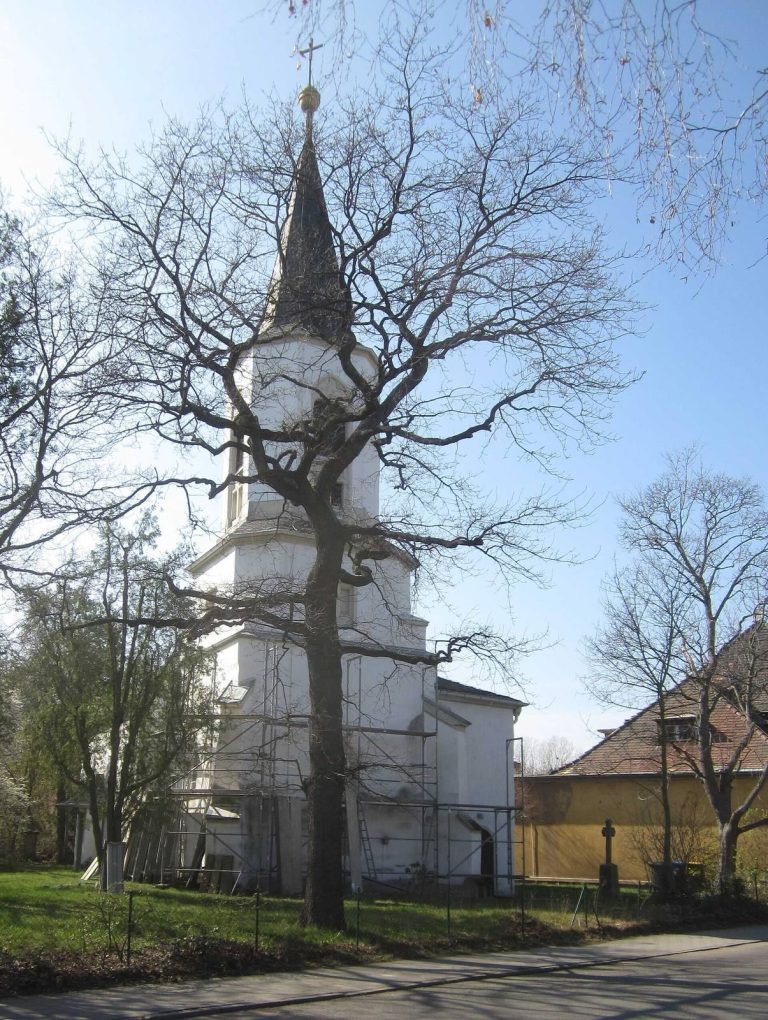
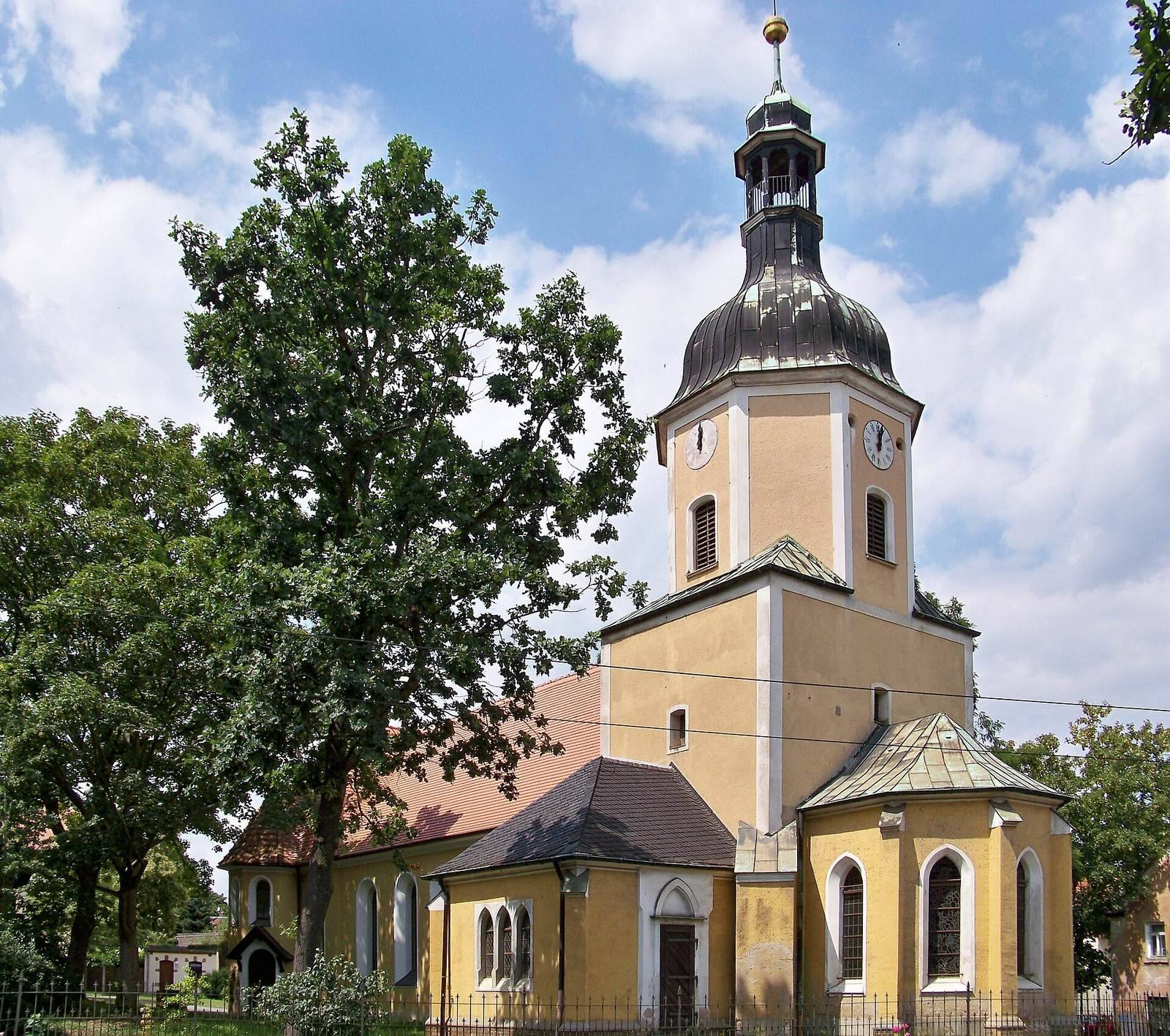
The surviving church brings together a nave and choir tower, with a polygonal apse and a sacristy on the south side. The lower section of the tower is the oldest part of the building. Its lower floor has a 15th-century star-ribbed vault, a vaulted ceiling whose ribs form a star pattern. The present octagonal upper storey dates to 1689 and is crowned by a curved, domed Baroque roof.
Nave and additions
The polygonal apse and the south-side sacristy were added during the 1890 renovation. The nave’s former flat ceiling was replaced by a shallow barrel vault in 1900, when a western structure flanked by two polygonal stair towers was also built. The pulpit and baptismal font date to the 1890 work.
Furnishings and fittings
Winged altarpiece
The early-16th-century winged altarpiece has side panels that can be opened or closed and includes seven carved figures. Its central shrine depicts Rochus, Sebastian and Antonius, saints associated with plague devotion. Wolfgang, a 10th-century bishop of Regensburg, and Laurentius appear on the left wing; Mary, the mother of Jesus, and Elisabeth, the mother of John the Baptist, appear on the right. A predella, the lower section beneath an altarpiece’s main image, was added in 1933 and depicts the Veil of Veronica. The altarpiece may have been installed in connection with the plague epidemic of 1520.
Organ
The Jehmlich organ built in 1900 uses air pressure to operate its notes. It has 19 stops, which select sets of pipes, two manuals (keyboards) and a pedal (foot-operated keyboard). The original specification for the second manual included six stops at 8-foot and 4-foot pitches.
Choir windows and bells
Two leaded-glass windows in the choir were made in 1949 to designs by German painter and illustrator Paula Jordan. The church’s three bells date to 1953 and are dedicated to Mary, Catherine and Susanna.
Exterior gravestones
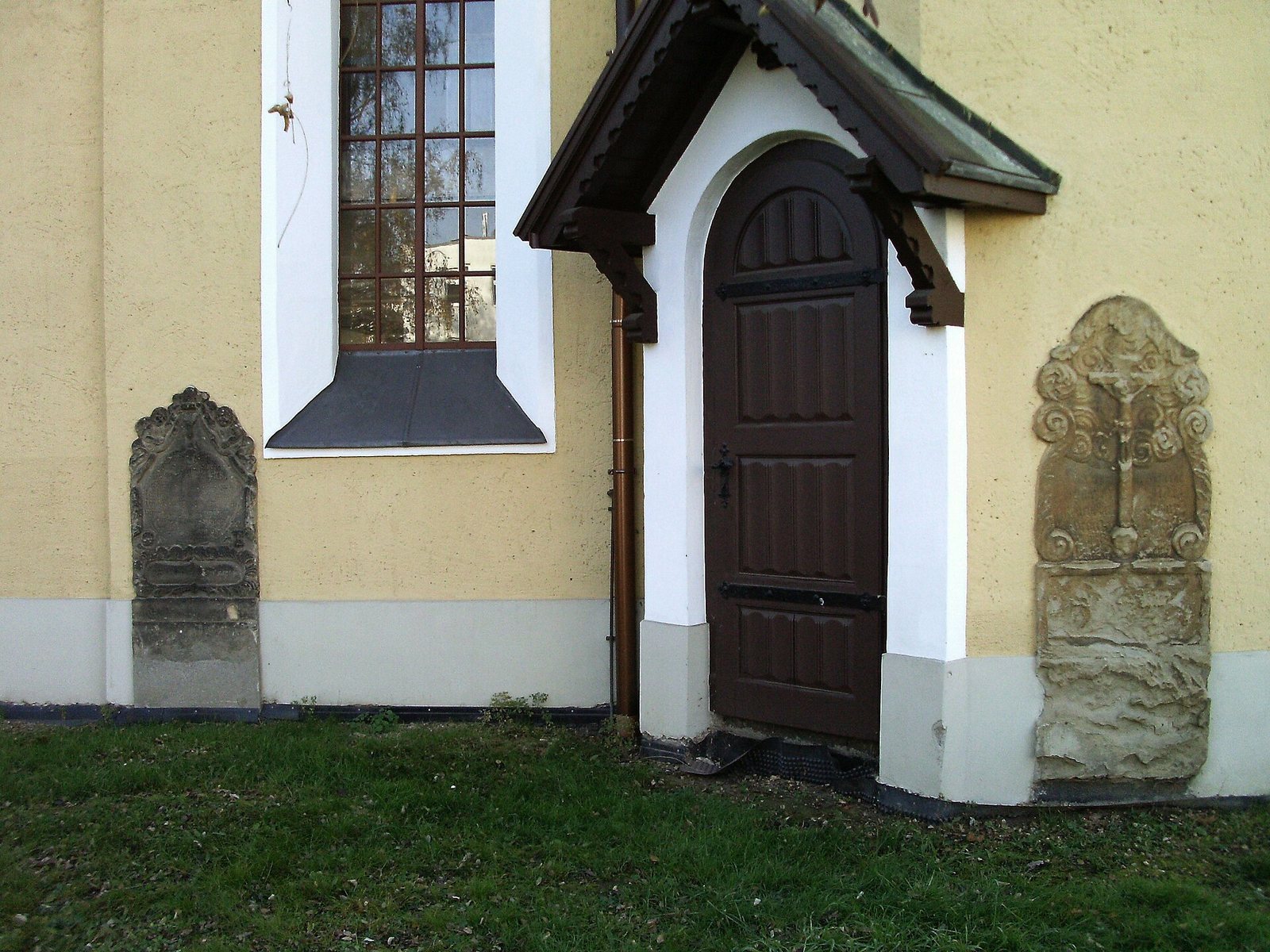
Eighteenth-century gravestones are set into the church’s exterior walls. They originally stood in the churchyard.