Ribeira Grande Municipal Hall: A Seat of Local Government
Site at a Glance
- Popularity
- Very Low
- Country
- Portugal
- Primary era
- Early Modern
- Eras represented
- Early Modern, Modern
- Civilizations
- Portuguese
- Site type
- Civic
- Remains
- Town Hall
On this page6 sections
History
Ribeira Grande Municipal Hall is a civic building in central Ribeira Grande on São Miguel Island, Portugal. Its construction history extends across the sixteenth and seventeenth centuries, with work on a municipal building beginning in the seventeenth century. Described as medieval in style, the hall is regarded as an emblematic building of the city.
Municipal origins and rebuilding
The region’s first political authority was established on 4 August 1507. The earliest surviving municipal minutes date from 5 January 1555, providing a record of local government in the following decades.
A combined seismic and volcanic event in 1563–1564 destroyed the community and its original municipal hall. Work on a municipal building began in the seventeenth century, after this destruction.
Prison expansion and civic changes
On 17 February 1796, municipal representatives resolved to build two arches over Rua das Espigas, with rooms above for prison officers. Their plans also set aside space for a chapel where prisoners could attend Mass, and included a tower and clock. A wing was later built over the public passage to house prison officers and inmates, with bells and a municipal clock.
Public gardens were laid out in front of the hall between 1860 and 1864. Interior remodeling by the 1930s added a staircase, a stained-glass window to light it, and a ceiling in the main hall. Tilework by Portuguese artist Jorge Rei Colaço was installed in 1936.
The hall has been classified as a Property of Public Interest since 1984. A 2006 plan to safeguard Ribeira Grande’s historic center included the building, which is owned by the Portuguese Republic.
Remains
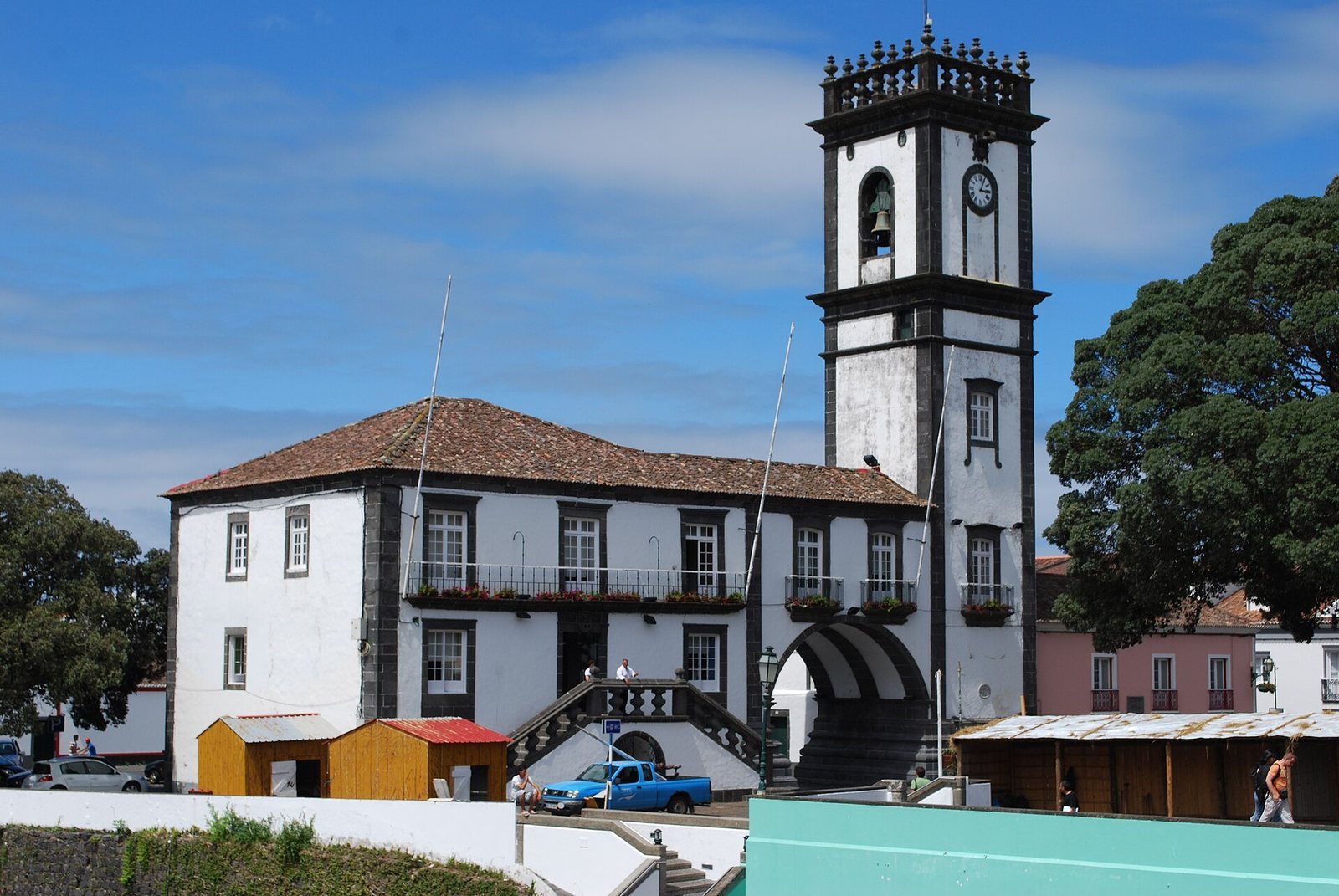
Built of stone masonry, the three-storey hall consists of a principal rectangular block and a shallower section on the right. The building stands beside the walls and sloping bank of the Ribeira Grande River. The gardens of Praça Hintze Ribeiro, also known as the People’s Garden, lie in front; the Church of the Misericórdia, the Church of the Holy Spirit, and the Church of Nossa Senhora da Estrela are to the east, while the Ribeiragrandense Theatre is to the southwest.
Main façade and public passage
A symmetrical exterior staircase with large balusters, the short posts supporting its handrails, rises to an entrance flanked by windows. The doorway’s horizontal lintel, or supporting beam, bears the municipal coat of arms, flanked by two diamond shapes and connected to the support beneath the balcony above. Three windows with verandas rise above the main body. On the upper floors of the principal façade are two veranda windows and two vertically sliding windows; the rear openings are plain. A rounded window at the upper left has flag and geometric motifs, and another window lights the staircase. A further opening is in the Manueline style, a Portuguese form of late Gothic architecture. The shallower right-hand section contains a lateral clock tower and spans a public road as an arched bridge, with a large framed arch at ground level.
Prison passage and interior
A tunnel-like passage above the main staircase leads to the below-ground floor, where the jail had successive levels. Inside, a separate staircase is lit by stained glass, and the main hall has a ceiling. Its glazed ceramic tile panels depict watermills, the Cavalhadas de São Pedro, a traditional celebration associated with Saint Peter, feasts of the Holy Spirit, which are Christian observances, tea plantations, and Gaspar Frutuoso, a sixteenth-century Azorean historian and cleric. The panels also show the former municipal coat of arms from the constitutional monarchy, a system in which the monarch’s powers were limited by a constitution. The hall contains an old pillory stone, from a post used for public punishment and as a sign of municipal authority, and portraits of Portuguese heads of state from Queen Maria II, a nineteenth-century monarch, to the present.