Liden Old Church: A Medieval Stone Church in Sweden
Site at a Glance
- Country
- Sweden
- Primary era
- Early Modern
- Eras represented
- Medieval, Early Modern, Modern
- Civilizations
- Swedish
- Site type
- Religious
- Remains
- Church
On this page15 sections
History
Medieval origins
Liden Old Church stands in Liden, Sweden, in the Indalsälven valley. It belongs to Liden Parish in the Diocese of Härnösand, a regional church jurisdiction within the Evangelical Lutheran Church of Sweden. A predecessor church, probably built of wood, existed by the thirteenth century at the latest. The present stone church was consecrated in the sixteenth century.
According to a tradition written down in the seventeenth century by parish priest Johannes Clemens Thelaus, construction of the stone church began in 1483. Josephus, a Finnish-born Dominican friar, initiated the work. The Dominicans were a Roman Catholic order whose friars preached and lived in religious communities. The church was completed in 1510. That year, Josephus drowned while crossing the Indalsälven.
Changes to the church
The church was painted in 1561. An inscription in the choir was understood to dedicate the decoration to God’s honor and the adornment of the holy place. In the 1750s, the paintings were covered with whitewash, and a new altar ornament and pulpit were installed.
Russian attacks in 1721 destroyed an earlier bell tower, which was replaced in 1730. A bell dated 1729 is now kept in the present tower. In 1768, the parish recorded an expense for a church bell; it later served as the small bell in the successor church. A cracked bell from the old church was also used to cast that church’s large bell.
Magnus Huss, a Swedish entrepreneur remembered for his connection with the Ragunda catastrophe, was buried beside the church in 1797. The catastrophe occurred when a lake suddenly drained, sending floodwaters through the Indalsälven valley. Huss drowned the following year, and his body washed ashore at the Liden ferry crossing. The Huss family association erected a memorial stone in 1951.
Demolition and restoration
A decision to demolish the church and build a replacement was made in 1802, but work on the old building did not begin until 1856. Workers dismantled its brick vaults and removed the windows and doors in an attempt to recover bricks for the new church. The mortar held so firmly that only about a hundred bricks could be freed intact. Furnishings and fittings, including images of the Madonna, were left exposed in the churchyard. The most valuable objects were eventually rescued and stored in a shed, then kept out of sight in a space in the successor church’s tower. Avoiding the cost of maintaining two churches may also have contributed to the demolition.
Stripped of its doors and windows, the old church stood abandoned and deteriorated for more than fifty years. Restoration took place from 1911 to 1928, largely through the initiative of parish priest Lars Hoflin. The old wall paintings were uncovered, but the brick vaults were not rebuilt. The earlier bell tower was turned into firewood during the 1856 demolition. A new tower was built on its site in 1958.
Stolen and recovered objects
The church experienced repeated break-ins in which valuable sculptures were stolen, including a thirteenth-century Madonna. The latest theft took place in 2005, during a wave of thefts that also affected other churches in the county. The stolen objects were recovered in Spain, and the crimes were solved. Some objects were restored, secured against theft, and returned to the church; others remain at the County Museum in Härnösand. The Madonna, which had been on loan from Holm, was displayed at the museum for a time before being returned to Holm Parish.
Remains
Church building
Plan and construction
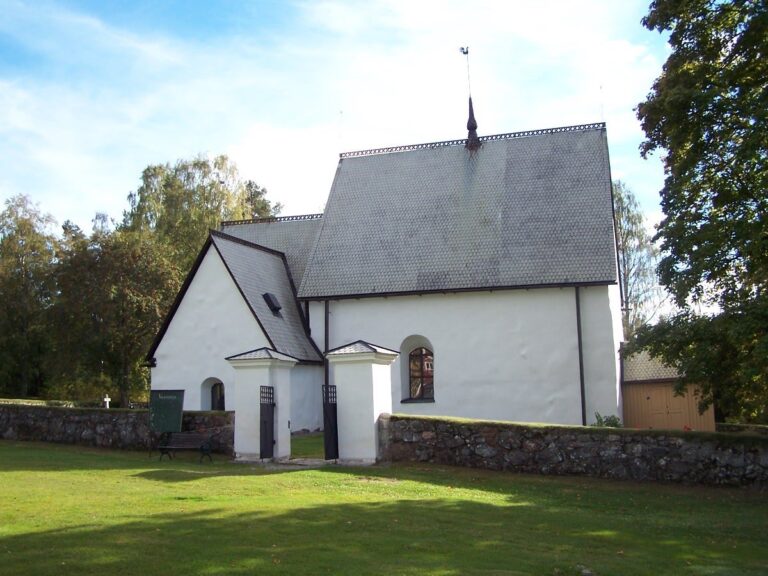
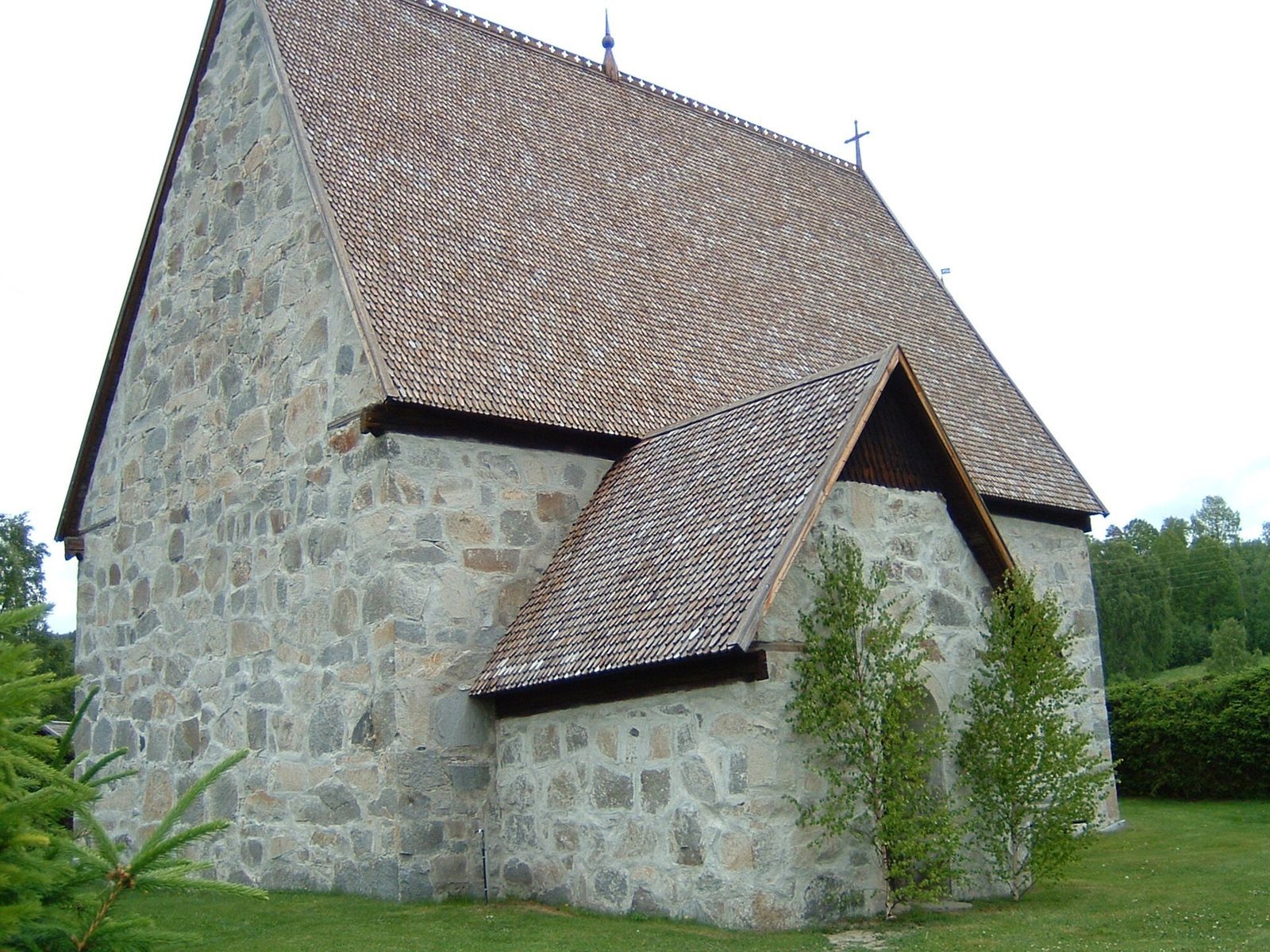
The stone church has a rectangular but slightly irregular plan. Its exterior measures 16.6 by 9.7 metres, its walls are 1.4 metres thick, and the building rises just over 10 metres. Grey stone forms the main walls, with brick around the windows and doors. A porch and a sacristy, a room used to store church vessels and vestments, extend from the main body. Their walls do not interlock with the main walls, and they were probably added not long after the church was built. The porch measures 5.0 by 4.4 metres and the sacristy 4.8 by 4.4 metres.
Ceilings and windows
The church originally had brick star vaults, ribbed ceilings whose ribs form a star pattern. The present interior has a curved wooden ceiling instead. A painted band in the northeast corner shows the shape of the earlier vaults. The sacristy has brick vaults with arches resting on projecting corner supports; the porch probably had a brick vault as well.
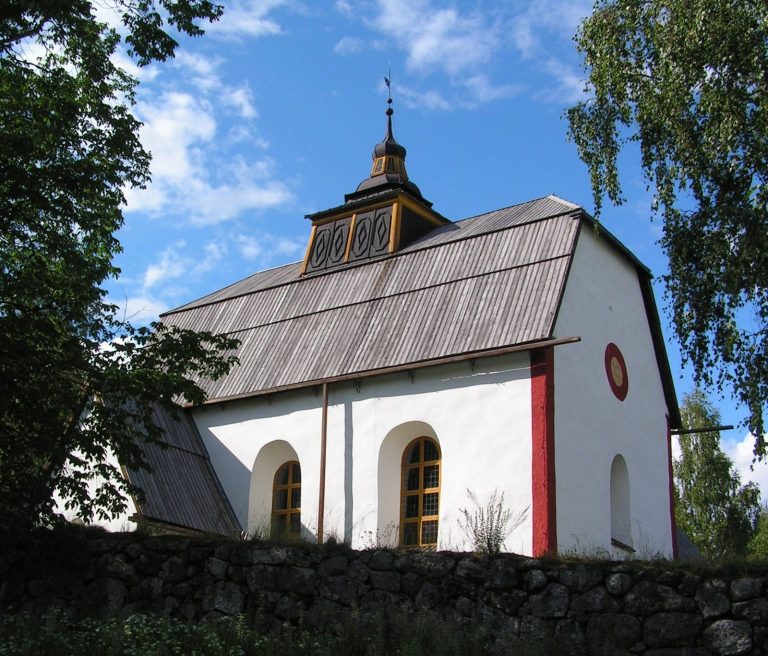
The exterior was replastered and limewashed from 1740 to 1741, when the east and south windows were enlarged. A window opened on the north side in 1760 was later sealed during restoration. The other windows have round arches, and the sacristy also has a window. Smooth white plaster and a new roof date from the restoration carried out between 1911 and 1928.
Churchyard and associated structures
Gate and cemetery
A stepped gate framed with logs serves the church and churchyard entrances. It may date from 1693. A spruce hedge follows the former line of the timber boundary around the church and cemetery. Two grave crosses stand in the old cemetery, and several eighteenth-century crosses are mounted in the gate.
Bell tower and memorial
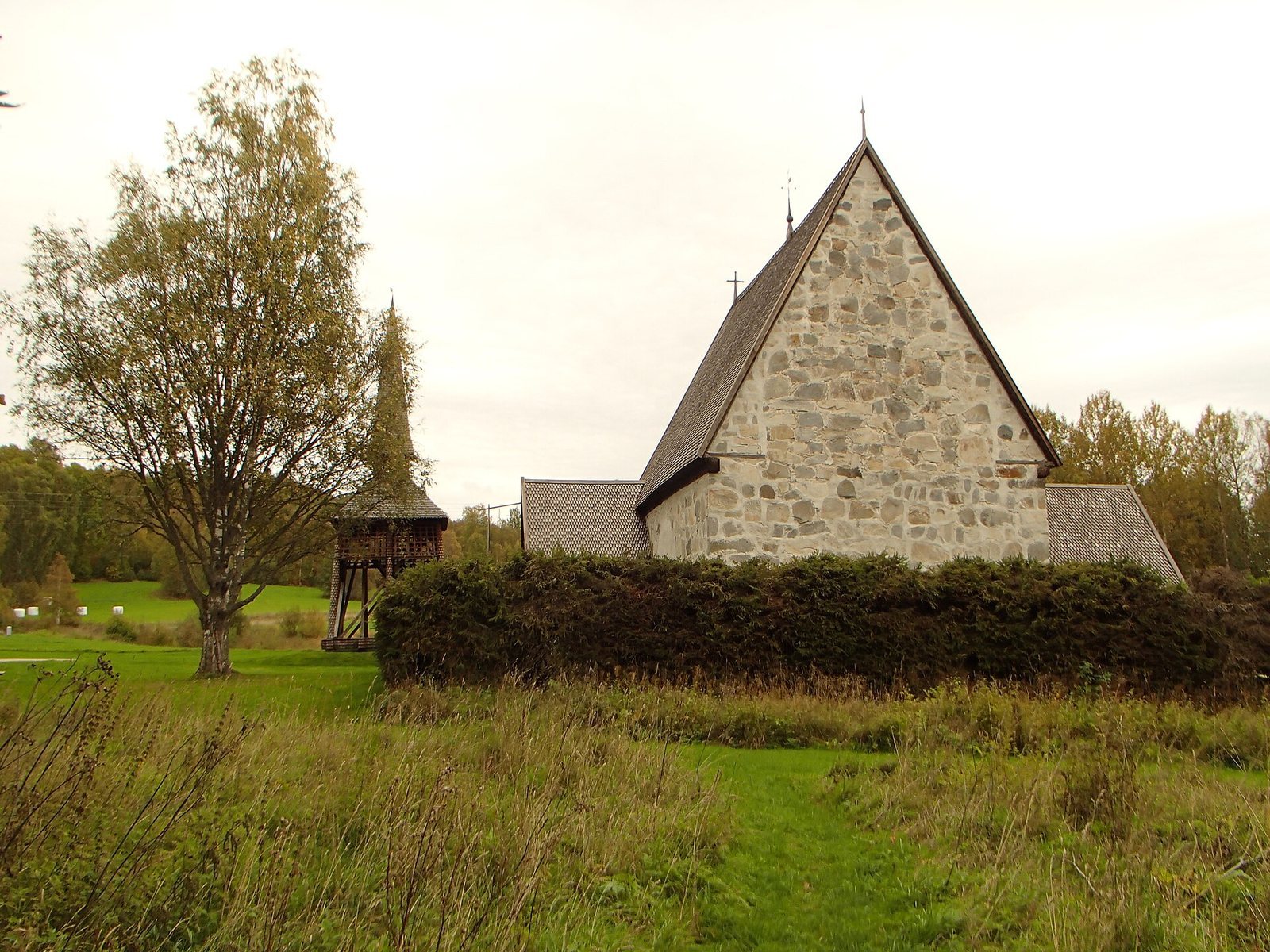
The present bell tower was built in 1958 on the site of the earlier tower. It holds the old church bell dated 1729. A memorial stone to Magnus Huss stands beside the church.
Furnishings and objects
Medieval furnishings
Among the preserved furnishings is a large crucifix probably made in the thirteenth century. A large crucifix of this kind was traditionally displayed above the division between the main body of a church and its chancel. The church door has an old-fashioned ring handle with a dragon’s head, a type associated with the twelfth century. A late-medieval shrine centered on an image of the Virgin Mary was made in Lübeck at the end of the fifteenth century.
Later fittings and parish collections
Images of saints remained in the church after its wall paintings were whitewashed. Sculptor Jonas Granberg made the altar ornament and pulpit in 1755; their flowing, elaborate forms reflect the Rococo style of the eighteenth century. Objects removed from the old church were later brought back. The church also holds some objects deposited by neighboring Holm Parish from its old church; these are not connected with Holm’s present church.