Gräsö Church: A Seventeenth-Century Wooden Church in Sweden
Site at a Glance
- Country
- Sweden
- Primary era
- Early Modern
- Eras represented
- Early Modern, Modern
- Civilizations
- Swedish
- Site type
- Religious
- Remains
- Church
On this page15 sections
History
Gräsö Church is a wooden church on Gräsö, Sweden, whose foundations were laid in 1695 and which was consecrated in 1697. Its pronounced Carolean character reflects an architectural tradition associated with the reigns of Swedish kings Charles XI and Charles XII in the late seventeenth and early eighteenth centuries.
The predecessor chapel and the new church
A chapel once stood near Söderboda village in northern Gräsö. It was probably used by fishermen, but fell into disrepair and was demolished around 1640. Its former location is known as Kapellandet. Work on the present church began with the laying of its foundations in 1695. The church was consecrated in the autumn of 1697, although construction was not yet finished. The western porch was built at the same time. The plans may have been drawn by Swedish architect Johan Hårleman.
Wartime damage and additions
In 1719, during the Great Northern War, a conflict between Sweden and a coalition of European powers, Russian forces vandalized the church and used it as a stable. They took one of its two iron bells. Repairs had to wait 25 years, until funds became available. A sacristy, a clergy room for service preparations and vestments, was added in 1753, and the interior walls were panelled in 1758-59.
Restoration and parish history
An extensive restoration in 1887 brought a new floor, replaced closed pews with open ones, and covered the fixed furnishings with paint. In 1906, the interior was repainted and the wooden-shingle roof covering was replaced with iron sheeting.
Architect Sigge Ullén led a restoration from 1930 to 1933, with Sven Dalén serving as conservator. Workers removed overpainting from the pulpit, altar rail, and organ gallery, repainted the rest of the interior, and rebuilt the pews. They also added a window with stained glass to the porch’s north wall, covered the sacristy walls with fibreboard, and installed low-pressure steam heating in its basement. The gilded altar cross was moved to the porch. Electric heating followed in 1951.
Before the church’s 300th anniversary in 1997, a major restoration provided a new floor and heating system. The separate bell tower was renovated in 1990 and again in 2015. Until 2002, the church belonged to Gräsö parish, which then became part of Öregrund-Gräsö parish. It belongs to the Church of Sweden, a Lutheran church, and the Diocese of Uppsala, a regional church district.
Remains
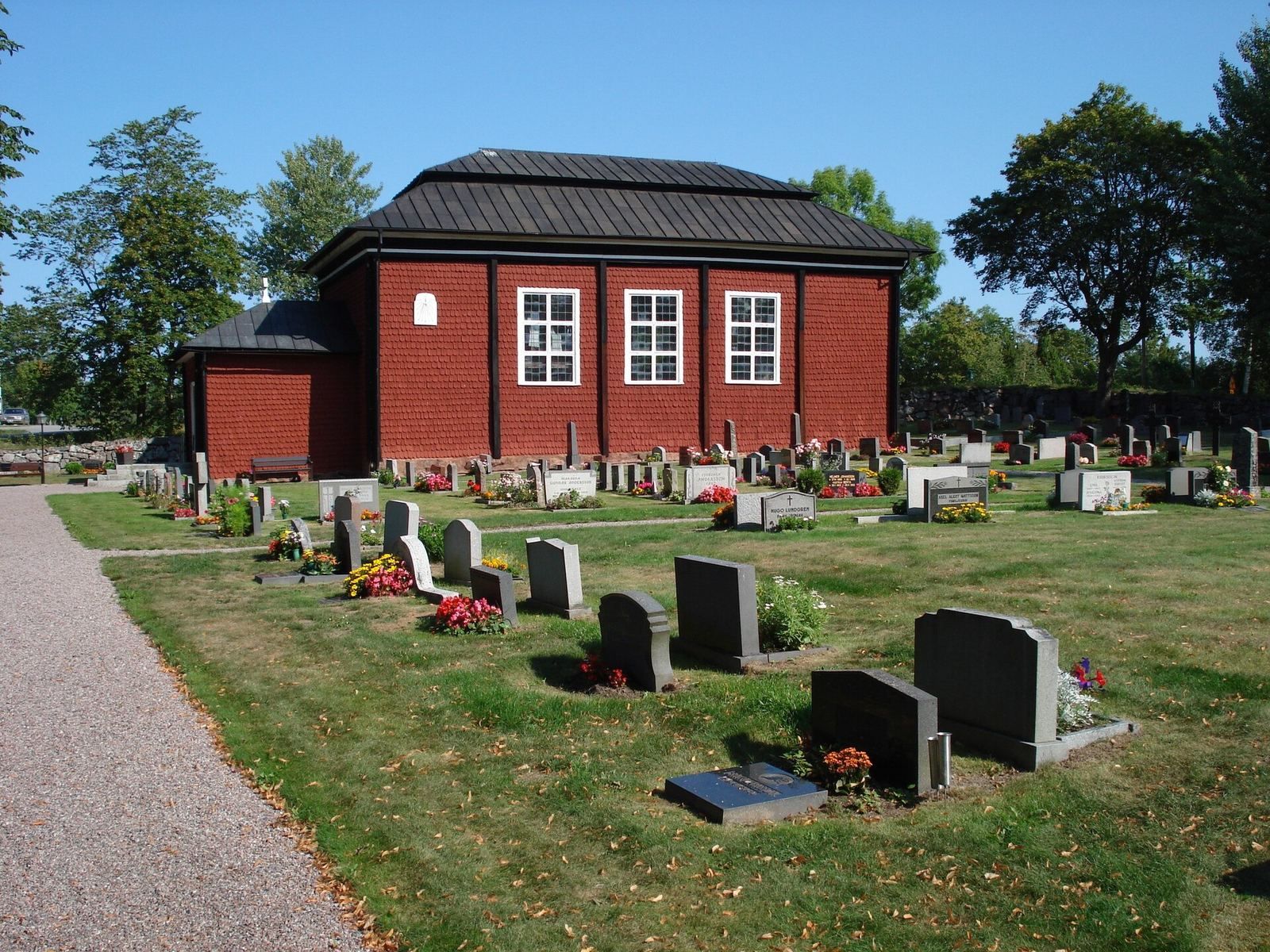
The church is built from horizontal logs resting on a cobblestone base. Angled walls at the corners create an elongated octagonal interior, with extra spaces reached through doors leading to stairs and storage areas.
Exterior and setting
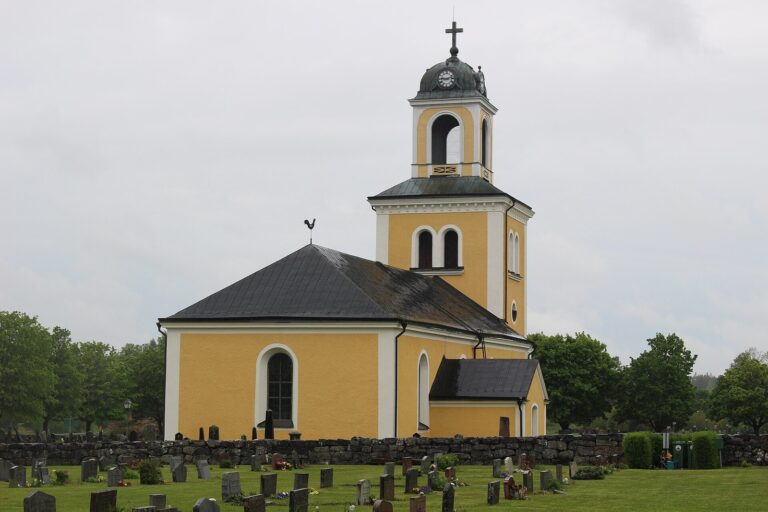
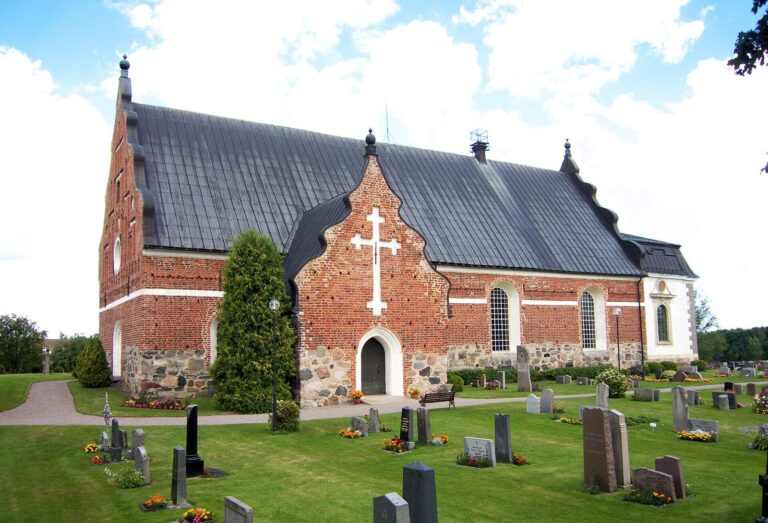
The church stands near the centre of Gräsö, beside the crossing to Öregrund and about 100 metres from the strait. Its exterior has changed little since construction. The western porch is half the height and half the width of the main building, while a sacristy is attached on the north side. The roof has an unusual shape.
Interior and furnishings
Interior plan and finishes
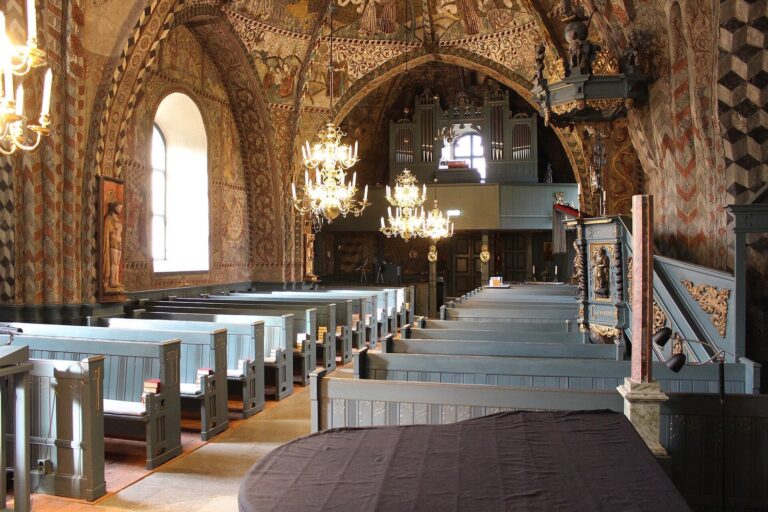
The angled corner walls form additional spaces with doors to stairs and storage areas. The walls are grey below and ochre-yellow above. The choir, the area around the altar, is only lightly set apart from the rest of the room.
Gallery and pulpit
Master builder Jacob Ersson built the western gallery in 1748-49. Carpenter Per Olofsson made the pulpit in 1697; its base and sounding board, a canopy designed to carry the speaker’s voice, were added in the 1740s.
Altar and devotional objects
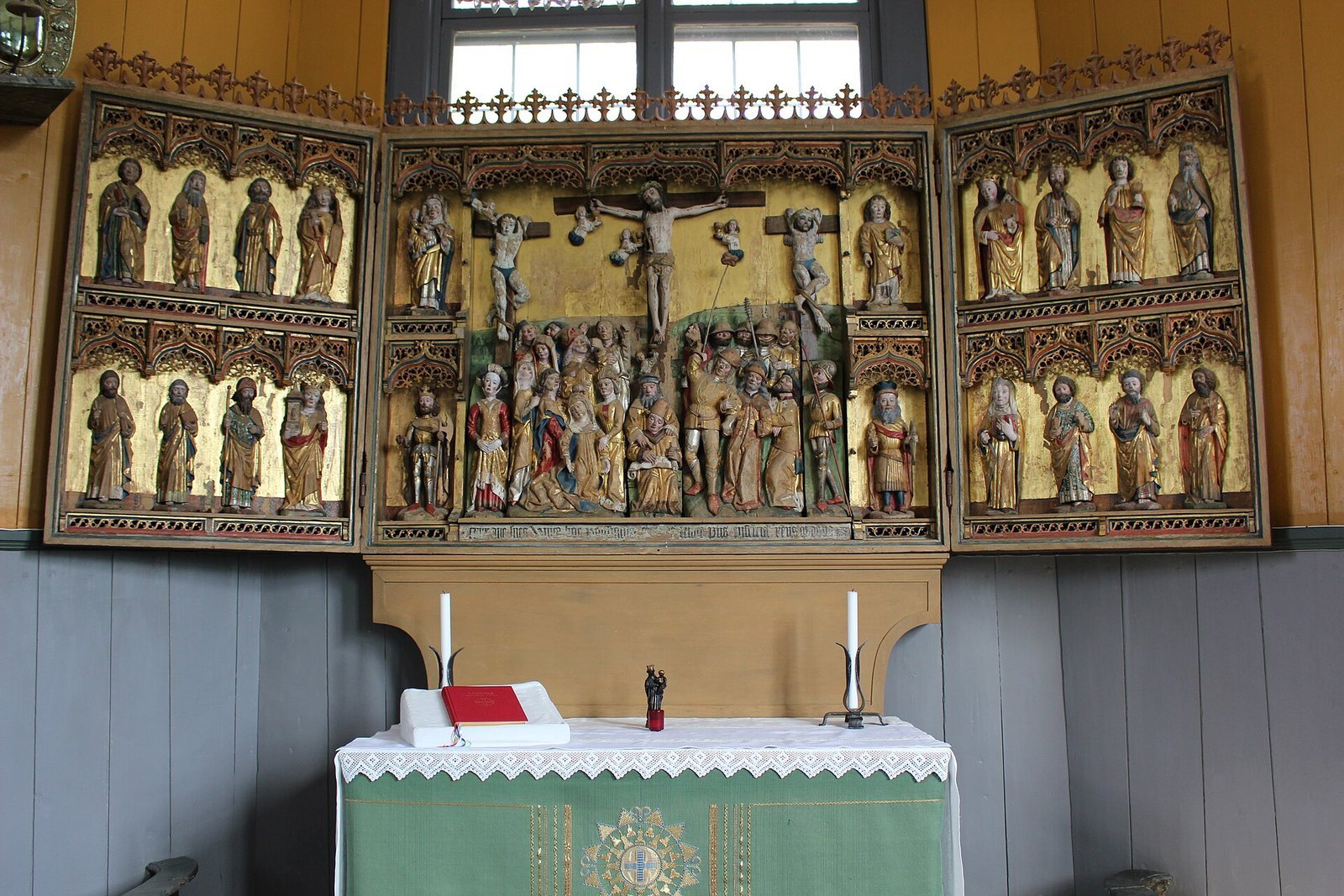
The wooden altar dates from the nineteenth century. Its original green and grey-green marbled finish was uncovered in 1933. The gilded oak altarpiece, a carved panel behind the altar, dates from the latter half of the fifteenth century and was probably made in Sweden. Johan Hallman bought it from Edebo Church in 1743 and gave it to Gräsö Church. A sixteenth-century crucifix may have come from the predecessor chapel. A gilded cross with a crown of thorns and white cloth was placed on the altar in 1842 and moved to the porch during the 1930-33 restoration.
Organ and suspended furnishings
The first organ was built in 1842 by Pehr Gullbergson. It had six stops, a key mechanism, and a stop valve. A rigged votive ship, a model offered to a church and often suspended indoors, was bought in 1765 and installed in the middle of the church in 1880. Two copper-alloy chandeliers date from the eighteenth century. A crystal chandelier hangs over the central aisle near the choir, and a seventeenth-century tinned-metal chandelier is in the sacristy.
Bell tower
The free-standing, octagonal bell tower stands east of the church and was built in the 1740s. An earlier tower, built in 1696, was demolished in 1742. The present tower received its board cladding in 1906. Its profiled hood is covered with black-painted iron sheeting, and an iron spire with spirals supports a weather vane dated 1788. The smaller bell was cast in 1750 and the larger in 1788.
Churchyard and poor box
Churchyard and boundary
Several layers of sand were added to the churchyard during the eighteenth century to address waterlogged, marshy ground. The yard was extended south in 1865, and its wall was extended at the same time.
Poor box
South of the western entrance, an iron poor box for charitable donations stands on a round post beneath a small gabled shelter. Acquired in 1747, the box and shelter are made of black-painted pine. A white wooden plaque added in 1863 bears the inscription "TO THE POOR. BLESSED ARE THE MERCIFUL."