Palace of the Governors: A Historic Government Seat in Santa Fe
Site at a Glance
- Country
- United States
- Primary era
- Early Modern
- Eras represented
- Early Modern
- Civilizations
- Spanish
- Site type
- Civic
- Remains
- Palace
On this page5 sections
History
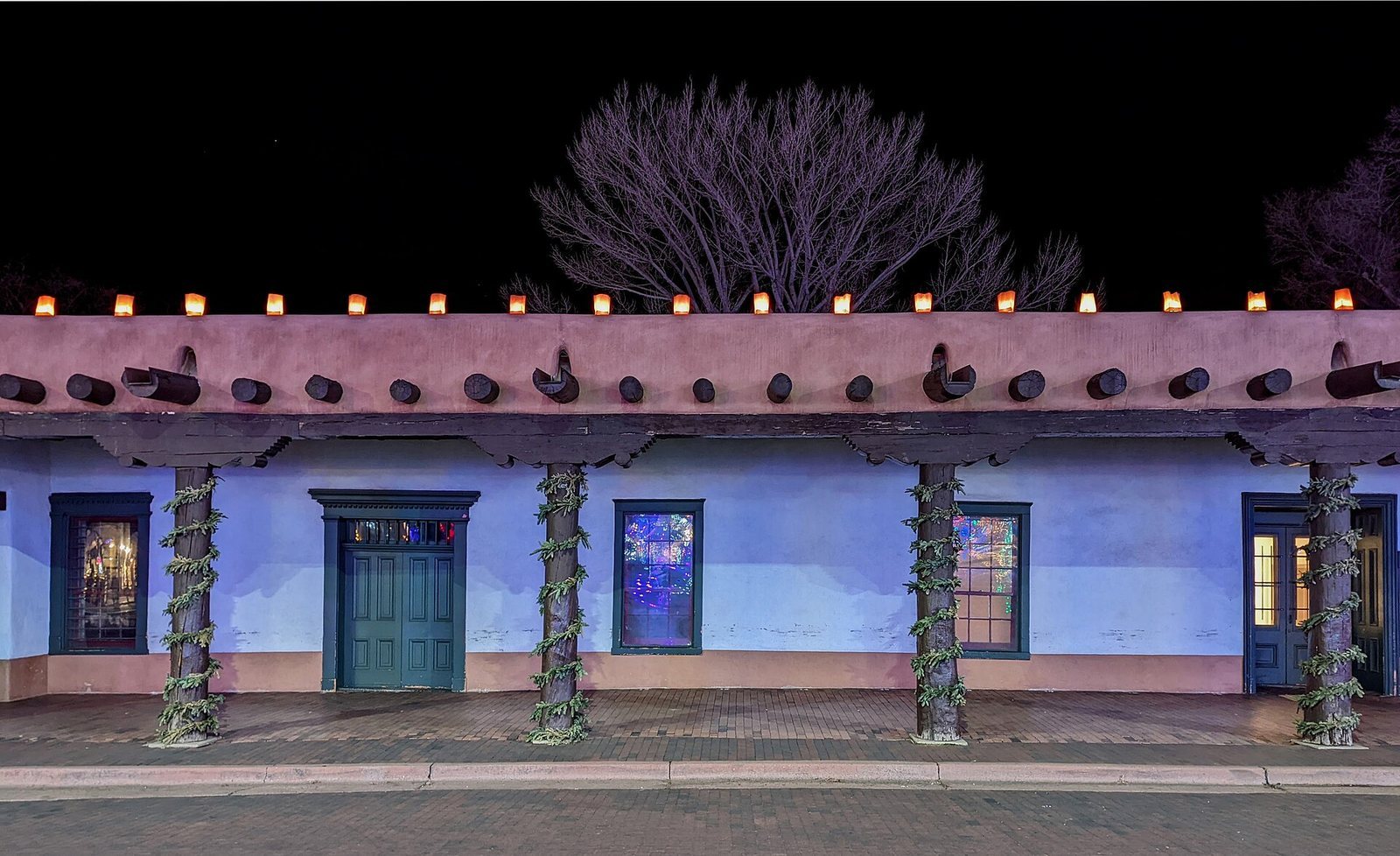
The Palace of the Governors is a government building on the Santa Fe Plaza in Santa Fe, New Mexico, United States, established in 1610 as the capitol of Spanish Nuevo México. Its architecture is described as Territorial Style Pueblo, blending Pueblo building traditions with features associated with New Mexico’s U.S. territorial period.
Spanish colonial rule
Construction is traditionally dated to 1610 and credited to newly appointed governor Pedro de Peralta. Later historical research places the start around 1618 and suggests that another governor may have begun the work. The Palace served as the seat of government for Spanish Nuevo México and stood within the Santa Fe presidio, a Spanish military post and fortified settlement described as the province’s most important. At times, the colony extended across much of what is now the American Southwest.
In 1680, the Pueblo Revolt, an uprising by Indigenous Pueblo communities against Spanish colonial rule, changed control of the province. Spanish forces reconquered it in 1693–1694, and the Palace passed through these changes in colonial authority.
Mexican and U.S. government
After Mexican independence in 1821, the Palace served as the administrative seat of the Mexican province of Santa Fe de Nuevo México. The United States took control in 1848. When New Mexico became a U.S. territory, the Palace became its first territorial capitol. It continued as a government seat until 1901; New Mexico achieved statehood in 1912.
Territorial governor Lew Wallace, who held office from 1878 to 1881, wrote the final parts of Ben-Hur: A Tale of the Christ in the Palace. He later recalled writing the novel’s climactic Crucifixion scenes in the spring of 1879, after a tense meeting with Billy the Kid in Lincoln County. During a severe thunderstorm, Wallace worked by lamplight and feared a shot from outside amid tensions associated with the Lincoln County War.
Restoration and public history
In 1909, anthropologist Edgar Lee Hewett invited archaeologist Jesse L. Nusbaum to direct restoration of the Palace, which had fallen into disrepair. The work was completed in the fall of 1913. Nusbaum, the first employee of the School of American Archaeology, later called the School of American Research, and the Museum of New Mexico, emphasized adapting the building to its climate and setting, including its colors in relation to earth and sky. He later applied a similar approach as superintendent of Mesa Verde National Park. The Palace housed the state history museum from 1909 until the summer of 2009, when the New Mexico History Museum opened next door.
The Palace became a National Historic Landmark in 1960, joined the National Register of Historic Places in 1966, and was recognized as a contributing property of the Santa Fe Historic District in 1973. It was designated a National Treasure in 2015. On June 17, 1960, the U.S. Postal Service issued a turquoise 1¼-cent stamp depicting the building from a front angle, based on a photograph by Santa Fe photographer Tyler Dingee. The stamp’s release coincided with the opening day of Santa Fe’s 350th-anniversary celebration, and it was the eighth “national shrine” honored in the series.
Remains
The Palace occupies less than one acre on Palace Avenue, between Lincoln and Washington avenues. It is built of adobe, earth shaped into blocks and dried, and is also classified in the Neo-Pueblo and Neo-Spanish Colonial revival styles, which draw respectively on Pueblo and Spanish colonial traditions. The building includes a shuttered governor’s study.