Fort Christian: A Danish Colonial Fort on Saint Thomas
Site at a Glance
- Country
- United States
- Primary era
- Early Modern
- Eras represented
- Early Modern, Modern
- Civilizations
- Danish, Denmark–Norway
- Site type
- Military
- Remains
- Fort
On this page12 sections
History
Danish Settlement and Construction
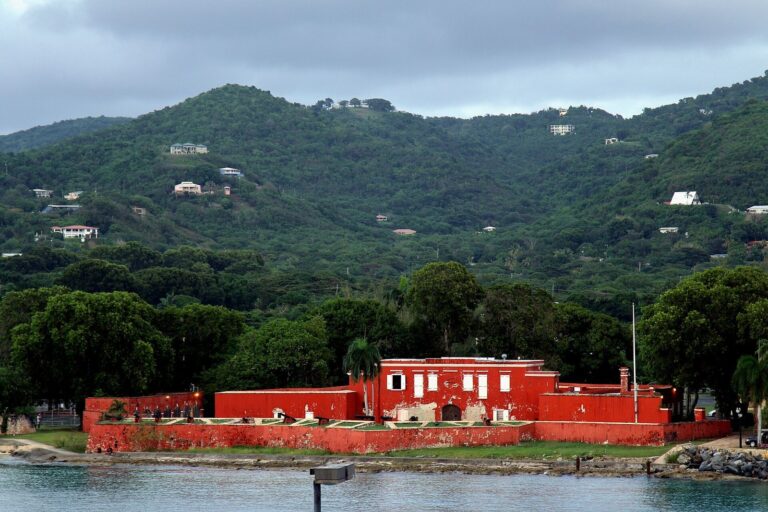
Fort Christian is a Danish colonial fort in Charlotte Amalie, on Saint Thomas in the U.S. Virgin Islands. Built between 1672 and 1680 in the Danish military tradition, it became a defensive stronghold and administrative center. It is the oldest standing structure in the U.S. Virgin Islands and the oldest and largest fort on Saint Thomas.
An earlier Danish effort to colonize Saint Thomas failed in 1665. The settlers faced English raids for supplies, an unfamiliar climate, tropical diseases, and disruption from the Second Anglo-Dutch War. The few survivors returned to Denmark. Trade in tobacco, rum, and other local products encouraged Denmark-Norway to try again.
Governor Jørgen Iversen Dyppel led the renewed expedition, which reached Saint Thomas on 25 May 1672 and began building the fort. It was named for Christian V, king of Denmark and Norway from 1670 to 1699.
Defensive and Administrative Center
French forces attacked Saint Thomas in 1678 but did not take the fort. It was enlarged during the eighteenth century, with further work carried out between 1724 and 1735. Under the joint Danish-Norwegian monarchy and later Danish rule, Fort Christian served both military and civic purposes. It was the residence of the island’s first governors and housed government offices and a jail.
From Fort to Museum
In 1874, Fort Christian ceased to serve a military role and became a police station and prison. Danish administration of the islands ended in 1917, when they were sold to the United States. The police and prison institutions left the fort in 1983. A museum had opened there in 1971.
From 1960 to 1975, the property formed part of Charlotte Amalie National Historic Site, also known as St. Thomas National Historic Site. After that site was dissolved, the Virgin Islands took ownership and administered the fort as a territorial park. Fort Christian was added to the National Register of Historic Places and designated a U.S. National Historic Landmark in 1977; it is also part of the Charlotte Amalie Historic District. Restoration work led to its closure in the 2000s, and it reopened in 2017, a century after the transfer to U.S. jurisdiction.
Remains
Fort Christian covers 1.92 acres (0.78 hectares) and has a roughly square plan. Built on rock with stones brought as ship ballast, it combines Danish military fortification with Late Victorian elements, associated with the later part of Queen Victoria’s reign, and Gothic Revival features that draw on medieval Gothic forms. Changes to the surrounding shore have altered its original setting: the fort once stood on a narrow peninsula extending into the natural harbor, with water on three sides. Veterans Drive now separates it from the former harbor, and reclaimed land borders it to the east and west.
Fortifications and Enclosure
Walls, Bastions, and Outer Defenses
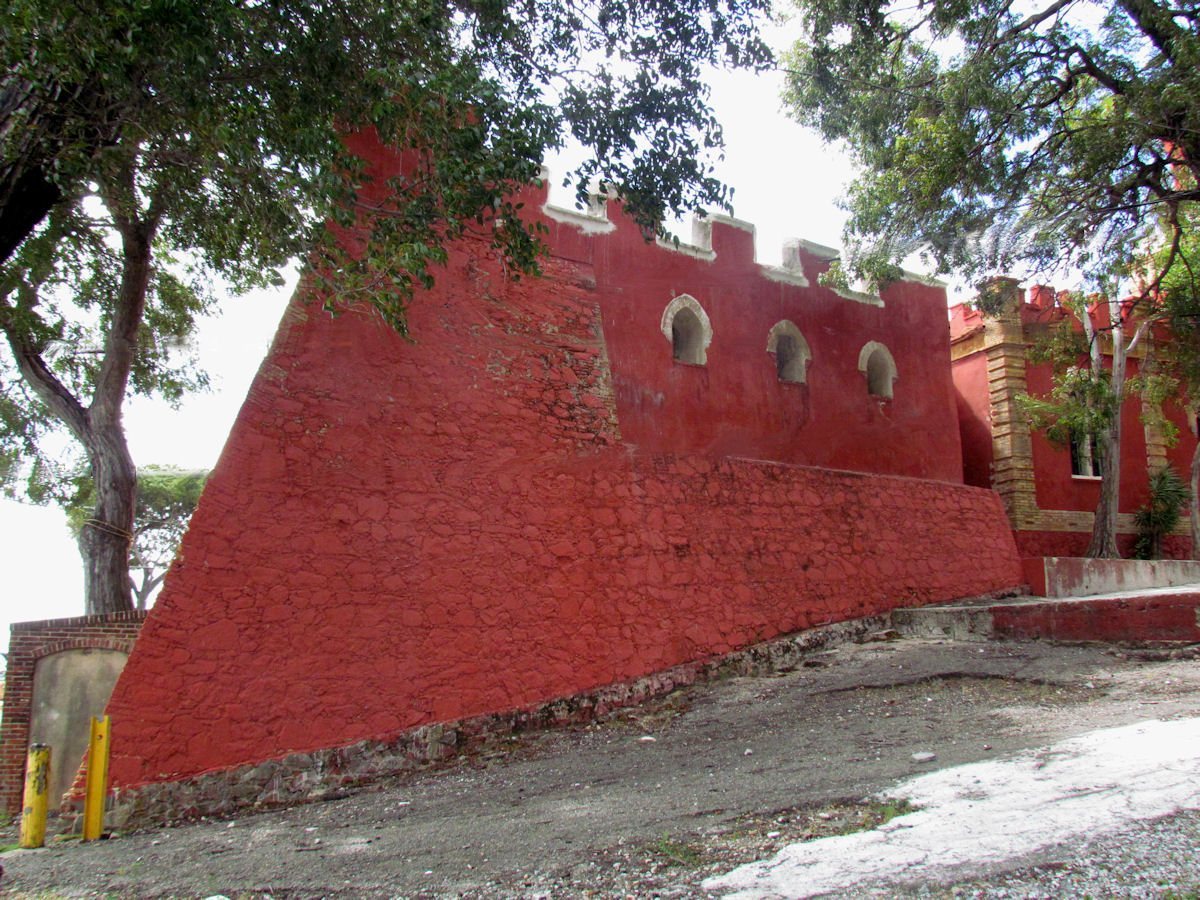
The fort’s sloping stone curtain walls, the main defensive walls between projecting structures, are 1 to 2 meters thick. Diamond-shaped bastions, projecting platforms that helped defend the walls, stand at the corners. Detached outer defenses once strengthened the north, east, and west sides. Three of the four curtain walls and all four bastions survive.
Living Quarters and Enclosed Buildings
Living quarters were built along the surviving walls. The enclosure contains 21 buildings, forming the built interior of the fort.
Entrance and Interior Structures
Northern Entrance and Trygborg
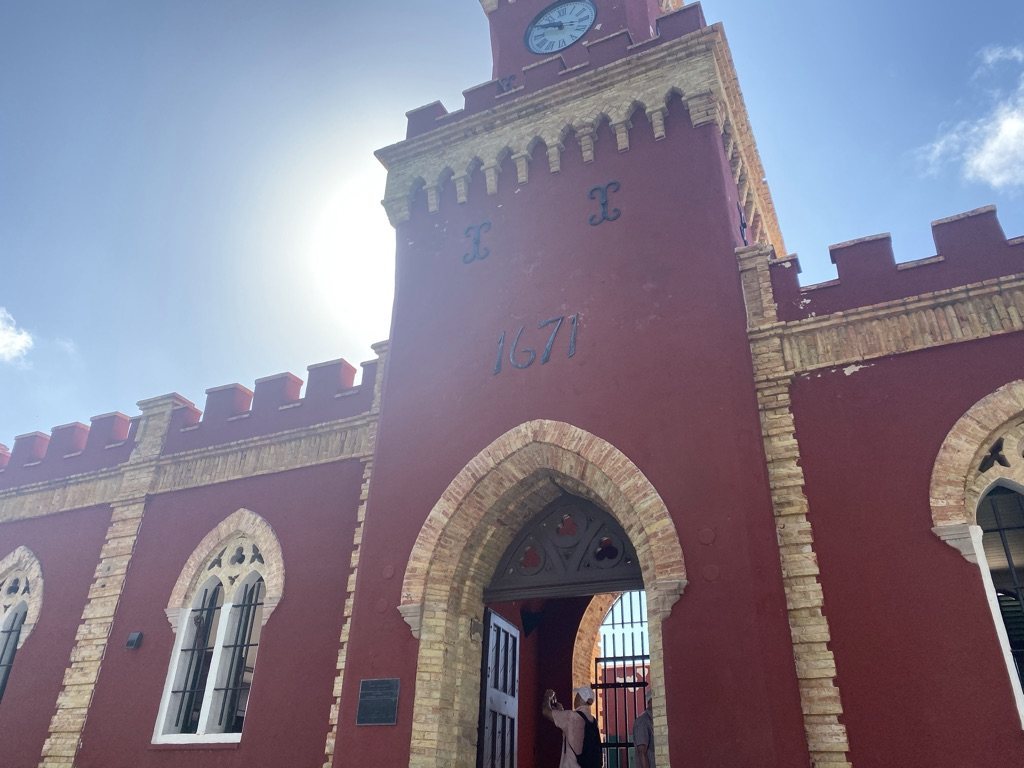
An oval tower called Trygborg once stood at the fort’s north end. In 1874, the north side and the tower were removed to make way for a new entrance with a clock tower. The entrance tower has Victorian and neo-Gothic, or Gothic Revival, features. The year 1671 above the gate commemorates the departure of the first ships from Denmark for Saint Thomas, rather than the fort’s construction.
Central Tower and Administrative Building
A large circular stone tower originally stood at the center of the fort. It was demolished in the nineteenth century and replaced by an administrative building in the Gothic Revival style.
Museum
The fort now houses the St. Thomas Museum, whose collection includes artifacts and art from the colonial period.