Fort Provintia: A Dutch Fort and Historic Site in Taiwan
Site at a Glance
- Country
- Taiwan
- Primary era
- Early Modern
- Eras represented
- Early Modern, Modern
- Civilizations
- Dutch, Japanese, Qing
- Site type
- Military
- Remains
- Fort
On this page19 sections
History
Fort Provintia is a Dutch fort in Taiwan, begun in 1653 by the Dutch East India Company and completed in 1655. Built north of the town of Provintia, it became a defensive stronghold and later an administrative centre under the Zheng regime.
Dutch and Zheng rule
In January 1625, the Dutch East India Company, a chartered trading company that governed Dutch possessions in Taiwan, acquired land at Sakam from the local Siraya community. The Siraya are an Indigenous people of southwestern Taiwan. The company paid 15 bolts of cloth and planned a town called Provintia, a name recalling the Dutch Republic, a federation of seven united provinces. It established two small forts and a bamboo enclosure around the settlement, then brought increasing numbers of Chinese and Japanese traders there.
The Dutch built Fort Provintia after the 1652 Guo Huaiyi uprising prompted them to reinforce their defenses. Dictionaries and commercial records associated with the fort recorded the Siraya language and regional trade. In April 1661, Koxinga, a Ming loyalist military leader who fought the Dutch in Taiwan, captured the fort during his campaign against them. He made it the seat of Chengtian Prefecture, the Zheng regime’s highest administrative unit on the island. The fort then became commonly known as Chihkan Tower.
In 1664, Koxinga’s son and successor, Zheng Jing, renamed the regime’s territory Dongning and abolished Chengtian Prefecture. The former government building was put to use storing gunpowder.
Qing rule and new institutions
During Zhu Yigui’s 1721 uprising against Qing rule, the fort’s cast-iron gate plaque was taken down and melted to make weapons. Human damage, typhoons, and earthquakes further weakened the site, leaving much of the fort in ruins. In 1750, the Taiwan County magistrate moved the county office beside it, arranged repairs, and took charge of its management. The fort’s evening light became known as Chihkan at Sunset, one of the scenic views of the prefectural city.
Guanyin devotees built a temple on the grounds during the early Tongzhi reign, a Qing period in the nineteenth century. Later in that century, Qing officials established the Sea God Temple, Wenchang Pavilion, and Five Sons Shrine on the former fort site. The Guanyin Hall, demolished during the Sino-French War of 1884–85, was rebuilt. In 1886, an academy, a school for Confucian learning and preparation for civil examinations, opened on land west of the site, succeeding an earlier local academy.
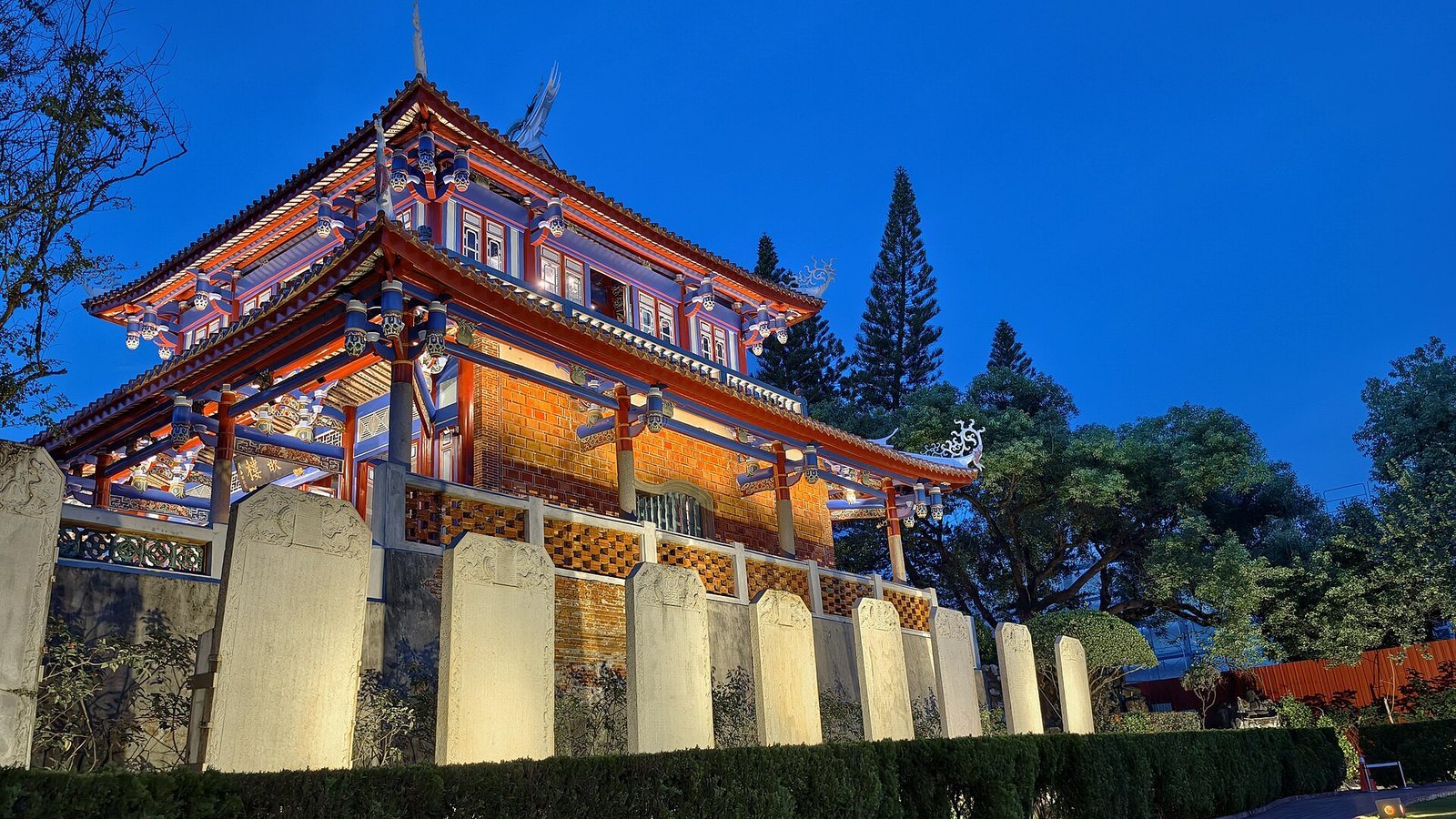
The nine tortoise-backed steles now at the site belong to a group commissioned by the Qing court after General Fukang’an suppressed Lin Shuangwen’s major rebellion against Qing rule in Taiwan in the late 1780s.
Japanese rule
During Japanese rule, the Sea God Temple, Wenchang Pavilion, and other shrine buildings served as a military garrison hospital and student dormitories. Their upper floors received Japanese-style interiors, and the pavilion buildings were repaired. The site also housed a branch of a Japanese-language school from 1918. A typhoon brought down the Five Sons Shrine in 1911.
Excavation, restoration, and changing use
In 1935, the site was designated a first-class historic site under the name Ruins of Fort Provintia. Work to clear a well between the Sea God Temple and Wenchang Pavilion identified it as a structure from the Dutch period. Major repairs to the two buildings began in March 1943 and ended in December 1944. Excavations during the work uncovered the old fort entrance and remains of its northeastern bastion, a projecting part of a fortification. A reconstruction of the Five Sons Shrine was planned but never carried out. The Guanyin Hall and Five Sons Shrine had been dismantled in 1942, while only the academy’s entrance hall remained.
During the Second World War, adjoining houses were removed to make an open space for air-raid protection. After an air raid destroyed the Tainan City History Museum, historical materials were moved to the academy grounds. The city history museum later used the site as its premises and opened an exhibition there in 1946.
A major renovation in 1965, led by a university professor, replaced the principal timber frames of the Sea God Temple and Wenchang Pavilion with reinforced concrete and created a garden. Further renovation followed in 1975, and a study and restoration plan was prepared in 1992. The site was included among Taiwan’s first group of first-class historic sites in 1982, received national historic-site recognition in 1983, and became a National Historic Site when the classification system changed in 1997.
In 2000, the city designated a wider area as Chihkan Cultural Park, with Fort Provintia as its principal site. A redevelopment project launched in 2016 uncovered substantial archaeological remains. The plan was revised to exclude a proposed museum and backfill the remains. A new repair campaign began in 2022 in response to deterioration in the buildings and outdated equipment.
Remains
The present site brings together parts of the Dutch fort, later Chinese religious buildings, and the surviving entrance hall of an academy to the west. The fort once had walls with a perimeter of about 141 metres and a height of about 10.5 metres. Later Chinese construction enclosed it with high brick walls.
Dutch fortifications
Original defenses
The fort’s original layout included gun towers at its northern and southern corners, storage cellars for provisions, and a water supply intended to serve the garrison during a siege. These features formed part of the defensive complex whose surviving components include the entrance structure, platform, and remains of a northeastern bastion.
Entrance and northeastern bastion
Only the doorway portion of the original entrance remains; red brick seals the rest of the structure. The surviving northeastern bastion has thick red-brick walls resting on a traditional composite foundation made from oyster-shell lime, sugar juice, and glutinous rice.
Religious buildings and well
Sea God Temple
The Sea God Temple stands on the southern side of the site. Formerly used to worship the Four Dragon Kings of the Sea, deities associated with the seas, and Mazu, a goddess widely worshipped for protection at sea, it now displays historical material relating to the site. Its exhibits include images of the Four Dragon Kings, models of old ships, a map of the Taijiang lagoon, and a memorial requesting an honorific title for a sea deity. A ceremonial approach in front of the building marks its formal entrance.
Wenchang Pavilion
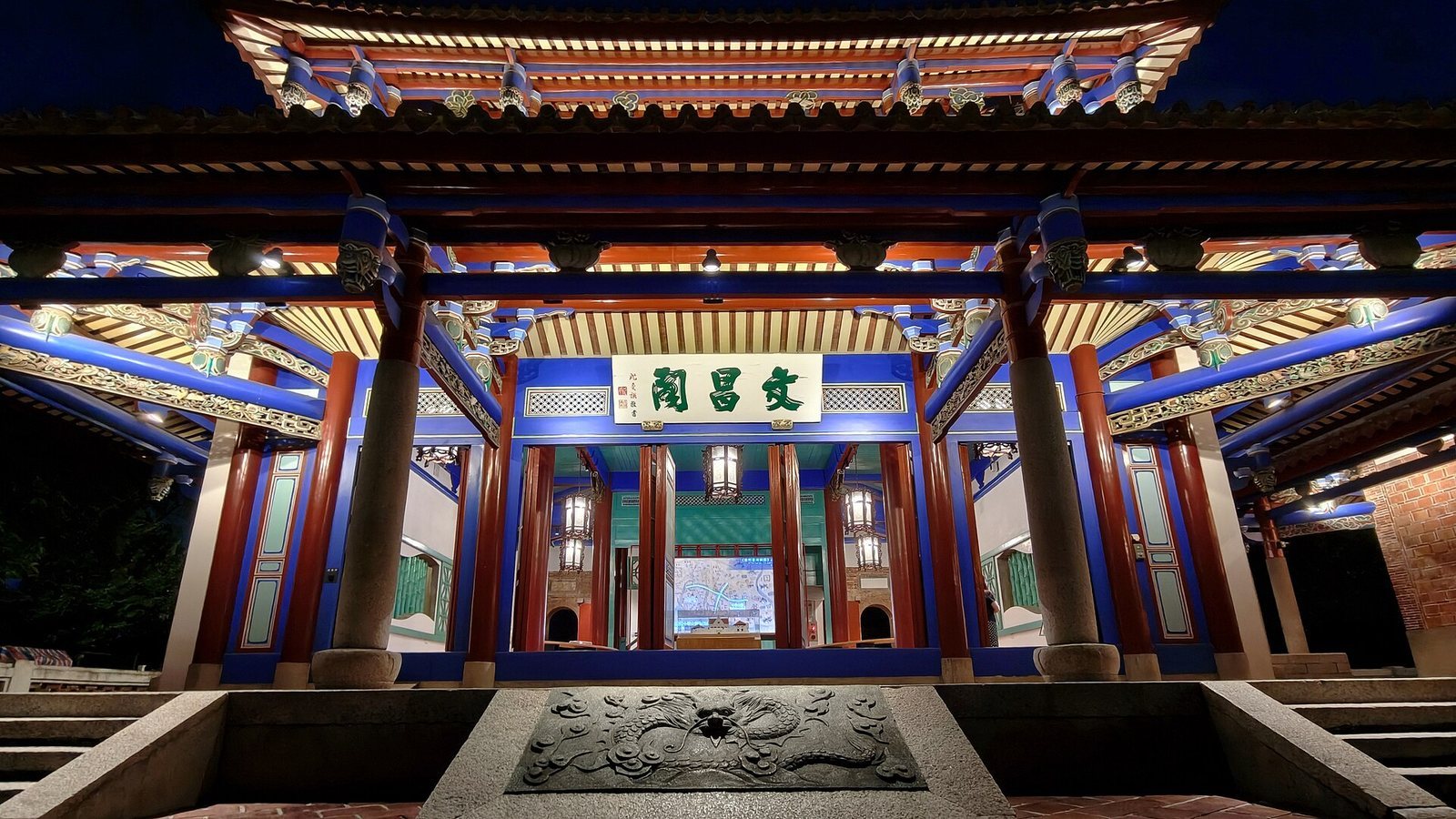
On the northern side, Wenchang Pavilion was formerly dedicated to five deities associated with literature and civil examinations. The two buildings are Chinese-style structures with two levels, double-eaved hip-and-gable roofs (with sloping ends and gabled sides), galleries, and enclosed spaces between the upper and lower eaves. Their roof-end ornaments depict leaping carp. The pavilion’s ground floor is used for displays, while a statue of Kuixing, associated with literary achievement, remains worshipped upstairs. A plaque naming the pavilion was written by the Qing county magistrate who promoted its construction. The building also holds a bronze statue donated in 2002 of a mayor from the Japanese period.
Dutch-period well
A semicircular well lies between the two buildings. It dates to Dutch rule and was identified as the old well during the clearance work of 1935.
Academy and grounds
Academy entrance hall
The academy’s surviving entrance hall follows the Minnan architectural tradition associated with southern Fujian. It retains a plaque bearing the academy’s name. Its red-brick side walls have green-glazed windows and surviving panels above them.
Garden and plaza
A garden courtyard contains a fishpond. In the outer plaza, a sculpture depicts Zheng Chenggong’s peace negotiations.
Steles and stone objects
Stone monuments
About 34 steles, upright inscribed stone monuments, form a group along the western wall. Some were moved to a stele park at South Gate before being transferred to the site. Nine tortoise-backed steles stand beside the Sea God Temple. Their inscriptions are in Chinese, Manchu, or both, and commemorate the Qing campaign against Lin Shuangwen’s rebellion. The original group contained ten monuments. After one tortoise support fell into the harbor, a sandstone copy replaced it; the recovered original tortoise was later placed in a temple elsewhere.
Other stone works
Two stone lions from the Kangxi reign, an early Qing period, stand beside the main entrance. They were transferred from Kui Tower Academy. A stone horse from the tomb of a Qing military figure was excavated at Zhouzaiwei in 1933 and later brought to the site. Dozens of other stone objects are kept along the path beside the Sea God Temple, including a lifting stone once used to test candidates for military examinations.