Fort Zoutman: A Dutch Coastal Fort and Lighthouse in Aruba
Site at a Glance
- Country
- Aruba
- Primary era
- Early Modern
- Eras represented
- Early Modern, Modern
- Civilizations
- Dutch
- Site type
- Military
- Remains
- Fort
On this page9 sections
History
Construction and the harbor
Fort Zoutman is a Dutch coastal fort on Aruba, completed in 1798 to defend Paardenbaai, or Bay of Horses, an intermediate harbor on the route between Curaçao and Venezuela. A military committee in Curaçao planned defenses for the harbors of Aruba, Curaçao, and Bonaire in 1796, under acting governor Johann Rudolf Lauffer. The plans aimed to protect the harbors from pirates and other enemies.
Enslaved Africans built the fort using materials supplied by Indigenous people compelled to work for the Dutch West India Company, a chartered company active in Atlantic trade and colonial activity. The fort was named for Johan Arnold Zoutman, an eighteenth-century Dutch naval officer who fought in the Fourth Anglo-Dutch War (1780–1784), a conflict between Britain and the Dutch Republic, and the American Revolutionary War (1775–1783), when North American colonies rebelled against British rule. Zoutman never visited Aruba. Economic growth around the fort helped the settlement develop into Oranjestad, Aruba’s capital.
Changing use
In 1826, Commander Simon Plats began renovating the fort after finding it in poor condition. It had no garrison from 1830 to 1834. A small colonial police brigade occupied it in 1859, and prison cells were built against its eastern and western walls.
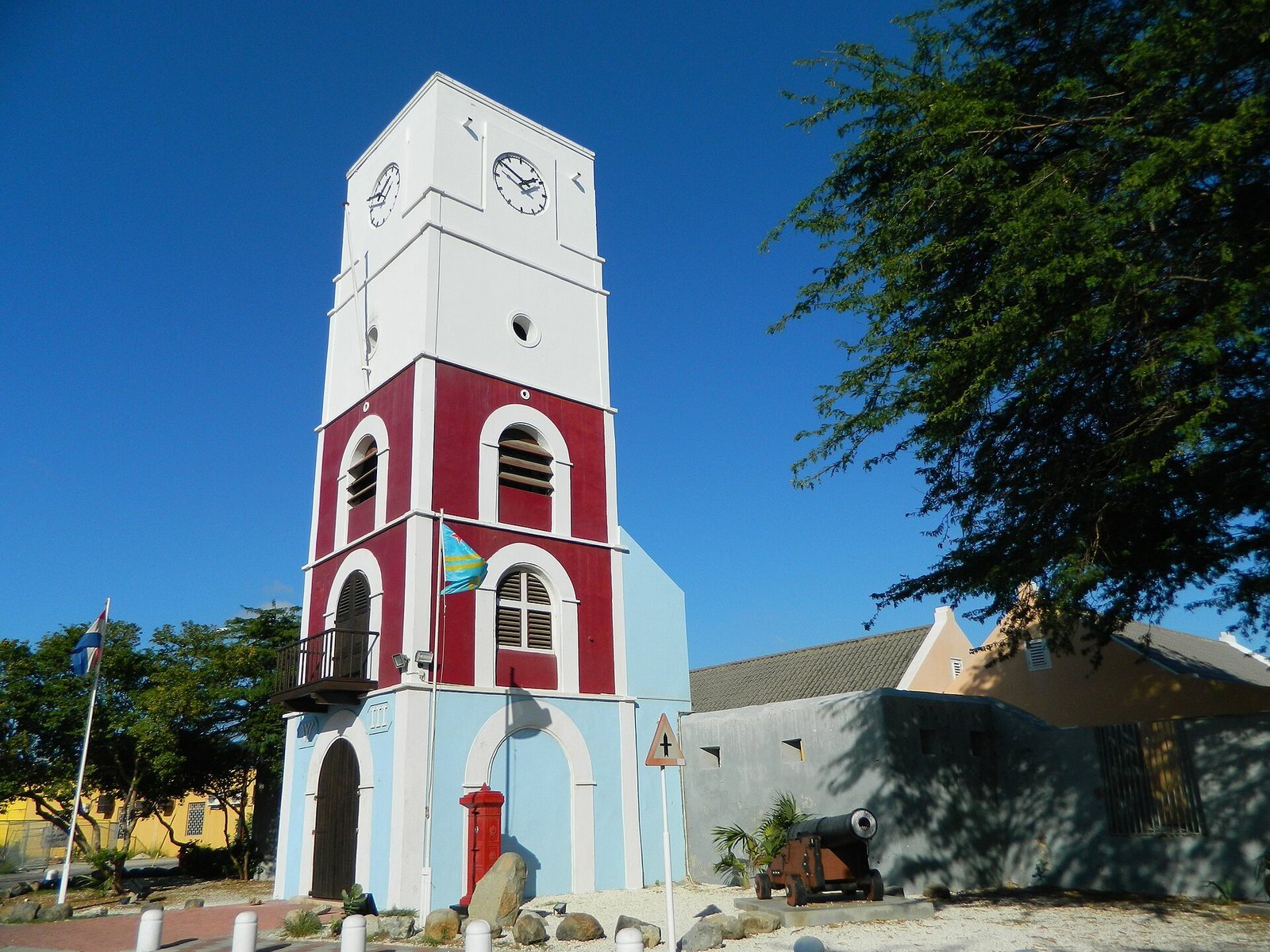
At the request of Lieutenant Governor J.H. Ferguson, work began in 1866 on a lighthouse at the fort. The planned tower was also to hold the town bell, which rang on the hour. Named Willem III Tower for King William III of the Netherlands (1849–1890), it was first lit on 19 February 1868, the king’s birthday. The lighthouse ceased operating in 1963, when its lamp was removed. The tower also served at different times as a clock tower, courtroom, library, post office, tax office, watchtower, and Aruba Police Force station.
Restoration and museum
The fort and tower were restored from the mid-1970s through 1980. The complex reopened as the Historical Museum of Aruba on 15 September 1983. The museum had been founded in 1961, and the Aruban Museum Foundation has administered it since 16 March 1992. UNESCO regards Fort Zoutman as a “Place of Memory of the Slave Trade Route in the Latin Caribbean.”
Remains
At the shoreline of Paardenbaai, the fort’s stone and coral-concrete walls and its western entrance tower form the principal surviving structures.
Fort walls and tower
Walls and prison cells
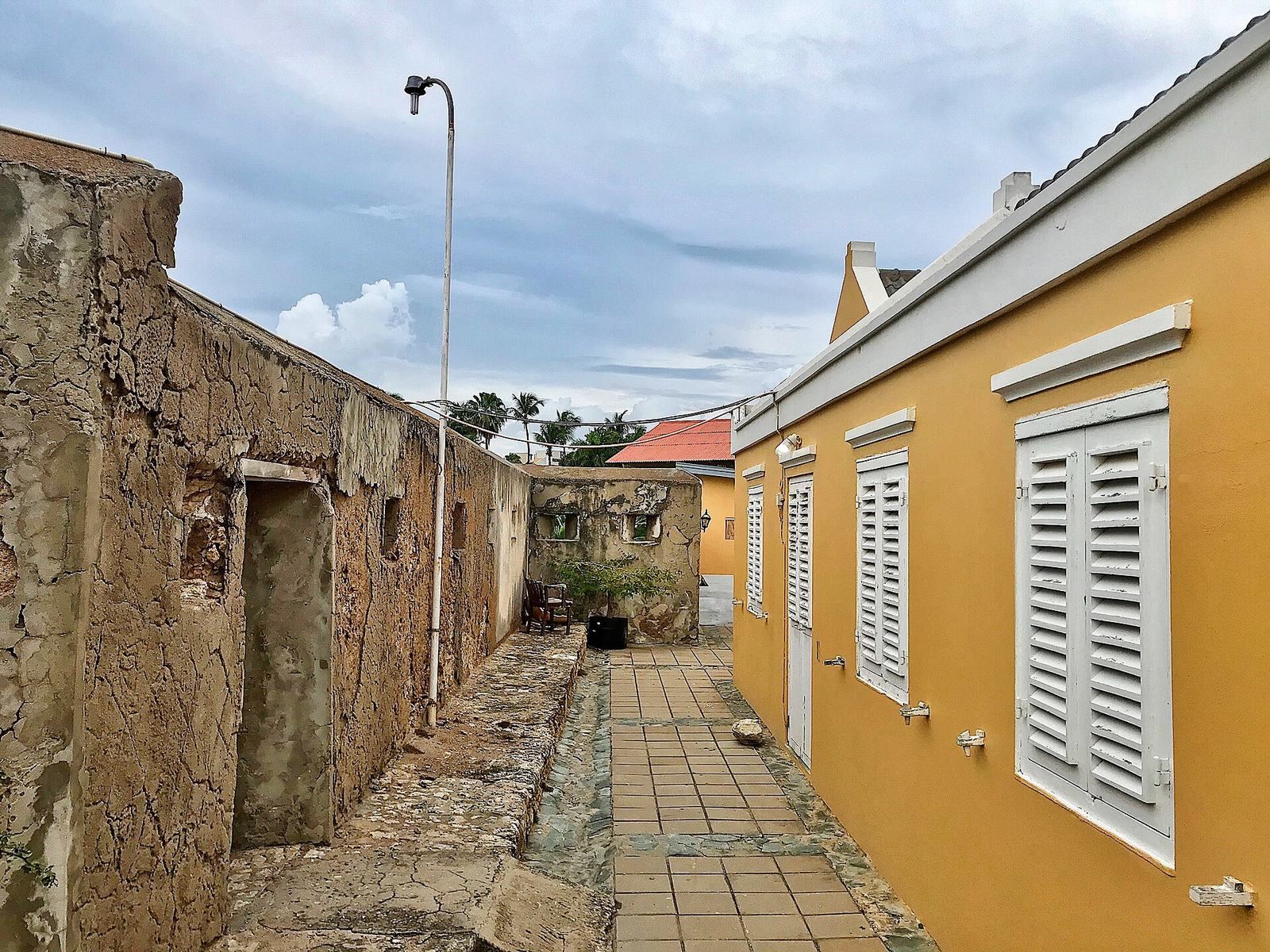
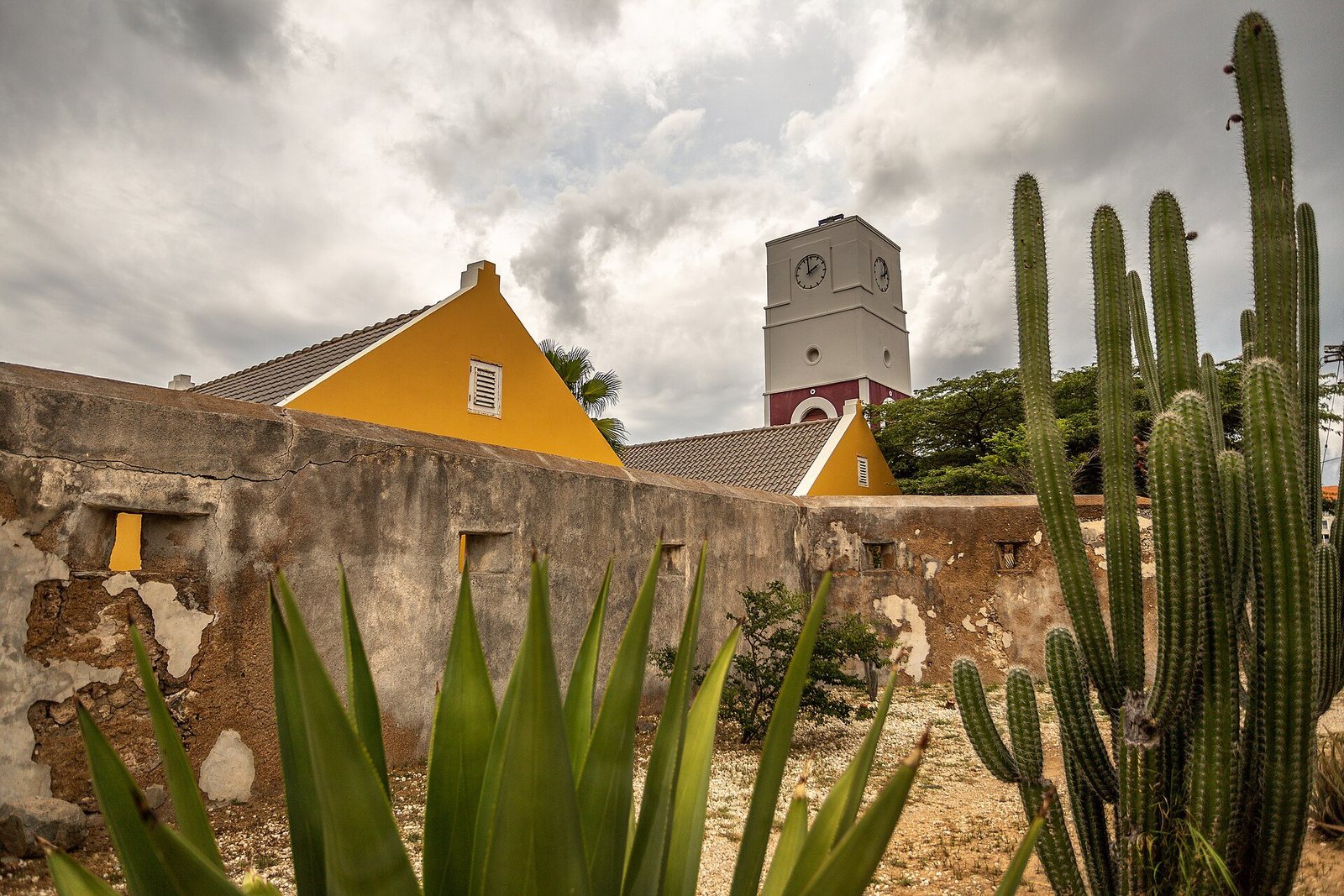
The surviving fort walls date to 1936. Before restoration began in 1974, 31 cannon openings were counted in walls that had contained as many as 35. Building prison cells against the eastern and western walls removed some firing openings. The eastern cells were later replaced with concrete units.
Willem III Tower
Willem III Tower stands at the fort’s western entrance, where arches at its base form the entryway. Designed to accommodate both a lighthouse and the town bell, it used a kerosene lamp at first. A petrol lamp replaced it, followed by an acetylene lamp in 1930 and electrical lighting in 1935.
Museum displays
The museum’s exhibits cover Aruba’s early history and development through the beginning of the twentieth century. They include objects relating to the Spanish period, rural life in the nineteenth century, aloe cultivation, and the Balashi and Bushiribana gold mines.