Ksar Beni Isguen: A Fortified Ibadi Settlement in Algeria
Site at a Glance
- Country
- Algeria
- Primary era
- Medieval
- Eras represented
- Medieval, Early Modern, Modern
- Civilizations
- Amazigh
- Site type
- Military
- Remains
- Fortified Town
On this page11 sections
History
Foundation and religious role
Ksar Beni Isguen is a fortified settlement in Algeria, founded in 1051 by refugees from Tahert who followed Ibadism, a distinct Islamic tradition. They arrived after the Fatimids, an Ismaili Shi’a dynasty that ruled parts of North Africa, destroyed the Rustamid kingdom in the tenth century. The Rustamids were an Ibadi dynasty based at Tahert. Beni Isguen became one of the five settlements in the M’Zab Pentapolis, the historic group of towns in the M’Zab region.
The town grew in the sixteenth century as people moved there from Ghardaia. It became known as the M’Zab’s learned town and a guardian of Ibadi teachings and religious practice. Its strong hold over religious knowledge limited the influence of Mozabite reformists. Although Beni Isguen is now associated with holiness, that reputation developed relatively recently. In the nineteenth century, Melika was regarded as the M’Zab’s holy town, while Beni Isguen was seen as the Pentapolis’s military settlement.
Nineteenth-century change
In the nineteenth century, two walls enclosed the town, and their gates were shut at night. Nomads could trade with residents in the space between the walls. After France annexed the M’Zab in 1882, Beni Isguen expanded and its outer wall was removed.
Community and recent development
Customary laws regulate local life, including a prohibition on men smoking in the streets. At Lalla Achou, an auction and second-hand market operates every day except Friday. Members of the Azzaba, an assembly associated with Ibadi community governance, oversee transactions; Mozabite women are not permitted to cross the market.
In the early 2000s, between 7,000 and 8,000 people lived within the town walls, with approximately the same number in the modern town. Residents belonged to social groups with their own committees and spoke Mozabite Berber. The M’Zab Valley, including Beni Isguen, was inscribed on UNESCO’s World Heritage List in 1982. Beni Isguen’s listed area is 14.52 hectares; the cultural criteria recognize human exchange, distinctive cultural traditions, and traditional settlement or land-use patterns. An eco-neighborhood called Tafilalet was established in the 2010s.
Remains
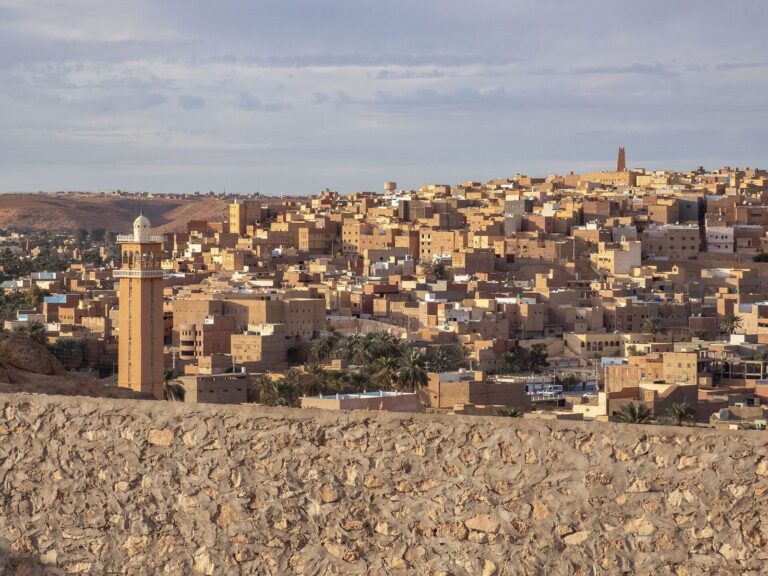
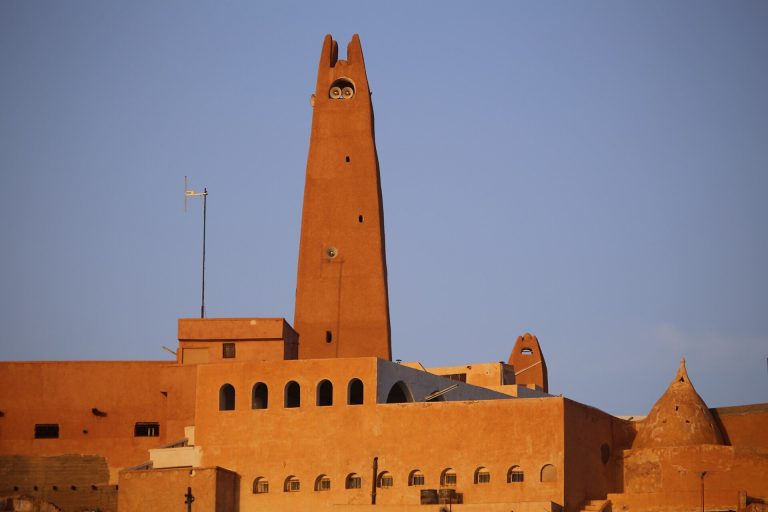
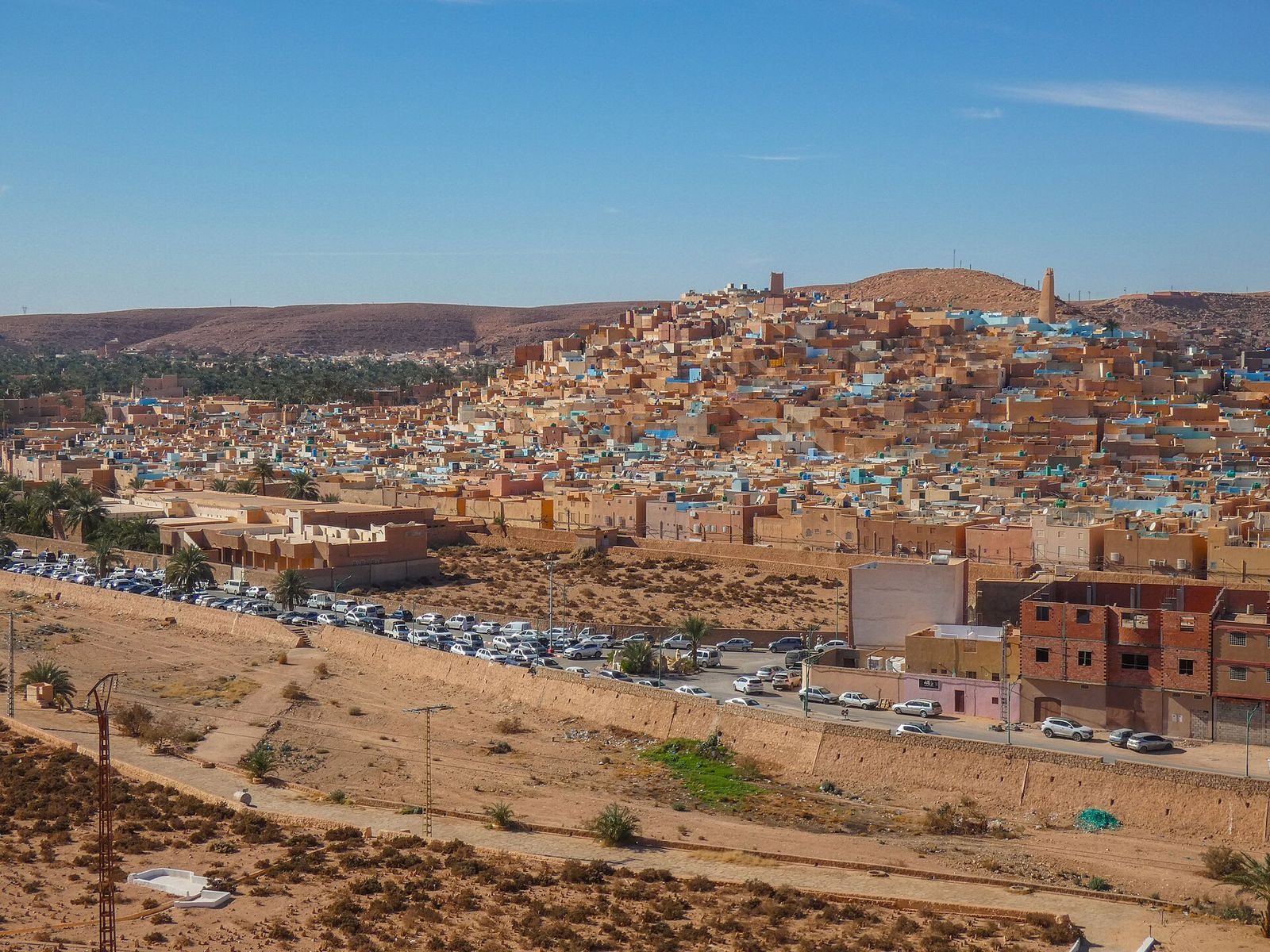
Beni Isguen is the only settlement in the Pentapolis built on the slope of a rocky hill rather than in the M’Zab wadi. It lies between Melika and Bounoura, with a palm grove upstream. The ksar has a rising, pyramidal form and a concentric plan organized around its main mosque and minaret. A second mosque stands in the settlement, while the Tower of Boulila marks its highest point.
The historic settlement
Enclosure and gates
The town’s established layout includes an enclosure, a narrow lane running along its inner side, and watchtowers. Its two main gates, Bab Chergui to the north and Bab Gherbi to the south, are supplemented by three smaller gates leading toward different cemeteries. The entrance is closed by a heavy door made from palm trunks.
Houses and libraries
Houses have separate entrances for family members and guests. Their small exterior windows allow occupants to look out while limiting views into the home. Libraries in houses hold manuscripts and books.
Market and later development
Lalla Achou market
The Lalla Achou market square occupies the edge of the town. Its daily auction and second-hand trade form part of the settlement’s commercial life.
Tafilalet
Tafilalet comprises more than 1,000 houses built in the traditional Mozabite architectural style. It occupies the top of a plateau overlooking the M’Zab Valley. Its park contains date palms, fruit trees, shrubs, and medicinal plants.