Azm Palace: An Ottoman Governor’s Residence and Museum in Hama
Site at a Glance
- Country
- Syria
- Primary era
- Early Modern
- Eras represented
- Early Modern, Modern
- Civilizations
- Ottoman
- Site type
- Domestic
- Remains
- Palace
On this page19 sections
History
Construction and Ottoman government
Azm Palace is an Ottoman governor’s residence in central Hama, Syria, built by As’ad Pasha al-Azm and dated to 1742. The Ottoman Empire, a state centered in Anatolia that ruled Syria for centuries, governed the region. Pasha was a title used by senior Ottoman officials, and As’ad held the governorship of Damascus. Verses in the Golden Hall indicate that construction began around 1740. The palace became the residence of successive Azm governors of Hama, whose family rule there ended in the nineteenth century.
In 1743, As’ad built a larger palace in Damascus using the same basic plan, as he took up the governorship of that city. The two residences were thus linked to his administration in Syria, while the Hama palace continued to serve the local Azm governors.
Family residence and additions
In 1780, Nasuh Pasha al-Azm restored the Golden Hall. The palace’s function shifted from a governor’s residence toward private family use, including quarters for women. Nasuh also added a northern section for guests and government business.
Mu’ayyad Pasha al-Azm expanded the women’s quarters in 1824. In 1830, Ahmad Mu’ayyad Pasha completed decoration on the ground floor, added an iwan, a large vaulted hall open on one side, and a substantial eight-sided fountain. He also built a palace bath known as the Mu’ayyadiyya, named after him.
School, museum, and restoration
Ahmad Mu’ayyad Pasha’s descendants lived in the palace until 1920. It then became a school operated by Hama’s Dar al-Ilm private society. In 1956, during the presidency of Syrian politician Shukri al-Quwatli, it was converted into a museum. It has since served as both a regional archaeological museum and a museum of popular traditions.
The palace suffered extensive damage during the 1982 Hama uprising and was subsequently largely restored. Later restoration work included the Golden Hall and the room opposite it, with painted and gilded ajami decoration reinstated on walls and ceilings.
Remains
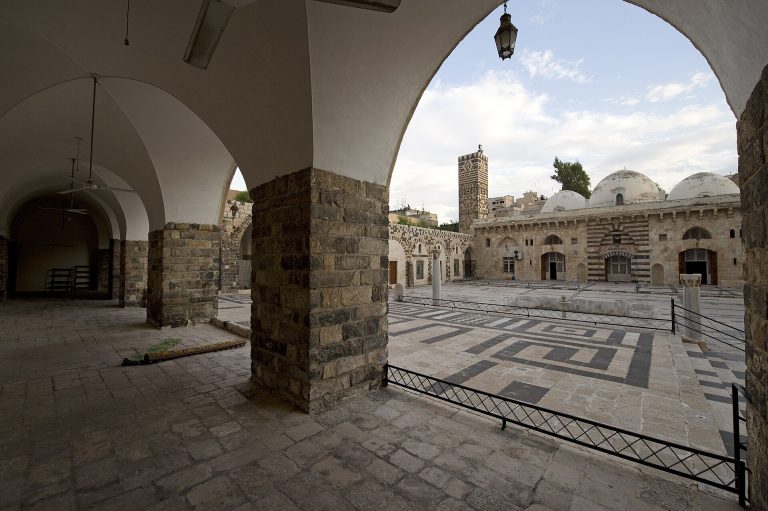
The two-storey palace is arranged around courtyards, with reception rooms, guest and service areas, and family quarters. It stands in central Hama beside the Orontes River, near a public garden and the city’s waterwheels, about 400 metres south of Hama Citadel. The palace windows and roof look toward the citadel, Nuri Mosque, the old quarters, and other historic mosques.
Courtyards and reception rooms
Ground-floor courtyard
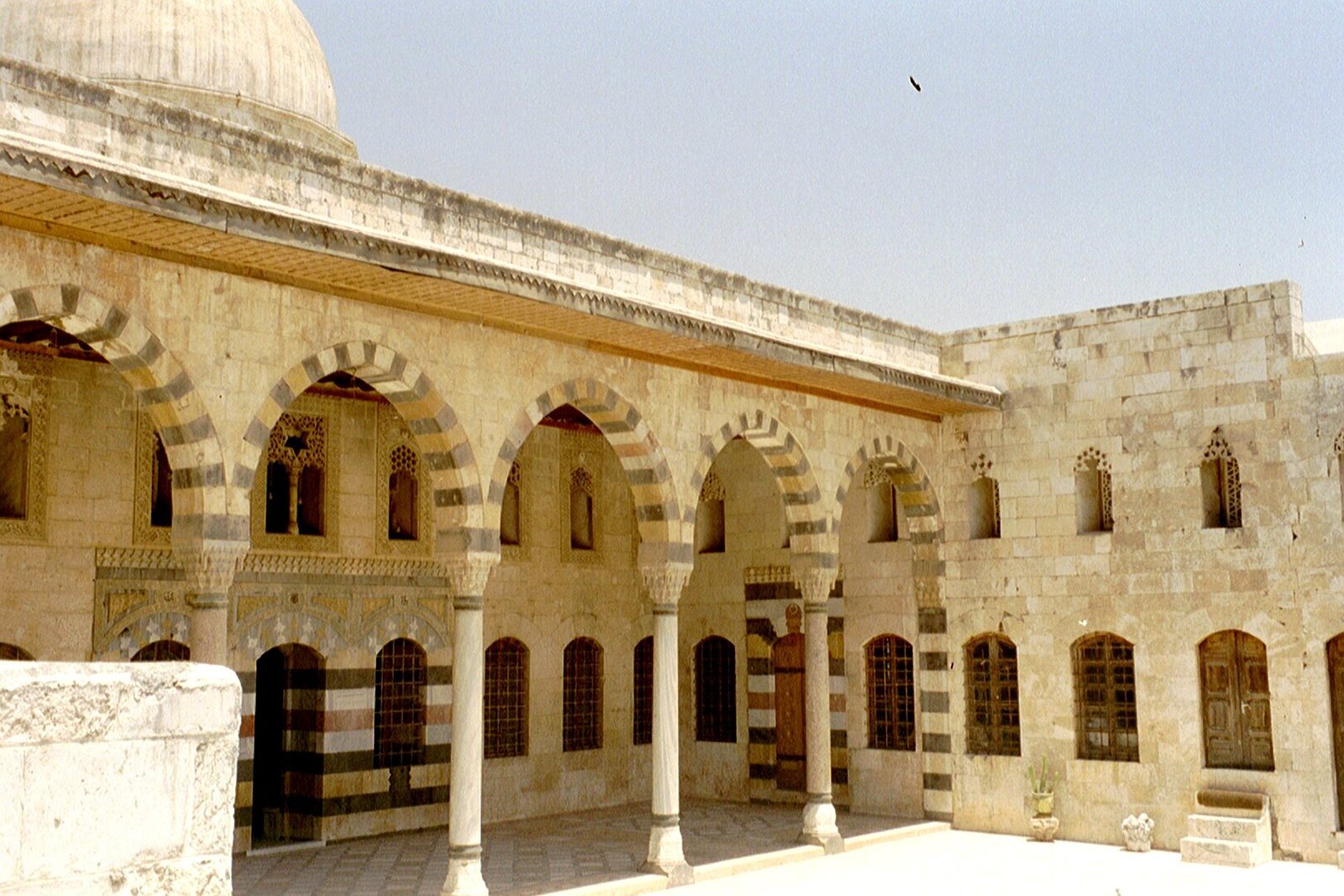
The main ground-floor court has a fountain at its centre and trees planted for shade. At one end, a three-sided liwan, a covered sitting space open to a courtyard, provides a place to sit. A magnolia tree in this court has been described as more than a century old.
Northern courtyard
The northern guest and administration section has its own open-air ground-floor courtyard. A small pool occupies the court, with colored-marble ornament around it.
Upper courtyard and reception room
The upper-floor court is designed to benefit from cool air and breezes. Stairs connect it with a large reception room. An arched covered gallery shelters the room’s façade, and a large dome rises over its central area.
Guest, service, and family quarters
A single-storey guest wing occupies the west side of the palace, while service rooms with arched ceilings lie to the east. The second floor served as the family residence. A direct entrance to the guest reception room and southern liwan also gives passage toward the service wing and the Azm family tomb.
Women’s quarters
A separate, smaller lower-floor courtyard served the family and women’s quarters. A ground-floor arched space in this area adjoins the stable. To its south, an upper-floor wing contains decorated and carved rooms arranged to correspond with the Golden Hall.
Interior, bath, and conservation
Decorated interiors
Palace interiors combine painted woodwork, bands of stone, and patterned marble. Other rooms have fountains and painted panels showing birds and trees. Restoration work on the Golden Hall and the room opposite it included renewing ajami, a form of ornamented painted and gilded woodwork, on walls and ceilings.
Private bath
Near the entrance, the private bath has three sections and a separate chamber. Statues depict successive stages of bathing through to the resting areas. Glass openings in the ceiling admit daylight, and the bath appears to have served both household members and members of the public.
Rooms identified for repair
Repair work identified three ground-floor rooms and two arched-ceiling spaces for renewed plaster. The ceiling of the room opposite the iwan also required restoration.
Museum collections
Archaeological finds and mosaic
The museum displays archaeological finds from Hama and its surroundings, including material from the citadel. A notable late-fourth-century Roman mosaic depicts female musicians playing an organ, a double aulos (a paired-pipe instrument), forked and hand-held cymbals, and a kithara (a lyre-like instrument). The scene also includes an oxyvaphi, a set of eight yellow-colored metal bowls played with two sticks.
Textiles and domestic life
In the iwan, a display includes white cotton furnishing fabric printed in black and red in Hama, alongside a brazier, a coffee pot, and a painted wall panel. Upper-floor displays include two figures in rural dress, one grinding grain and the other spinning wool, as well as a bridal dressing scene. The bride’s black silk gown is decorated with small tied fabric knots dyed in natural red and yellow, along with sequins and beads. Plant and animal forms are embroidered on its black velvet collar. The attendant wears a Hama costume with plant-pattern embroidery.
Glassware, crafts, and games
Glass cases contain transparent, gilded, and opaline glassware, along with colored porcelain. The objects include lamps, flasks, jugs, and cups. Displays in the women’s quarters recreate a furnished guest room with embroidered pieces and show Hama-style cloth printing and the stages of thread-making, from spinning to weaving. Two figures in equestrian dress represent a sword-and-shield game.