Eternal Golden Castle: A Qing Coastal Artillery Fort in Taiwan
Site at a Glance
- Country
- Taiwan
- Primary era
- Modern
- Eras represented
- Modern
- Civilizations
- Japanese, Qing
- Site type
- Military
- Remains
- Fort
On this page14 sections
History
Eternal Golden Castle is a coastal artillery fort built in Taiwan by the Qing dynasty, China’s last imperial dynasty, and the island’s first Western-style artillery fort. Construction began in September 1874 and was completed in August 1876, as the Qing government sought to strengthen Taiwan’s coast against foreign attack.
Qing construction and defense
The fort was first called Third Kunshen Battery and later became known as Anping Great Battery, distinguishing it from Anping Old Battery, built by a Qing official in 1840. Its later name, Erkunshen Battery, reflected the shifting identification of the connected second and third Kunshen formations and their changing mapped positions.
Construction followed the 1871 Mudan Incident, in which shipwrecked Ryukyuan sailors were killed in southern Taiwan, and Japan’s 1874 expedition to the island. Qing official and naval administrator Shen Baozhen commissioned French engineers to design the fort. They had worked at the Mawei Shipyard, and their plans drew on the outer defenses of Paris. Several hundred troops were stationed at the fort, which also trained 300 naval sailors.
Conflict and Japanese rule
The fort saw fighting during the Sino-French War, a conflict between Qing China and France in 1884–1885. It faced another attack in 1895, when Taiwanese resistance to Japanese forces operated under the Republic of Formosa, a short-lived government formed in opposition to Japanese annexation. Liu Yongfu, a Qing military commander, led the resistance. On October 21, Japanese forces arrived in four warships and landed troops in 15 small boats. They defeated 340 Qing defenders and captured the fort; Liu later fled to mainland China.
The fort was under Qing control from 1874 to 1895, Japanese control from 1895 to 1945, and Republic of China control after 1945. Under Japanese rule, developments in military technology reduced its defensive value. After the capture it served mainly as a guarded site, but formal military guarding ended when it passed to the Governor-General’s Civil Affairs Department in 1909. In 1931, Japan designated it a historic scenic site under a law protecting historic places, scenic areas, and natural monuments.
Neglect and preservation
A charitable institution in Tainan took over management in 1917, dismantled the guns, and sold them as scrap to raise funds. One small cannon on the north wall remained. After the Pacific War began in 1941, recreational use declined and the fort and its surroundings fell into neglect.
After the Second World War, unauthorized occupation and building caused further damage. During storms and floods, nearby fishpond owners took earth from the fort’s walls to repair pond embankments, while pond construction damaged roads. The city used the entrance area as a tree nursery. In 1956 the fort was named one of Tainan’s Twelve Scenic Views, as “Dawn at Golden Castle.” In 1962, a legislator used his position to occupy a large area inside the fort for a temple to the Yellow Emperor, a legendary culture hero and ancestral figure in Chinese tradition. Earth was removed from the walls and bricks brought in for the foundation, but the project stopped when funds ran out.
A major restoration began in 1975, the centenary of the fort’s construction, and another restoration followed in 1999. The site was included among Taiwan’s first 15 first-class historic sites in 1983. After a 1997 revision of the Cultural Heritage Preservation Act replaced the former three-tier system, it was classified as a National Historic Site.
Remains
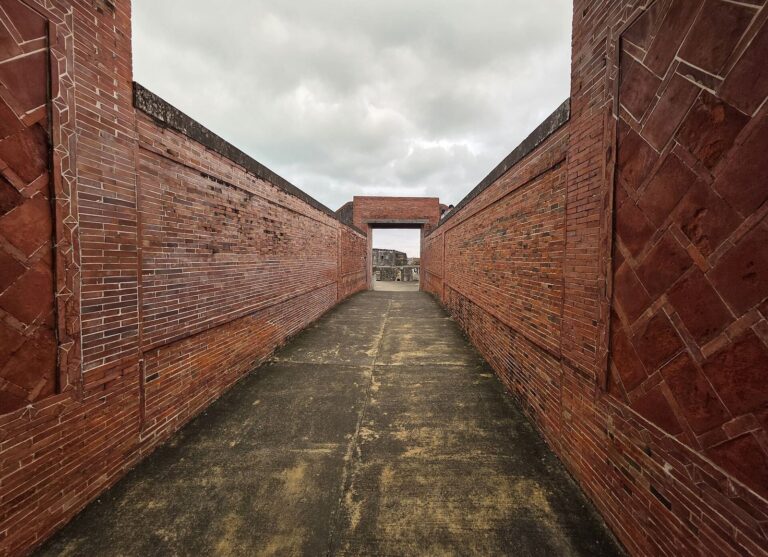
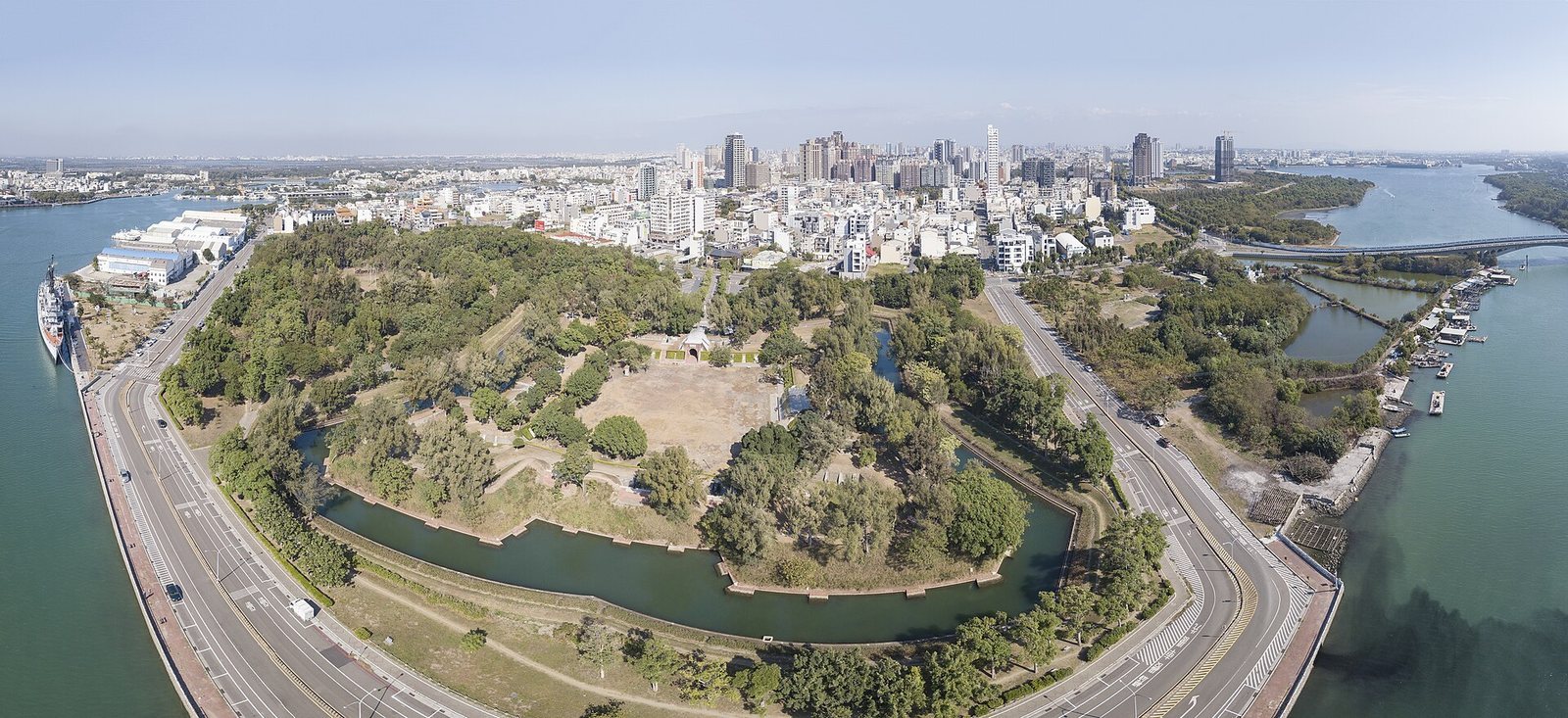
The fort has a roughly square, star-shaped layout organized around a central parade ground. Brick and a traditional lime-and-earth composite were its principal building materials. Some of the bricks were reused from the ruins of Zeelandia Fort, about 1.5 kilometres to the north.
Ramparts and water defenses
Ramparts and corner platforms
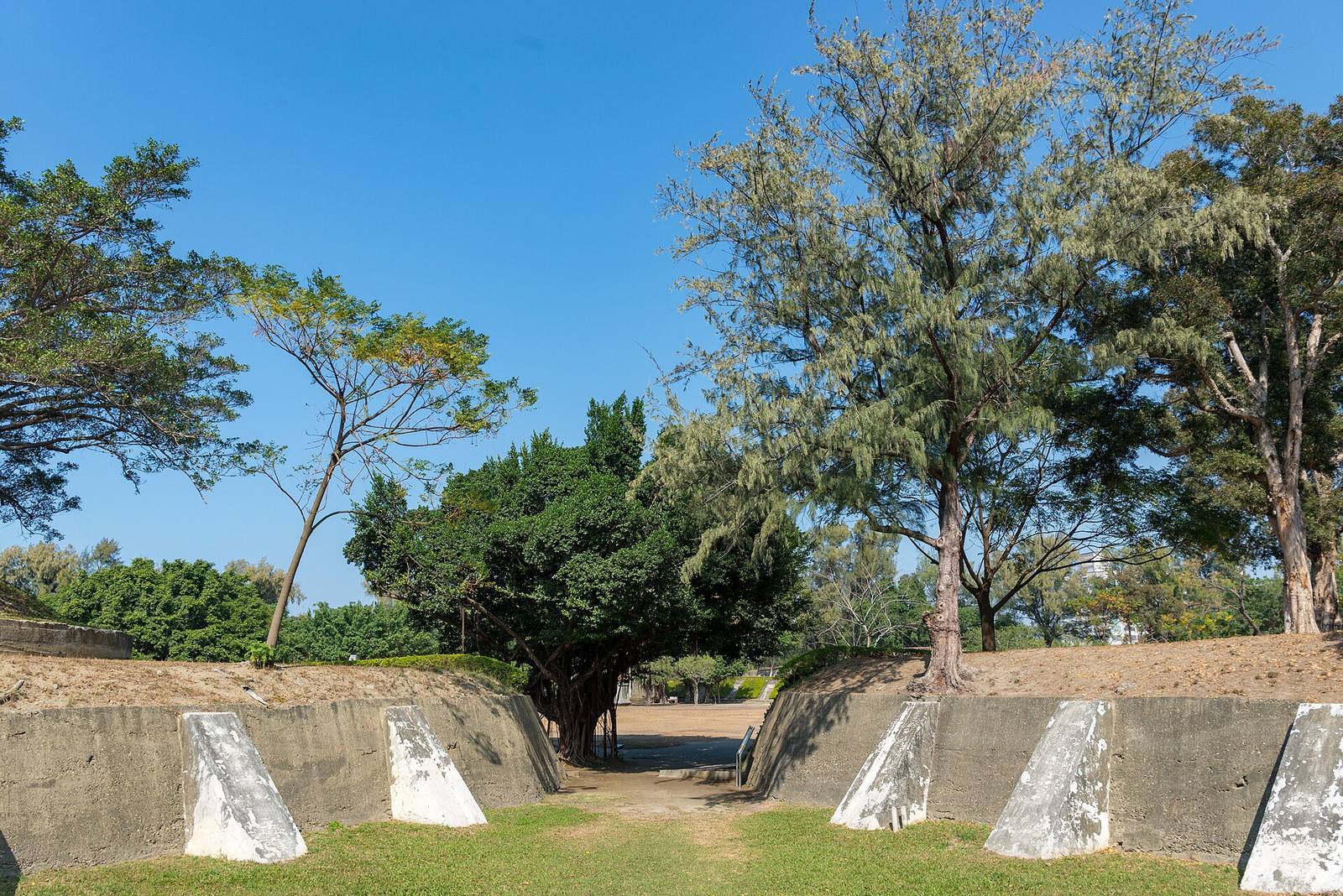
The ramparts rise about 5 metres and are approximately 6 metres wide, with their outer faces sloping at roughly 45 degrees. A projecting defensive platform, or bastion, occupies each corner. These raised platforms held cannon positions, while the inward-curving wall sections between them allowed defenders to fire on attackers approaching the fort.
Moat
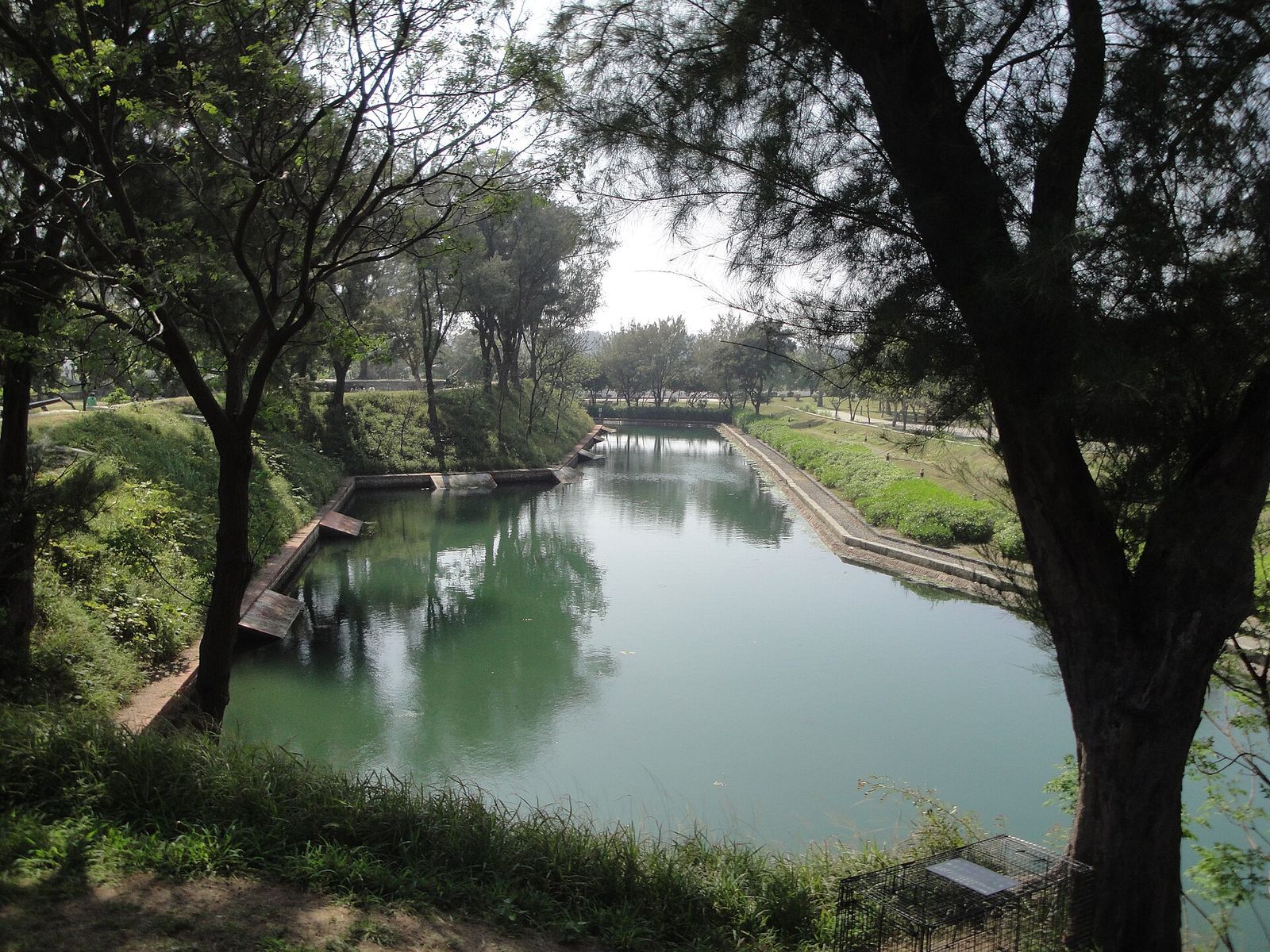
A moat surrounds the fort and could be filled with seawater. It is about 22 metres wide near the drawbridge and about 13.3 metres wide around the corner platforms. Its average depth is 2.3 metres, reaching 3 metres at high tide.
Entrance and courtyard
East gate and bridge
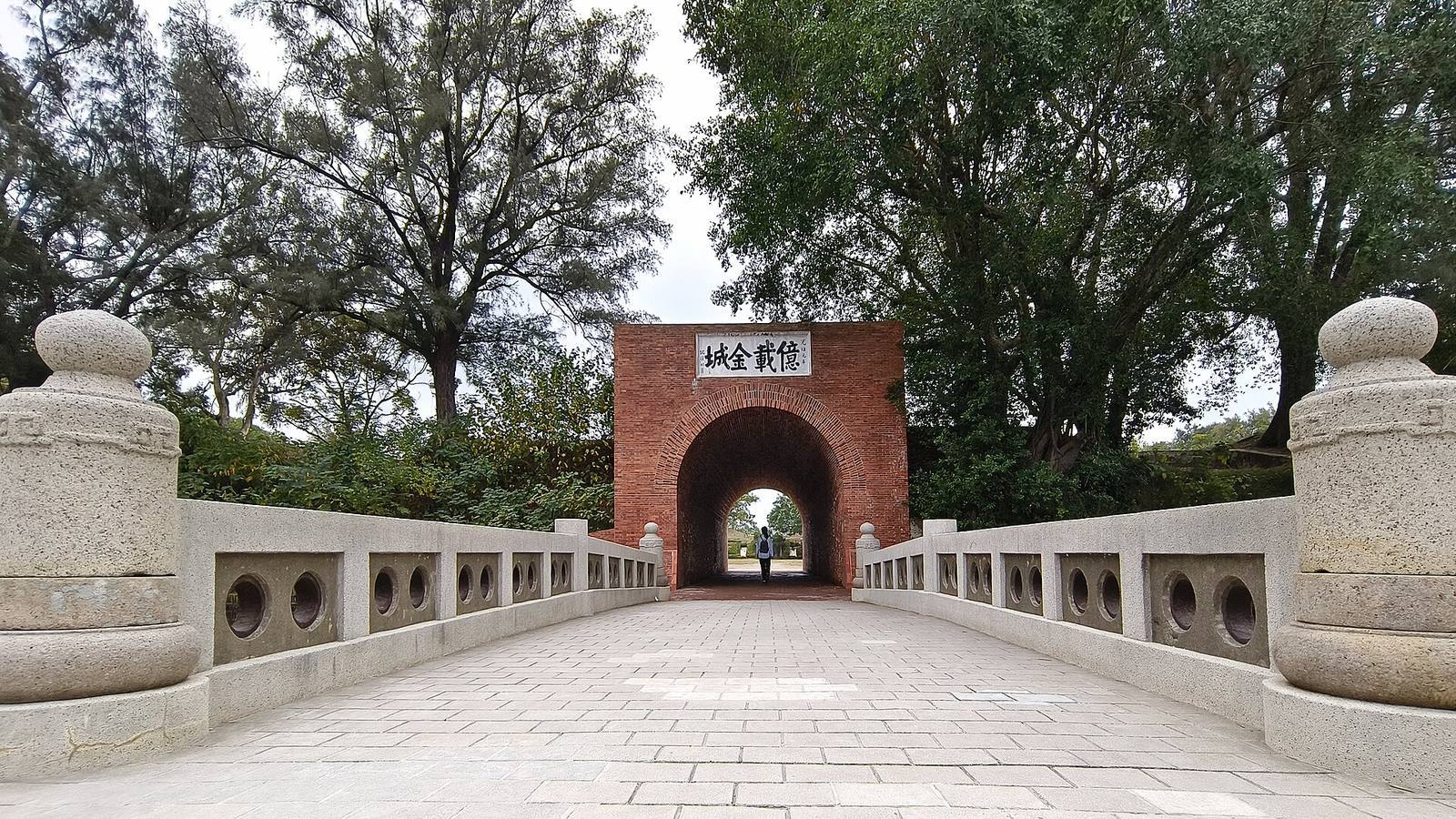
The east entrance is a rectangular red-brick gate, with bricks laid in an alternating pattern of short and long faces, known as Flemish bond. Shen Baozhen’s inscriptions on its two sides translate as “Eternal Golden Castle” and “Pillar Sustaining the Myriad Currents.” A passage about 21 metres long leads through the gate to the central parade ground.
Access originally crossed a wooden drawbridge on the east side. During Japanese-era repairs, an iron bridge with railings replaced it. In 1939, a reinforced-concrete bridge with a pebble-wash finish on its railings took the iron bridge’s place.
Courtyard buildings
Barracks and ammunition stores once stood around the central courtyard. Restoration work uncovered remains of barracks and a small artillery-ammunition store, whose walls were made from the lime-and-earth composite. These remains are now buried for safety.
Artillery and memorial
Cannon positions and displayed guns
The original armament included five British 10-inch, 18-ton Armstrong guns loaded through the front of the barrel, four 40-pounder guns loaded in the same way, and four 20-pounder guns loaded through the rear. Cannon reproductions were installed during the 1975 restoration. Three reproduced 18-ton guns point west, while two other 18-ton gun positions face northwest and southwest. One displayed 20-pounder is original; the other displayed guns are replicas.
Shen Baozhen statue
A bronze statue of Shen Baozhen stands within the fort, recalling the Qing official who commissioned its construction.