Fort Morgan: A Coastal Defense Fort at Mobile Bay
Site at a Glance
- Country
- United States
- Primary era
- Modern
- Eras represented
- Modern
- Civilizations
- Unclassified
- Site type
- Military
- Remains
- Fort
On this page19 sections
History
Fort Morgan is a masonry bastion fort, a fort with projecting defenses that cover its walls and approaches, at the entrance to Mobile Bay in the United States. Built by the United States from 1819 to 1834, it replaced an earlier fort on the same site and was intended to protect both the landward approach and the bay entrance. Designed by French military engineer Simon Bernard, it later figured in the Civil War and successive programs to defend the coast.
Fort Bowyer and the construction of Fort Morgan
After Spanish authorities left Mobile in April 1813, the United States built an earth-and-wood redoubt, or small enclosed defensive work, on Mobile Point. Named Fort Bowyer for Colonel John Bowyer, it was completed before he left in 1814. The fort resisted a British land and naval assault in September that year. In February 1815, after returning from their defeat at New Orleans, the British forced its surrender. They learned that the Treaty of Ghent, which ended the War of 1812 between Britain and the United States, had been signed on December 24, 1814. They withdrew after news reached them that the treaty had been ratified.
After the war, the United States set about strengthening its coastal defenses, and Fort Morgan was built to replace Fort Bowyer. A construction contract went to Benjamin Hopkins in 1818, but he died of yellow fever about a year later after making little progress. His successor, Samuel Hawkins, died in 1821 before the work was complete. The U.S. Army Corps of Engineers then took charge under Captain René Edward De Russy. Enslaved laborers working under De Russy advanced construction until illness forced him to pass responsibility to Lieutenant Cornelius Ogden in 1825. Ogden completed the fort in March 1834.
Fort Morgan received its first garrison that same month. Captain F. S. Belton, commanding Company B of the 2nd U.S. Artillery, took charge. The unit remained for about a year and a half before transferring to Florida for the Second Seminole War, a conflict between the United States and Seminole people in Florida.
The Civil War
On January 3, 1861, eight days before Alabama declared its secession from the United States, Colonel John B. Todd led four companies of Alabama volunteers in taking Fort Morgan. Confederate forces strengthened the defenses around Mobile Bay, including the land approaches and the main ship channel. During the Civil War, fought between the Union and the Confederacy, the fort’s guns helped protect blockade runners. All 17 vessels that departed Mobile Bay evaded capture, as did 19 of the 21 that tried to enter. Union soldiers used Sand Island Lighthouse to observe the fort, which then fired on the island and destroyed the lighthouse.
On August 5, 1864, Union naval forces under Admiral David G. Farragut passed Fort Morgan and entered Mobile Bay. They captured the Confederate ironclad Tennessee and gunboat Selma, drove the gunboat Gaines ashore and burned it, and captured Fort Gaines. Union Army troops under Major General Gordon Granger then besieged Fort Morgan. After two weeks of bombardment from land and sea, its commander, Richard Lucian Page, surrendered on August 23, having disabled the fort’s guns to prevent their use.
After its capture, Fort Morgan served the Union as a base for reconnaissance raids and as a staging ground for the battles of Spanish Fort and Fort Blakeley, fought shortly before Confederate General Robert E. Lee surrendered at Appomattox Court House. Fire during the siege badly damaged the citadel. After the war, crews reused brick from its ruins to repair the fort, and the remaining structure was demolished in the 1880s for use in a breakwater.
Coastal defenses and the World Wars
A renovation in the 1870s added twelve 200-pounder Parrott rifled cannons. The federal government later abandoned Fort Morgan, and it fell into disrepair. Under President Grover Cleveland, Secretary of War William Endicott chaired a board that recommended a new coastal-defense program. From 1895 to 1900, five concrete batteries were added at the fort, along with systems for fire control, electricity, and communications.
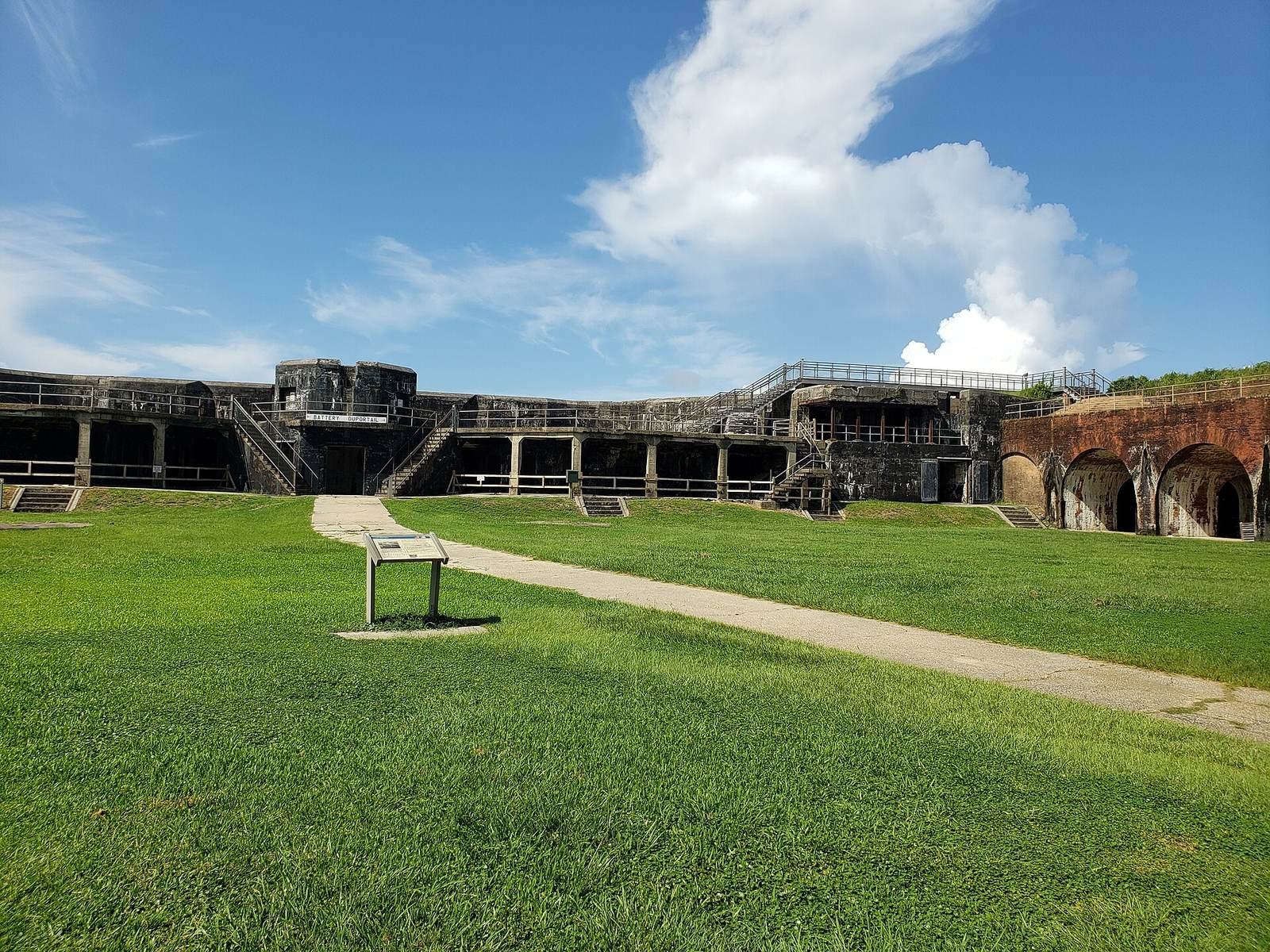
Battery Bowyer served during the Spanish-American War. It closed in 1917, and its guns were removed for conversion into railway guns for service in Europe during World War I. Battery Thomas was deactivated that year and its guns were taken away. Battery Duportail was decommissioned in 1923. Before leaving its guns in place, the Army removed their breechblocks and plugged their rear openings; the guns were scrapped in the early 1940s.
After the United States entered World War I in April 1917, Fort Morgan trained Coast Artillery soldiers in modern weapons and trained field anti-aircraft units. The Army also ran a radio transmitting and receiving station there as part of a national Morse-code network. Its call letters, WUR, went to Fort McClellan when Fort Morgan was abandoned. The Army added four British howitzers in 1920, then abandoned the site in 1924. The guns were scrapped, and the base deteriorated.
The Army returned to Fort Morgan in April 1942. The Department of War transferred it to Alabama in 1946, and the Army completed its departure in 1947. Fort Morgan became a National Historic Landmark in 1960 and entered the National Register of Historic Places in 1966. The Alabama Historical Commission maintains the site.
Remains
Layout and central fort
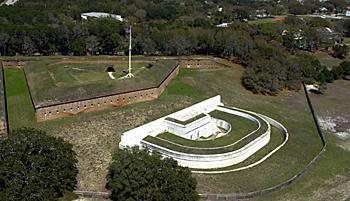
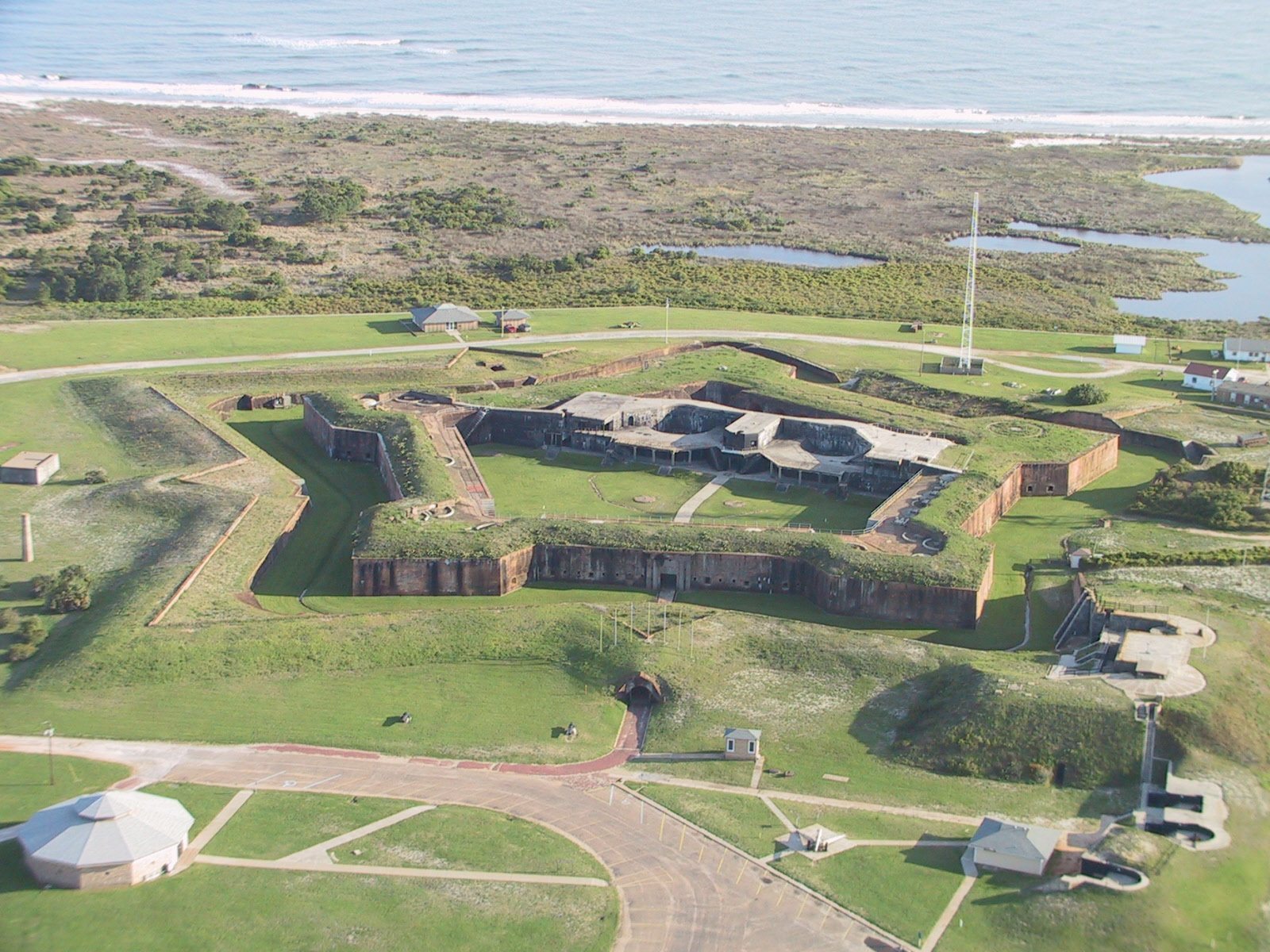
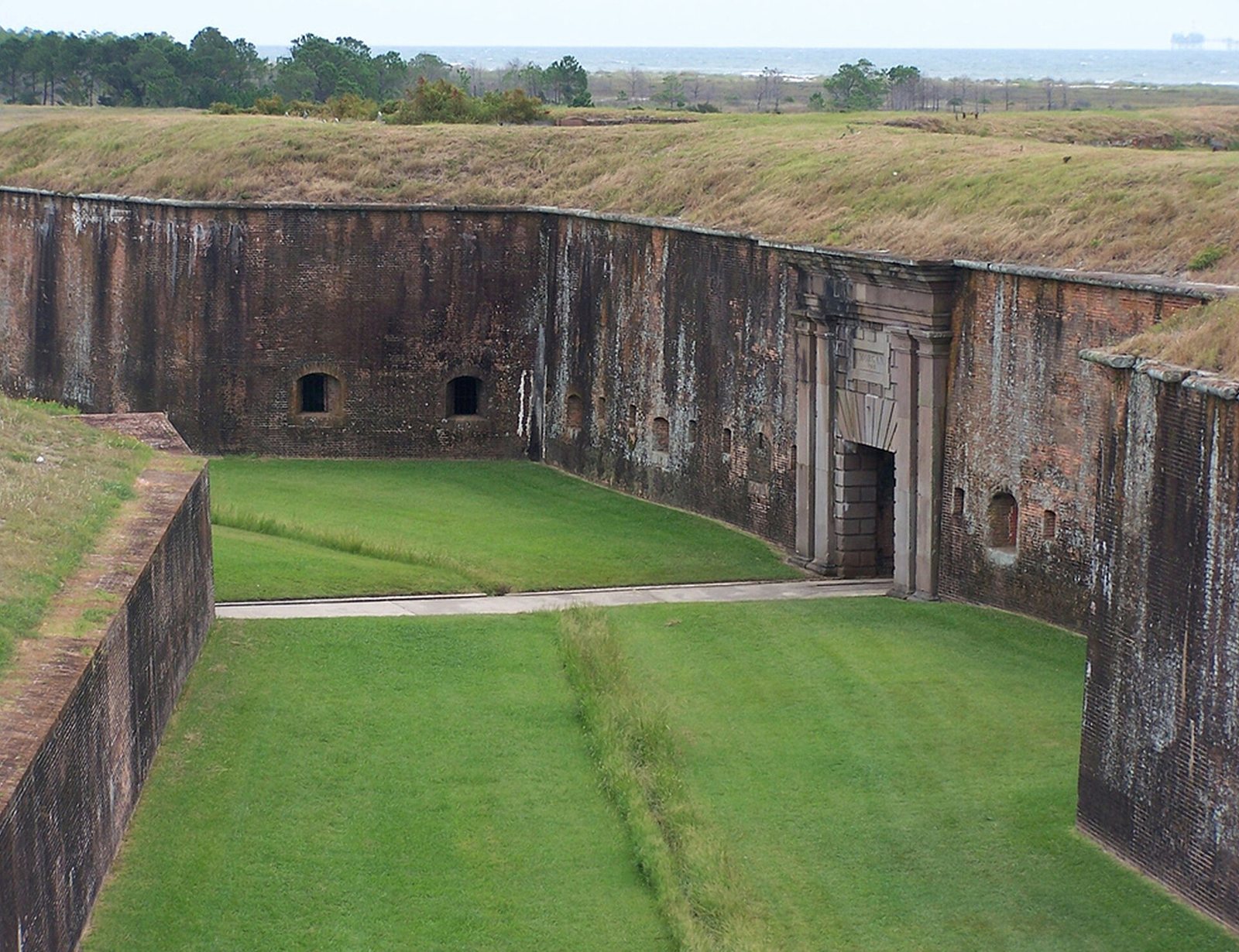
Fort Morgan occupies the tip of Mobile Point, where the point extends into the Gulf of Mexico. Water borders it on three sides, and Fort Gaines stands across the bay on Dauphin Island; together, the two forts enclose Mobile Bay. The fort has a pentagonal plan, measures about 540 metres long and 540 metres wide, rises roughly 10 metres, and sits at sea level. Its area is approximately 250 dunams, or 250,000 square metres. A moat and a lower outer wall surround the central fortification. Concrete arches have been incorporated into the walls from the Civil War period onward. Redoubts and trenches, including small enclosed defensive works, were built east of the fort to hinder a land attack.
The central building was three stories and star-shaped. Its citadel, a central fortified structure, housed enlisted men in a ten-sided barracks beneath a wooden roof. An original plan for the fort is dated 1817. A corridor is identified within the building, and a sign above the main entrance reads “Fort Morgan 1833.”
Guns and batteries
Civil War armament
During the Civil War, Fort Morgan mounted 46 guns. Eighteen of its heaviest pieces faced the main ship channel, the only approach deep enough for major warships. These included two 7-inch Brooke rifles and two British-made 8-inch Blakely rifles. Rifled guns have grooves cut inside their barrels.
Parrott and Rodman guns
The 1870s renovation brought twelve 200-pounder Parrott rifled cannons. The fort also received eight 10-inch Rodman smoothbore guns, later converted to 8-inch rifles by inserting sleeves into their barrels. The Army eventually gave the converted guns to cities for Civil War memorials.
Battery Bowyer
Battery Bowyer, a prepared artillery position, held four 8-inch guns loaded from the rear. They stood on disappearing carriages, which lowered each gun behind a protective wall after firing.
Battery Dearborn
Completed in 1900, Battery Dearborn contained eight 12-inch coastal-defense mortars in two pits, with four guns in each. These mortars fired shells on a high arc intended to strike the less-armored decks of approaching vessels.
Battery Duportail
Also completed in 1900, Battery Duportail mounted two 12-inch guns loaded from the rear on disappearing carriages.
Battery Thomas
Battery Thomas mounted two British 4.7-inch rapid-fire Armstrong guns. Its intended task was to stop smaller enemy vessels from passing through the ship channel.
Battery Schenk
Battery Schenk initially held two 3-inch rapid-fire guns, later increased to three, to protect the ship channel.
Battery Test
Built about a mile from the fort in 1915, Battery Test held a single 10-inch gun on a disappearing carriage. In 1916, the battleships USS New York and USS Arkansas shelled the experimental battery for two days to test its strength. It sustained little damage, and the gun was soon removed.
Other features and later artillery
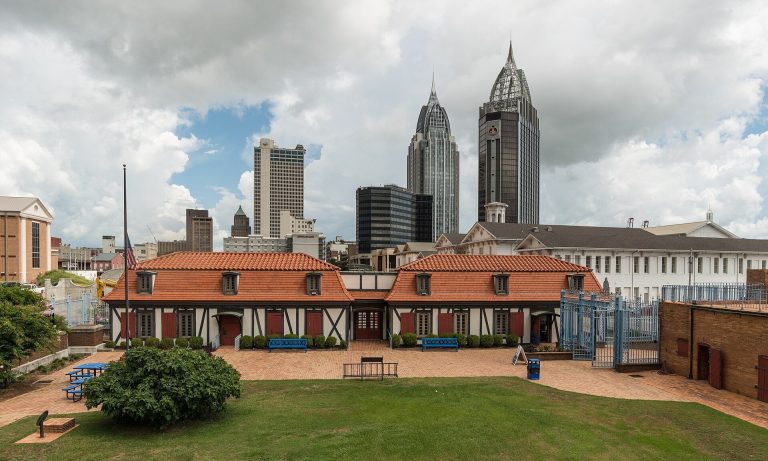
Officer’s Row
Officer’s Row consisted of wooden houses with broad porches. Hurricanes in 1906 and July 1916 damaged the houses, particularly the porches.
Twentieth-century guns
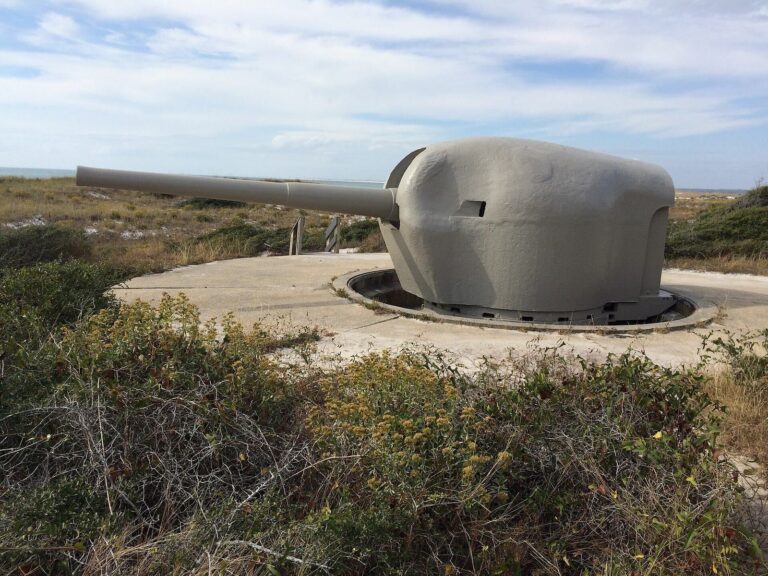
In 1920 the fort received four British 9.2-inch howitzers. During the Army’s return in 1942, five Model 1918 guns of 155-millimetre calibre were brought to the site. Two were placed on top of the fort on mounts that allowed them to turn through 360 degrees; the other three stood on the parade ground.
Union naval shell
In June 2008, excavation during repairs to cracks in the fort’s walls uncovered a live 90-pound naval shell. A Union warship had fired the projectile from a Parrott rifle during the 1864 bombardment.