Sukhumi Fortress: A Roman Coastal Fortification in Georgia
Site at a Glance
- Country
- Georgia
- Primary era
- Classical
- Eras represented
- Classical, Medieval, Modern
- Civilizations
- Georgian, Ottoman, Roman, Russian
- Site type
- Military
- Remains
- Fort
On this page6 sections
History
Sukhumi Fortress is a Roman coastal fortification on the Black Sea coast at Sukhumi, Georgia, built in the second century AD under the name Sebastopolis. A city grew around it, and urban life flourished from the second half of that century. About a century after its foundation, Sebastopolis had become a major trading center. Its importance declined from the late fourth or early fifth century, and by the end of the fifth century it had lost its former standing.
Roman foundation and later rebuilding
Local material traditions continued alongside evidence of outside cultural connections. This pattern has been interpreted as placing Abkhazia within the ancient cultural world, though near its periphery.
During the first half of the sixth century, the Persian-Byzantine War, a series of conflicts between the Byzantine and Sasanian Persian empires, brought destruction to the fortress walls. They were rebuilt in the second half of the century under Byzantine emperor Justinian I, who ruled from 527 to 565. The defenses were altered and reconstructed again between the eleventh and fifteenth centuries.
Princely residence and Russian occupation
In the late eighteenth century, Sukhumi Fortress became the residence of Abkhaz ruler Kelesh-Bey Shervashidze, also known as Kelesh Chachba. He was killed on 2 May 1808. Russian forces occupied the fortress in 1810, after which Ottoman forces left Sukhumi for many years.
In the 1830s, the garrison consisted of two infantry companies and a fortress artillery detachment. Marshes around the fortifications bred mosquitoes that carried malaria. In the early 1840s, Russian general N. N. Raevsky initiated efforts to drain the marshland.
Ottoman control and conflict
During the Crimean War of 1853-56, in which Russia fought an alliance that included the Ottoman Empire, Ottoman forces occupied Sukhumi and damaged parts of the fortress. In 1858, under Sultan Murad, the Ottomans rebuilt it as a military base. An inscription above the gate marked the work, and the fortress became known as Sukhum-Kale. Ottoman forces used it as a base for raids on Abkhaz communities.
In 1866, an uprising against intensified tsarist colonial rule spread in northwestern Abkhazia. About 2,000 rebels took Sukhumi on 28 July, while the Russian garrison held the fortress. Reinforcements numbering about 8,000 prevented the rebels from capturing it and relieved the garrison. The insurgents laid down their arms on 20 August. In early December, their leaders Khanashv Kalgi, Kakuchal-ipa, and Kizilbek Margania were executed by the fortress wall.
During the Russo-Turkish War of 1877-78, Ottoman forces occupied Sukhumi. As they withdrew, they looted the city and removed historical objects from the fortress.
Prison and political upheaval
After the war, the fortress was used as a prison. During the Russian Revolution of 1905-07, prisoners there included Bolsheviks G. K. Ordzhonikidze, L. I. Gotoshia, and V. Z. Kondjaria. The Bolsheviks were a revolutionary Marxist faction that became Russia’s ruling party after the 1917 Revolution.
Remains
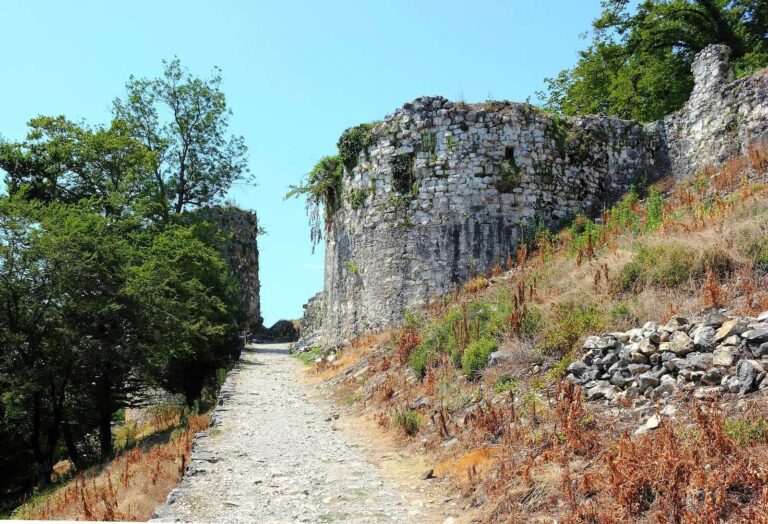
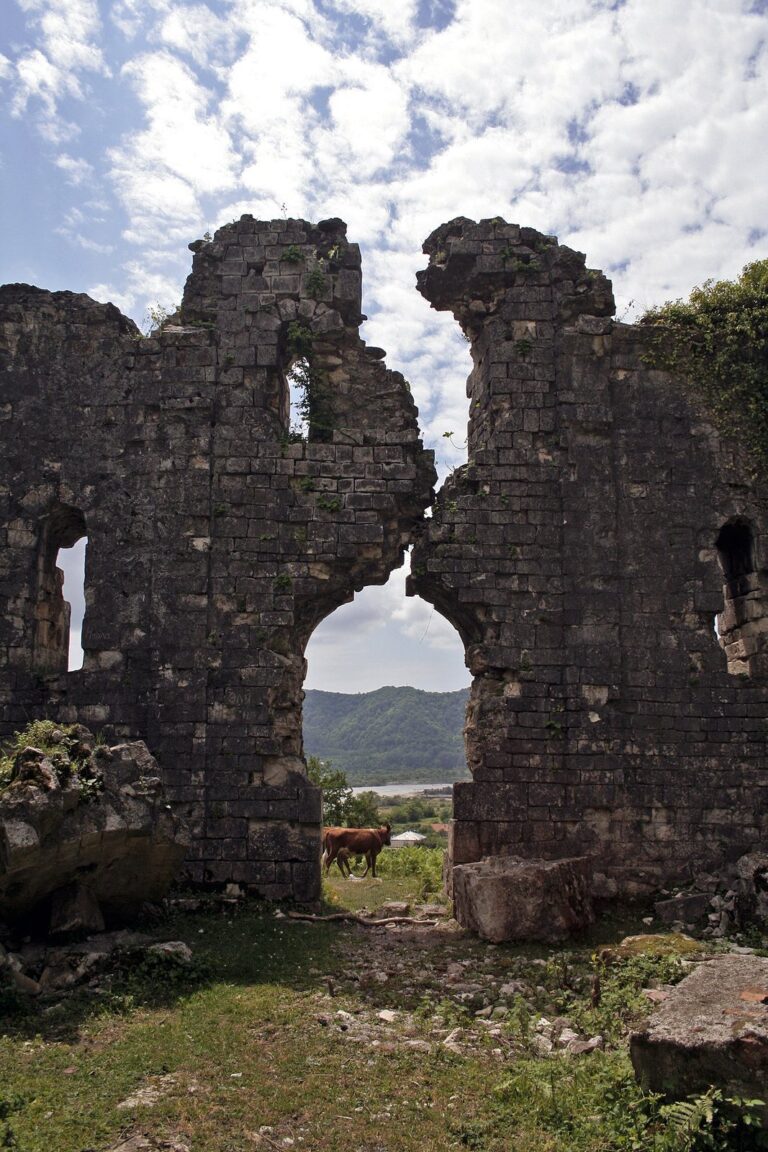
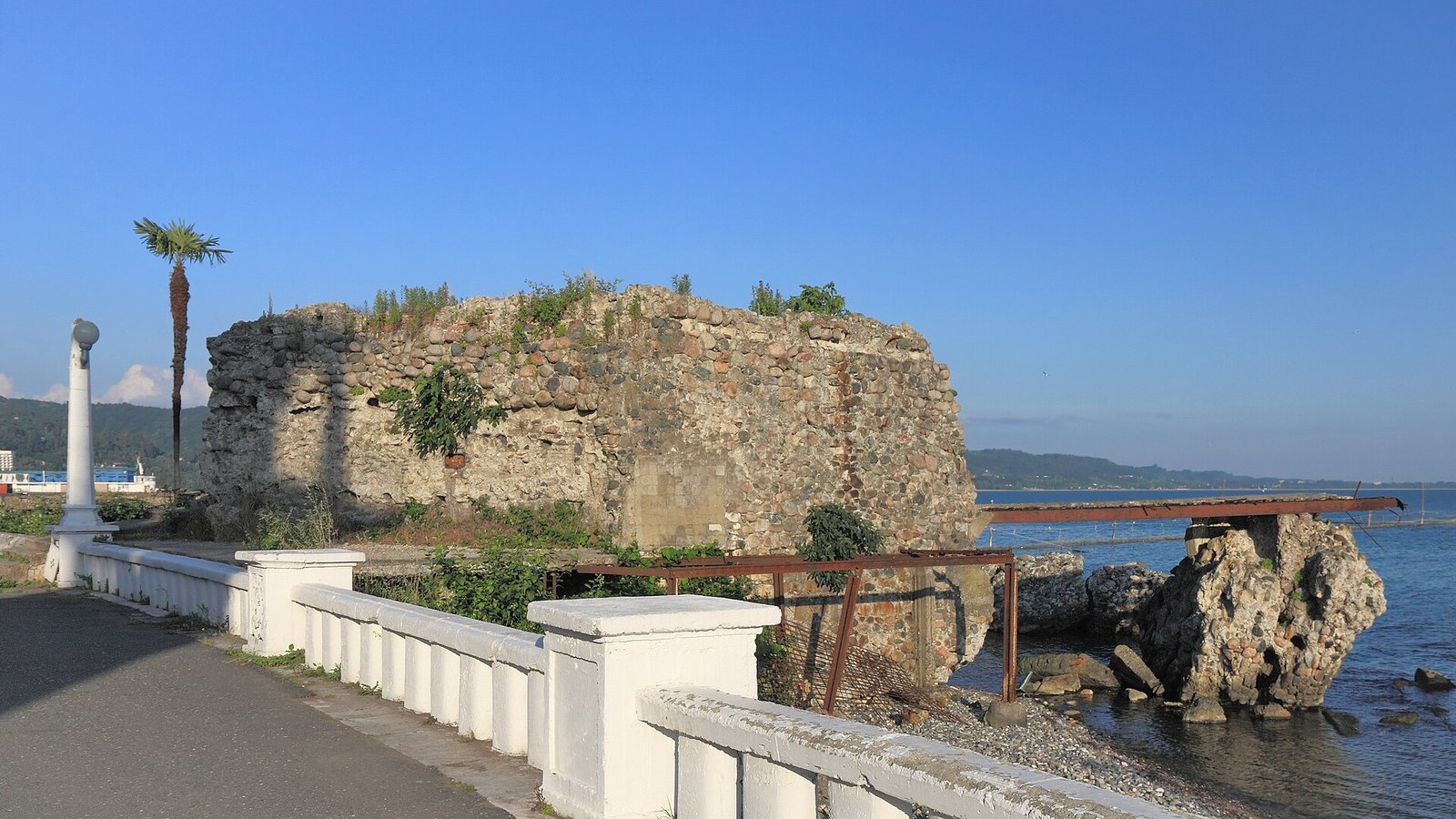
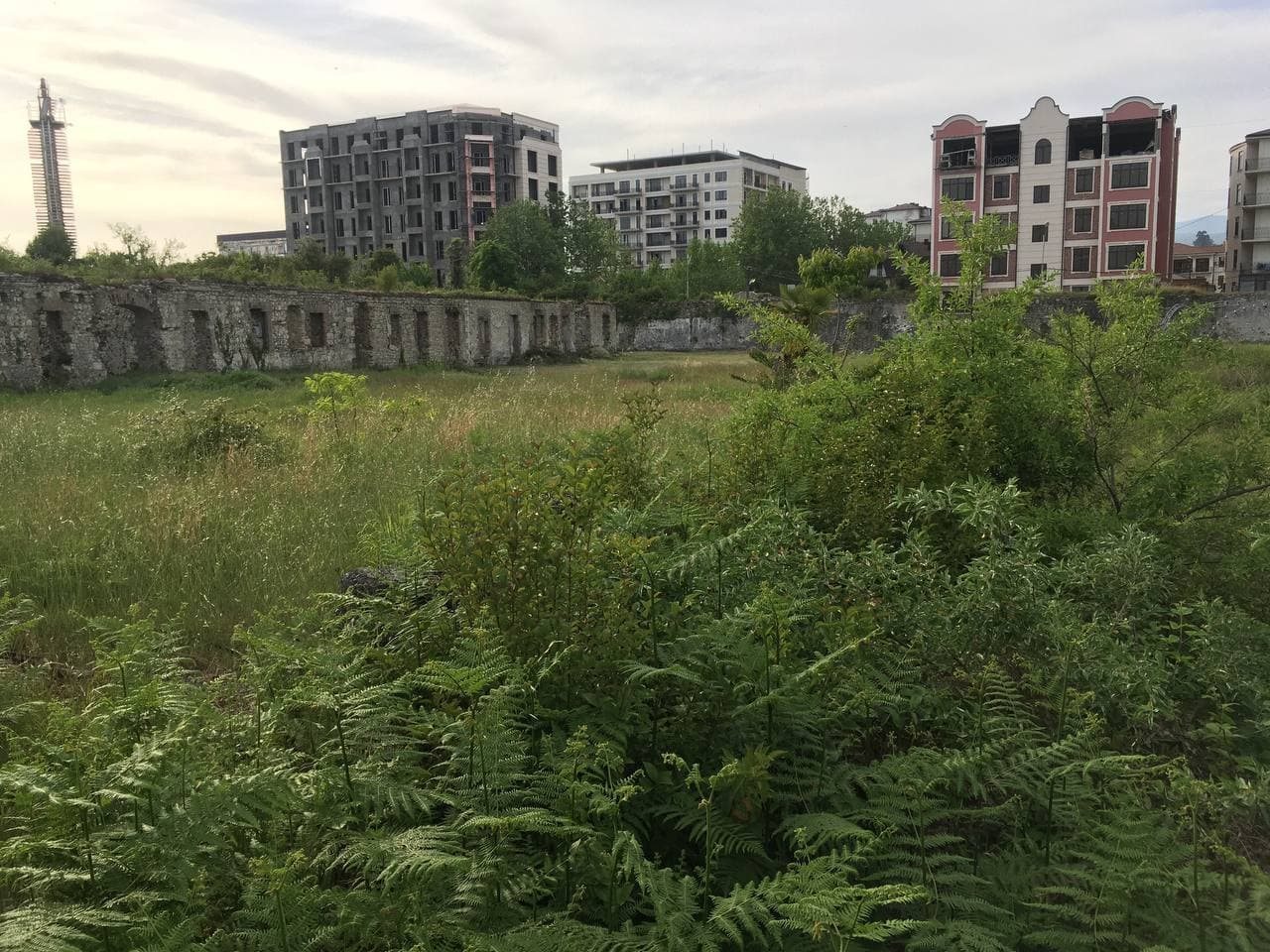
The ruined fortress stands on the Black Sea coast where the Dioscuri Embankment meets the Mahajirs Embankment. Its ancient walls were built with stone masonry characteristic of Roman construction, and a preserved interior section of the enclosure survives. In the nineteenth century, the fortress had a regular square plan enclosed by a high, thick wall. Two entrances opened on its eastern and western sides. The walls were sturdy, though age and damage from the Crimean War had caused deterioration in places.
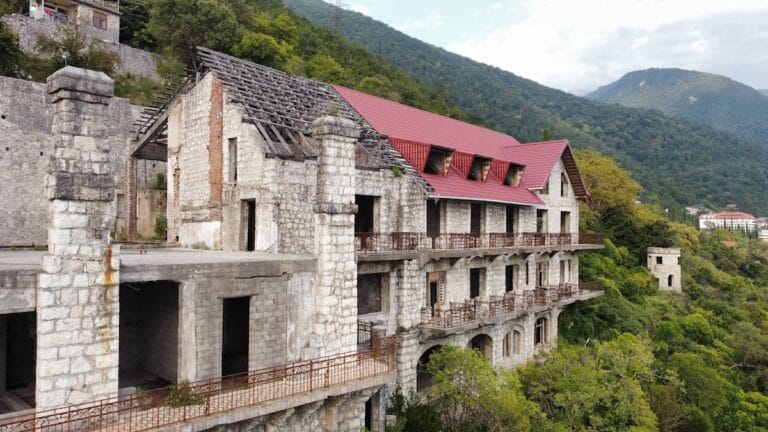
Outside the southern entrance, two rows of shops stood in the 1830s. Buildings within the walls were lower than the enclosure. By the early 1840s, they included cramped artillery barracks, a commandant’s office, an old church, and officers’ houses. The houses were in poor condition, with rain leaking through their roofs. During the fortress’s later use as a prison, stone bastions, projecting defensive structures, and wooden buildings were adapted to hold prisoners; purpose-built cells for political prisoners were added by the end of the nineteenth century.
Marshland surrounded the fortifications. Ottoman defenses later included deep ditches running along the walls, lined with stone and filled with water. These works altered the older enclosure’s perimeter.
Excavations uncovered remains of residential, public, and cultural buildings, along with large quantities of imported goods. These include amphorae, large jars used to transport and store supplies, red-coated pottery made with a thin layer of clay, and glassware. A stone slab discovered in a fortress wall during the 1980s records that Flavius Arrian, a Greek-speaking writer and historian, visited Sebastopolis in AD 134 on behalf of Emperor Hadrian, who ruled from AD 117 to 138. The inscription says Arrian placed the slab on the wall and made a circuit of the wall and moat.
A richly ornamented marble fountain removed from the fortress during the Ottoman withdrawal of 1877-78 is now in the courtyard of Topkapi Palace in Istanbul, a principal residence of the Ottoman sultans. Its design resembles the Fountain of Tears at Bakhchisarai, which is associated with the poetry of Polish poet Adam Mickiewicz and Russian poet Alexander Pushkin. Modern Turkish guidebooks refer to the fountain as the Sukhumi Monument.
A detached tower served as the only outlying fortification associated with Sebastopolis during the 1917-21 struggle to establish Soviet rule in Abkhazia. It stood on the southeastern edge of a hill in northwestern present-day Sukhumi, about two kilometres from the coast of Sukhumi Bay. The hill slopes east toward Battery Gorge and west toward the Gumista River valley.