Fort Zachary Taylor Historic State Park: A Coastal Defense Fort in Key West
Site at a Glance
- Country
- United States
- Primary era
- Modern
- Eras represented
- Modern
- Civilizations
- Unclassified
- Site type
- Military
- Remains
- Fort
On this page10 sections
History
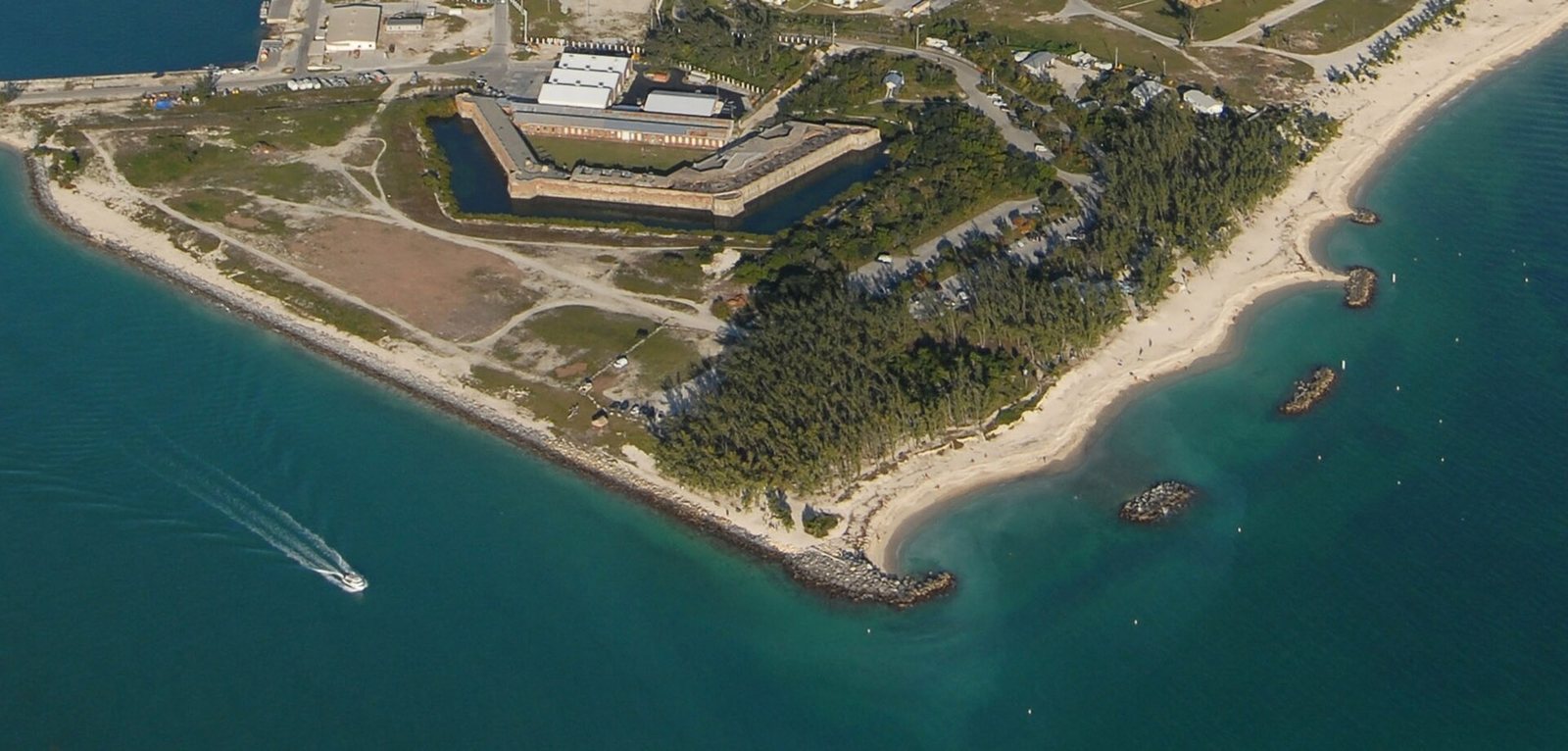
Fort Zachary Taylor Historic State Park is a coastal fort and public park on Key West in the United States. The U.S. Army began building the fort in 1845 as part of a nineteenth-century program to defend the southeastern coast and protect Key West’s harbor and town.
Planning and construction
In 1822, Thompson Island, a shoal about 350 metres southwest of Key West, was selected for the fort. Military engineers Simon Bernard and Joseph G. Totten prepared plans approved in 1836. The Army Corps of Engineers leased enslaved people from local slaveholders to build Fort Zachary Taylor and nearby Fort Jefferson. The arrival of construction workers may have helped increase Key West’s enslaved population from fewer than 90 people to more than 400.
The fort received its name in November 1850, several months after the death of Zachary Taylor, the 12th president of the United States. Yellow fever outbreaks and shortages of building materials slowed work through the 1850s, and construction was completed in 1866. The Pensacola firm Raiford and Abercrombie supplied bricks for both Fort Zachary Taylor and Fort Jefferson, which was under construction at the same time.
Union garrison and Civil War
As the Civil War approached, the federal government considered keeping control of the fort essential to national defense. At midnight on January 13, 1861, Union Captain John Milton Brannan moved 44 men from the 1st U.S. Artillery Regiment at the Key West Barracks to the fort. Acting without orders, he sought to prevent its capture by Confederate forces. The fort became a Union outpost used against blockade runners, ships attempting to evade naval blockades. Major William H. French arrived with an artillery unit in April 1861.
Military changes and later use
The fort’s upper levels were rearranged in 1889 to accommodate new weapons. In 1898, during the Spanish-American War, it was reduced to two stories and new batteries were installed. Civil War-era guns were buried inside the new battery as fill. The fort saw heavy use during the Spanish-American War, World War I, World War II, and the Cuban Missile Crisis. Two Martello towers, small coastal fortifications designed to mount artillery, provided supporting fire; one survives as the Martello Gallery-Key West Art and Historical Museum.
After the Army ended its use of the fort, the site passed to the U.S. Navy in 1947 for maintenance. Part of the former fort land nearer downtown became part of Truman Annex, associated with the former Naval Station Key West and its submarine base. Harry S. Truman used the naval station as a winter residence for 175 days over 11 visits. The Secret Service built a private beach there, later called Truman Beach, although Truman preferred public beaches. The station was decommissioned in 1974 after the Navy retired nearly all its diesel-electric submarines and newer nuclear-powered submarines proved too large for the port.
Archaeology and state park
Beginning in 1968, volunteers led by Howard S. England excavated buried Civil War guns and ammunition. The work continued for about a decade and helped prompt the fort’s listing on the National Register of Historic Places, the federal list of historic properties, in 1971. In 1973 it became a National Historic Landmark, a designation for places of exceptional national historical importance. The U.S. Department of the Interior received the fort in 1970, and Florida took ownership in 1976. The state park opened to the public in 1985.
Remains
Originally surrounded by water, the fort was connected to land by a causeway. Its foundation combines oolitic limestone, rock made largely of small rounded grains, and New England granite. The walls are five feet (1.5 metres) thick and rise 50 feet (15 metres) above mean low water. Filling the water between the fort and Key West in the 1960s created reclaimed land known as Truman Annex. A ditch dug around the fort by 1989 helps convey its nineteenth-century layout.
Fort layout and defenses
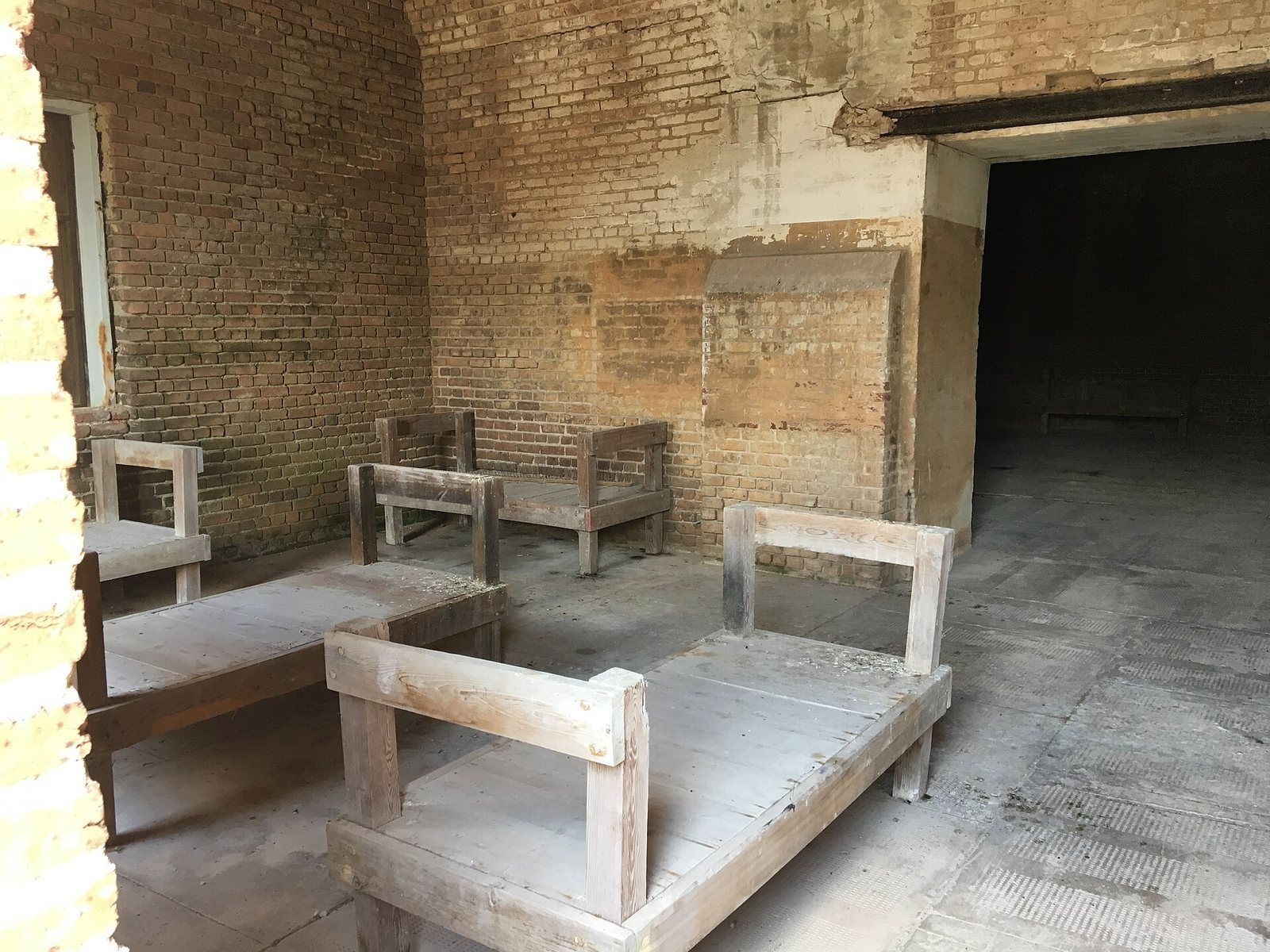
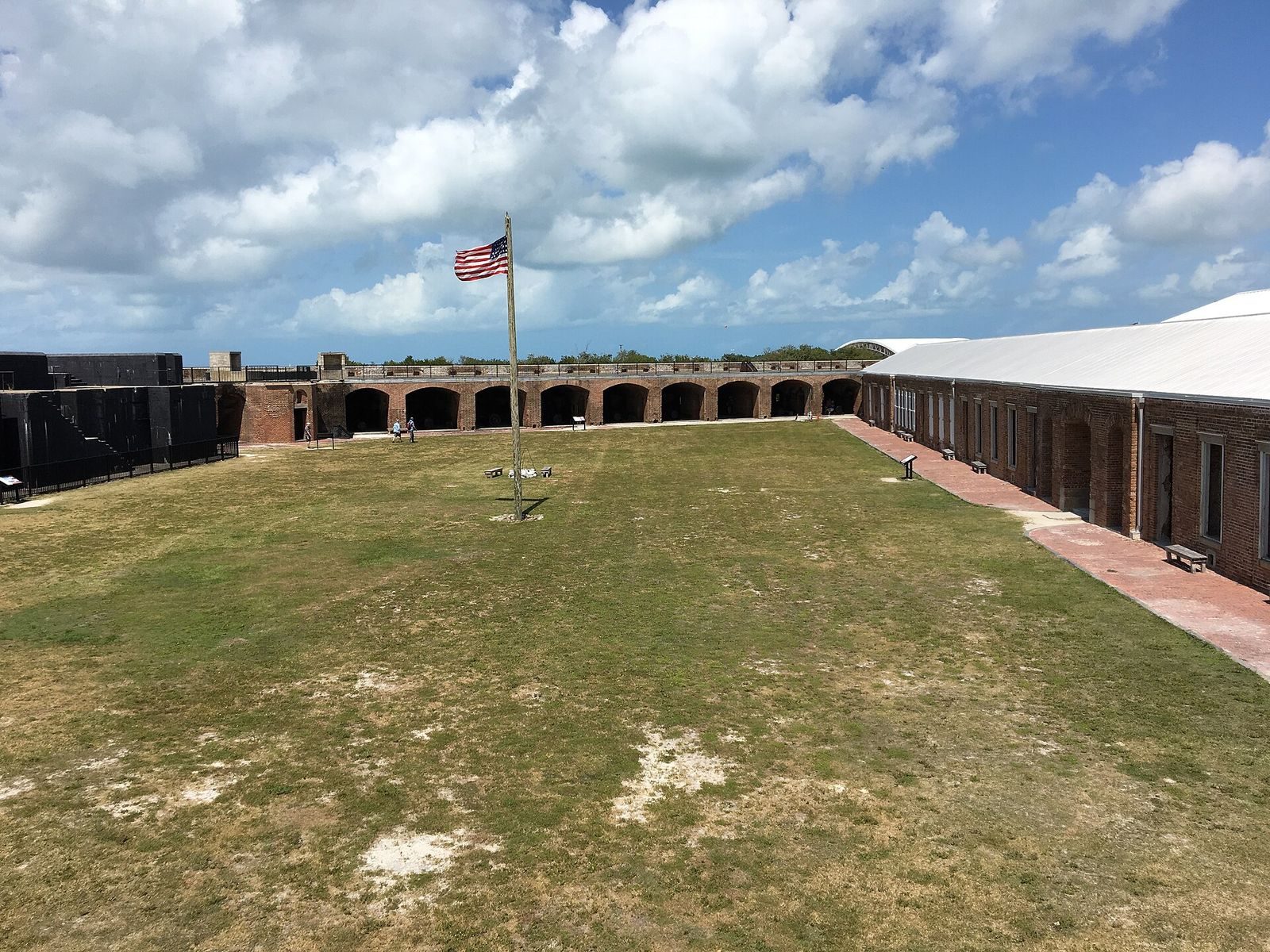
The fort has two tiers of casemates, protected chambers for guns or troops, topped by a terreplein, a level platform behind the rampart. Its three seaward curtain walls, the sections between projecting bastions, extend 495 feet (151 metres) between those defenses. Each curtain held 42 guns across three levels. On the land-facing side, barracks could accommodate up to 800 men, with a large gunpowder magazine at either end. A central sally port, a controlled passage through a fortification, linked to land by a 1,200-foot (366-metre) causeway. Underground cisterns along the perimeter collected rainwater.
Batteries and excavated remains
Battery Osceola was added to the south casemate and held two 12-inch M1895 guns. Battery Adair, on the west casemate, contained four 3-inch M1898 15-pounder rapid-fire rifles. Excavations exposed buried guns, cannonballs, other weapons, and remains of a seawater desalination plant from the mid-nineteenth century. The fort holds a large collection of Civil War cannons, while an associated museum displays additional restored excavation finds.
Excavation has not reached every part of the fort. Concrete reinforcement applied to the brick walls toward the end of the nineteenth century has contributed to masonry cracks and presents a risk of collapse. State repair funding has been limited, and the Friends of Fort Taylor organization raises donations for rehabilitation.
Park landscape and coastal habitat
The park covers about 87 acres (35 hectares), including filled land around the fort and a beach created to its south in the 1970s. Tropical hardwood trees and shrubs provide food and shelter for migrating birds in spring and fall. The park forms Key West’s largest green space; the island is the last landfall between Cuba and Florida. Frigatebirds and other uncommon birds occur in the park, and a Bahamian flycatcher was seen there in 2006. The park is part of the Great Florida Birding Trail, a network of parks and wildlife areas used for birdwatching.
Marine environment
The coastal waters support parrotfish, yellowtail snapper, lobster, and corals. Deeper water provides habitat for giant grouper (Epinephelus lanceolatus) and Atlantic tarpon. Reef restoration beyond the breakwater off the park beach included planting more than 5,500 corals.