Alferaki Palace: A Merchant’s Residence and Museum in Taganrog
Site at a Glance
- Country
- Russia
- Primary era
- Modern
- Eras represented
- Modern
- Civilizations
- Russian
- Site type
- Domestic
- Remains
- Elite Residence
On this page12 sections
History
Merchant residence and cultural center
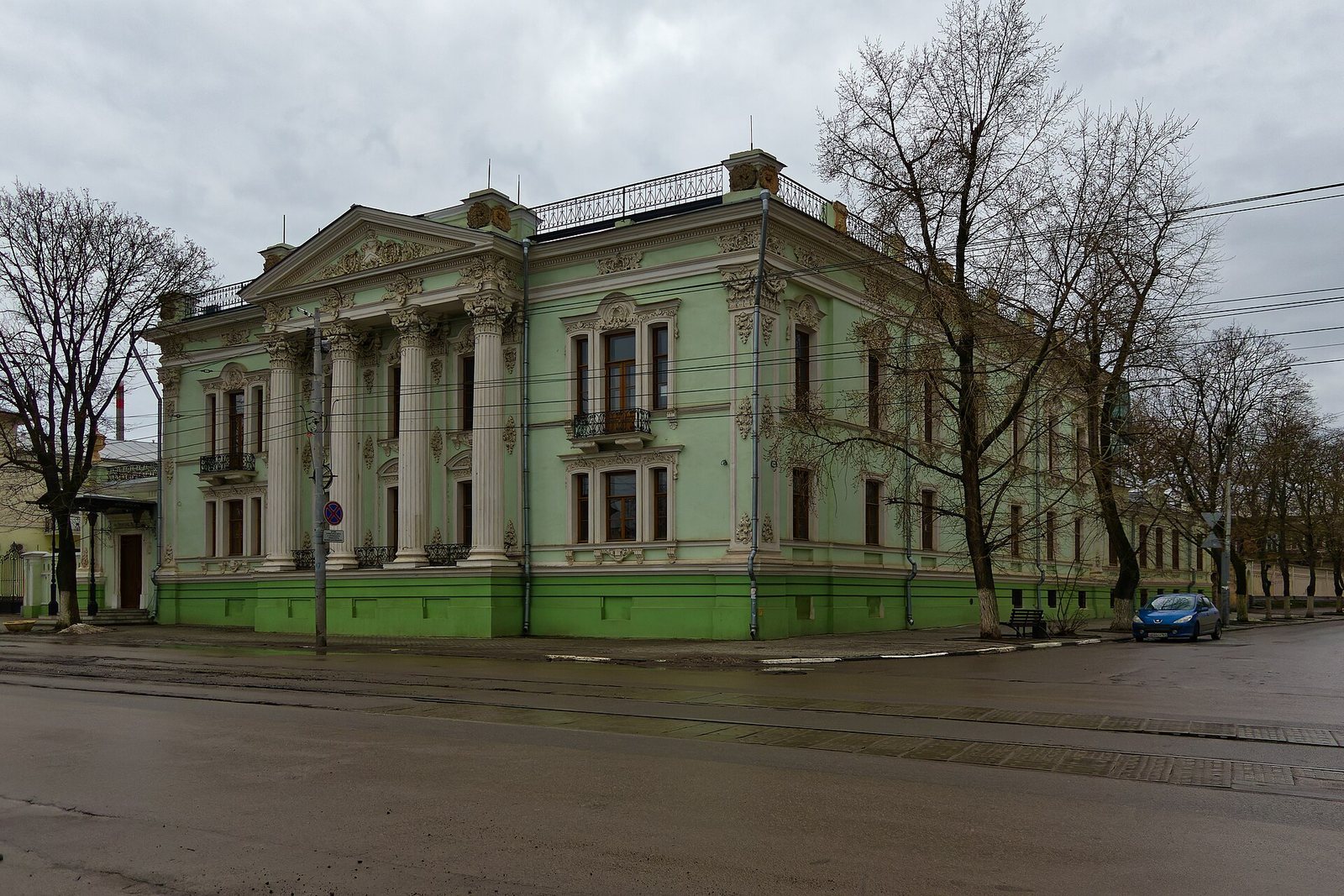
Alferaki Palace is a two-storey Neo-Baroque residence in Taganrog, Russia, completed in 1848 for the wealthy merchant Nikolay Dmitrievich Alferaki. He commissioned Russian architect Andrei Stackenschneider to design the building, which became a center of local cultural life. The Alferaki family lived there for about 30 years.
The house hosted lavish balls and masquerades for invited members of Taganrog society. A large, double-height hall was added later. In 1857, Prince M. G. Golitsyn visited and praised the palace’s paintings, sculptures, antiquities, and other works of art, comparing its magnificence with that of royal residences.
Commercial Assembly and Chekhov
After the Alferaki family’s finances declined in the 1870s, the estate passed to the merchant Negroponte, who sold it in parts. A merchants’ association then acquired the palace and garden for use as its Commercial Assembly club. Concerts were held there. In 1876, Anton Chekhov attended a concert featuring violinist Leopold Auer and composer Sergei Taneyev. Composer Pyotr Ilyich Tchaikovsky also visited the club while in Taganrog.
The club and garden later informed Chekhov’s stories “Ionych,” “The Mask,” and “My Life.” These works drew on the building’s social life, including card playing and walks in the garden.
Museum and political use
At Chekhov’s initiative, a local-history museum was established in Taganrog on June 22, 1898. After the 1917 revolutionary upheaval, Soviet administrative bodies used the palace. From February to April 1918, it housed the Taganrog Soviet Workers’ Council, a representative council in revolutionary-era Russia. During the German occupation in 1918, the building served as a military hospital. In 1919, it housed the staff of Anton Ivanovich Denikin, a general and leading commander of the anti-Bolshevik White forces during the Russian Civil War.
The palace became the home of the local-history museum in 1927. During the German occupation of Taganrog, occupation authorities looted its Russian art collection and 339 other art objects.
Restoration and present use
Restoration between 1989 and 1996 substantially recovered the palace’s original appearance, including its grand double-height hall. The museum’s present exhibition was assembled in 1995–1996, and concerts and receptions resumed in the building. The palace is a federally significant cultural-heritage monument in Russia and currently houses the Taganrog Local History Museum, a branch of the Taganrog State Literary and Historical-Architectural Museum-Reserve.
Remains
Exterior and estate
The two-storey palace combines Neo-Baroque forms with elaborate façade decoration. Four Corinthian columns, with capitals carved in the characteristic leafy style, support the front composition beneath a triangular pediment bearing the Alferaki family coat of arms. A balustrade runs along the roof, while masks and vases provide further ornament. Antique-style stucco appears on both the exterior and interior. A corridor-plan wing stood beside the main house, and the estate also included a garden. Gates from Frunze Street lead into the palace yard.
Interior and grand hall
The ceremonial rooms are arranged as an enfilade, a sequence connected by doorways aligned along a common axis. A marble staircase has 41 steps. Pilasters with classical capitals frame the door leading to the belvedere, an elevated room designed to provide a view. The palace’s rooms are broadly Baroque in decoration, while the later-added grand hall has Rococo ornament.
About nine metres high, the grand hall is divided into three sections and contains paintings, a fireplace, and a large clock. A graceful arch opens into it. In the central section, ceiling arches rise toward the middle, with fresco medallions between them. The paintings show elaborately dressed ladies and gentlemen in scenes from the salons of Versailles under Louis XIV, Louis XV, and Louis XVI. Italian artists painted the salon ceiling.
Museum collections
Exhibition and archaeological holdings
The museum’s exhibition occupies 13 rooms, with displays of archaeology, metalwork, weapons, ceramics, glass, textiles, paintings, sculpture, and coins. Its archaeological collection contains about 78,580 objects, including material gathered through excavations at Stone Age sites in northeastern Azov. The Imperial Archaeological Commission, a state body responsible for archaeological work and preservation, donated some finds in 1903. The museum’s excavated Palaeolithic and Neolithic materials, from the earlier and later phases of the Stone Age, are among the most comprehensive in southern Russia.
Finds from settlements and burial grounds
The collection includes finds from the Nizhne-Gnilovskoye settlement, Tanais, an ancient Greek city and archaeological site, a barrow near Krasny Kut, the Kobyakovo burial ground, barrows near Semenkin in Volgodonsk district, and the Semikarakorsk settlement. Objects from Kobyakovo date to the first and second centuries AD. Materials from barrows between the Manych and Sal rivers indicate the presence of nomadic societies in the third and second millennia BC. Bronze Age burials from the Neklinovsky, Matveyevo-Kurgansky, and Kuibyshevsky districts represent agricultural and pastoral communities.
Medieval and Golden Horde material
Finds from the Kurichi settlement, dating to the eleventh through thirteenth centuries, illustrate the medieval settlement of northeastern Azov by Rus’ communities. Other objects associated with the Golden Horde, the Mongol-ruled khanate that controlled parts of eastern Europe and western Asia, come from the Semenkin burial ground and barrows in the Neklinovsky, Matveyevo-Kurgansky, and Tsimlyansky districts.