Valsgärde: A Burial Ground of the Vendel and Viking Ages
Site at a Glance
- Country
- Sweden
- Primary era
- Medieval
- Eras represented
- Iron Age, Classical, Medieval
- Civilizations
- Swedish
- Site type
- Burial
- Remains
- Necropolis
On this page17 sections
History
Valsgärde is a burial ground beside the Fyris River in Sweden, about 3 km north of Gamla Uppsala. Its earliest known burials date to the pre-Roman Iron Age, and its most intensive use came during the Vendel and Viking Ages. The cemetery remained in use into the 11th or possibly 12th century, and its boat burials provide a detailed record of changing status and funerary customs in central Sweden.
Early burials
At least four people were buried near the hilltop during the pre-Roman Iron Age. One of these burials dates to about 350 BC. Some early graves were later covered or cut into by new burials. After a gap of roughly 400 years, burial resumed in the late Roman Iron Age.
Two cremations belong to the Migration Period, before the Vendel Age. Burials from this phase are scattered around the hill, a pattern that may partly reflect later graves disturbing earlier ones. Graves 20 and 24 were chamber burials, while grave 49 was a cremation; grave 82 also belongs to this early sequence. The cemetery may have served a small community whose dead were buried on both sides of the route toward the summit.
Vendel Age
During the Vendel Age, some burials came to express exceptional status. Boat graves 5, 6 and 7, along with cremation grave 57, belong to this more prestigious phase. Grave 57 was the cremation of a high-status woman. Other burials include grave 63, another high-status woman’s cremation, and grave 29, whose occupant is considered a high-ranking man. Grave 99 is a cremation from the later Vendel Age. These graves were placed among earlier Iron Age burials.
The boat-burial custom began in the late 6th or early 7th century and continued into the Viking Age. The richly furnished, uncremated boat burials stand apart from the cremation practiced for many others. Their spacing, at roughly one burial per generation, has prompted the suggestion that the position they represented could be held by only one person at a time. The occupants have been variously linked to the legendary Ynglings, also called Scylfings, to leaders associated with the Leidang, a Scandinavian system of naval military obligation, or to local leaders who gained wealth through trade. The region’s position between the Mälaren lake and Tiundaland, a historic district of Uppland, has been proposed as one source of local wealth. The riches of the graves have also led to suggestions that many occupants were royalty, but their identities remain interpretations rather than established fact.
Valsgärde’s boat burials have been compared with those at Sutton Hoo, an Anglo-Saxon burial site in East Anglia. Sutton Hoo’s principal burial is probably dated to about AD 610–635, providing a point of comparison for the early Scandinavian boat-burial tradition.
Viking Age
The earliest Viking-Age cremations, graves 59 and 67, lie at the western end of the cemetery. Four early boat burials were also placed in the western part. In general, uncremated burials are associated with people of high status and cremations with people of lower status, though grave 66 does not fit that pattern. It was a richly furnished cremation without weapons and may have held a man and a woman together. Numerous animal offerings or companions were also included.
Sword burials 13 and 14 belong to the 9th-century sequence. In the 10th century, cremation became less common. Graves 85 and 94 were high-status women’s burials, while grave 86 belonged to a person of lower status. These cremations were grouped among contemporary boat graves 2, 3 and 4. About two-thirds of the graves in this phase are considered high-status.
Late Viking-Age boat graves were concentrated at the cemetery’s western end, north of earlier burials. Graves 12 and 15 were made at nearly the same time, followed in sequence by boat and chamber graves 10, 1, 9, 11, 23, 22, 28, 26 and 25. The final three date to the 11th or 12th century. Five chamber burials are known from the 11th century, when chamber graves took the place of boat burials. Christianity initially brought little change to burial customs, but burial eventually appears to have shifted to churchyards, bringing the cemetery’s use to an end.
Limited grave looting has helped preserve an unusually rich body of evidence. Grave goods, particularly those from men’s burials, allow 15 boat graves to be arranged in sequence from the early Vendel Age to the end of the Viking Age, followed by five 11th-century chamber burials. The interval between burials averages about 30 years, approximately a generation. Women appear to have been cremated about three times as often as men.
The farm and archaeological investigations
By around 1540, Valsgärde was a small farm and no longer had the reputation or standing of the substantial Iron Age estate that may have preceded it. The present farm dates from the 16th century.
Finds near the farm led to an inspection in 1926. Long depressions on the hill were then thought to be sunken boat graves. Uppsala University began archaeological investigations in 1928, and work continued into the mid-1950s. The first boat grave was excavated by hand in the spring of 1928; eight men spent 11 days on the work. Investigations also examined depressions and cremation burials, while trial trenches prepared for wider excavation. The earliest parts of the burial ground remain particularly incompletely investigated.
The settlement associated with the cemetery was identified in the 1950s. Excavation in the 1990s uncovered a large hall and its raised terrace, evidence of a substantial settlement connected with the burial ground.
Remains
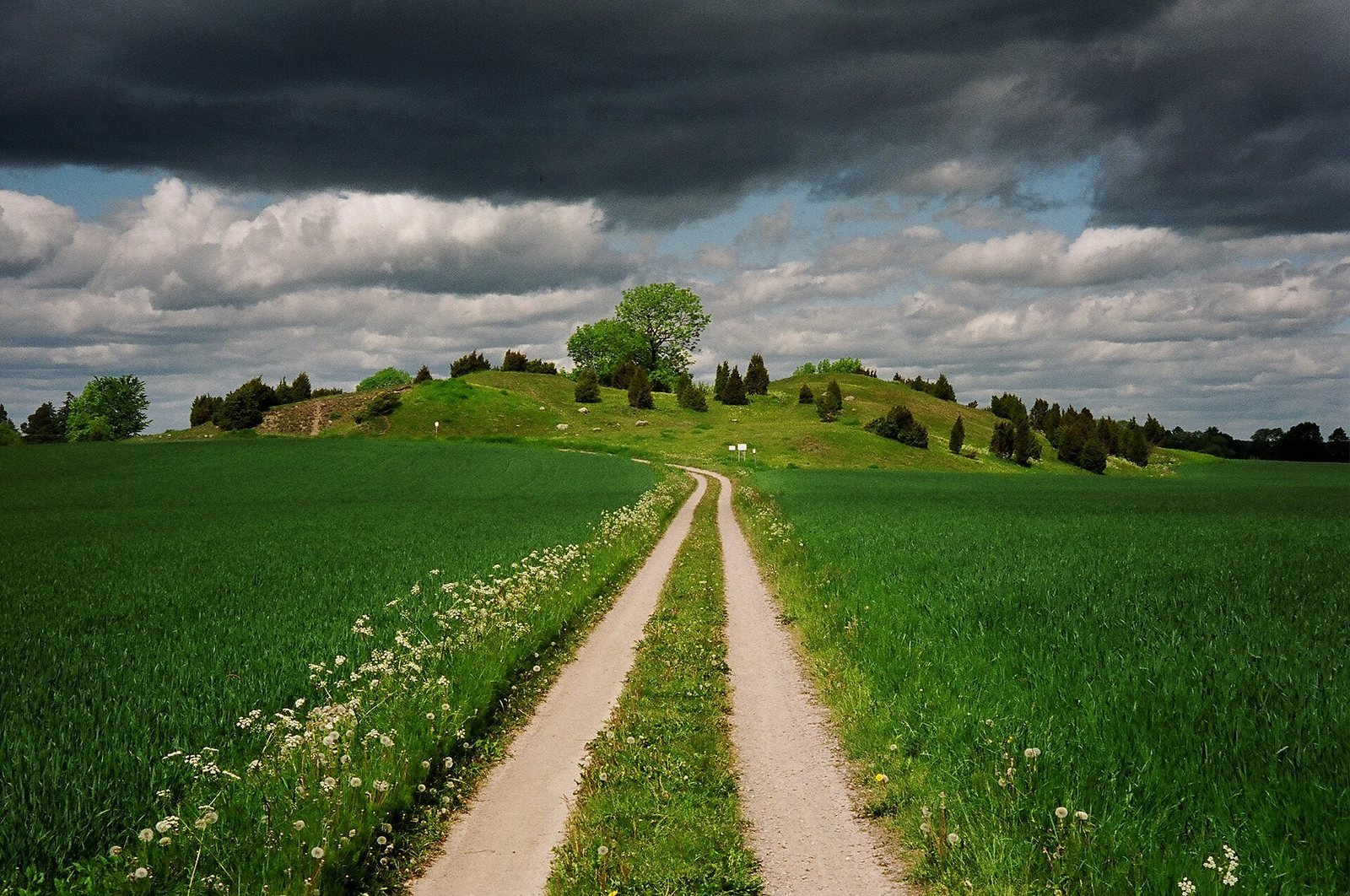
Valsgärde occupies an esker, a long ridge of sand and gravel deposited by glacial meltwater, within the Uppsalaåsen ridge system. The valley was once seabed; land uplift raised it above sea level around the end of the Stone Age and the beginning of the Bronze Age. Wave action exposed the ridge crest, while clay accumulated in lower parts of the valley. The ridge reaches 25 m above sea level. During the Vendel Age, it stood among cultivated plains and served as a landmark from both the land and the river.
The cemetery and its layout
The burial ground contains 15 uncremated boat graves, 15 other inhumation and chamber burials, and at least 62 cremation burials, alongside other archaeological features. About half of the 15 non-boat inhumation and chamber burials date to before AD 700. The oldest known burials include uncremated bodies in wooden coffins, while the youngest include Christian coffin burials.
Before excavation, earth mounds and stone settings covered parts of the ridge. Their stone borders formed circular, rectangular or irregular outlines, and their interiors were often densely paved. Rows of depressions left by collapsed grave chambers created ship-like patterns. Grave goods and human remains lay beneath them. Sunken boat graves also formed long, boat-shaped depressions, often set out in parallel rows.
A cleared, levelled road crosses the ridge and is thought to date from the earlier Iron Age. Four sand pits were later dug to supply the farm, and the extraction probably destroyed many graves. Seventeen features on the hill are not associated with burials; they include layers of human activity and traces of hearths.
Ship-shaped setting
A small ship-shaped setting is outlined by 14 regularly spaced holes, with a further hole at its centre that may belong to the arrangement. Unlike most settings of this kind, it was not made of stone. The stones may have been removed, or wooden posts may have stood in their place and later decayed. The setting measures 9 m by 4.2 m and runs approximately north–south, turned slightly clockwise. Grave 82 was later dug across it, placing the setting before the Vendel Age, although its precise date is uncertain. Such settings are generally considered older than boat burials. It may have served a symbolic purpose that lost its meaning when actual boats began to be buried.
Boat graves
Boat grave 1
Boat grave 1 held a boat about 8 m long, 1.4 m wide and 0.55 m deep. It had five rows of planking on each side, with planks about 3 cm thick and 15–20 cm wide. Nine frames supported the hull: V-shaped at the bow and stern, and U-shaped amidships. Around 500 nails and rivets survived in their original positions, making it possible to reconstruct the boat’s form and fittings. A conifer-wood fragment 45 cm long, perhaps from the keel or bow, also survived. The grave was first dated to AD 950–1000 from its objects, then placed in the early 11th century through comparison with finds from other Valsgärde graves. Nearby graves 15 and 10 may have preceded it.
The deceased lay near the middle of the boat on its starboard side, with his feet toward the stern. A shield and knife were beside him, while the shield boss and knife blade rested on the boat’s bottom. The shield, considered an eastern type, was about 4 cm thick. An 85 cm Viking-style sword lay to his right, 35 cm above the bottom. It is classified as a Petersen S-type, a category within the typology of Viking-Age swords. The burial also contained a bow brooch and two other brooches.
A horse still had its bit in its mouth, and a dog lay beside it. At the other end of the boat were an iron cooking pot retaining a greasy substance, perhaps from food, and a repaired bronze bowl, 26 cm in diameter, that was poorly preserved. Two bowls made from birch or aspen survived beneath the bronze bowl. Four gaming pieces were also found. A wooden chest without a lid, reinforced with iron hoops and measuring about 40 by 40 cm and 20 cm deep, probably held goods that did not survive; a similar chest dates to about AD 950.
The boat was hauled from the river through a trench 1–2 m deep and supported in place. After the deceased, weapons and other goods were placed aboard, a horse and dog were killed and laid in the bow with food and vessels. Timber covered the boat, and earth from the grave cut was piled above it. The mound measured about 10 m long, 5 m wide and 0.5 m high. As the boat and timber decayed and collapsed, the mound subsided, leaving a boat-shaped depression about 0.5 m deep before excavation.
Boat grave 5
Dated to the 8th century, boat grave 5 contained an 11.7 m clinker-built boat, made with overlapping hull planks fastened together with about 425 iron nails. It was large enough for four or five pairs of rowers. The deceased lay amidships on soft bedding, probably beneath a cloak. A sword, two single-edged seaxes and a glass beaker lay to his left, and he wore a knife at his belt. One shield covered him, two others leaned against the boat’s upper edge, and a helmet lay below his feet. The grave also held a spear, three bridles, a roasting fork and 18 arrows, probably carried in a quiver and likely accompanied by a bow.
Equipment placed to one side included a cauldron with its suspension gear, an iron support for burning logs, an axe and shears. Food remains included beef, one and a half pigs, some horse meat and possibly greylag goose. Two whole horses and a cow were buried north of the boat, and four dogs were placed to its south.
Boat grave 6
Boat grave 6, dated to about AD 750, held a clinker-built spruce boat about 10 m long, fastened with roughly 350 iron nails and sized for four or five pairs of rowers. The deceased lay on a feather bed in the stern. Two swords, a seax and two glass beakers were to his left, with another seax to his right. The body and equipment appear to have been covered with blankets. Shields leaned against the boat’s upper edge, with textiles and birch-bark mats above them, interpreted as a tent. Two bridles and two bundles of arrows lay at the deceased’s feet.
The grave’s other contents included a tool chest, a cauldron with suspension gear, cooking equipment, a glass bowl, a board game and pieces, sword harness, two belts, a spear, a casket and a helmet. A horse and two or three dogs were inside the boat, while another horse and an ox lay outside it. The burial also included three shields, a decorated helmet with a chain-mail neck guard, two swords with wooden scabbards, a spear, three work axes, arrowheads and kitchen equipment.
Boat grave 7
Boat grave 7, dated to about AD 675, contained an 8.5 m clinker-built oak boat joined with about 520 nails and capable of carrying three or four pairs of rowers. The deceased lay in the stern in a wagon basket, on a feather bolster with a pillow. A sword and seax lay to his left; another sword, its harness and a seax lay to his right, along with a quiver of arrows. Three shields covered the body. A wooden drinking cup and horn were placed to the left, with two smaller horns farther aft. A helmet lay north of the body, perhaps originally in a basket or chest.
Toward the bow were an axe, wool shears, rope, a dog leash and small objects inside a locked chest with its key. Combs and wooden bowls were also found there. Near the belt was a leather case containing tweezers, a fire steel and a spare horse stud. Other objects included two more groups of arrows, game pieces, a board, dice and a lance.
Cooking equipment in the bow included a spit, frying pan, cauldron with suspension gear, roasting spit, cooking fork and three wooden buckets. Food remains included cattle, pig, sheep, goose and pike, as well as capercaillie, snowy owl, duck and hazelnuts. A cow, four horses and a pig were buried whole beside the bow. Three horses were stallions and one was a gelding; all four were bridled and had metal studs on their hooves to improve grip, and one was saddled. One of the three shields bore two fittings shaped like birds of prey. The grave also contained two swords with gilded bronze hilts, two wooden scabbards, and a helmet decorated with stamped metalwork and almandine inlays on its brow pieces.
Boat grave 8
Boat grave 8, broadly dated to the 6th or 7th century, contained a 9 m clinker-built boat made mainly of spruce and fitted with about 440 nails. The deceased lay on a bolster with a cover and pillow. Two shields covered his legs; beneath them were two chests, one holding armour pieces and the other small tools. Two bundles of arrows lay under one shield, and a helmet was at the foot of the body. A glass beaker was to his left, with two more drinking vessels and at least five wooden bowls in front of his feet.
A toolbox held a whetstone, knife, wool shears, comb, fire steel, tweezers, iron wire and resin. At the bow were a board game and pieces, a chest, a cauldron with suspension gear and a cooking fork. A dog with a leash lay in the forward part of the boat. Two horses with metal studs on their hooves lay outside one side of the hull; one was bridled. A cow lay in front of the bow.
Boat grave 13
Boat grave 13, dated to the 9th century, held a clinker-built boat 9.8 m long. The deceased lay just behind the boat’s midpoint. The body and much of the equipment were covered by about 4 square metres of yellow-green, felt-like textile. An orange-yellow bead may have belonged to the clothing, and a bronze brooch with enamel inlays lay on the body. One shield was above the head and another in the stern. A sword, much of whose wooden scabbard survived, lay to the deceased’s left; two bundles of arrows were near the middle of the boat.
At the bow were a bridle with enamel inlays and a toolbox containing wool shears, a hammer and unused horse studs. Food remains included fish, birds, sheep and cattle, along with gaming pieces. Three horses lay in a row outside the boat. All had metal studs on their hooves, and two wore halters.
Some boat-grave textiles survive in unusually good condition and retain bright colours. They came from Sogdiana, a historical region of Central Asia east of the Caspian Sea, and from China.
Cremation burial
A cremation burial of an older woman who died in the first half of the 10th century contained beads of carnelian, rock crystal and glass, a bronze arm ring, an equal-armed brooch and an iron hook probably used to pull a wagon. Horse-hoof studs and remains of a horse, two dogs and a rooster were also present. A carved bone animal head with carnelian eyes may have belonged to a staff or sceptre of the kind often carried by powerful women. It resembles objects from the Oseberg grave and Birka.
Associated settlement
The large hall associated with the cemetery stood on a raised terrace, markedly higher than other buildings and the surrounding plain. The hall and terrace form the surviving evidence for a substantial settlement connected to the burial ground.