Norrby Church: A Parish Church Rebuilt in the Neo-Romanesque Style
Site at a Glance
- Country
- Sweden
- Primary era
- Modern
- Eras represented
- Medieval, Early Modern, Modern
- Civilizations
- Swedish
- Site type
- Religious
- Remains
- Church
On this page12 sections
History
Norrby Church is a stone church in Sala Municipality, Västmanland County, Sweden, within the historical province of Uppland. Its original building was probably erected around 1300, and the church was substantially rebuilt in the Neo-Romanesque style in 1887. It belongs to Norrby parish in the Diocese of Västerås, a regional jurisdiction of the Church of Sweden, an Evangelical Lutheran church. The church is associated with a consecration in the fourteenth century and another in 1887.
Medieval origins and early extension
The original stone church dates probably to around 1300. In the sixteenth century, it was extended to the north. This addition became known as the Finn Church or the New Church.
Seventeenth- and eighteenth-century work
During the seventeenth and eighteenth centuries, repeated repairs strengthened the vaults and porch. New roof vaults and a stone floor were installed in 1741.
A larger remodeling took place in 1785 under master mason Johan Sundberg. Workers removed the south porch, raised the north wall to match the south wall, and replaced the roof with one carried by heavier trusses. They enlarged the window openings and laid the foundation for the church tower. New lychgates, or roofed entrances to the churchyard, were also built on the south and east sides of the cemetery wall.
Nineteenth- and twentieth-century rebuilding
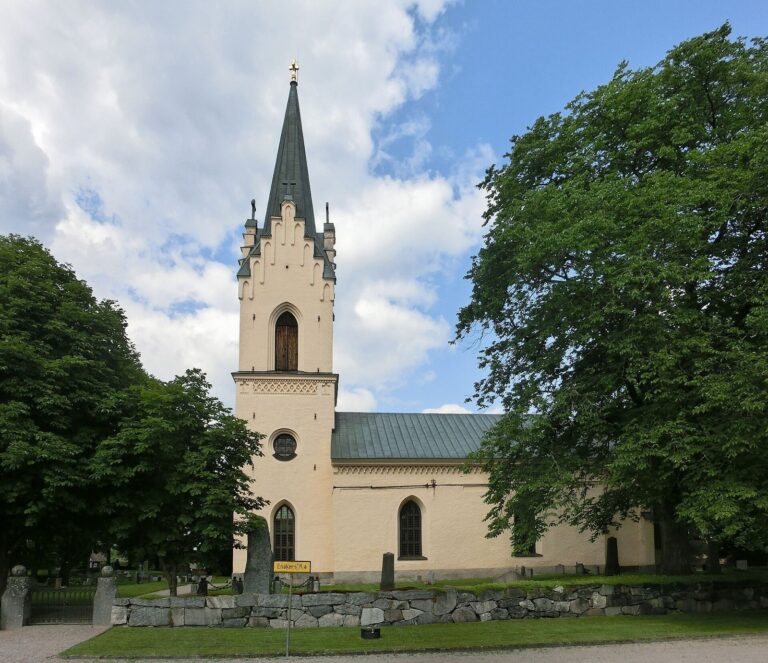
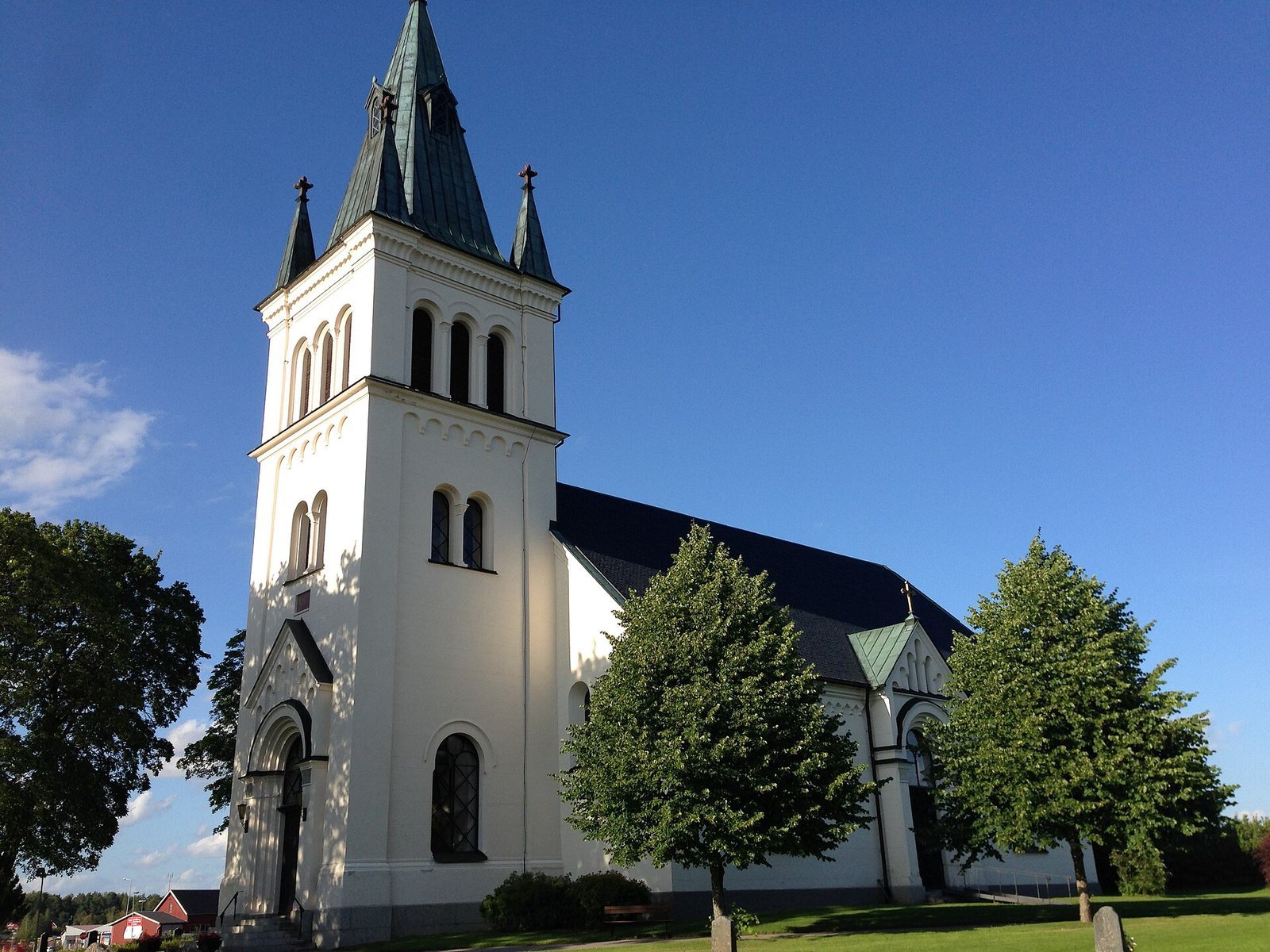
Architect Gustaf Dahl designed a major rebuilding in 1887 that amounted in effect to a new construction. In the Neo-Romanesque style, a nineteenth-century revival drawing on medieval Romanesque architecture, the work raised the exterior walls, completed the tower begun in the eighteenth century, and extended the church eastward.
Architect Viktor Segerstedt directed interior rebuilding in 1937. A restoration in 1960, led by Ragnar Jonsson, included rebuilding the western section. The church was restored again in 1982, when its present organ was renovated.
Remains
Setting and church structure
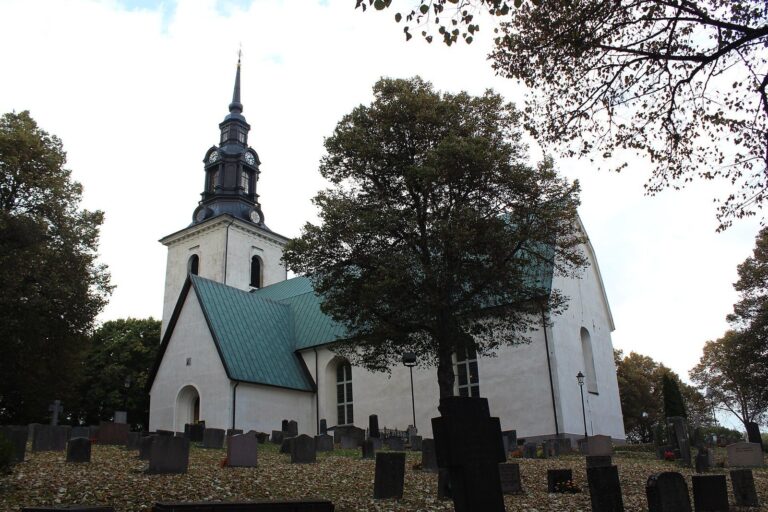
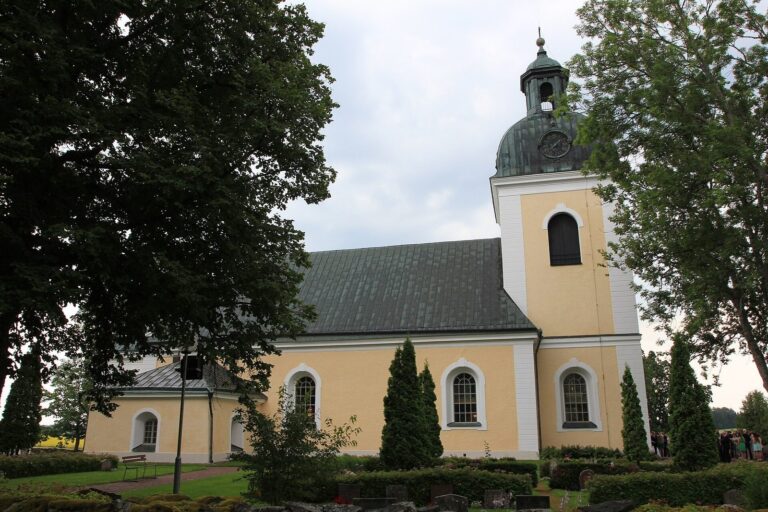
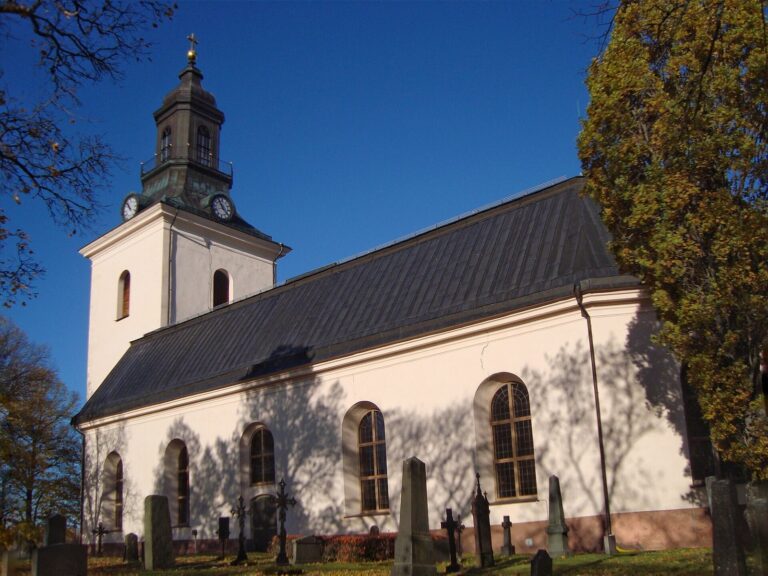
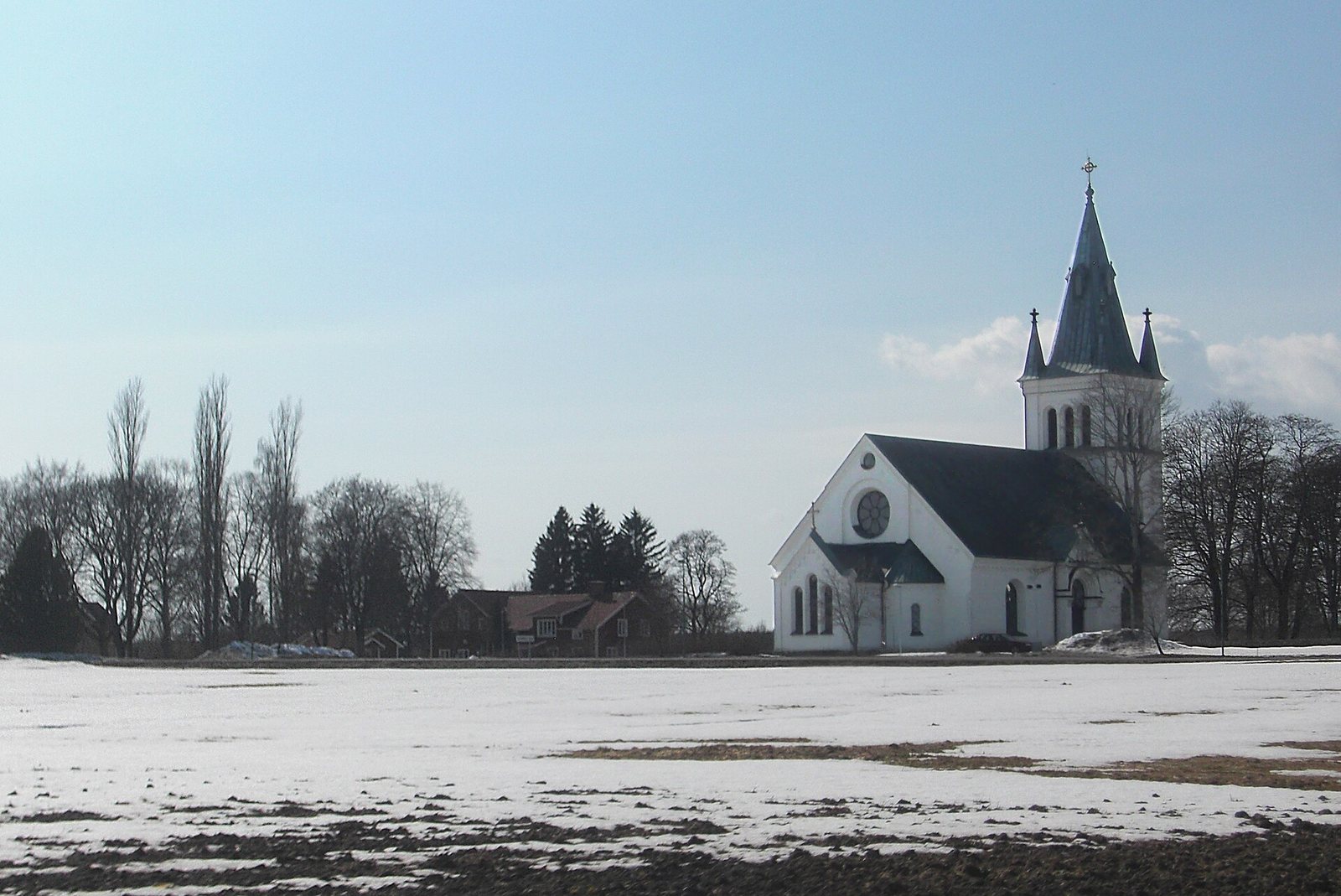
The church stands on the eastern bank of the Sagån River, which runs immediately to its west and marks the boundary with the historical province of Västmanland. Most of the churchyard lies west of the building. The church is made of stone, including fieldstone and brick. Its rectangular main body, or nave, is divided into three lengthwise aisles. A tower with an entrance adjoins the western end, while a lower, narrower sacristy, a room for preparing and storing items for services, is attached at the east. The nave has a tall roof covered with slate.
Interior and furnishings
Vaults and floor
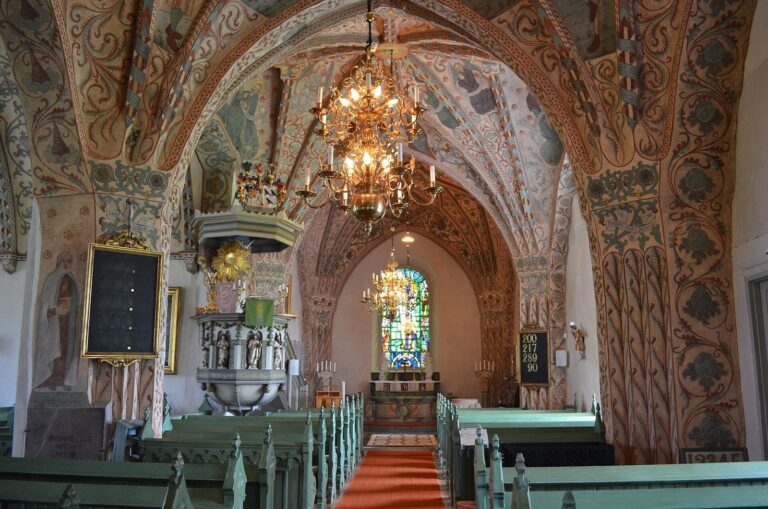
Cast-iron columns divide the interior. A high central barrel vault, a continuous arched ceiling, covers the nave, while partial barrel vaults cover the side aisles. The 1937 interior work replaced the earlier plank floor with hard-fired brick and drained the ground beneath it.
Altar and baptismal font
The gilded altarpiece was made by sculptor Magnus Granlund in 1752 in the Rococo style, an ornamental style associated especially with the eighteenth century. A mural by conservator Gösta Lindström is positioned above it. The stone baptismal font is medieval and may date to the earlier church.
Pulpit
Master Lars, a maker of pulpits, carved the pulpit in 1647. Its original colors were covered with gilding in 1758 to match the altarpiece. The sound canopy above the pulpit, which helps direct speech, was removed during the 1887 rebuilding and returned in 1960. It is now in place.
Organ and sacristy
An eight-stop organ, with each stop controlling a set of pipes with a particular sound, was built in 1730 by Stockholm organ builder Johan Niclas Cahman. The present mechanical organ was made in 1887 by E. A. Setterquist & Son of Örebro and has 15 stops. Organists Per Erik Dahlström of Sala and Er. Elin of Västerlöfsta parish inspected and approved it on 22 October 1887, praising its intonation and accuracy of tone color. The instrument was renovated in 1982 by Robert Gustavsson Orgelbyggeri AB of Härnösand. In the sacristy, wall-mounted cupboards have stained doors, and a round chancel window contains stained glass by John Österlund.
Roadside feature
A milestone is identified on the road leading to the church.