Electoral Palace, Bonn: Residence of the Prince-Electors of Cologne
Site at a Glance
- Country
- Germany
- Primary era
- Early Modern
- Eras represented
- Early Modern, Modern
- Civilizations
- German, Holy Roman Empire
- Site type
- Domestic
- Remains
- Palace
On this page15 sections
History
The Electoral Palace is a former residence of the Prince-Electors of Cologne in Bonn, Germany, commissioned by Joseph Clemens of Bavaria and built from 1697 to 1705. The Prince-Electors were archbishops who also had the right to choose the Holy Roman Emperor.
Electoral residence
An earlier palace, built between 1567 and 1577 for Salentin of Isenburg, stood beside Bonn’s southern city wall. It was destroyed during the 1689 Siege of Bonn, when forces allied with Joseph Clemens retook the city. Joseph Clemens then commissioned the replacement palace, designed by Enrico Zuccalli and built under the supervision of Antonio Riva. A double church was added to its west wing around 1700.
From 1715 to 1723, Robert de Cotte opened the palace toward the south and laid out the Hofgarten. In 1744, a gilded image of Mary, titled Regina Pacis (“Queen of Peace”), was installed above the garden entrance as a patroness of the university.
Fire and changing uses
A fire broke out in the west wing on 15 January 1777. It spread through the roof to the powder chamber, which exploded, and the blaze threatened the city. Rescue efforts lasted throughout the day, and many people died. Rebuilding was limited: the Hofgarten wing was restored in a simpler form, and a smaller double church in the east wing replaced the destroyed court church. In 1779, Johann Heinrich Roth built a palace church to serve as a court chapel.
The arrival of French revolutionary troops in 1794 ended the palace’s use as the residence of the Prince-Electors of Cologne. After French forces left, the Prussian crown took ownership. In 1816, King Frederick William III assigned the palace church to Bonn’s Protestant community; two years later, he gave the palace to the newly founded University of Bonn. The church remains in use by the university’s Protestant congregation. As a young man, Ludwig van Beethoven sometimes played its organ during services; he later became a major German composer and pianist.
University building and modern history
During the second half of the 1920s, wings destroyed in the 1777 fire were rebuilt using designs by Zuccalli and de Cotte, and a fourth corner tower was added. Allied bombing destroyed the palace on 18 October 1944. Reconstruction was completed by 1951: the exterior regained its earlier appearance, while most interiors were rebuilt in simpler form for university use.
The palace and Hofgarten are protected together as an architectural monument. On 22 October 1981, the garden hosted a demonstration against the NATO Double-Track Decision, attended by about 250,000 people.
Remains
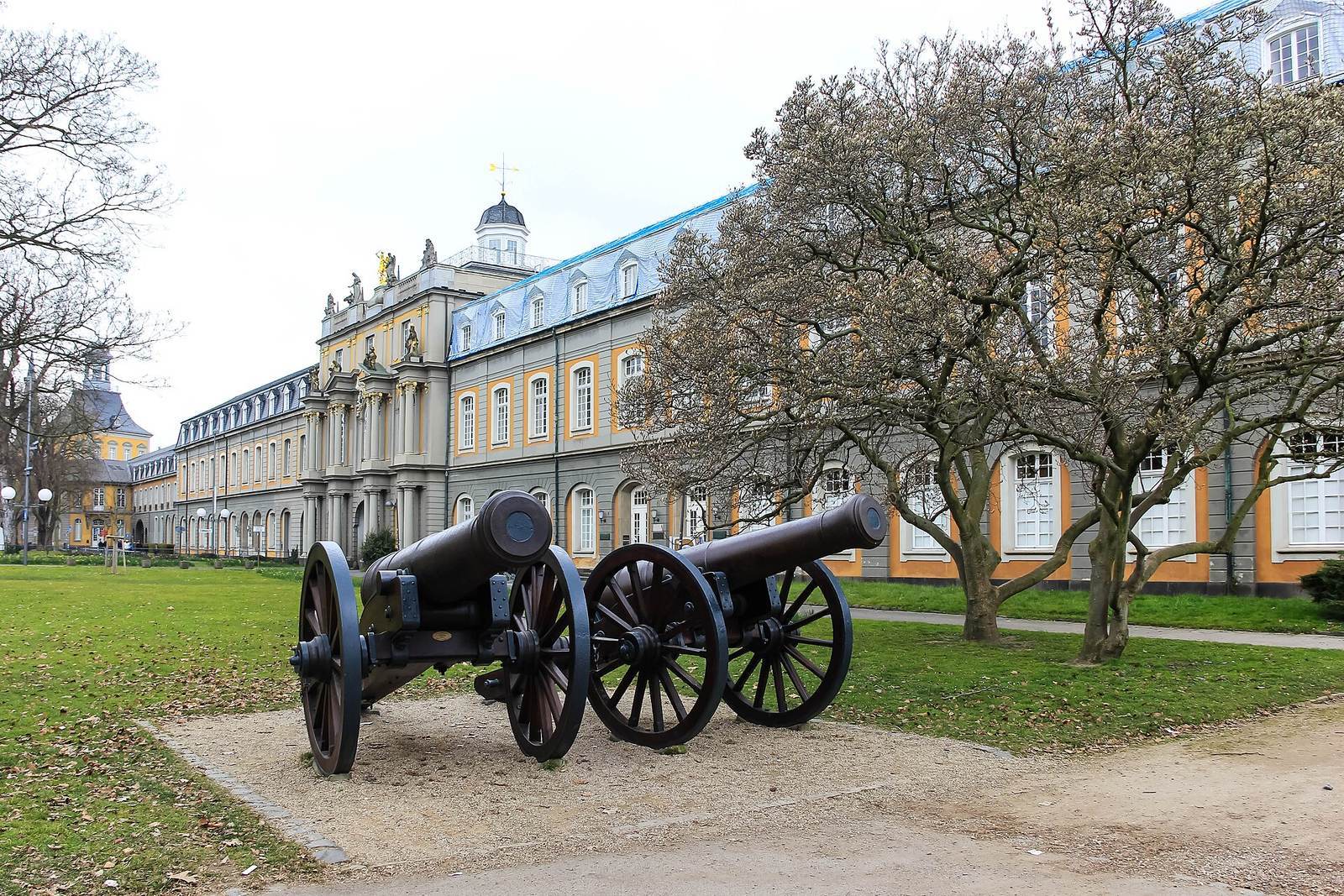
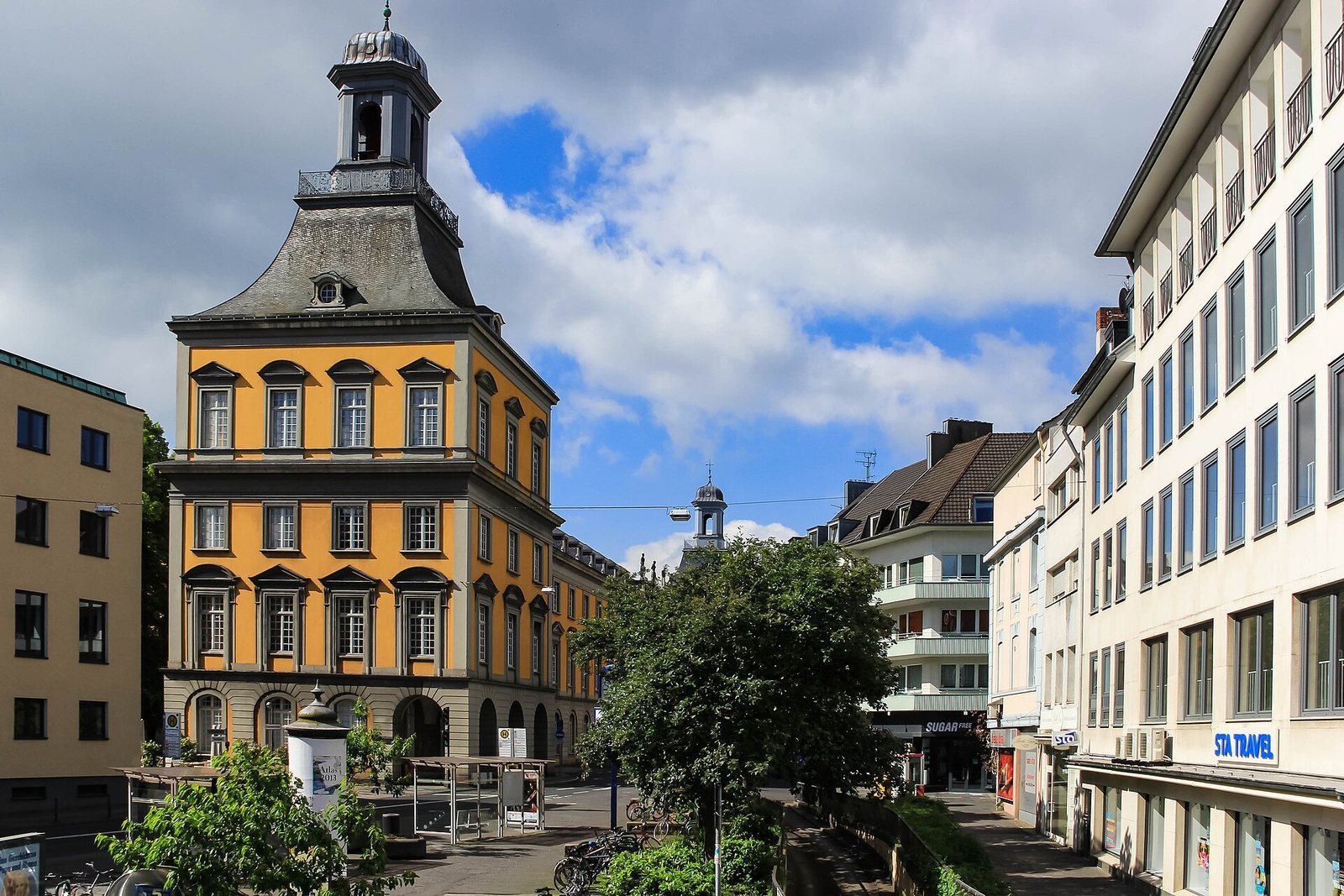
The palace is a three-storey rectangular complex with two long wings, interior courtyards and projecting corner structures. Its restrained, geometric design recalls El Escorial, a Spanish royal monastery-palace near Madrid, and Herrerianism, the understated style associated with it. The corner structures have inward-curving roofs and open lanterns, small roof structures with openings; the four-storey corner towers also carry lanterns. The west cross-wing faces Poppelsdorfer Palace across Poppelsdorfer Allee. Rows of arches surround the central courtyard, which connects the city to the northwest with the Hofgarten to the southeast. The northeastern cross-wing contains the palace church and separates this courtyard from an outer court flanked by two towers. The university auditorium occupies the former site of the west-wing double church.
Garden and south entrance
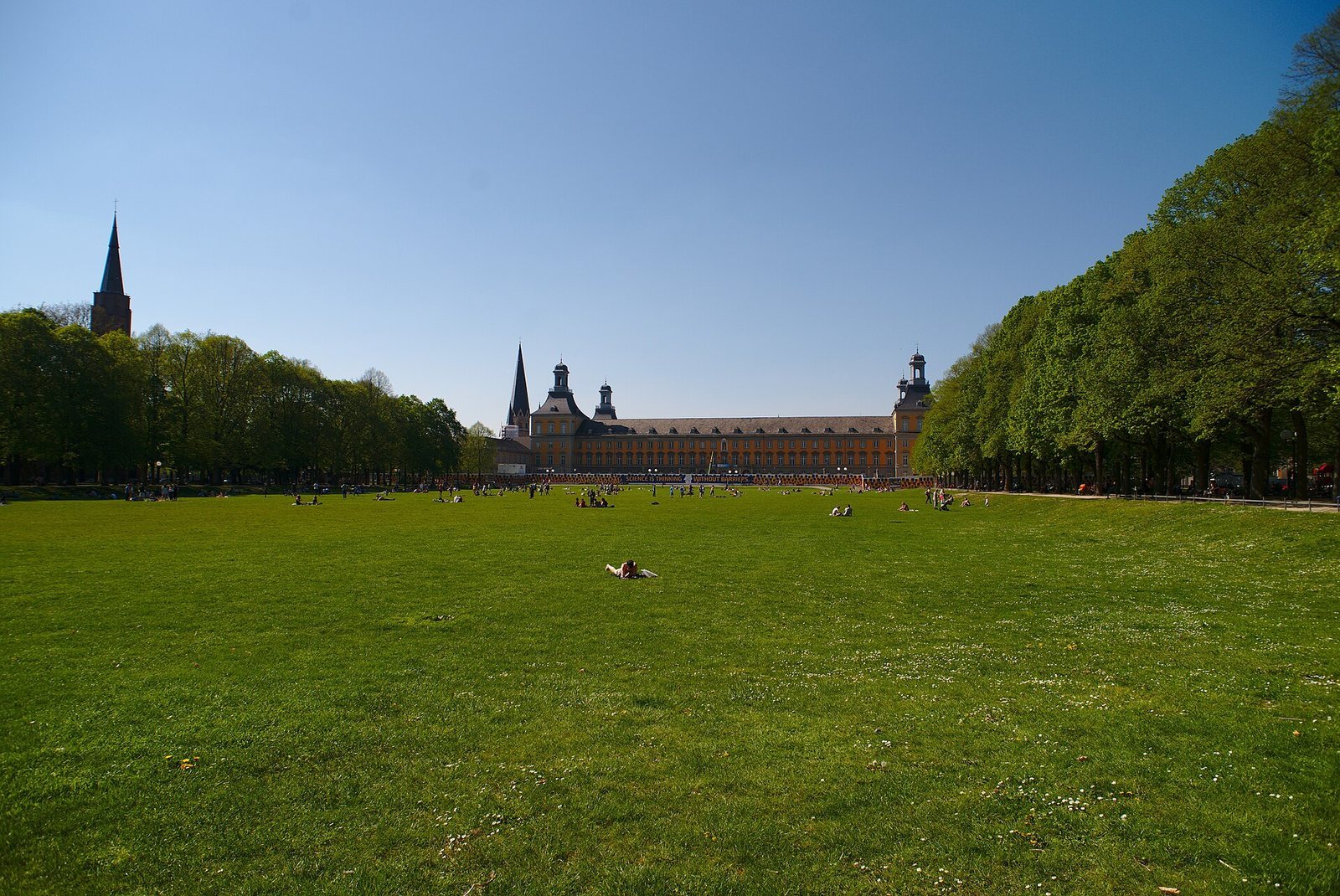
The Hofgarten is a large park south of the palace. Above the garden-facing entrance, centered on the building’s third storey, stands the gilded statue of Mary made by Wilhelm Rottermondt. Its title, Regina Pacis, means “Queen of Peace.”
Koblenz Gate
Inserted into the palace’s east wing between 1751 and 1755 for Elector Clemens August, the Koblenz Gate was built by Bonn master builder Michael Leveilly to designs by François de Cuvilliés the Elder. This three-storey Baroque structure contrasts with the plainer palace. It spans the present-day B9 road toward Koblenz, which passes through its lower level. Before Bonn’s urban highways were built, the gate constrained local and through traffic; about 36,000 motor vehicles passed through it each day in the early 1960s.
Lower level
The lower storey follows a triumphal-arch design, with rough-faced exterior walls and three passages divided by paired columns. The wider central passage was intended for riders and carriages, while the narrower side passages served pedestrians. The columns have Doric capitals, the simple tops of classical columns. A decorative band of alternating raised blocks and square panels runs across the projecting and recessed arch structure. The central hall originally served as a meeting place for the Order of Saint Michael, a chivalric order dedicated to the archangel.
Middle and upper levels
Windows and scroll-shaped Ionic capitals decorate the middle level. Its broken central pediment, a split triangular ornament, frames a coat of arms supported by small winged figures. Above it, four nearly life-size statues represent piety, endurance, strength and loyalty, virtues of the Order of Saint Michael. The upper level is simpler, with rectangular windows and Corinthian-style flattened columns.
Roofline and statues
A balustrade crowns the gate. Its recessed center surrounds a plinth bearing Wilhelm Rottermondt’s gilded statue of the archangel Michael slaying a dragon. Two female figures flank Michael, each defeating a male monster: one holds the Lamb of God, and the winged figure carries a spear. An eight-sided lantern with a dome and glazing on all sides rises above the gate.
Palace church and fittings
Church interior
The palace church is in the southeast tower. Its rebuilt interior includes elaborate restored stucco decoration. Karl Friedrich Schinkel designed its nineteenth-century pulpit and rebuilt the chancel in 1844.
Bells
Martin Legros cast two bells for Elector Maximilian Friedrich of Königsegg-Rothenfels in 1779; Christian Claren added a third in 1869. All three were confiscated during the Second World War. The two Legros bells, partly damaged, were returned in 1947 and placed in the church vestibule opposite the entrance in 1994. They serve as a memorial to the palace’s destruction in 1944. A separate peal of four bells, cast by the Bachert foundry in Karlsruhe in 1967, hangs in the lantern dome of the east tower.
Organ and carillon
Klais built the church organ in 2012. Installed at the back of the nave, it has 27 stops, two manuals and a pedal, with mechanical key and stop actions. Its carillon, a set of bells played from a keyboard, recalls one that hung in the northeast tower during the electoral period. The east tower’s four-bell peal sounds E-flat 2, G 2, B-flat 2 and C 3.
Gallery Wing
The Gallery Wing extends from the eastern tower toward the Rhine. It contains the Koblenz Gate and the Stocken Gate, which spans Stockenstraße.