San Francesco Church, Pistoia: A Franciscan Parish and Gothic-Renaissance Complex
Site at a Glance
- Country
- Italy
- Primary era
- Medieval
- Eras represented
- Medieval, Early Modern
- Civilizations
- Grand Duchy of Tuscany, Republic of Florence
- Site type
- Religious
- Remains
- Church
On this page21 sections
History
San Francesco Church is a Roman Catholic parish church in Pistoia, Italy. Its present complex began in 1289 in a Gothic-Renaissance style, combining medieval and Renaissance forms.
Franciscan foundation and construction
Tradition places St Francis of Assisi in Pistoia in 1220. During the first half of the thirteenth century, Franciscan friars established themselves in a small convent connected with an earlier church, Santa Maria al Prato, on or near the present site. The property appears to have been granted to them by the canons of the cathedral.
Construction of the present complex started in September 1289 and continued into the fourteenth century. By 1340, the church, with a single nave and side altars, was complete. It was first dedicated to the Holy Cross and is now dedicated to St Francis.
Artistic patronage
A plaque dated 1343 offers a plausible marker for the period after which the Bolognese painter Dalmasio degli Scannabecchi worked in Pistoia. In May of that year, the friars commissioned Sienese painter Lippo Memmi to create a polyptych, a multi-panel altarpiece, for the church. The work is lost. Giorgio Vasari later wrote that Memmi based it on a design by Simone Martini. In the seventeenth century, local noble families established numerous side altars. The wealthy merchant Bandino dei Ciantori, whose trade reached northern Italy, received the main chapel in perpetuity and commissioned its fresco cycle. The commission came after Giotto’s death, when his workshop was active in Milan.
Suppression and later custodianship
Napoleonic authorities suppressed the convent in 1808, and the friars left. They returned in 1819, but the Italian State closed the monastery again in 1866 and transferred its buildings to the municipality. In 1926, the convent was entrusted to the Friars Minor Conventual, a branch of the Franciscan order. In 2016, the Franciscans ceded the church and property to the Congregation of the Sacred Heart of Jesus of Betharram, a Catholic institute of priests and brothers founded in Betharram, France. They also left the parish. The church remains a parish in the Diocese of Pistoia, a district administered by a bishop, and is entrusted to Betharramite priests.
Remains
Facade
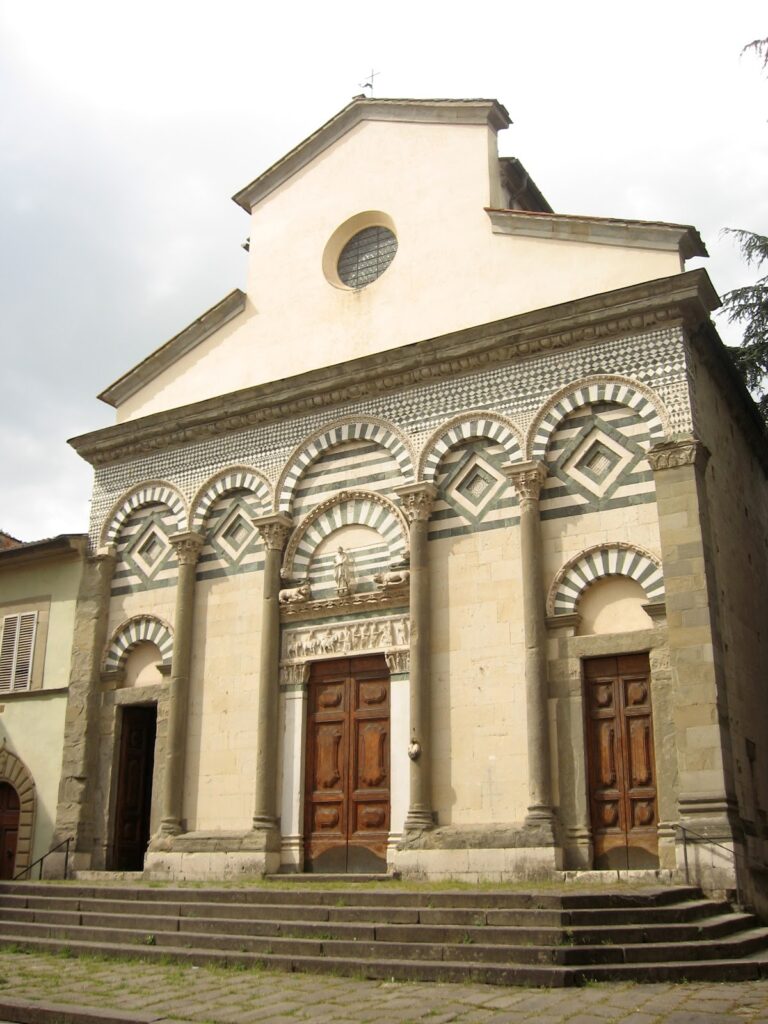
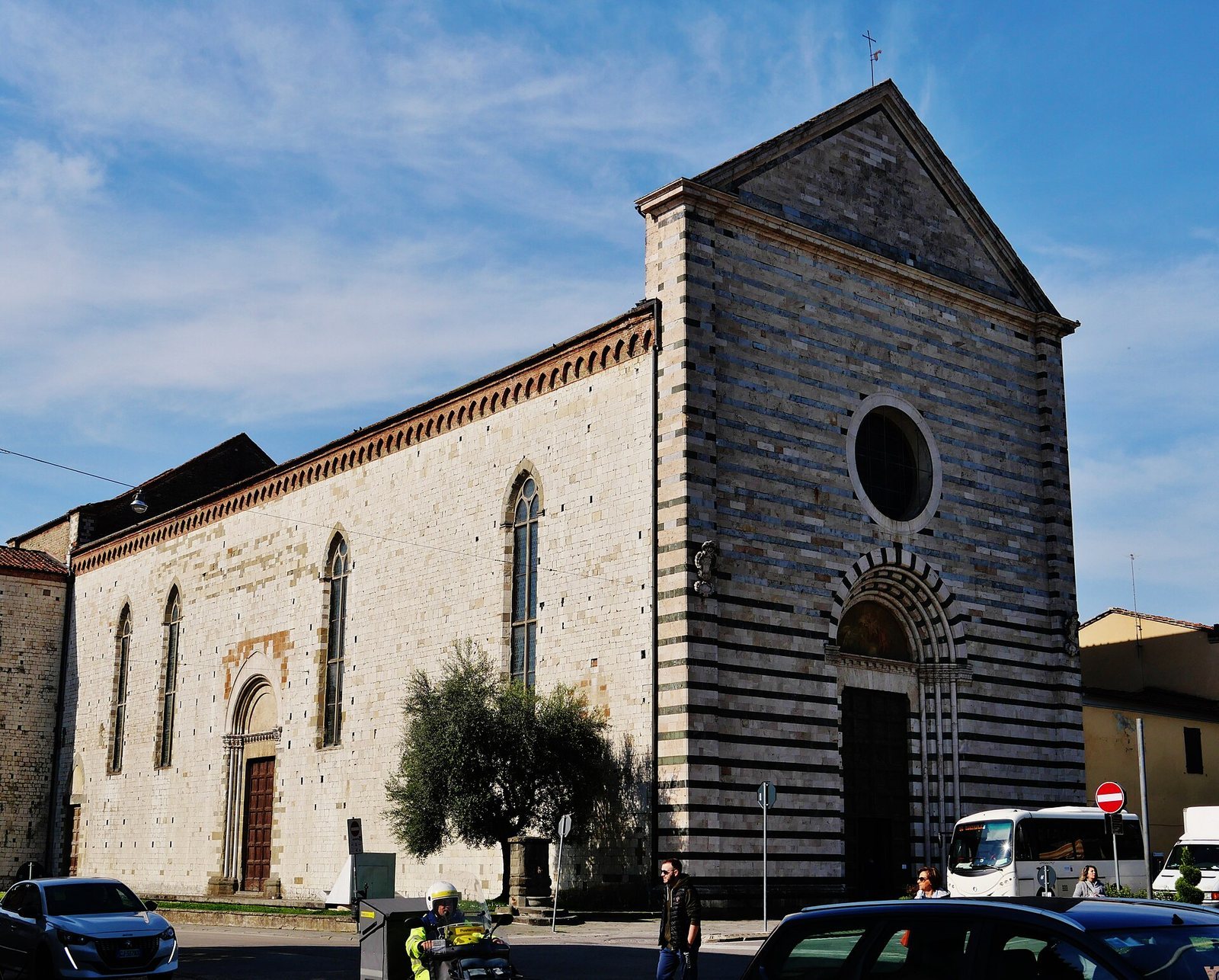
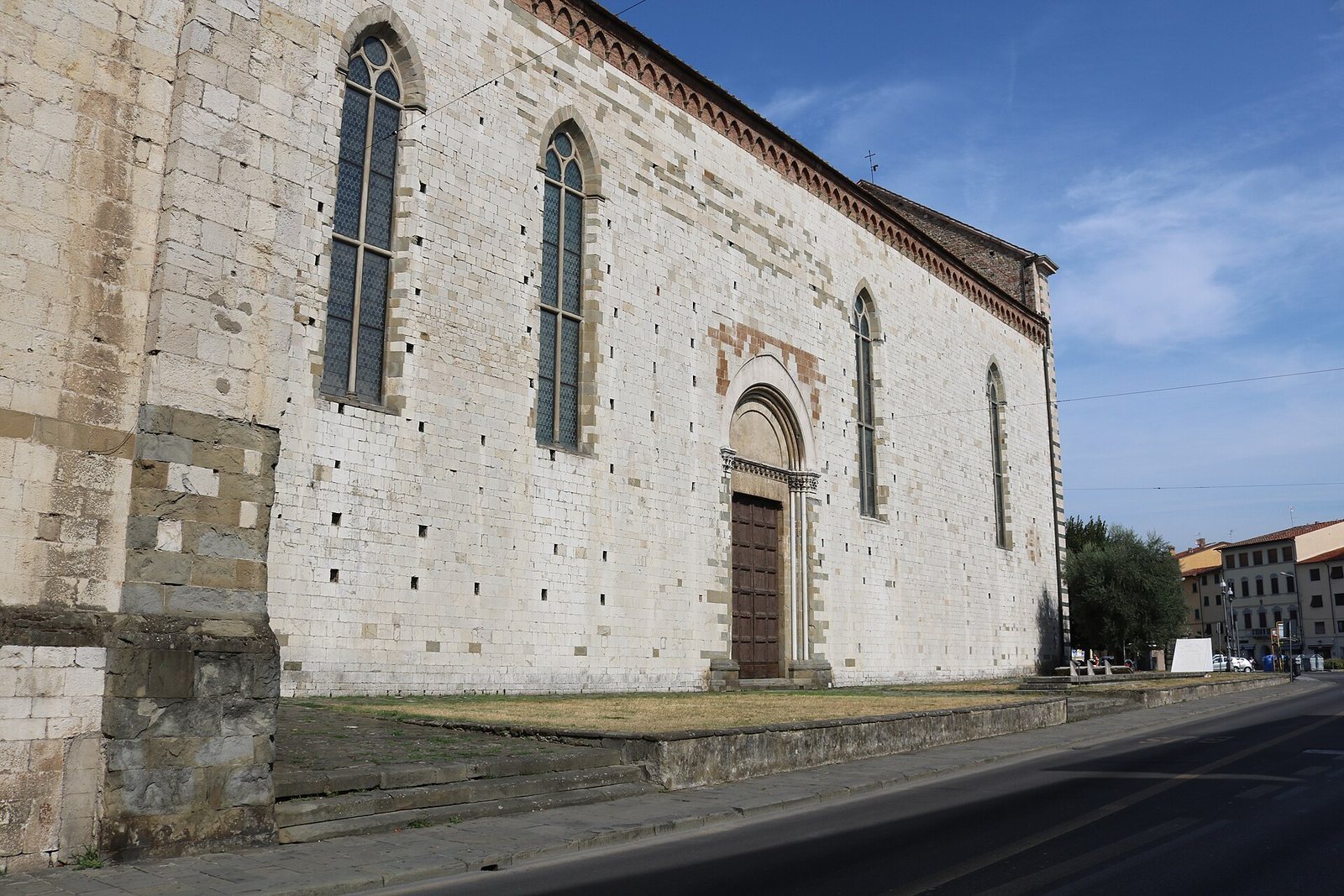
The gabled facade, completed in 1707, combines a Romanesque-style design with alternating bands of white and green marble. A single portal, which widens toward the exterior, has a painted lunette, the curved area above the doorway. Above it is a rose window, a large circular window; tall, narrow windows flank the entrance.
Interior plan
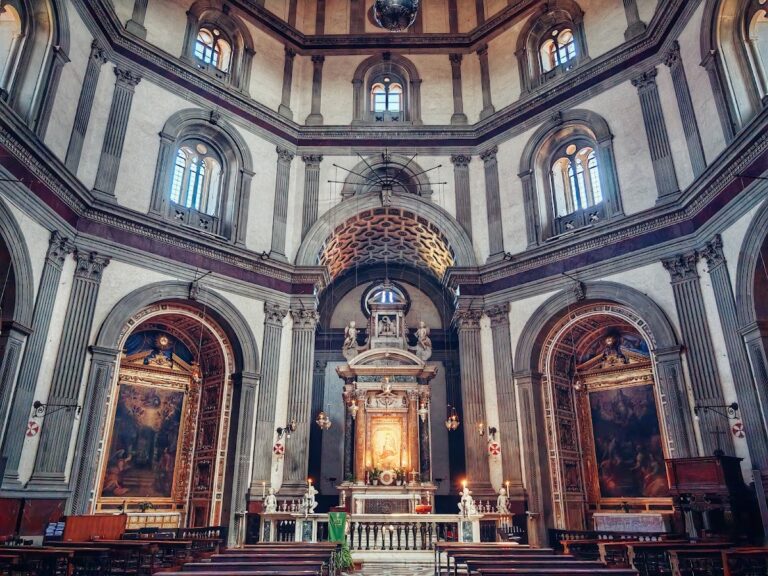
The interior follows a Latin-cross plan, with a broad nave, the main body of the church, covered by a timber ceiling supported by exposed roof frames. Chapels occupy the crosswise arms, or transept. Beyond a large triumphal arch, which separates the nave from the main chapel, four smaller chapels flank that sanctuary. Restrained decoration leaves the Gothic character less pronounced. Traces of fourteenth-century frescoes, paintings made on wet plaster, remain on the nave walls.
Altarpieces and memorials
Carafantoni and Marian altars
The second altar holds Giuseppe Schifino’s Adoration of the Shepherds, painted between 1606 and 1609. Pistoian painter and patron Bartolomeo Carafantoni commissioned it in memory of his son Curzio. At the third altar, a late-fourteenth-century Madonna of Grace is set within a painted frame showing God the Father and saints. The frame, once attributed to Poppi, is now assigned to Pistoian artist Tarquinio Grazzi and dated to the early seventeenth century.
Arrighi and Sozzifanti altars
The final altar on the right is associated with Pietro Arrighi, a jurist and Medici official. His funerary monument stands beside it, and the altar holds Poppi’s Presentation of Jesus in the Temple, signed with the initials PPP and dated 1584. Opposite, the Sozzifanti altar has Alessandro Allori’s signed and dated 1594 Resurrection of Lazarus. Alessandro Sozzifanti commissioned the painting and may be the friar shown in profile at its lower right.
Other altars described in 1853
A description from 1853 names additional works across the church. On the right, it lists the Lafri altar with an Adoration of the Magi by Gismondino Lafri or his son Jacopo, the Sozzifanti dal Duomo altar with an Annunciation by Lazzaro Baldi, and the Sanmarini altar with an Immaculate Conception attributed to followers of Poppi. It also names a Bracciolini altar with a Virgin and Saints from the school of Andrea del Sarto. In the area around the main altar, the description identifies a Gatteschi altar with St James by Pietro Marchesini and a Pazzaglia altar with St Anthony of Padua by Francesco Leoncini.
On the left, the same description records a Fioravanti altar with St Joseph of Cupertino by Francesco Artizzoni, and a Visconti altar with St Roch and other saints by Giacinto Gimignano, dated 1638. It also names a Franchini Wedding at Cana, begun by Gregorio Pagani and completed by Matteo Rosselli; a Desideri St Francis Receiving the Stigmata, showing wounds associated with Christ’s crucifixion, by Giovannone Zeti; a Gallo altar with Elisabetta Sirani’s copy of a Virgin by Reni; and the Bracciolini dalle Api altar with Aurelio Lomi’s Flight into Egypt. The description attributes a Resurrection of Lazarus at the altar dedicated to Prior Sozzifanti to Bronzino.
Painting now in the Uffizi
Pietro Lorenzetti painted Madonna Enthroned with Child among Eight Angels for the church in 1340. The work is now in the Uffizi.
Main chapel
Life of St Francis
The main chapel’s fresco cycle presents episodes from the life of St Francis in three horizontal bands on its side walls, read from left to right and from top to bottom. The scenes include Francis giving a cloak to a poor man, seeing a vision of the crucifix at San Damiano, renouncing his possessions, and preaching to birds. Other episodes show Pope Innocent III’s dream, approval of the Franciscan Rule, the expulsion of demons from Arezzo, a trial by fire, and Francis receiving the stigmata. The sequence begins with the saint’s dream and ends with his death. The renunciation and expulsion scenes are difficult to make out; the possible miracle and the death scene have been lost.
The paintings are in poor condition. Vasari attributed them to Puccio Capanna; other proposed artists include Lippo Memmi and Margaritone. The cycle’s color has been considered closer to Sienese than Florentine practice, and later interpretations placed its painter in Bologna. Roberto Longhi proposed Dalmasio degli Scannabecchi. The work is a rare Tuscan example of painting drawing on traditions from beyond the Apennines. Its figures are life-sized and set within architectural spaces, while the overall arrangement recalls the Franciscan cycle in the Upper Basilica at Assisi.
The cycle combines several artistic references. The emotional force of the cloak-giving scene recalls painting from Emilia, while the solemn, archaic quality of other figures echoes Pietro Lorenzetti. The dream of Innocent III recalls Assisi but has distinct architectural details. In the vision at San Damiano, the curved end of a building has been compared to the dome of the Pantheon, and a bundle appears at a window. The sermon-to-the-birds scene instead shows a walled city and reddish tones associated with Sienese painting. Naturalistic details include carefully rendered wild animals, the broad landscape in the stigmata scene, and the friar Elijah turning away from his book. Powerful figures in the trial-by-fire scene recall Maso di Banco, while its architecture has been compared with the work of Francesco da Rimini.
Figures and decoration around the chapel
Busts along the central arch represent apostles, saints, and Doctors of the Church, saints recognized for influential theological teaching. Most are difficult to identify, but figures identified include St Francis, St Jerome, St Augustine, and possibly St Zeno. Niches on the back wall contain Lazarus, a female saint, and Mary Magdalene; the vault depicts Franciscan virtues.
Other painted spaces
Side chapels
The Bracciolini Chapel contains a cycle of Mary’s stories completed by the second decade of the fifteenth century. In the Pazzaglia Chapel, scenes from the lives of St Anthony and St Louis are attributed to Giovanni di Bartolomeo Cristiani. The Gatteschi Chapel has scenes of St Donnino attributed to Bonaccorso di Cino. Other chapel paintings have been associated with Nanni di Jacopo, Bartolomeo di Giovanni Cristiani, and the Master of the Bracciolini Chapel. Bonaccorso di Cino is also credited with a History of the Cross.
Chapter hall and sacristy
The chapter hall and sacristy, a room for vestments and preparation for services, received painted decoration between 1386 and the end of the fourteenth century. Antonio Vite painted the chapter hall’s frescoes.
Organs
Principal organ
The principal organ stands against the back wall of the left arm of the transept. William Hill & Sons made it in 1896 for a Unitarian chapel in Hampstead, London; Unitarianism is a Christian tradition emphasizing the unity of God. Removed in 1997, the organ was restored between 2002 and 2004 before being installed in the Pistoia church. Its single case houses 27 stops, each selecting a set of pipes, and it has three manuals, or hand-operated keyboards, plus a foot-operated pedalboard. Air pressure operates the instrument’s pneumatic action. The controls for stops, couplers, and combinations are beside the keyboards.
Smaller organ
A smaller Costamagna organ, built in the mid-twentieth century, stands on the floor in the apse, the rounded end of the church, behind the high altar. It has 14 stops, two manuals, and a pedalboard. Its pipes are enclosed in a swell box, a casing with shutters that control the volume.