Alsike Church: A Medieval Parish Church in Knivsta, Sweden
Site at a Glance
- Country
- Sweden
- Primary era
- Medieval
- Eras represented
- Medieval, Early Modern, Modern
- Civilizations
- Swedish
- Site type
- Religious
- Remains
- Church
On this page14 sections
History
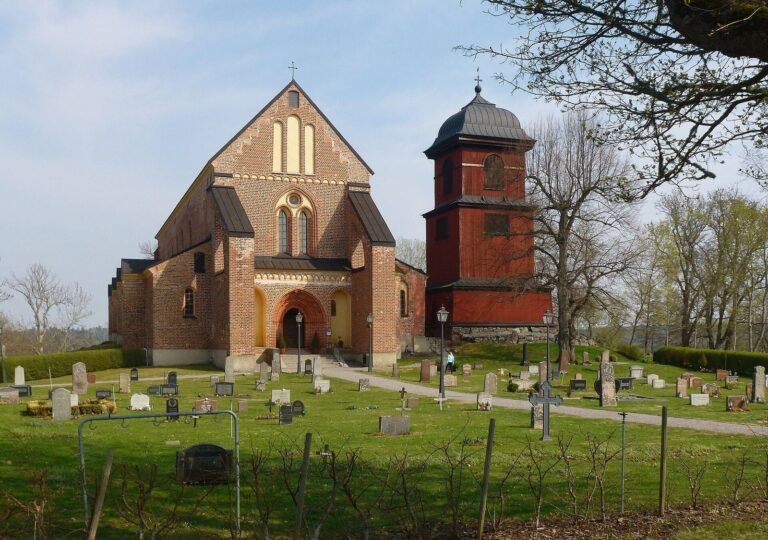
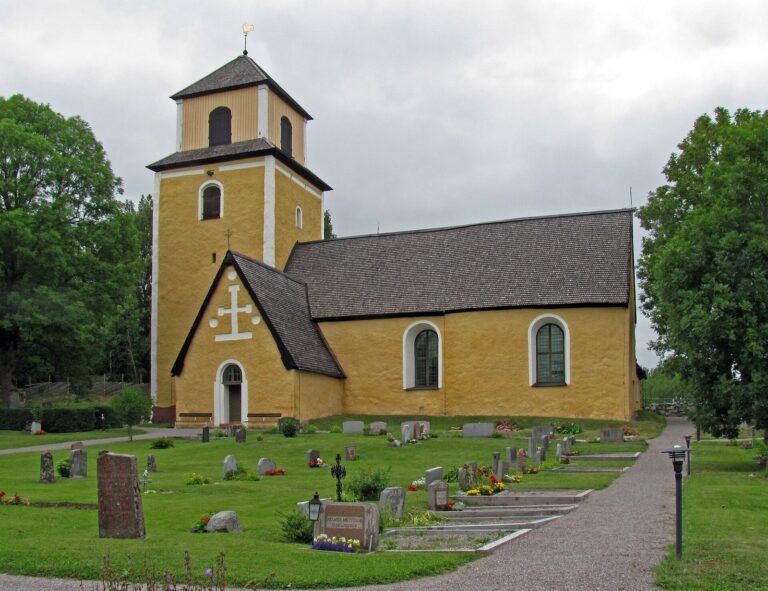
Alsike Church is an Evangelical Lutheran parish church in Knivsta, Sweden, affiliated with Alsike Parish and the Diocese of Uppsala in the Church of Sweden. Its main body was probably built between about 1250 and 1350, and it was consecrated in the 13th century. The church likely replaced an earlier wooden building, and its oldest surviving parts probably date to the late 13th century. Brick was costly and uncommon in medieval parish churches in Uppland; its use here may reflect the church’s proximity to wealthier churches in Sigtuna or Sko Abbey.
Medieval church and setting
The church stands in an old cultural landscape beside a water route that formerly linked Uppsala, Sigtuna, and Stockholm. A convent of the Sisters of the Holy Spirit is associated with the church and occupies the old village school beside it. During the 15th century, a tower and porch were added, and the church received vaulted ceilings decorated with wall paintings.
Structural repairs and rebuilding
Built on clay soil with inadequate piling, the church repeatedly settled and suffered structural damage. Its vaults were rebuilt in 1631, 1667, and 1773. Exterior buttresses supporting the north and south walls were removed in 1759. The western vault was built in 1767, while the two vaults farther east date to 1773.
During a visitation in 1828, Bishop Carl Rosén von Rosenstein noted serious cracks in the walls. Major work followed in 1859–1860 under architect Adrian Crispin Peterson, and architect Sigurd Curman led another substantial renovation in 1910–1911. The 1860 work added transepts to reduce pressure from the roof, but cracking continued. Iron supports were installed inside the church in 1875, its foundations were reinforced in 1910, and further cracking was reported in 1933.
Stabilization and later changes
A new foundation-stabilization project began in 1947. Workers pressed 57 concrete piles into the ground, completing the work in February 1948. On 5 December 1947, removing a large stone from beneath the church’s base revealed part of a runestone carved by Öpir. Its fragments were recovered and the stone reconstructed. Artist Stina Sörman repaired damaged wall paintings in 1949, and Bishop Erling Eidem reconsecrated the church on 11 December that year.
In 1999, workers cleaned the interior walls and ceiling, removed the transept pews, fitted out a side chapel in the south, and established a children’s play area in the north. In 2012, the tower lantern, an upper structure crowning the tower, and its windows were renovated; rotten timber was replaced and the lantern repainted.
Church silver was stolen on 29 September 1852. The objects included a chalice and paten from 1685, a wafer box probably donated in 1655, a wine jug made by Uppsala goldsmith Erik Ernander, and a wafer spoon by Olof Yttraeus. The church later acquired replacement communion vessels.
Remains
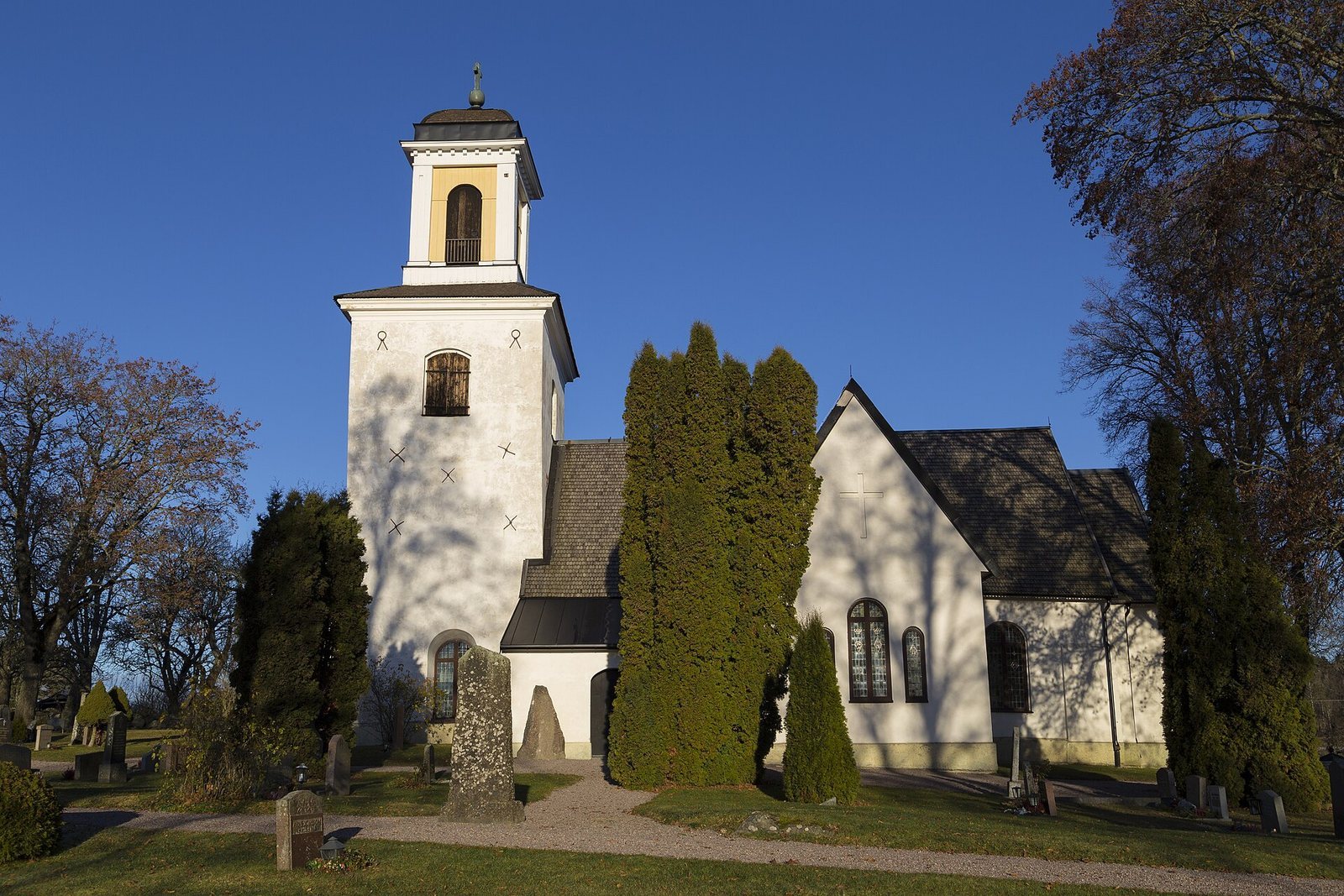
The church’s surviving fabric combines brick walls with fieldstone elements. Its plan centers on a rectangular nave, the main body of the church, with a chancel around the altar at the east end. A sacristy, a room for vestments and religious objects, stands to the north, and a porch is on the south. The western tower rises above a lower fieldstone section and a brick upper section.
Building and interior structure
Medieval plan and tower
The north sacristy is built of fieldstone and may be older than the church itself, perhaps belonging to its wooden predecessor. The south porch and tower belong to the medieval development of the building. The tower’s upper portion was replaced in 1799, giving it its present form; at that time, the bells were transferred from a separate bell tower.
Vaults and later additions
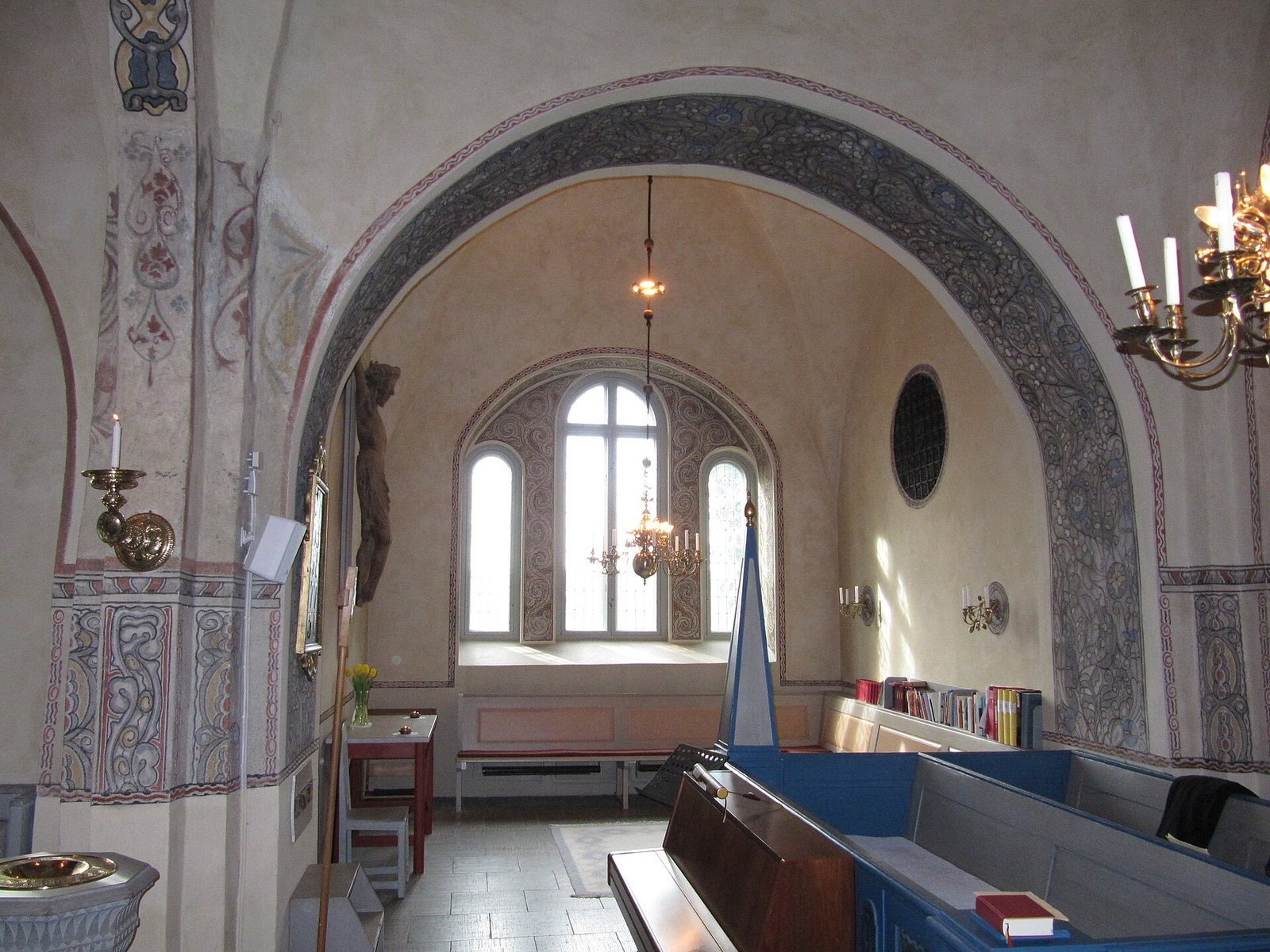
The interior has three plain, ribless vaults supported by pilasters, shallow projections from the walls. The pilasters have three stepped sections. Surviving medieval vaulting includes their lower parts, the points where the vaults begin to rise, and crosswise and wall arches. The transept vaults are also ribless. Transepts, arms crossing the nave, were added in 1860. An organ gallery was built at the west end at the same time, then reduced in 1910 to cover only the tower room.
The pews date from 1859 and were widened in 1910. They were first painted to imitate wood grain and received their present colors and motifs in 1911. Pyramidal ornaments at the front of the aisle toward the transepts, removed in 1860, were restored to their former position in 1911. The exterior was whitewashed during the mid-19th-century rebuilding.
Paintings and liturgical features
Wall paintings and consecration crosses
Plaster covers the church’s walls and vaults, which originally carried painted decoration. Fragments of medieval paintings remain on the nave walls and surviving parts of the medieval vaults. Their subjects include the apostles John and James the Elder. Rudolf Cederström uncovered and documented the paintings in 1897. The church also has two sets of consecration crosses, painted marks associated with a church dedication: one set belongs to its first consecration and the other to its rededication after the 15th-century vaulting.
Paintings added to the walls in 1911 are in the Art Nouveau style, a turn-of-the-20th-century decorative style known for flowing forms, and were made by Filip Månsson. A glass-mosaic window in the chancel, created in 1910 from a design by Gunnar Hallström, bears the coats of arms of the Cederström and Skjöldebrand families along its lower edge.
Altar and carved figures
The masonry altar dates from the 1910–1911 renovation. Its medieval altar slab was returned to its intended position after being used as a grave slab. The medieval altarpiece was destroyed during the 1860 renovation, but 15 of its carved saints survive in the Swedish History Museum in Stockholm. Two figures, depicting the Virgin Mary and Saint Sigfrid, returned to the church in 2003 and are displayed in the north transept.
The pulpit dates from the 1860 renovation and incorporates cherub heads from an older pulpit. A sandstone baptismal font donated in 1953 replaced the medieval sandstone font, which was destroyed during the same renovation. A separate figure of Christ from the 15th century is among the church’s furnishings.
Vessels, textiles, and other furnishings
A replacement chalice and paten, the plate used to hold communion bread, were made by Louis Constant Féron in 1854. A gilded-silver wine jug was acquired in 1904, and another chalice was purchased from Atelier Borgila in 1957. A communion set for visits to the sick, made in 1770 by goldsmith Carl Lemon, was kept in the rectory. The church’s bridal crown dates from 1938.
The church has two altar frontals, decorative coverings for the front of an altar, from 1650 and 1703. Karin Oxenstierna of Krusenberg donated the earlier one, and Johan Thegner of Rickebasta gave the later. Two older chasubles, priestly garments worn during services, date from the 18th century and 1833. Some 17th-century church textiles are held at the Swedish History Museum.
Five brass chandeliers hang in the church, four made in the 17th century. A chandelier donated by Emanuel Cederström in 1911, in the north transept, imitates the older examples. Two 17th-century brass candle reflectors hang beside the chancel window, and two similar reflectors made of silvered copper are on the walls of the chancel arch.
The altar crucifix is probably a 17th-century work from northern Italy. Its cross is carved from black-stained wood with inlays including ebony, and the figure of Christ is silver. Bought in Venice, it was donated in 1911 to mark C. G. R. Cederström’s seventieth birthday. A candle tree by the porch was made by artist Eric Ståhl, who is buried in the church cemetery.
Organ
Anders Gustaf Nygren of Stockholm built an organ for the new gallery in 1860. The present mechanical organ was made in 1911 by Åkerman & Lund’s Organ Factory. Its façade comes from the earlier instrument, and it has two fixed combinations.
Runestone
The reconstructed runestone stands outside the church entrance. Carved by Öpir, a medieval Scandinavian runemaster, it commemorates two sets of brothers. Its inscription says that Sibbe and Ingrid raised the stone in memory of their sons Gagi, whose name is uncertain, and Hard; Sigmund and Sigfast raised it for their brothers. The stone is registered as Uppland Runic Inscription Fv1948;168.