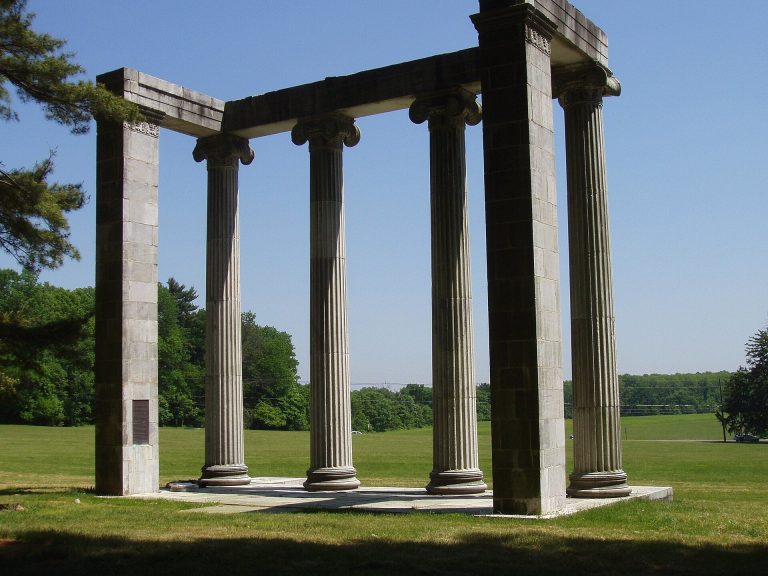
Fort Jay: A Coastal Defense Fort on Governors Island
Site at a Glance
- Country
- United States
- Primary era
- Modern
- Eras represented
- Early Modern, Modern
- Civilizations
- Unclassified
- Site type
- Military
- Remains
- Fort
On this page10 sections
History
Fort Jay is a coastal fort on Governors Island in New York Harbor, United States. American forces began earthworks at the site in 1776, and the fort was enlarged and rebuilt in the early nineteenth century as part of a federal program to strengthen harbor defenses. It later served as an Army post, headquarters, and center of military administration.
Revolutionary War earthworks
In April 1776, General Israel Putnam began building earthworks on the northeast side of Governors Island, then known as Nutten Island. Armed with eight cannons, the position was intended to defend New York Harbor. On July 12, the island batteries fired on the British warships Phoenix and Rose. The damage made British commanders more cautious about entering the East River. The batteries are also credited with helping George Washington’s army retreat from Brooklyn to Manhattan on August 29 and 30.
American forces abandoned the earthworks in September. The British improved them and used the island as a Royal Navy hospital. After British forces left on November 25, 1783, Governors Island passed to New York State. When the earthworks deteriorated, the state began paying for their improvement in 1794. The rebuilt fort had a square plan and was named for John Jay, a New York governor and statesman who had negotiated the 1794 treaty with Britain addressing disputes left by the American Revolution. Congress appropriated $30,117 for further work in 1797. In February 1800, New York transferred the island and fort to the federal government for one dollar.
Federal rebuilding and harbor defense
Beginning in 1806, Major Jonathan Williams of the U.S. Army Corps of Engineers directed an enlargement and rebuilding of the fort. The work formed part of the Second System, an early federal program to strengthen defenses at American harbors. Between December 15, 1806, and July 21, 1807, the fort was renamed Fort Columbus, a name it kept until 1904. A proposed connection between the renaming and Republican opposition to Jay’s treaty remains unverified.
Fort Columbus operated within a network of New York Harbor defenses that included Fort Wood, Fort Gibson, Castle Clinton, South Battery, and Castle Williams. Together, these positions helped deter a British naval attack on New York during the War of 1812. From the 1820s, newer forts at the Narrows, including Fort Richmond, Fort Hamilton, and Fort Lafayette, reduced the need for defenses in the upper harbor.
An Army post and arsenal
As the fort’s coastal-defense role declined, it continued as an Army post. Army personnel made meteorological observations there from the 1820s, and the post served for many years as an initial assignment or departure point for newly graduated West Point cadets. In 1833, the Army established the New York Arsenal beside the fort, but as a separate operation. The arsenal received and distributed weapons to Army posts across the country.
In November 1852, the Army established its General Recruiting Service for infantry at the fort. Regiments assigned officers there to recruit. The arsenal later became a center for disposing of surplus cannons and munitions. Items were transferred to war memorials and municipalities, sold abroad, or scrapped. Beginning in 1878, as the Army concentrated its New York City operations on Governors Island, Fort Columbus became the headquarters of the Division of the Atlantic and later the Department of the East. These commands oversaw almost all Army activity east of the Mississippi River.
Civil War and changing armament
During the secession crisis, troops and supplies left the post in two unsuccessful efforts to relieve Fort Sumter. President James Buchanan initiated the first in December 1860. On January 9, 1861, South Carolina cadets fired on the Army-chartered Star of the West as it entered Charleston Harbor, intensifying the crisis. Newly recruited troops departed in a second effort on April 9, 1861. South Carolina forces fired on Fort Sumter on April 12, beginning the Civil War.
During the war, Fort Jay and Castle Williams temporarily held Confederate prisoners, and the post operated a hospital for confined soldiers. Confederate Major General William H. C. Whiting died there of dysentery in February 1865, shortly after surrendering at Fort Fisher. Late in the war and in the years immediately afterward, the fort’s armament increased to nearly fifty 10- and 15-inch Rodman guns, large smoothbore iron cannons developed for coastal defense. Most were scrapped in October 1942 for the war effort.
Twentieth-century military use and preservation
Around the turn of the twentieth century, Secretary of War Elihu Root sought to expand the island’s military facilities and oppose proposals to make it a city park. The plan also addressed the need for a rapid federal response to protect Wall Street, the Customs House, and the Sub-Treasury in lower Manhattan. Governors Island expanded from 60 to 172 acres with fill from subway construction and dredging in New York Harbor. Root commissioned the New York firm McKim, Mead & White to plan changes across the island. The plan called for removing most existing buildings while retaining the island’s three original fortifications and a new chapel. In February 1904, Root restored the name Fort Jay to both the fort and the Army post.
During World War II, Fort Jay served first as headquarters for the First Army and later for the Eastern Defense Command. The latter coordinated defenses from Maine to Florida and included U.S. Army forces in Newfoundland and, from April 1942, Bermuda. In November 1964, the Army announced the fort’s closure as it combined the Second Army’s functions with the First Army and moved First Army headquarters to Fort Meade, Maryland. The Coast Guard took control of Governors Island in 1966 and housed officers at the fort until it closed its island base in September 1996. Military use of the fort ended by 1997.
Fort Jay became a New York City Landmark in 1967 and entered the National Register of Historic Places in 1974. On January 19, 2001, it, Castle Williams, and 23 surrounding acres became part of Governors Island National Monument, administered by the National Park Service. Fort Jay is recognized as one of the finest surviving examples of the Second System of American military fortifications.
Remains
Fortifications and outer defenses
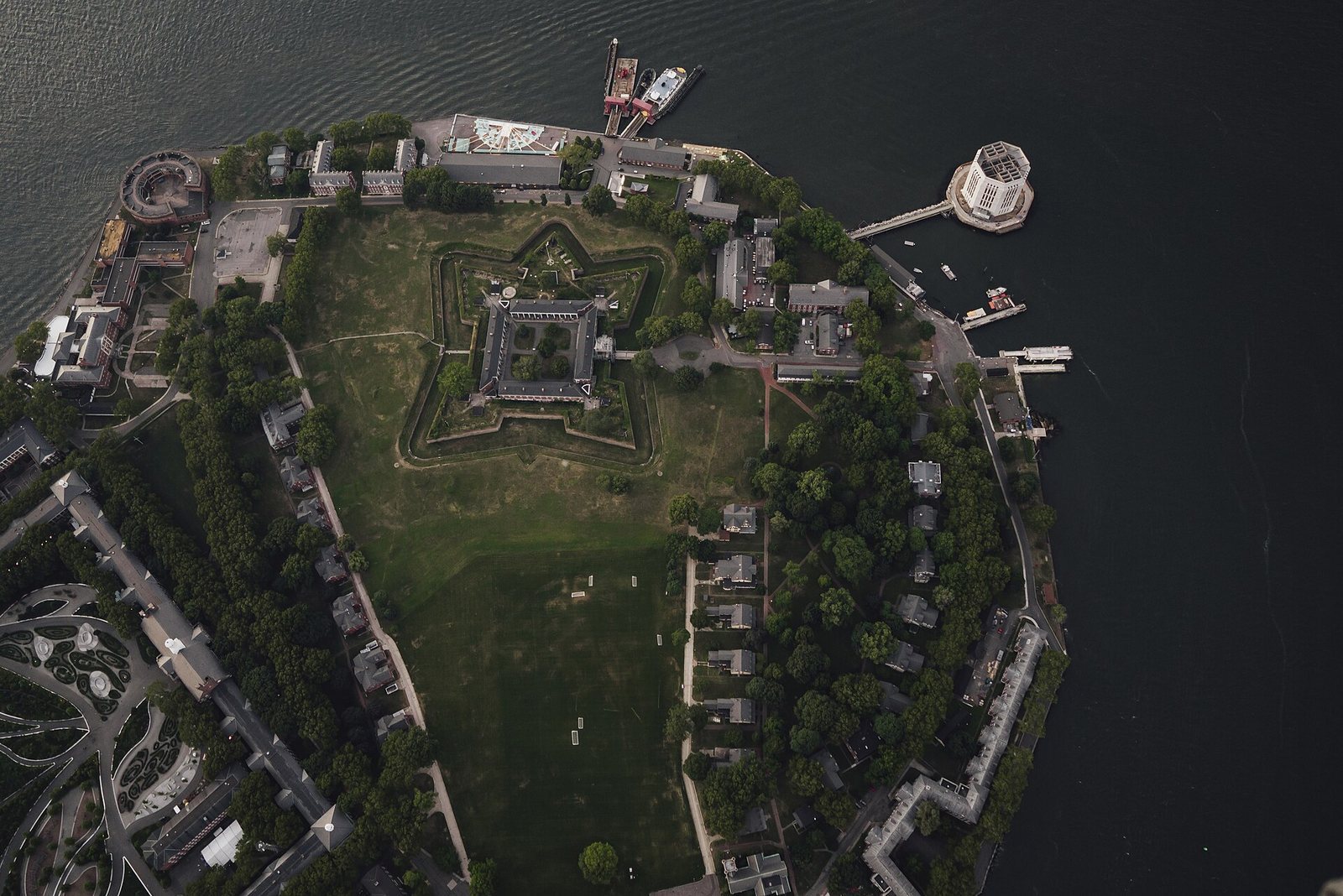
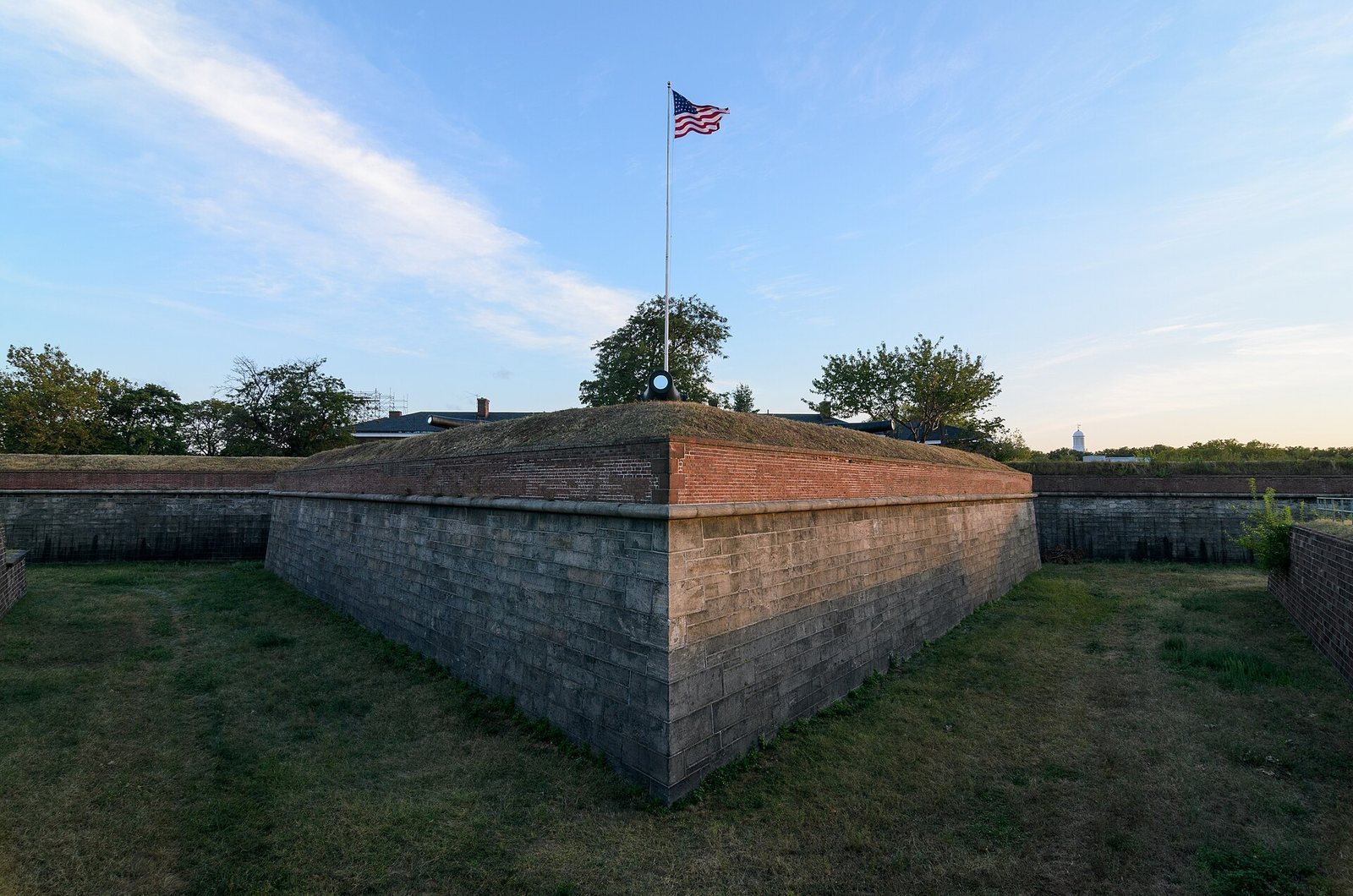
Fort Jay occupies the highest point on Governors Island and is the island’s oldest surviving defensive structure. Its square layout has four corner bastions, projecting sections that let defenders cover approaches to the walls. The fortification’s sandstone and granite walls also incorporate brick, and its walls and entrance gate were completed in 1808. An arrow-shaped ravelin, an outer defensive work placed in front of a fort wall, forms part of the defenses. A dry moat surrounds the works, with a sloping grassy glacis beyond it. This slope exposed approaching forces to defenders’ fire and helped impede or stop cannon shot from ships. The fort is in good condition.
Barracks and interior buildings
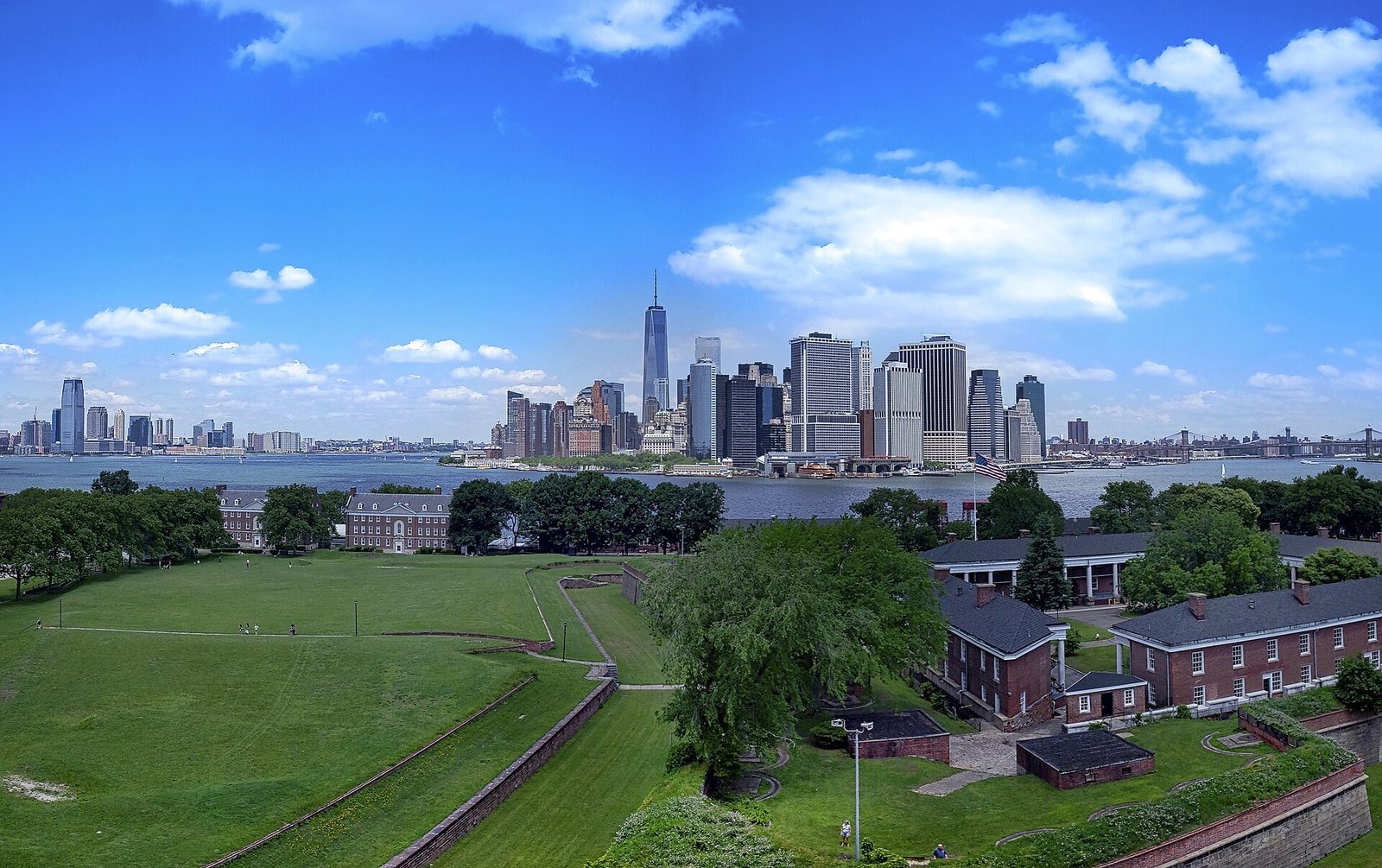
Small wooden and brick barracks were built inside the fort’s enclosed square. Four stone barracks replaced the earlier buildings in 1833. Designed in the Greek Revival style, they are joined visually by two-story Tuscan porticos, porches supported by plain columns, and remain at the fort. In the 1930s, a Works Progress Administration project converted each company barracks into four townhouse-style apartments for junior officers’ families. Eight garages, each designed to hold two cars, were built inside the fort behind the barracks.
Retained artillery
Five guns were kept as ornaments after most of the fort’s artillery was scrapped in 1942. Four are 10-inch guns and one is a 15-inch gun. They are positioned at the east entrance gate and the north ravelin.