Myus: An Ancient Greek City in Türkiye
Site at a Glance
- Popularity
- Medium
- Country
- Turkey
- Primary era
- Medieval
- Eras represented
- Iron Age, Medieval
- Civilizations
- Ancient Greek, Byzantine
- Site type
- City
On this page11 sections
History
Myus was an ancient Greek city near modern Avşar in Aydın Province, Türkiye, and a member of the Ionian League, a confederation of Greek city-states on the western coast of Anatolia. Its foundation is linked to legendary traditions, while its recorded history includes civic self-government, conflict with Persia, and eventual incorporation into Miletus.
Origins and civic life
A foundation legend credited Cyaretus, also called Cydrelus, the son of the legendary Athenian king Codrus. Another tradition placed a Carian settlement there before the Ionian arrival. The earliest known literary reference, in fragments by Hecataeus of Miletus, called the city Myes; Herodotus and Thucydides used Myus. Inscriptions and coin legends also preserve a civic name derived from Myes.
Myus was among the Ionian League’s smallest cities. It shared a regional form of the Greek language with Miletus and Priene. Herodotus described it as a self-governing city-state, with an assembly of citizens and a council responsible for civic affairs. Myus also issued its own coins.
Persian rule and the Ionian Revolt
Before the Ionian Revolt of 499 BCE, an uprising by Ionian Greek cities against Persian rule, a Persian fleet that had failed to capture Naxos briefly anchored at Myus. Myus later joined the cities supporting Miletus in the revolt. It contributed three ships to the Ionian fleet that fought the Persians at the Battle of Lade in 494 BCE.
Athenian connections and Macedonian control
Around 460 BCE, the Persian king Artaxerxes I assigned Myus, along with Magnesia and Lampsacus, to the Athenian exile Themistocles. The cities supplied him with provisions: Myus provided fish, Magnesia grain, and Lampsacus wine. During the Peloponnesian War, the conflict between Athens and Sparta and their allies, the Athenians suffered a setback near Myus against the Carians.
In 201 BCE, Philip V of Macedon captured Myus and transferred it to the Magnesians in exchange for figs.
Environmental change, abandonment, and rediscovery
Deposits from the Maeander River gradually shifted the coastline westward, leaving Myus cut off from the sea. Recurrent flooding and marsh formation accompanied this change. The river’s sediment also separated the Latmian Gulf from the sea and formed Lake Bafa. By Strabo’s time, the population was too small to sustain a separate political community, and Myus had been incorporated into Miletus. Its remaining inhabitants eventually moved there. Pausanias attributed their departure to troublesome flies, but recurring floods offer a more plausible explanation in light of the changing landscape.
After the population left, the site was probably used as a quarry. Latmian stone from the area was extracted and exported for Miletus’s walls. Theodor Wiegand began excavating Myus in 1908; Hans Weber carried out further work in 1934 and 1936 for the German Archaeological Institute in Istanbul. Inscriptions on architectural fragments naming Myus and Apollo Termintheus, published by P. Hermann, helped identify the ancient city at the ruins of a later fortress.
Remains
Settlement landscape and possible harbors
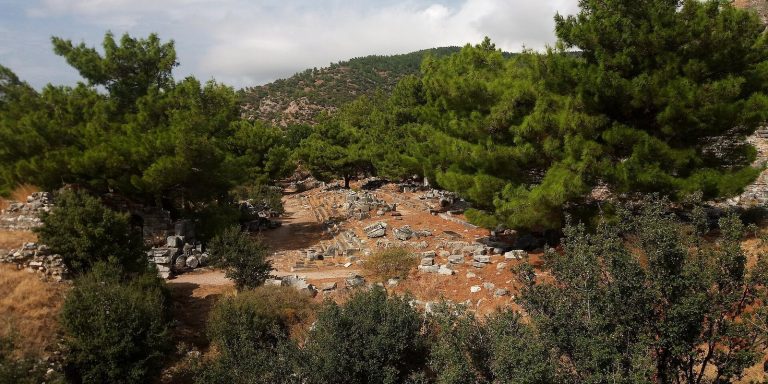
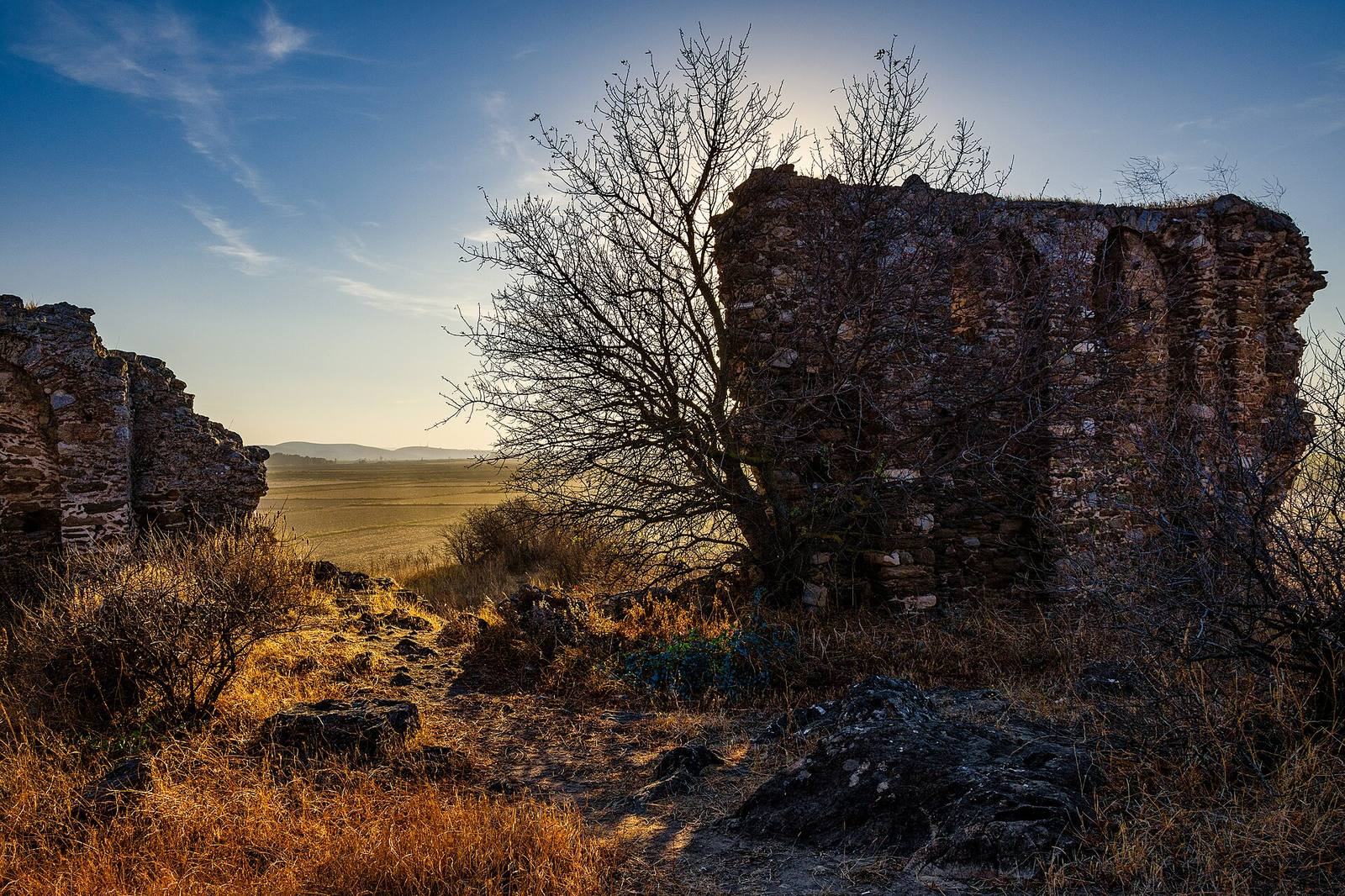
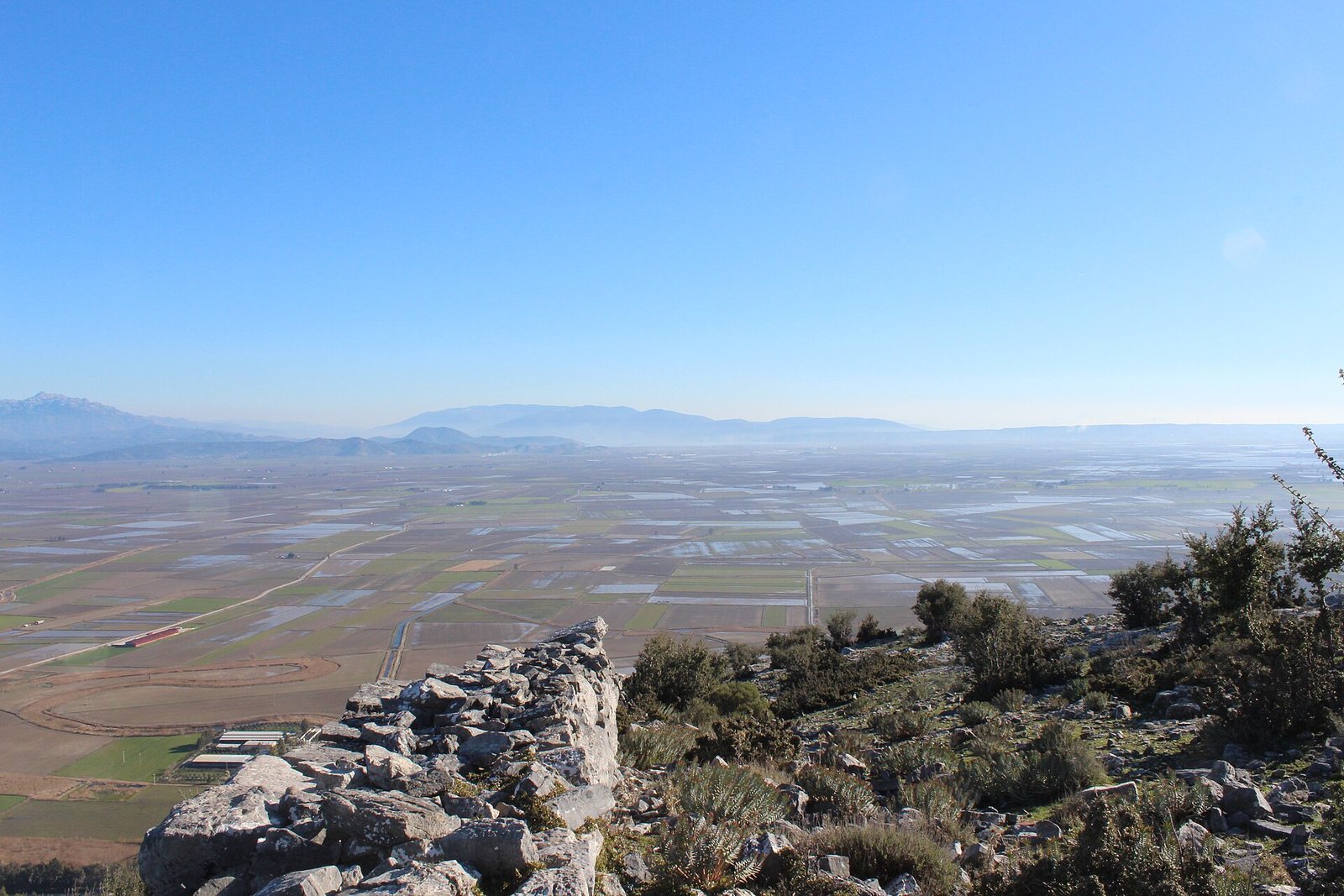
The ancient settlement occupied a small promontory that extended northwest from Mount Latmus into the former estuary of the Maeander River. The promontory is about half a mile long, with a ridge above the 100-metre contour. Now roughly 24.7 kilometres from the edge of the present delta, it appears as two raised areas within the plain. The northwestern rise, known as Castle Hill, stands 56 feet high; Settlement Hill, at the base of the promontory, preserves traces of habitation and rises toward Mount Latmus in broader, higher stages. Lake Azap borders Settlement Hill to the east. This shallow, intermittent lake occupies the position of a former inlet and reaches 2.17 kilometres in length when full. Samples from bay deposits on the promontory’s western side suggest possible harbors in the Archaic and Classical periods, though their dates and functions remain uncertain. A harbor that might have accommodated 200 ships has also been proposed for the eastern angle, but its location and existence are uncertain.
Temples and associated finds
Temple foundations on the lower terrace
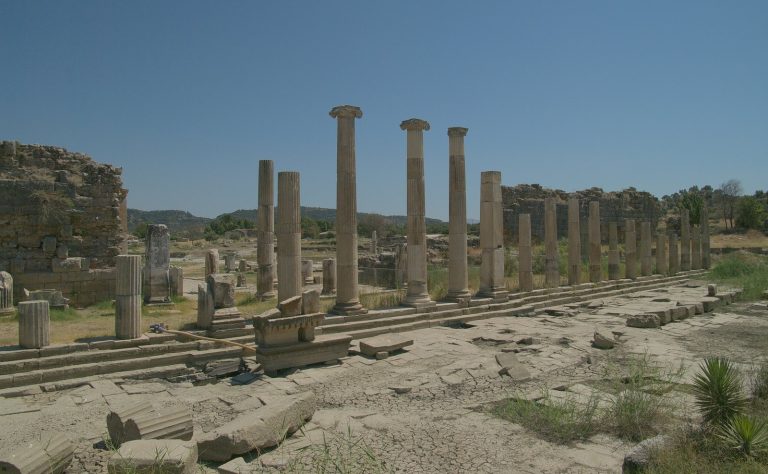
Foundations on a lower terrace belong to a white-marble temple measuring 30 by 17 metres and dating to the middle of the sixth century BCE. The temple is attributed to Dionysus, although Apollo Termintheus and Poseidon have also been proposed as its dedicatees.
Other religious remains
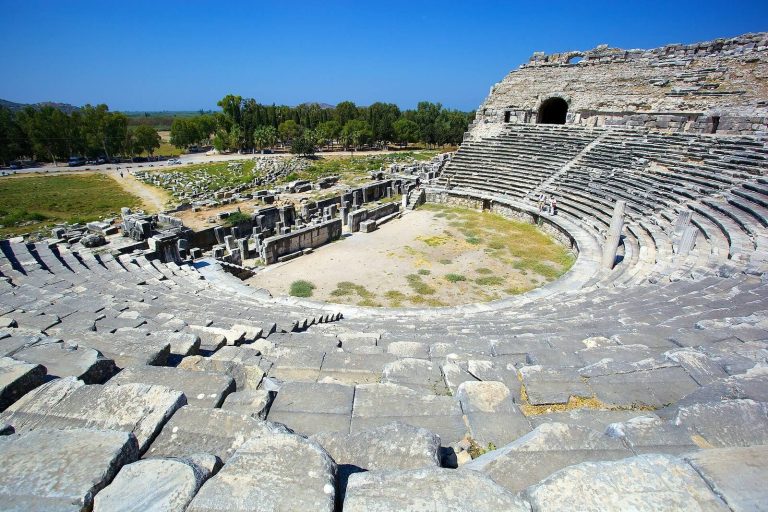
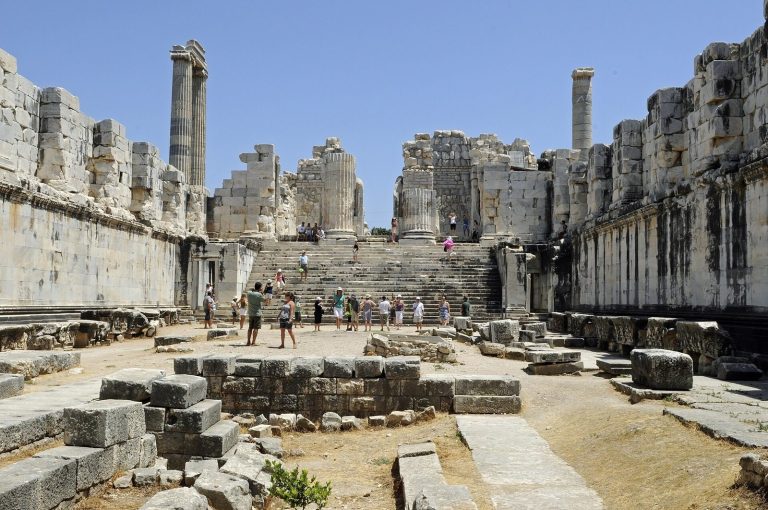
A ruined Doric temple, built in one of ancient Greece’s principal architectural styles, has been tentatively attributed to Apollo. Myus also had temples dedicated to Athena and Herodotus. Archaic architectural fragments were reused in the theatre, the Athena temple, and the stadium. A sixth-century BCE offering to Apollo from Myus is attributed to Hermonax and his child.
Byzantine fortress
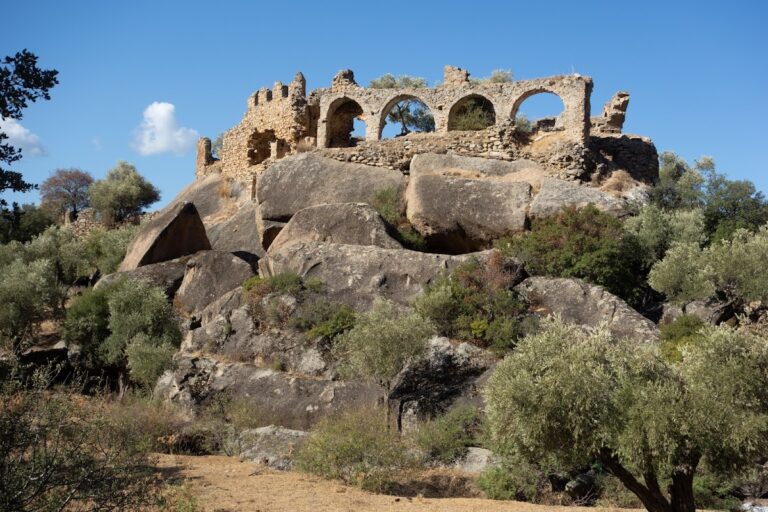
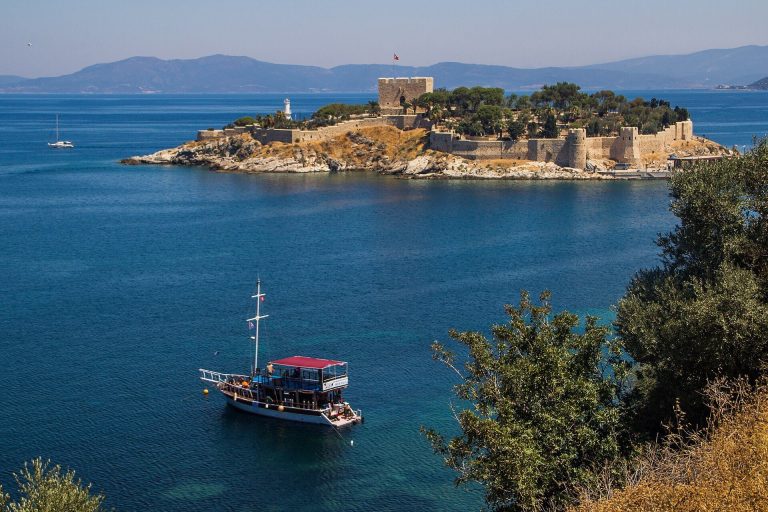
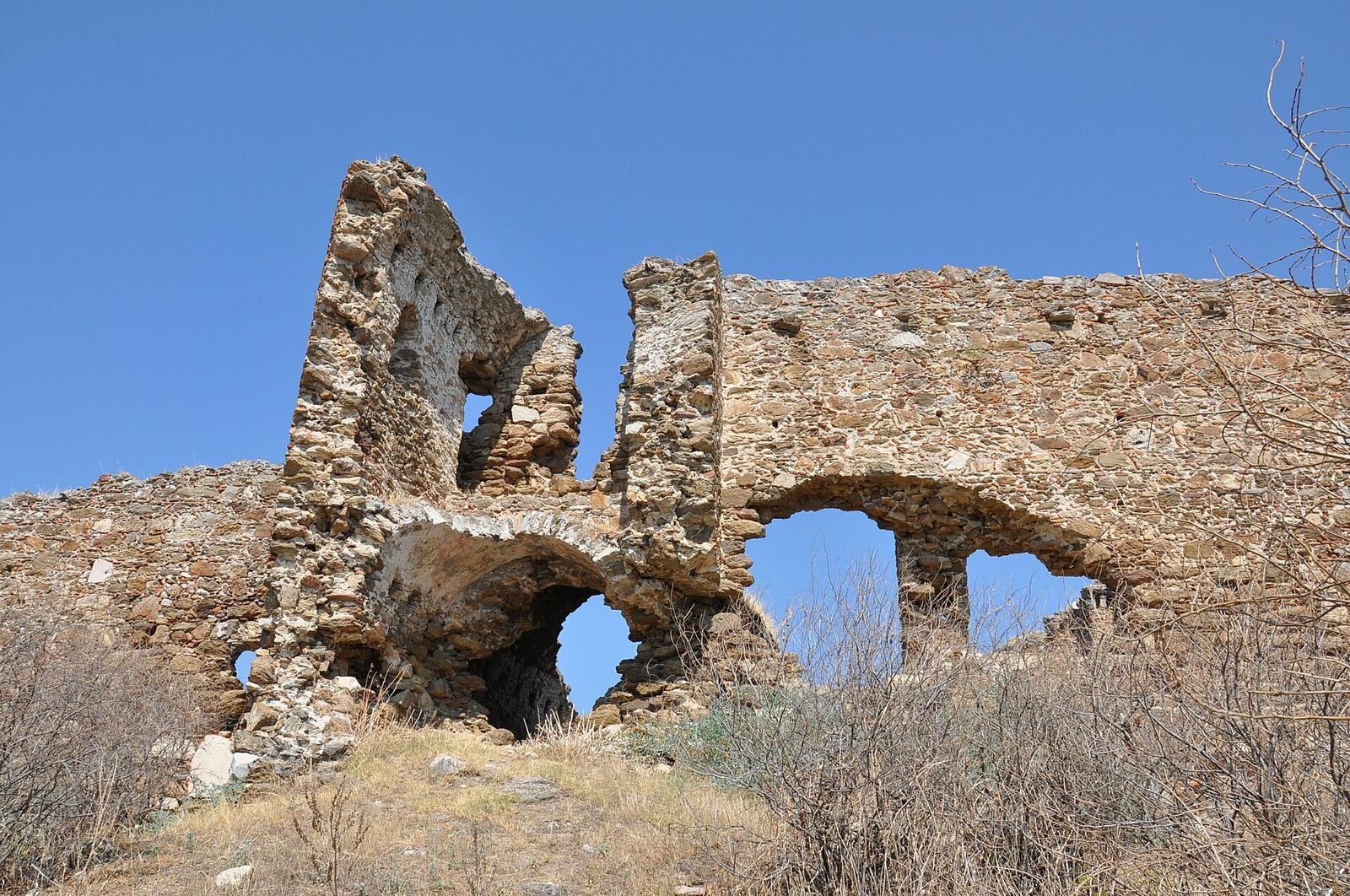
The fortress on Castle Hill dates to the thirteenth century CE. It belongs to the Byzantine period, the medieval eastern Roman Empire, and was built centuries after the ancient Greek city had disappeared.