Kamyana Mohyla: Ukraine’s Natural Rock-Art Site
Site at a Glance
- Popularity
- High
- Country
- Ukraine
- Primary era
- Stone Age
- Eras represented
- Stone Age, Bronze Age, Iron Age, Classical, Medieval
- Civilizations
- Unclassified
- Site type
- Religious
- Remains
- Sanctuary
On this page14 sections
History
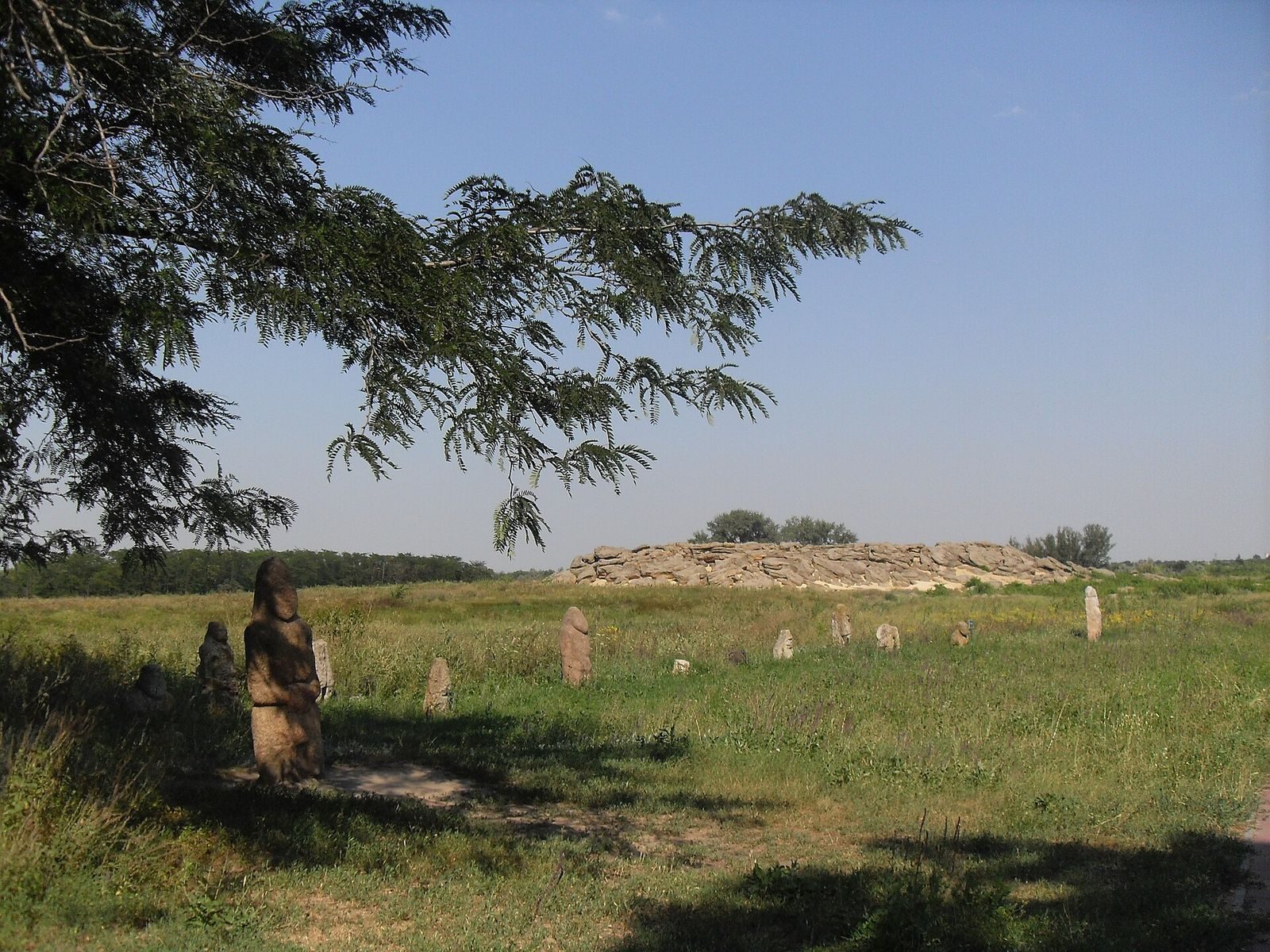
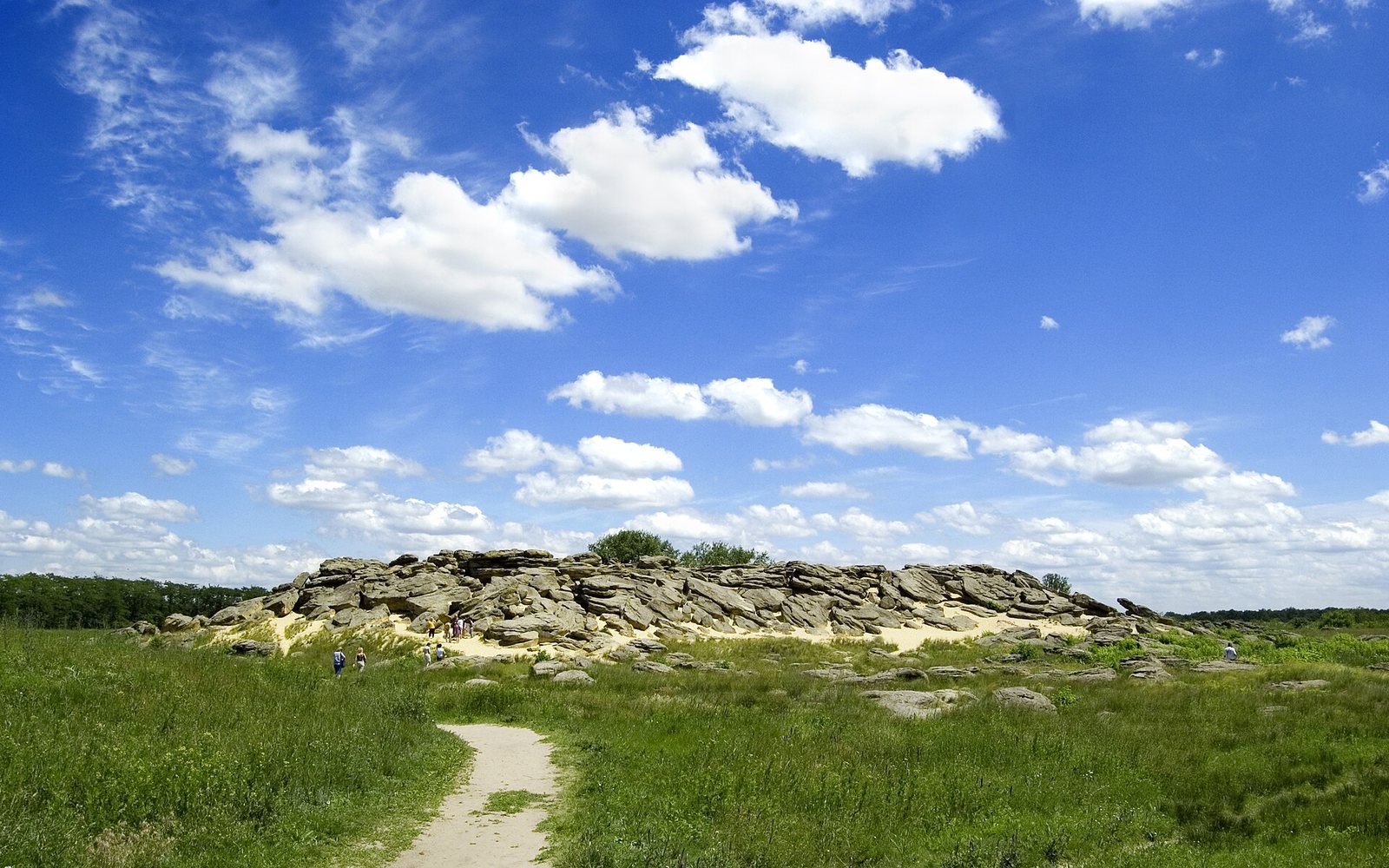
Kamyana Mohyla is a natural sandstone outcrop and rock-art site in Ukraine’s Molochna River valley. Its name means “Stone Grave,” although the formation is not a burial mound. Images carved into its grottoes and caves are generally dated from the Late Paleolithic to the Middle Ages, with proposed dates ranging from the 24th–20th millennia BCE to the 10th–13th centuries CE. Their placement has led researchers to interpret the site as a sanctuary, or place used for ritual.
Early descriptions and excavation
In 1739, physician and travel writer Johann Jakob Lerche described a large rocky hill across the Molochna River that looked from a distance like a settlement. A guard post and postal station were established beside the postal road in 1778. A map from 1793 marked the locality with a Turkic-derived name translated as “Gathering Stone.” The name has been interpreted as referring to a place where Tatar groups assembled before campaigns into Ukrainian and Polish lands.
Peter Koeppen described sandstone outcrops and natural overhangs on the river’s right bank in 1837. A guide told him of inscriptions inside the grottoes. Archaeologist Nikolay Veselovsky visited in 1889 and excavated several caves the following year, having initially mistaken the natural formation for an artificial burial mound. His work ended in 1890.
Research and protection
The Melitopol local history museum began taking an interest in Kamyana Mohyla in 1932. During the 1930s, Valentin Danylenko drew attention to the rock carvings and led investigations. The site became part of the Azov–Black Sea archaeological expedition’s research area in 1936 and its main focus in 1938, under Otto Bader. The team identified more than 30 additional locations with images. Work stopped in 1941 during the Second World War. Because of his German origin, Bader was deported to Nizhny Tagil and could not return to the western Soviet Union after the war.
Research resumed in the 1950s with Danylenko, Boris Mikhailov, and Mikhail Rudynsky. Across seven field seasons from 1951 to 1957, Rudynsky identified 13 more locations with images. A proposed reservoir in the Molochna valley threatened to flood Kamyana Mohyla and other archaeological remains, but the plan was abandoned in 1953. On 7 July 1954, the Ukrainian government established a reserve covering 30 hectares.
Valentyn Hladylin investigated the site from 1961 to 1963, finding further grottoes and re-examining the Bull Grotto. From the early 1970s, Danylenko and Mikhailov continued to find caves. Mikhailov’s investigations between 1983 and 2006 identified 17 more grottoes and caves. In 1986, the government decided to establish a state historical-archaeological museum-reserve at his initiative; Mikhailov became its first director. The rock outcrop and adjacent area had been designated a geological natural monument of national significance in 1963.
Dating and interpretations
The age of the carvings remains disputed. Researchers have proposed Paleolithic, Neolithic, and Eneolithic dates; these are successive periods of the Stone Age. Some reference works also give a Mesolithic date. Valentin Danylenko and Otto Bader supported a Paleolithic dating, while Mikhail Rudynsky and other researchers favored a Neolithic one. A large image at the site has variously been identified as a mammoth or a bull, a disagreement that has shaped arguments about the carvings’ chronology. Rudynsky considered the images to represent one culture working in a single period, while other researchers allow that the site was used across several periods.
In 1994–1996, Anatoly Kifishin argued that some marks were Proto-Sumerian inscriptions, dating them to the 7th–3rd millennia BCE. He proposed links with inscriptions from Ur and Shuruppak, interpreted some images as a map of Ukrainian rivers, and described the site as an important sanctuary for Proto-Sumerian groups. These claims remain disputed and were discussed chiefly in popular publications. I. M. Rassokha offered a different interpretation, comparing many marks with Ogham, Germanic runes, and early Slavic signs and proposing a connection with the Sredny Stog culture of the 4th millennium BCE.
National status and recent history
Ukraine nominated Kamyana Mohyla for the World Heritage List in 2006, and it remains on the country’s Tentative List. In 2008, the reserve received national status and the official name National Historical and Archaeological Reserve “Kamyana Mohyla.”
The site came under Russian occupation in February 2022. In November, the occupying authorities announced that the reserve would be placed under the administration of the Chersonesos Taurica museum-reserve in occupied Crimea. In May 2023, 120 archaeological artifacts from Kamyana Mohyla were taken to Sevastopol. The Zaporizhzhia regional administration reported that a military training ground had been established on the reserve grounds.
Remains
Geology and layout
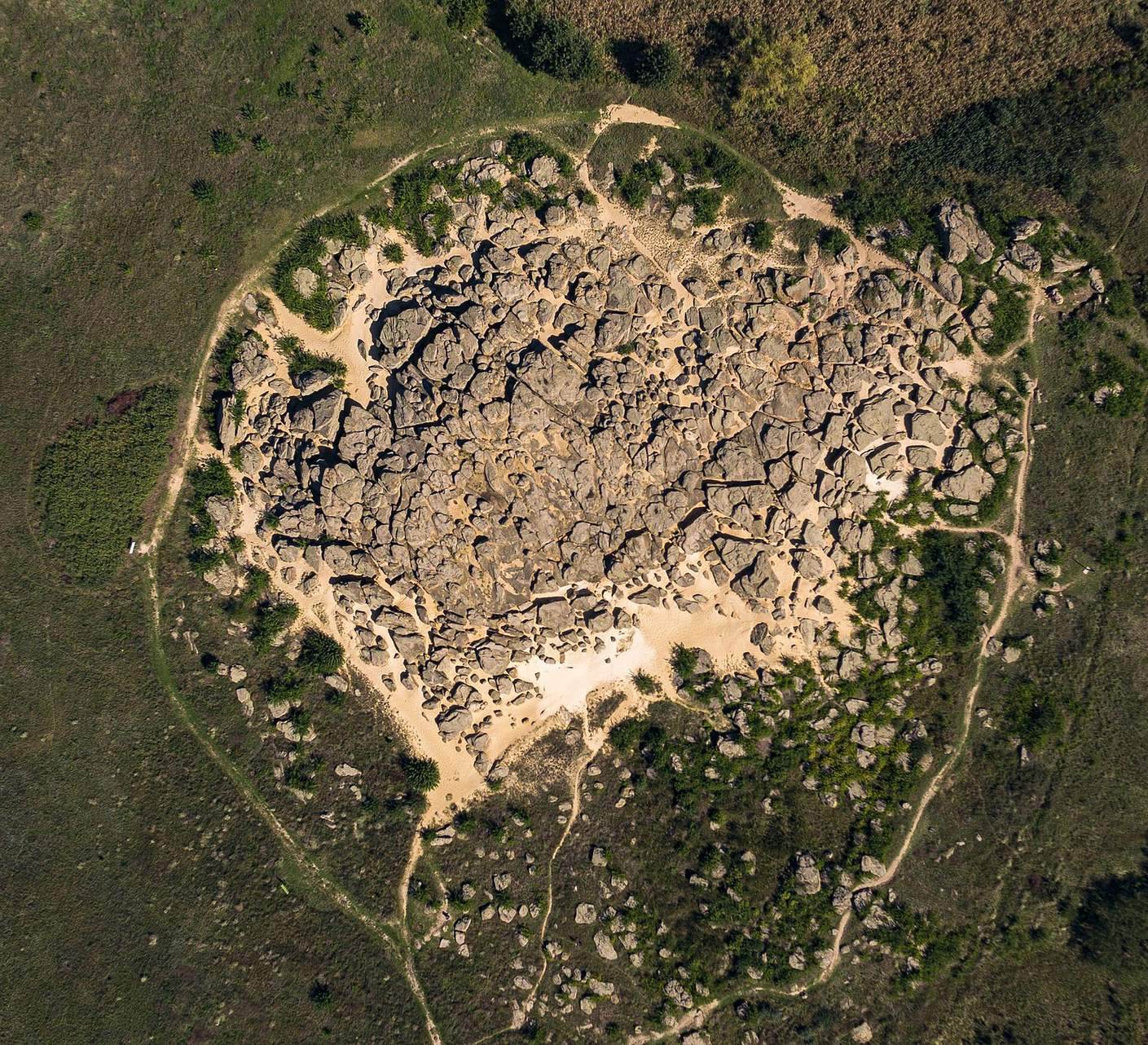
The outcrop stands about 12 metres high and covers approximately 30,000 square metres, measuring roughly 240 by 160 metres. More than 3,000 sandstone slabs and blocks make up the formation. It began as a marine sandbank that hardened into dense, quartzite-like sandstone. Iron and manganese oxides occur along cracks and layers in the rock.
Water erosion shaped the outcrop, which stood as an island in the Molochna River for a long period before the river channel shifted west. Weathering and gravity broke the sandstone into slabs, generally about half a metre thick. Their irregular arrangement formed numerous cavities. Surveys have identified 87 grottoes and caves, with thousands of carvings in 65 of them. Many are narrow, low fissures, commonly 5–8 metres long and 1.2–1.5 metres high, with flat or nearly flat ceiling slabs. Sand fills many decorated interiors as protection, since removing it could contribute to further rock falls.
Caves and rock carvings
Most images are on the inner surfaces of slabs and can be seen from within the grottoes, passages, and caves. Artists usually made them by rubbing or working the softer sandstone with harder stone. Traces of red pigment survive on some images, and black and red mineral pigments are also described. Cave No. 36 is an exception where images were painted. Researchers recovered several quartz stones used to make marks on the sandstone.
The carvings include people, wild and domesticated animals, hunting scenes, intersecting lines, geometric designs, and solar signs. Some arrangements have been interpreted as teams of animals, animals among vegetation, defensive bulls, or scenes of human and animal sacrifice. Intersecting lines have sometimes been read as fishing nets. A few marks resemble round depressions or human footprints known from sites in Sweden and Karelia; most are considered distinctive to Kamyana Mohyla.
Bison Cave
Bison Cave, also identified as Cave No. 36b, contains images interpreted as a mammoth, a bird, a bison, and horses.
Bull Grotto
The large image in the Bull Grotto has been identified as either a bull or a mammoth. Re-examination revealed the ceiling of a lower slab two metres below the surface, bearing images of bulls, people, and linear-geometric designs.
Other grottoes
Goat Cave is identified as Cave No. 60. A horizontal stone inside Grotto No. 9 may have served as an altar, although this proposed use has not been confirmed. Other grottoes contain reliefs and stone sculptures representing a dragon, fish, a lion, and a human head.
Sculptures and archaeological finds
Stone figures and carved marks
A sculpture found in a grotto and attributed to the Bronze Age has been identified as the head of Vritra, a dragon-like adversary in Vedic mythology. The site also has a two-metre stone figure described as a human-fish and images of the Tree of Life. Slabs with marks described as ancient writing have been dated to the 6th–early 5th millennia BCE.
Mesolithic images and finds
Mikhailov’s investigations identified images interpreted as a deer, a doe, an archer, and a woman, assigned to the Mesolithic. At the Kamyana Mohyla I Mesolithic complex, excavations in 2016 recovered two sandstone stones carved with snake-head images. One, made of yellow sandstone, is dated to 8300–7500 BCE; the other is dated to about 7400 BCE.
The outcrop remains exposed to the elements, and researchers observed gradual deterioration of the carvings during the 20th century. A museum at the reserve exhibits finds dating from the Late Paleolithic through the 13th century.