Gwanggaeto Stele: A Goguryeo Royal Memorial in China
Site at a Glance
- Popularity
- Very High
- Country
- China
- Primary era
- Classical
- Eras represented
- Classical, Modern
- Civilizations
- Chinese, Goguryeo
- Site type
- Civic
- Remains
- Monument
On this page9 sections
History
The Gwanggaeto Stele is a commemorative monument erected in 414 by King Jangsu of Goguryeo at Ji’an, China, in honor of his father, Gwanggaeto the Great. The monument is associated with Gwanggaeto’s tomb, and its inscription dates his burial to September 29 of that year. Goguryeo was an ancient kingdom centered in the northern Korean Peninsula and nearby parts of northeast Asia.
Goguryeo’s capital and the monument’s purpose
Goguryeo established its capital at Gungnae Fortress in Ji’an in 3 CE. The capital moved to nearby Wandu Mountain Fortress in 209 and later to Pyongyang in 427, while Ji’an remained a central seat of Goguryeo power for about 424 years. The stele’s inscription recounts the kingdom’s origins and royal succession, Gwanggaeto’s campaigns, and the arrangements made for the care of his tomb.
The inscription presents Jumong, Goguryeo’s legendary founder, as descended from the Heavenly Emperor and Habaek, a river deity’s daughter. In this sacred origin story, Jumong is born from an egg, crosses a river, and establishes a capital. The text traces the royal line from Jumong to Gwanggaeto, described as the founder’s seventeenth descendant.
According to the inscription, Gwanggaeto took the throne at eighteen in 391, adopted the era name Yongnak, meaning “Eternal Enjoyment,” and died at thirty-nine. The accession year differs from the 392 date given in the later histories Samguk Sagi and Samguk Yusa. The inscription’s accounts of campaigns provide important evidence for Goguryeo’s history, though some episodes can also be compared with later records.
Campaigns described on the stele
In 395, Gwanggaeto personally led a campaign against the Paeryeo, often identified with a Khitan group. The inscription says his forces defeated three settlements and between 600 and 700 camps, and took livestock in uncounted numbers. The following year, he led a naval attack on Baekje, another kingdom on the Korean Peninsula. His forces seized numerous fortresses and reached its capital. Baekje’s king surrendered 1,000 men and women and 1,000 bolts of fine cloth, and promised lasting submission. The text claims Goguryeo took 58 fortresses and 700 villages; Gwanggaeto returned with the Baekje king’s younger brother and ten senior officials.
In 398, Gwanggaeto dispatched troops into Poshen territory, a name tentatively associated with the Sushen people. The force captured more than 300 people. The inscription says that afterward the group sent tribute and reported on its affairs. In 399, after Baekje renewed its alliance with Wa, a name the inscription uses for a people or force associated with Japan, Gwanggaeto went to Pyongyang. A Silla envoy asked for help, reporting that Wa troops had invaded Silla and sought to make its king their subject. Gwanggaeto agreed to assist.
In 400, he sent 50,000 troops to Silla. The Wa forces withdrew as the Goguryeo army approached Silla’s capital. Goguryeo’s pursuit reached a fortress in Imna Gaya, a name associated with southern peninsula polities, which surrendered. The inscription also refers to Anra soldiers stationed in the area, but the meaning of that passage is disputed. It says that Silla’s king thereafter came in person to pay tribute, unlike earlier rulers of Silla.
In 404, Wa forces invaded the Daifang border region. Gwanggaeto marched from Pyongyang and defeated them, inflicting heavy losses. Three years later, he sent 50,000 infantry and cavalry on another campaign. The opponent’s name is not legible in the inscription. Its account describes the capture of more than 10,000 suits of armor and substantial military equipment, as well as the destruction of several fortresses on the army’s return.
Gwanggaeto campaigned against Eastern Buyeo in 410 after it stopped paying tribute. The inscription describes the state as submitting and says people followed the Goguryeo army back. It gives totals of 64 fortresses and 1,400 villages, but it is uncertain whether these figures refer only to this campaign or to Gwanggaeto’s campaigns as a whole. Across its accounts, the text presents Goguryeo as the center of a regional hierarchy. It calls the Goguryeo ruler “king” and Baekje’s ruler “lord,” describes Baekje and Silla as former subject peoples, and uses the disparaging name “Baekjan” for Baekje.
The disputed Sinmyo passage
A damaged passage referring to 391, the Sinmyo year in the traditional East Asian cycle, has remained contested. One longstanding Japanese interpretation makes Wa the force that crossed the sea and subdued Baekje and Silla. Korean interpretations have variously identified Goguryeo or Baekje as responsible for the actions that follow. Other readings understand the passage as a wider justification for later campaigns in the south, rather than a clear account of a single event in 391. Missing characters and uncertain sentence divisions leave its meaning unsettled. The passage alone does not establish that a centralized Japanese polity controlled the Korean Peninsula.
Rules for maintaining royal tombs
The inscription also addresses the burden of maintaining Gwanggaeto’s tomb. It says that relying only on older populations for this work would overtax them, and assigns 220 households from groups called Han and Ye, together with 110 older households, to tomb service. It divides the service households into 30 state households and 300 watcher households, the latter designated for tomb upkeep. The text also says Gwanggaeto ordered markers for earlier royal tombs, where the keeper households had become confused because the graves had no steles. It prohibits the sale or purchase of tomb keepers and sets penalties for violations.
The combination of campaign accounts and detailed custodial rules has led to differing views about the monument’s main purpose. Some interpretations emphasize its praise of Gwanggaeto’s achievements, while others stress its provisions for the long-term care of his tomb. Both themes appear in the inscription.
Rediscovery and changing interpretations
The stele came to wider attention amid resettlement in the late nineteenth century, after Qing restrictions on entry to the area eased. In 1883, Japanese military officer Sakō Kageaki obtained a tracing of the inscription and took it to Japan the next year, helping prompt scholarly study there. The text became publicly known in Japan later in the decade. Early attempts to expose the carved surface caused damage.
A lime coating and damage to the text led Lee Jin-hui, in the 1970s, to propose that the Japanese military had altered the inscription. Later examinations attributed the lime to local copyists seeking clearer impressions and found no evidence of Japanese alteration. A rubbing dated to 1881, discovered in 2006, matches Sakō’s copy and further weakened the claim. In 1906, Shiratori Kurakichi and the Japanese navy considered moving the stele to Japan, but abandoned the plan because transport posed difficulties and risked damaging it. Access for Japanese field researchers was restricted for many years; a team led by Furuta Takehiko was allowed to examine the monument in 1985.
The stele was included in the Donggou Ancient Tombs National Key Cultural Relics Protection Unit in 1961 and later became part of the UNESCO World Heritage property Capital Cities and Tombs of the Ancient Koguryo Kingdom, inscribed in 2004.
Remains
The site centers on a freestanding, four-sided pillar carved from tuff breccia, a rock formed from volcanic fragments. It stands about 6.3 metres high. Its faces range from about 1.38 to 2 metres wide, while its sides measure about 1.35 to 1.46 metres; the base is approximately 3.35 by 2.7 metres, and the pillar’s girth is nearly 4 metres.
The carved inscription
About 1,800 characters cover the pillar’s four faces. They are written in Classical Chinese, using clerical script, a formal Chinese writing style associated with the Former Han dynasty. The inscription is arranged in three main parts, moving from Goguryeo’s origins and royal line to military campaigns and arrangements for tomb custodians. Lists of captured fortresses and submitted territories form part of its campaign narrative. Weathering and surface damage make more than 100 characters difficult or impossible to read.
Setting and protection
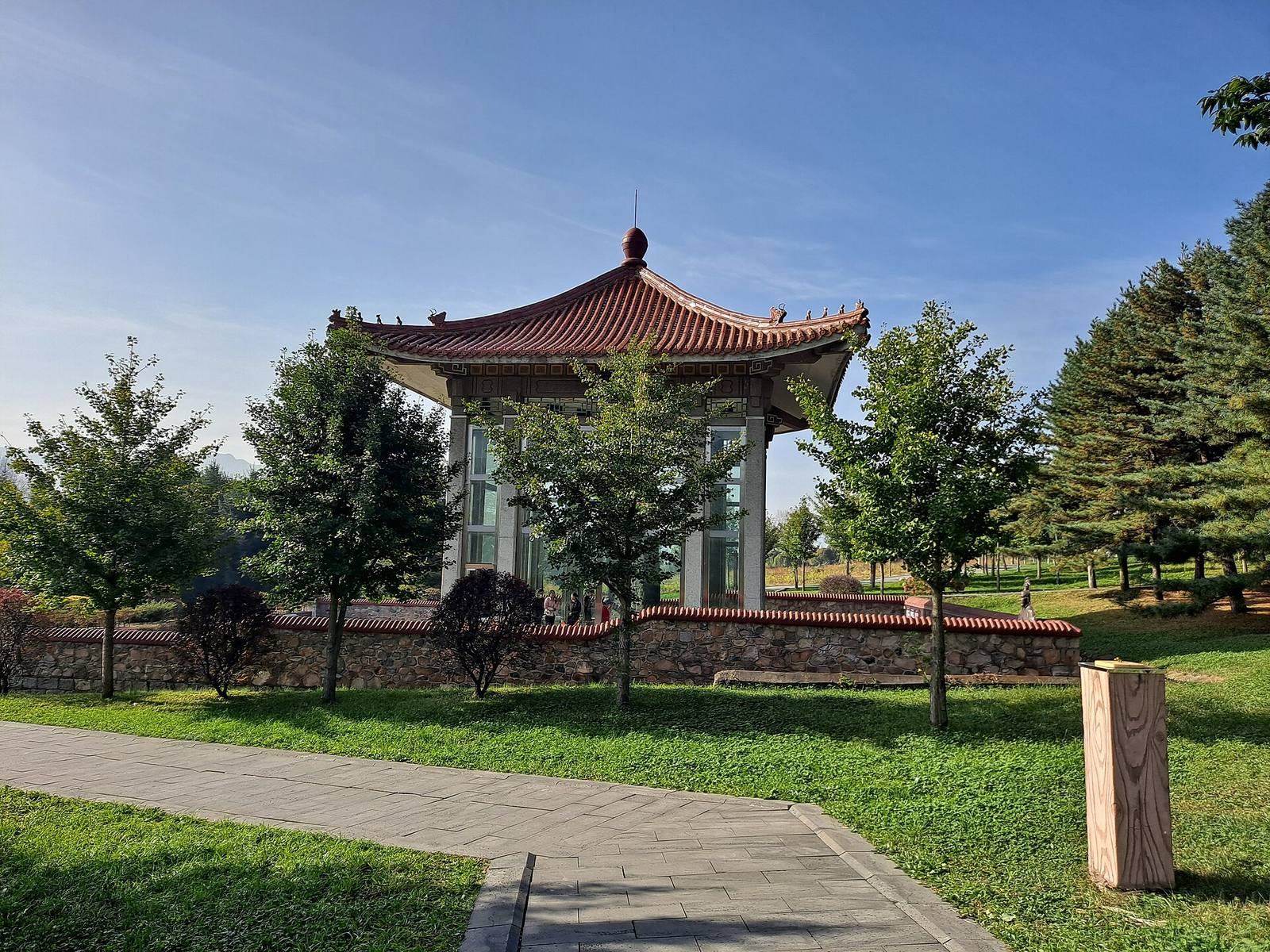
The pillar stands beneath a protective roof and within a glass enclosure. It was exposed to the weather until the roof was installed in 1982–83, and glass was added around it in the twenty-first century to limit further deterioration. Nearby monumental tombs known as General’s Tomb and Taewang Tomb are considered possible royal burials, but which, if either, is Gwanggaeto’s tomb remains uncertain.