Phanagoria: A Greek Colony and Bosporan Capital in Russia
Site at a Glance
- Popularity
- Very High
- Country
- Russia
- Primary era
- Classical
- Eras represented
- Iron Age, Classical
- Civilizations
- Ancient Greek, Bosporan Kingdom
- Site type
- City
On this page25 sections
History
Phanagoria was an ancient Greek city in Krasnodar Krai, Russia, founded around 543 BC by settlers from Teos, an ancient city in Asia Minor. They had left amid conflict with Cyrus the Great, the Persian king. Tradition connects the city’s foundation and name with Phanagoras, a leader among the settlers; another possibility is that it was a colony of Abdera, whose people also traced their origins to Teos. Phanagoria grew into a major trading center linking the Maeotian region, around the Sea of Azov, with the southern Caucasus and communities around the Black Sea and Mediterranean. Its commerce included grain and exchanges with Scythians, Sindi, and local Maeotian peoples.
Greek foundation and Bosporan rule
By about 480 BC, Phanagoria was associated with the Archaeanactid dynasty, one of the ruling houses linked to the Bosporan Kingdom, while retaining some autonomy. The Spartocids’ overthrow of the Archaeanactids, around 480 to 470 BC, coincided with a major fire and destruction in the city. Phanagoria later recovered its prosperity. In the early fourth century BC, the expanding Bosporan Kingdom, an ancient state centered on the Cimmerian Bosporus, incorporated the territory of the Sindi, including the city.
Phanagoria became the kingdom’s eastern, or Asian, capital, while Panticapaeum served as its western capital across the strait. The eastern city’s political and economic weight grew as Panticapaeum declined. By the beginning of the first century AD, Phanagoria was described as the kingdom’s leading city.
Roman connections and political change
During the Mithridatic Wars, conflicts between Rome and Mithridates VI, king of Pontus, Phanagoria sided with the Roman Republic and resisted a siege by Pharnaces II of Pontus. A revolt against Mithridates VI then broke out in the city. His sons, who held its citadel, were forced to surrender to the insurgents. The uprising brought Phanagoria independence from the Bosporan Kingdom, and its support for Rome helped it retain its regional standing.
In the first century BC, Bosporan king Polemon I temporarily changed the city’s name to Agrippia in honor of the Roman commander Marcus Vipsanius Agrippa. An inscription records Queen Dynamis honoring Augustus, Rome’s first emperor, with titles describing him as ruler and guardian of land and sea.
Byzantine and Khazar periods
The Huns sacked Phanagoria in the fourth century. It was rebuilt and entered the Byzantine sphere, although Khazar influence later became strong. A traditional claim that the city was the capital of Great Bulgaria under the Bulgar ruler Kubrat remains uncertain: Byzantine accounts instead place Phanagoria within the Byzantine Empire. The city nevertheless served as a link between Byzantium and Great Bulgaria.
By the late seventh century, Phanagoria had come under the Khazar Khaganate, a polity ruled by a khagan and extending around the northern Black Sea and Caspian regions. A Khazar official, or tudun, probably exercised control, and the city later became one of the Khazars’ administrative centers. In 695, the deposed Byzantine emperor Justinian II took refuge there under the protection of his brother-in-law, the Khazar khagan Busir Glavan. Justinian later returned to Byzantium and regained the throne.
A Jewish community lived in Phanagoria from at least the early centuries AD. An inscription dated to 52 AD records the freeing of enslaved people, their dedication to a synagogue, and the community’s role as their legal guardian. A Hebrew-inscribed amphora from the late ninth or early tenth century provides evidence of Jewish life in the city at a later date.
Abandonment and later settlements
At the beginning of the tenth century, rising sea levels and the silting of the Kuban’s channels affected the settlement, and most or possibly all of its inhabitants left. Many moved to neighboring Tmutarakan, a medieval settlement on the Taman Peninsula. A small community remained among the ruins in the eleventh century.
In the late Middle Ages, a Genoese settlement called Matrega arose on the site. It became the head of a Catholic ecclesiastical province in 1349, and the church see was suppressed around 1400. During the fifteenth century Matrega was a center of the de Ghisolfi family’s dominions. A settlement also occupied the area in the sixteenth through eighteenth centuries, when it belonged to the Ottoman Empire.
Rediscovery and archaeological investigation
In the eighteenth and nineteenth centuries, the name Phanagoria, or Phanagoria Fortress, was mistakenly applied to a different fortification. Built by Russia in 1794 on the site of the Turkish fortification of Hunkala, it stood at Taman and was not a continuation of the ancient city. The location of Phanagoria itself was identified in the eighteenth century after the discovery of marble statue bases dedicated to Aphrodite.
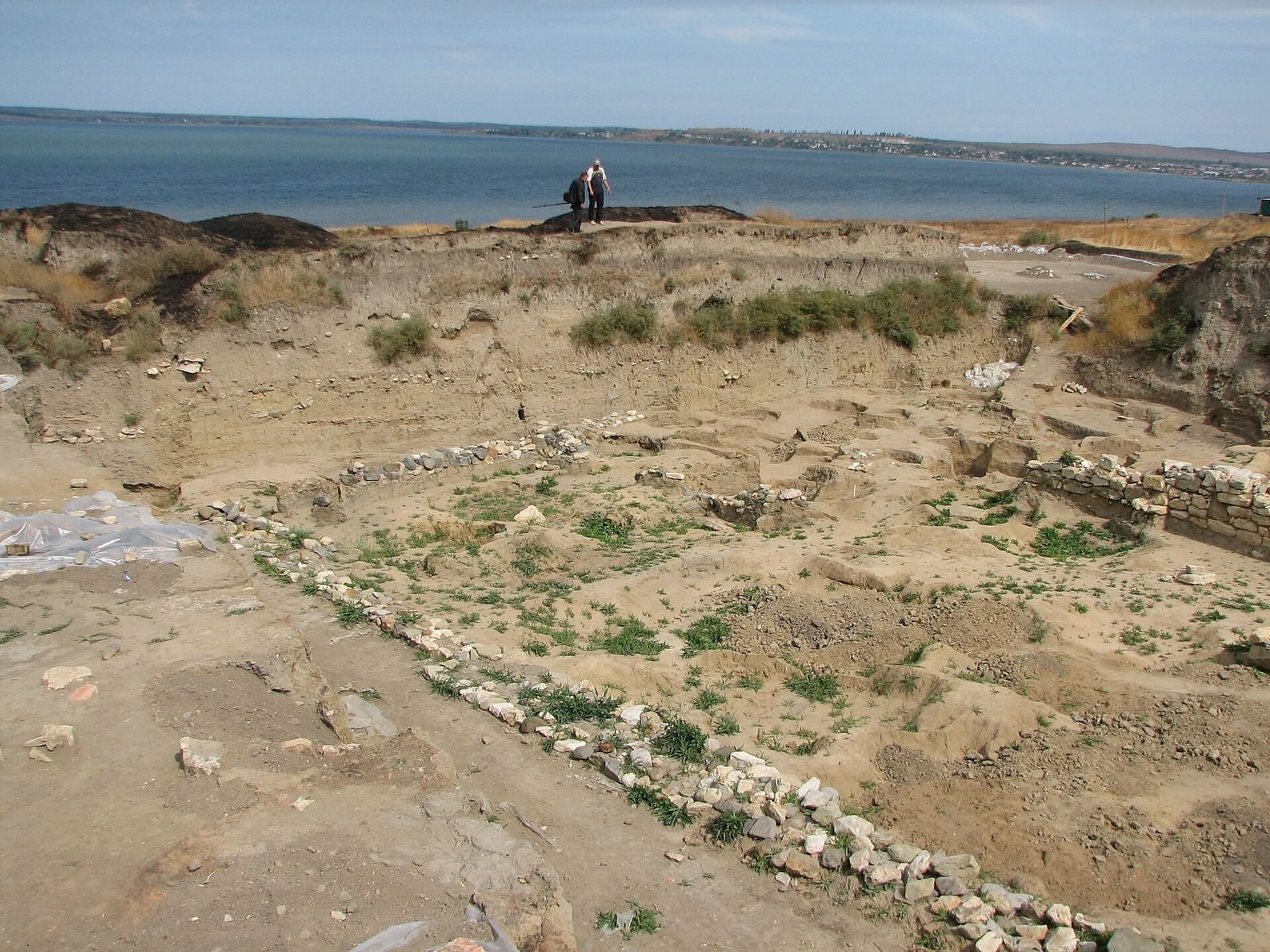
Archaeological exploration began in 1822, when soldiers excavated a large burial mound and divided its gold and silver finds among themselves. Much nineteenth-century digging was unsystematic, and as many as twelve burial mounds were levelled in a single season. Excavations have taken place annually since 1936, except for a break during the Second World War. Vladimir Blavatsky led the Soviet-era investigations that began that year, and later work has included underwater excavation. In 2014, the site became a state historical and archaeological museum-reserve and was designated a cultural heritage site of federal importance in Russia.
Remains
The ancient city covered an estimated 60 to 75 hectares on an island in the Corocondamitis archipelago, between the Black Sea and the Maeotian waters. Its lower level contained the urban center, while a fortified acropolis, the high defended area of an ancient city, occupied higher ground. About one-third of the urban area now lies underwater, where excavations have also found architectural fragments. Removal of building stone for house foundations in nearby Sennoy has damaged many burials, structures, and other ancient remains.
City and harbor
Urban levels and buildings
Remains of the lower city include paved streets, wells, water pipes, house cellars, and houses with tiled roofs. Excavations in the upper city in 2009 uncovered a structure thought to be a palace of Mithridates VI; it had burned in antiquity. Traces of a gymnasium, an institution for athletic training and education, date to the third century BC.
The submerged city and harbor
Ports and other harbor-related remains belong to the city’s waterfront. Among underwater finds is a marble grave marker for Hypsicrateia, the wife of Mithridates VI. After her death, the marker was reused in a harbor foundation and eventually entered the sea. In 2019, a warship was found in Taman Bay beneath a protective structure on the seabed. Its wooden frame dates to the second or first century BC and may help reconstruct how the vessel was built. A ship thought to be a bireme, an ancient warship with two banks of oars, was found nearby in 2012; a bronze warship ram from the era of Mithridates VI was discovered close to that vessel in 2014.
Sacred and civic buildings
Early altar complex
An altar complex found during the 2018 field season dates to around the city’s foundation in the mid-sixth century BC. It represents one of the earliest known Greek sanctuaries in Russia.
Aphrodite sanctuary
A prominent sanctuary was dedicated to Aphrodite, the Greek goddess associated with love and fertility. In antiquity it was regarded as one of the most important sanctuaries to the goddess in the northern Black Sea region. An inscription records its repair by the Bosporan king Sauromates. Local myth connected the sanctuary’s title for Aphrodite with the story of Heracles hiding from the Giants and killing them by deception.
Gymnasium
Traces of the third-century BC gymnasium place an institution for exercise and education among the city’s identified civic remains.
Jewish quarter
Synagogue
The synagogue was a rectangular building oriented from east to west, covering more than 120 square metres. Two principal rooms each measured about 60 square metres. Marble columns, Jewish decorative motifs, and large stone menorahs, multi-branched Jewish ritual lamps, formed part of its interior. It may have been built around the beginning of the first century BC and was destroyed in the sixth century.
Residential and communal remains
Residential buildings, a winery, a garden, and a water system have been found in the Jewish quarter. Large clay storage jars in the garden were used for irrigation. Finds from the quarter include inscriptions bearing Jewish symbols and Hebrew writing, as well as Jewish tombstones.
Burial grounds and tombs
City necropolis
A large cemetery, or necropolis, extends around the ancient city on three sides. It contains thousands of burials, including marble and cypress sarcophagi.
Bolshaya Bliznitsa mound
The Bolshaya Bliznitsa burial mound, excavated in the 1860s, contained the burial of a priestess of Demeter, the Greek goddess associated with agriculture and grain.
Royal burial chamber
One royal mound contained a stone stairway leading to a rectangular passage and a burial chamber measuring about 3.70 by 3.75 by 4.70 metres. Arched coverings spanned both passage and chamber. Painted designs on the walls imitated marble. Long stone boxes beside the entrance held the remains of four horses, with gold and gilded-bronze harness and saddlery.
Inscriptions, church remains, and other finds
Persian-inscribed stone
Fragments of an inscribed stone slab, or stele, were found in 2016. Its ancient Persian text is attributed to an order of Darius I from the first half of the fifth century BC and concerns the suppression of the Ionian Revolt. The slab may originally have stood at Miletus. Its broken pieces are thought to have reached Phanagoria as ship’s ballast.
Christian remains and coin hoard
Finds from a fifth- or sixth-century Christian church include fragments of a marble table and a baptismal font. A hoard discovered in 2021 inside the broken neck of an amphora consists of coins minted in the late third or early fourth century. They are thought to have circulated until the sixth century and may have been hidden before an attack. The hoard’s findspot may have been occupied by an early Christian basilica, a large rectangular building type used in early Christian architecture.
Coins and regional exchange
Finds from the Taman region include Byzantine gold coins, some clipped around their edges, an Arab silver dirham, and a silver coin of the Kievan ruler Vladimir Sviatoslavich found near Phanagoria. Together, Byzantine, Arab, and early Rus’ currency provides evidence of trade in the region between the eighth and eleventh centuries.