El Castillo de Huarmey: A Wari Monumental and Funerary Complex in Peru
Site at a Glance
- Popularity
- Medium
- Country
- Peru
- Primary era
- Medieval
- Eras represented
- Medieval
- Civilizations
- Wari
- Site type
- Burial
- Remains
- Necropolis
On this page19 sections
History
A Wari center on the northern coast
El Castillo de Huarmey is a monumental archaeological complex near Huarmey, Peru, built chiefly during the Middle Horizon, about AD 650–1050, by the Wari civilization. The Wari, a major Andean society centered in Peru’s southern highlands, may have used the complex as a palace or administrative center and as a regional hub on the northern coast. Intact elite tombs found there strengthened the interpretation of the site as a Wari center.
The complex stood near the boundary between Wari and Moche influence. The Moche were a distinct civilization of northern Peru, and El Castillo may have been built over or adapted from earlier Moche structures. In the nearby Culebras Valley, the disappearance of Moche residences, the arrival of Wari forts and observation posts, and a road connecting settlements southward toward El Castillo may reflect Wari expansion north.
The monumental complex was repeatedly enlarged and rebuilt. Later construction surrounded earlier buildings, while builders altered stairs, passages, and walls, sometimes taking apart portions of existing structures. Cemeteries north of the core reflect activity over a longer span, from the Early Horizon, which preceded the Middle Horizon, through the Late Intermediate Period, which followed it.
Burials, research, and archaeological work
Antiquities from the Huarmey Valley drew archaeologist Julio C. Tello’s attention in 1918. He planned an expedition, but an outbreak of bubonic plague prevented excavation. He later returned to the valley and commissioned an archaeological reconnaissance in 1930. In the late 1950s, Ernesto Tabío and Duccio Bonavia carried out early joint surveys. Bonavia’s 1982 register listed 69 archaeological sites in the valley, while, around the late 1960s, Dorothy Menzel proposed that a Wari-influenced center had existed on the Ancash coast.
Looting damaged El Castillo extensively and increased after the 1970 earthquake exposed previously undisturbed graves. In 1979, archaeologist Frederic Engel recorded the architecture and alerted Peru’s cultural authorities to the site’s condition. Alberto Bueno Mendoza also drew attention to damage caused by clandestine digging. Heiko Prümers cleared several looters’ pits and studied surface material in 1985. His 1985–86 survey gathered about 1,600 pottery fragments, 366 pieces of textile, and roughly 1,300 fragments of wood and decorated gourds. The materials went to the National Museum of Anthropology, Archaeology and History in Lima. The textiles included wool-and-cotton examples, mainly in a Moche–Wari style, as well as smaller groups in Classic Wari, Nazca, and Lambayeque styles.
A research project led by archaeologists Miłosz Giersz and Roberto Pimentel Nita began in 2010 through cooperation between the University of Warsaw and the Pontifical Catholic University of Peru. Krzysztof Makowski provided scientific support. The team used material analysis and chemical studies, building on a decade of research in the Huarmey and Culebras valleys that had identified more than a hundred archaeological sites. Initial work at El Castillo identified intact funerary contexts whose seated burials and Wari-style textiles pointed to Wari or southern Andean influence rather than typical coastal Moche customs.
Excavation of the upper complex began in September 2012. Beneath the Red Mausoleum, the team uncovered an undisturbed elite burial complex, announced publicly in June 2013 after several months of confidential work intended to reduce the danger of further looting. The discovery comprised 63 intact burials and about 1,200 associated objects. It provided the first intact Wari elite funerary contexts identified in the region and substantially strengthened the case for interpreting El Castillo as a Wari palace or administrative center on the northern coast.
The principal burial group included about 60 people, most of them women, and six adolescents described as sacrificial victims. Three small chambers held high-status women, one buried with an adolescent. The woman known as the Queen of Huarmey, around 60 years old, appears to have held the most privileged position. Her rich grave and the weaving equipment associated with elite burials indicate that women could attain high status in Wari society and that textile production was linked with wealth and authority. The length and sequence of burial remain uncertain: the tomb may have been sealed soon after the bodies were placed inside, or some wrapped bodies may have been kept elsewhere beforehand. In the latter case, the death or expected death of an important person may have prompted construction of the complex.
In 2022, archaeologists found six burial chambers in a rocky hollow behind the Red Mausoleum’s south wall. The area, called the Gallery of Artisans, included one undisturbed chamber and five that had been looted. Work at the site has also revealed unusual burials from earlier periods, including a child aged six or seven buried head-down in a narrow grave over large pieces of an adult woman’s pelvic bones. Textiles, pottery, and wooden objects recovered from nearby cemeteries in the 1960s entered collections at the Museum of the Five Continents in Munich and the Amano Museum in Lima.
Peru declared El Castillo de Huarmey Cultural Heritage of the Nation in 1999, under the National Institute of Culture, now the Ministry of Culture.
Remains
The ridge and raised platform
Setting and layout
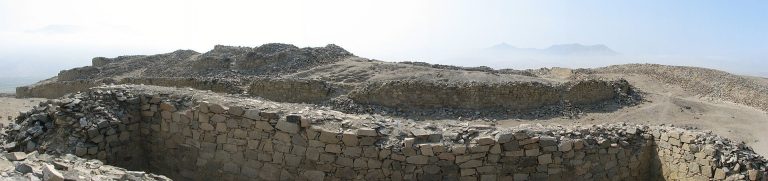
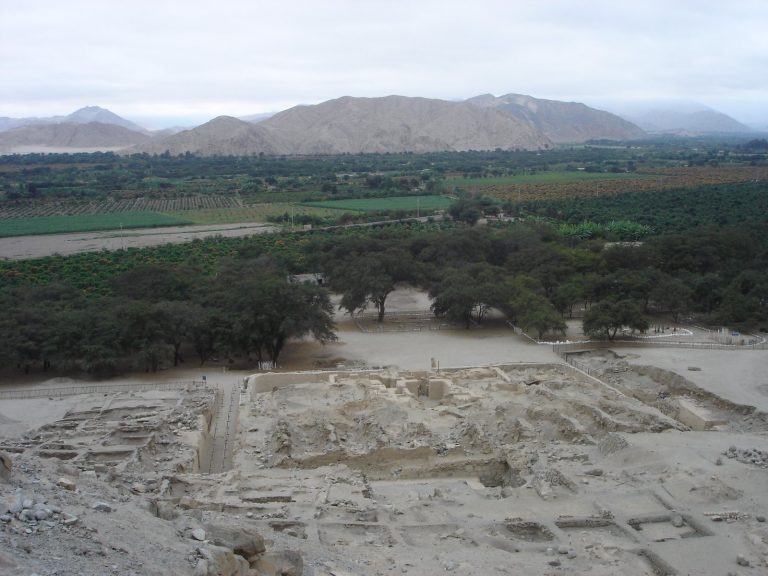
The archaeological complex covers about 45 hectares roughly one kilometre east of Huarmey, on the right bank of the Huarmey River and about two kilometres from the Pacific coast. Agricultural fields surround its principal rocky rise, with traces of ancient buildings surviving in a few places. The monumental core occupies about 8,500 square metres on an elongated ridge oriented toward the river. The El Castillo complex measures approximately 150 metres long by 70 metres wide. The broader platform construction extends about 200 metres north to south, reaches up to 65 metres across, and rises about 12 metres above the valley floor.
The platform’s northern end rests on the rocky rise, while its surface descends toward the southwest. Buildings there reach up to eight metres high, maintaining an elevated level above the valley floor. Builders extended the natural rise with artificial terraces, creating a stepped, pyramid-like form. Ruined adobe buildings, made of sun-dried mud brick, and other platform structures continue down toward the valley. Traces of quarries at the foot of nearby cliffs mark places where building stone was extracted.
Retaining walls
Retaining walls ran along the platform’s eastern and western sides, rising in stages and incorporating narrow ledges. Sections survive on the southwest and southeast flanks; elsewhere, spoil from clandestine digging has covered portions of the walls. Their construction combines adobe and masonry, reinforced with regularly spaced horizontal wooden beams. Most adobe walls received a fine mud-plaster coating, traces of which retain red and white paint. Wall thickness ranges from about 70–80 centimetres to a maximum of 1.1 metres.
Mausoleums and associated funerary architecture
The Red Mausoleum
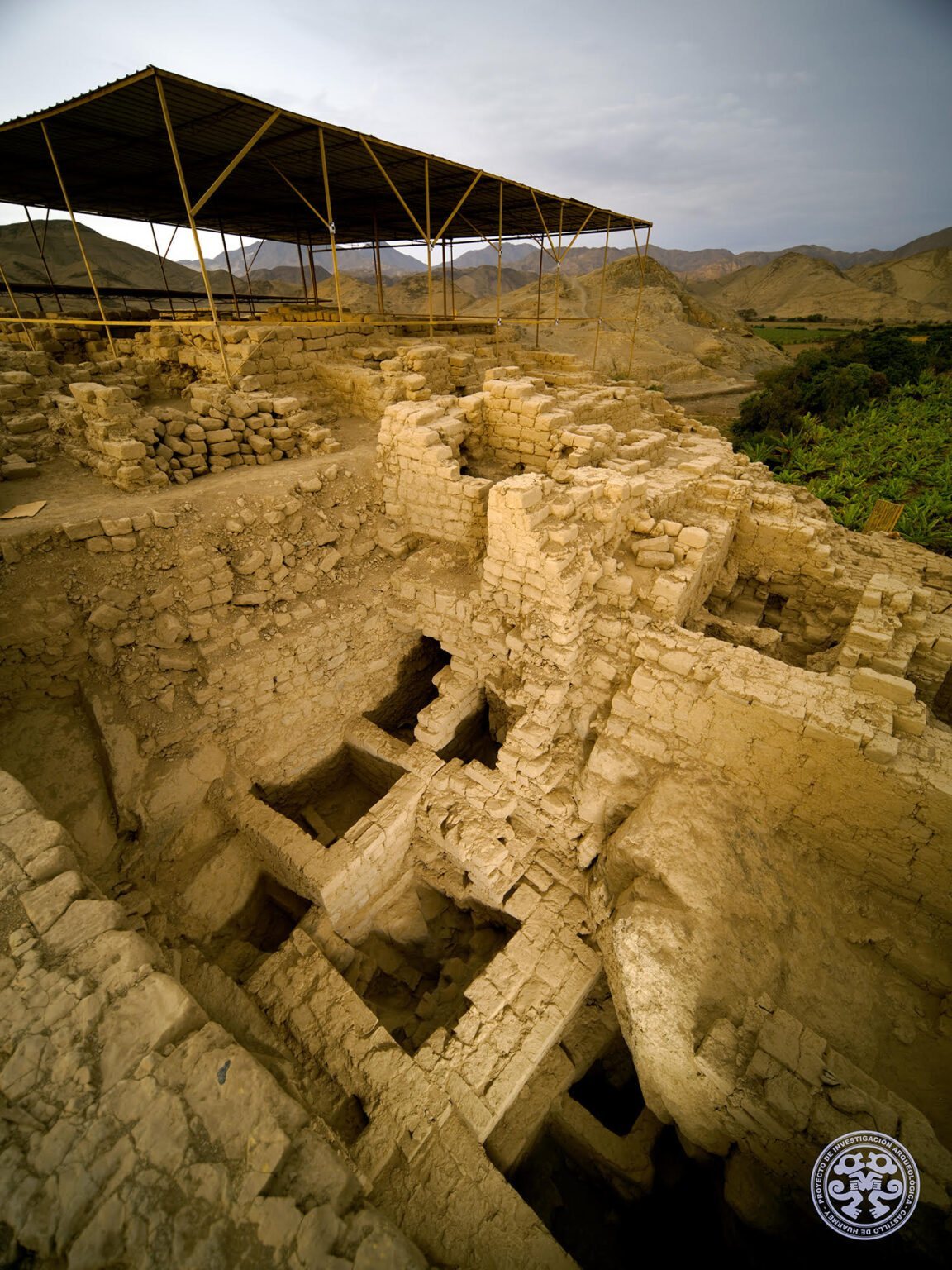
The southern group centers on the Red Mausoleum, once coated in red plaster. Built of adobe, it has a rectangular plan of about 13 by 11 metres, with rooms arranged around a central chamber measuring roughly 4.3 by 3.4 metres. That chamber retains traces of a throne-like bench and niches in the walls. Its only exit opens into a formal suite facing northeast. Several rooms behind the main hall have no openings at the surviving level. Camelid, condor, and monkey bones came from some of these isolated spaces and may have been offerings. Vessel fragments, fine textiles, and mummified remains in other rooms point to funerary or ritual use.
The principal burial chamber
A stone-and-adobe platform, about 31 by 25 metres, supports the Red Mausoleum and adjoining buildings. Clay mortar binds its materials, and long wooden beams strengthen the construction. Beneath the mausoleum’s main hall, a rectangular burial chamber was cut partly into bedrock. An antechamber approached it from the east; four separate compartments in the platform to the west held secondary burials of human bones. These spaces were filled with gravel and sealed before the funerary buildings above them were erected.
The principal chamber lay below a floor made of unusually shaped trapezoidal adobe bricks. It measured about 4–4.5 metres long, 3.5 metres wide, and 1.5 metres deep. A channel in the floor ran from outside toward the small chambers and may have carried ritual liquids. After the burials, builders covered the chamber with about a metre of gravel. The dead were wrapped and placed in flexed, seated positions. Partitions in the northeast corner created three small chambers for elite burials. At the original entrance, hollows cut into the rock held a man and a woman interpreted as guards. Both had lost their left legs well before death, and the man’s remains also showed battle injuries.
Burial objects and textile work
The graves contained more than a hundred tubular and disk-shaped ear ornaments, some worn by the dead and others placed in baskets. Gold and silver decoration combined with finely carved wood or bone; designs include animals and geometric forms. Some ornaments are hollow and contain small pieces that rattle when moved. Other personal objects include decorative pins, necklaces, rings, and metal plaques attached to clothing.
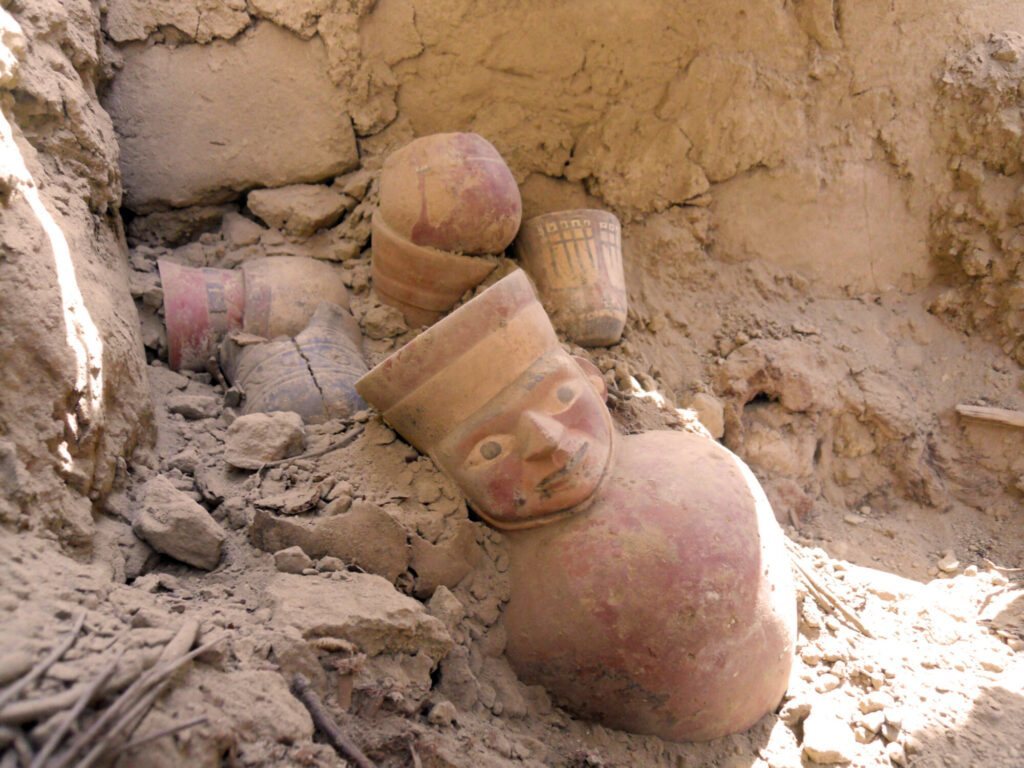
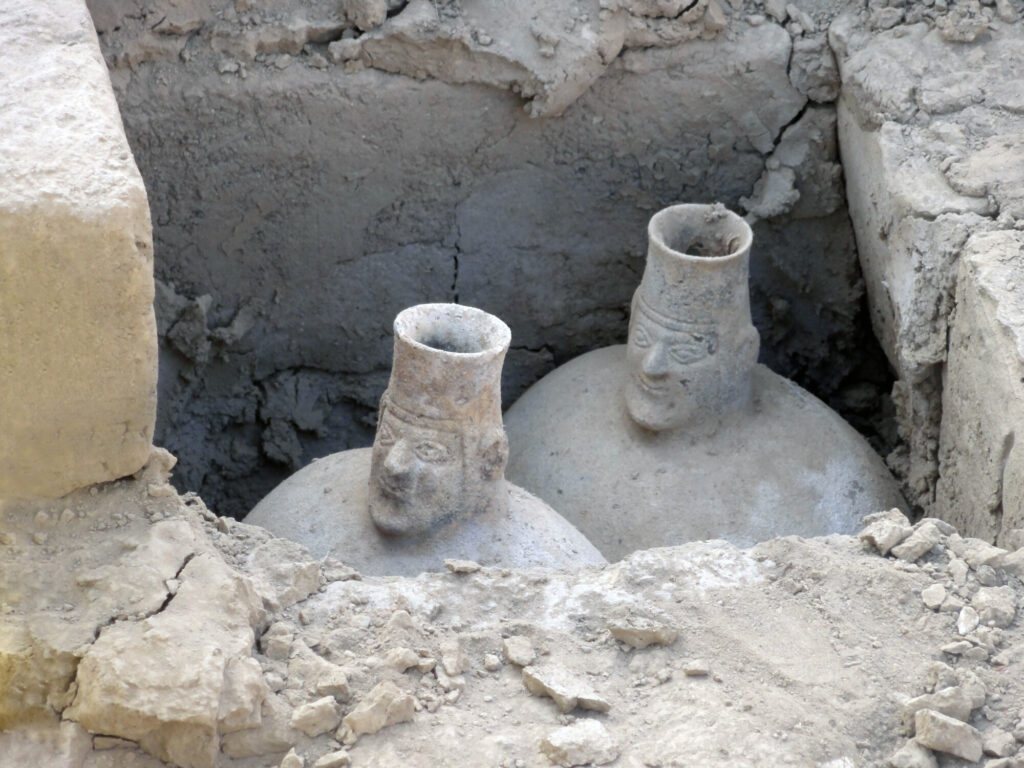
Tools for weaving and spinning included combs, spindles, beaters, needles, weighted spindle whorls used to spin fibers into thread, and parts of handlooms. They were made from gold, silver, copper and copper alloys, carved bone, or wood. Double-spouted vessels joined by a bridge handle, characteristic of northern coastal styles, were found alongside pottery in several Wari styles. Small carved containers held lime used with coca leaves, a traditional mixture in which lime helps release the leaves’ stimulant compounds. One container depicts a feline-faced figure holding reeds topped with human heads. Gourd fragments decorated by burning designs show fantastic beings in imagery distinct from standard Wari designs, with apparent Moche, Chavín, and Cupisnique influences.
The Queen of Huarmey
The Queen of Huarmey was buried in a flexed position, wrapped in a fine textile with green designs. Cinnabar, a red mineral pigment, decorated her face, and she wore tubular ear ornaments. A bronze decorative pin remained with cloth held in her hands. Three baskets beside her held ornaments, weaving tools, textiles, and yarn that may have been personal weaving samples. Their thin walls were made from reeds split lengthwise and decorated with colored threads wrapped around them.
Her grave goods also included pottery, a silver bowl, and ceremonial drinking cups. One cup, carved from soft alabaster stone, has a human face that may have been inlaid with shell. Similar fragments from the Red Mausoleum’s main hall may belong to a matching cup, perhaps forming a symbolic pair. Other notable vessels include two polychrome examples with human figures and a vessel shaped as a richly dressed person on a raft.
The Stone Mausoleum
The northern group centers on the Stone Mausoleum, a rectangle about ten metres on each side. It was heavily looted and is less fully understood than the Red Mausoleum. Its seven rooms included a central chamber with wall niches and an adobe throne, as well as an underground burial chamber.
Secondary towers
Secondary tower structures around both mausoleums probably served funerary purposes. The best-preserved examples retain traces of plaster, wall niches, throne-like benches, and parts of upper storeys. They have no identified underground chambers.
Other burial and architectural areas
The Gallery of Artisans
The Gallery of Artisans occupies a rocky hollow behind the Red Mausoleum’s south wall. Its six chambers include one intact burial and five looted chambers. The intact chamber held an adult man, buried flexed and seated in textiles, a 15-year-old, and the remains of a dog. More than 250 associated objects include thread, fabric, leather offcuts, prepared and unprepared reeds, and tools connected with basket-making. The man had severe osteoporosis and lacked both feet, either from birth or because they had been removed early in life. His upper-body development is consistent with moving by his arms and with strenuous basket-making.
His bronze knives, saw, and chisel had been broken or bent before burial, apparently to prevent their reuse. Fifteen miniature reed-basket walls, decorated with wrapped threads, may have served as samples or templates. A piece of leather painted with a gridded design may also have aided his work. His grave goods included gourds, vessels, and two lime containers shaped as male and female figures. The looted chambers held remains belonging to two adult women, another man, and two other adolescents.
Additional burials on the rise
An undisturbed chamber in a platform on the side of the rocky rise contained a young man and woman with fine textiles, carved ear ornaments, and weaving equipment. Another burial context held a young man with a solid-silver bowl and Wari-style textiles.
Patio and surrounding structures
South of the main necropolis is a monumental square patio about 20 metres on each side. It may have served as a palace for local elites. Geophysical surveys around the main rise have also detected buried adobe or brick structures that may have had funerary, residential, ceremonial, or administrative uses.
Cemeteries north of the monumental core
Looted cemeteries occupy hollows between rises north of the main complex. Early Horizon graves include simple burials in sandy pits, sometimes with small offerings. Later burial areas have surface traces of adobe funerary structures and rectangular or square mud-walled buildings resembling Andean funerary towers. The child placed head-down in a deep, narrow grave over large fragments of an adult woman’s pelvic bones represents an unusual burial among the site’s varied funerary remains.