Trinity Hall: A Cambridge College Founded in 1350
Site at a Glance
- Popularity
- Very High
- Country
- United Kingdom
- Primary era
- Medieval
- Eras represented
- Medieval, Early Modern, Modern
- Civilizations
- British, English
- Site type
- Civic
- Remains
- University
On this page19 sections
History
Trinity Hall, formally the College or Hall of the Holy Trinity in the University of Cambridge, is a college in Cambridge, United Kingdom, founded by William Bateman, Bishop of Norwich, on 15 January 1350. It is the fifth-oldest surviving Cambridge college. Bateman established it to educate clergy in canon law, the rules governing the Church, and civil law, which concerns the law of the state. He also intended the college to support public administration and serve the Church and Diocese of Norwich during the rebuilding of church and legal leadership after the Black Death, the plague pandemic that devastated Europe in the mid-fourteenth century.
Foundation and medieval development
The Black Death of the 1340s may have killed about half of England’s population, and Bateman lost nearly 700 parish priests. Rebuilding the priesthood may therefore have been one reason for the foundation. Bateman planned for a Master, the head of the college, and 20 Fellows, senior members with academic and governing responsibilities. When he died in 1355, the community consisted of a Master, three Fellows, and two scholars. Its numbers remained close to that level until the sixteenth century, and the original target of 20 Fellows was not reached until 1952.
Bateman selected a site previously occupied by Gonville Hall, founded in 1347 but in financial difficulty. Edward III authorized the acquisition of land and houses in February 1350. The college probably already had a house there, and in November Bateman paid the Prior and Convent of Ely £300 for land and a house formerly used by Ely monks studying in Cambridge. A further house and plot followed in 1354. Acquisitions gradually brought the central site to its present extent by 1544, with an additional plot to the northwest purchased in 1769.
The college received its first statutes in December 1352. They provided for a Master chosen by the college community and for Fellows to be selected from its own students or, if suitable candidates were unavailable, from Gonville Hall. In September 1353, Bateman confirmed an agreement with Gonville Hall describing a lasting bond of friendship. The colleges appeared together in public processions, where Trinity Hall took precedence. The two institutions remain distinct: Gonville Hall was later incorporated into the college now known as Gonville and Caius.
Building work was underway by February 1352, when royal protection was granted to carpenters transporting timber to the site. The east side of the court and the hall on its west side were complete before 1374. Contracts that year covered further carpentry on the west side and probably the north side. Trinity Hall also had its own chapel, while sharing St John Zacharias with Clare Hall until that church was demolished in the fifteenth century to make way for King’s College. Trinity Hall was then granted use of the nearby Church of St Edward, King and Martyr, on Peas Hill, a connection that continues.
Law and institutional survival
Cambridge colleges were initially called Halls or Houses, and Trinity Hall kept the name Hall after Henry VIII founded Trinity College next door. The name may also have been intended as a rebuke to Stephen Gardiner, a bishop and royal adviser who opposed the king’s remarriage and lost much of the college’s land through confiscation. The college’s legal emphasis grew stronger after the Faculty of Canon Law was suppressed in 1536. Its limited endowment also restricted its size. From 1544, annual student enrollments remained below ten for nearly three centuries, averaging about five. Between 1565 and 1720, Trinity Hall had fewer matriculations than any other Cambridge college. It generally had 25 or 30 pensioners, students who paid for their own maintenance, though the number sometimes fell to 10 or 15 in the eighteenth century.
Despite its small size, the college maintained a strong presence in legal life. Four Cambridge Professors of Civil Law between 1550 and 1600 came from Trinity Hall. From 1666 to 1873, two Masters and ten Fellows held the professorship in succession without interruption. Before 1856, eight members had served as Dean of the Arches, a senior judge in the Church of England’s ecclesiastical courts, and about as many had become Admiralty judges.
Trinity Hall narrowly avoided a proposed merger with Clare College in 1548–49. A royal commission recommended combining their revenues to establish a new College of Civil Law, but political turmoil and Bishop Nicholas Ridley’s objections to dissolving the college associated with Hugh Latimer helped defeat the plan. During the English Civil War, Master Thomas Eden supported Parliament and signed the Covenant, a solemn pledge. The college and its valuable silver and tableware passed through the conflict unharmed. After the monarchy returned in 1660, Trinity Hall avoided political controversy.
Reform and growth
In 1831, Trinity Hall sold the university 38 acres for £2,210 and received seven acres of university land in exchange. The exchanged land became Bateman and Norwich Streets. The university intended to move its Botanic Garden there, but disagreement over the garden’s importance and funding delayed its establishment at the new site until 1846.
The college changed markedly in the nineteenth century. The university introduced the Law Tripos, its law course and examination, in 1854. Revisions to college statutes in 1860 and 1881, together with Henry Latham’s tutorship from 1855 to 1885, brought stronger organization and new encouragement to study beyond law. Roman law remained prominent in the course. Annual undergraduate entries rose from about 12 around 1850 to nearly 70 around 1890, when Trinity Hall briefly became Cambridge’s fourth-largest college.
George Bridgetower, a Polish-born violin virtuoso and one of the university’s first Black students, studied at Trinity Hall and received a Bachelor of Music degree in 1811. He was a longstanding friend of Charles Hague, a Fellow and Cambridge Professor of Music, and performed in more than 15 public Cambridge concerts Hague organized between May 1795 and June 1811. Bridgetower’s degree exercise was an anthem performed with orchestra and chorus at Great St Mary’s on 30 June 1811. The college established an essay prize in his name in 2022.
Trinity Hall’s boat club began in 1827. At the 1887 Henley Royal Regatta, it won all but one of its races. Between 1890 and 1898, the club held the leading position in the Mays, Cambridge’s May Bumps rowing races, for an unbroken 33 days, then the longest continuous defence of the position by one club. The college also acquired and developed grounds beyond its central site. It had owned land off Huntingdon Road since 1674 and began renting ten acres on Madingley Road from St John’s College in 1892. It purchased that land in 1923, after which work began on playing fields and a pavilion.
Modern expansion and change
Student numbers were kept near 220 between the First and Second World Wars. They rose to about 270 after 1945, alongside growth in postgraduate study, and benefactions enabled the college to nearly double its accommodation. Its academic results improved markedly in the 1980s. In four of the six years from 1981 to 1986, Trinity Hall led the university-wide table for Tripos firsts and upper-second results across all subjects. The literary society Hesperides, founded in 1923 by Neil McLeod Innes to discuss literature and the arts, was named after an influential work by Robert Herrick. It was dissolved in 1976 and re-established in 2020 to encourage literary activity after the COVID-19 pandemic.
Following changes to university statutes in 1965, Trinity Hall amended its own statutes in 1967 to admit women. Its first women Fellows were elected in 1975, its first women graduates followed in 1976, and its first women undergraduates arrived in 1977. Mary Hockaday was elected the first female Master in 2022 and took office in September that year.
In 2015, ten students formally complained that Fellow Peter Hutchinson had verbally sexually harassed them. The college asked him to withdraw permanently from teaching and from social events attended by students, but he was apparently invited to one of those events by mistake in 2017. An independent review followed, and a later agreement specified which events he could attend. After further protests by students and alumni, Hutchinson resigned.
In 2020, Acting Senior Tutor William O’Reilly was accused of mishandling a disciplinary process involving a student facing multiple sexual-assault allegations. The claims included that O’Reilly had a close relationship with the student and testified on the student’s behalf. O’Reilly also faced a sexual-assault allegation, which he denied. Master Jeremy Morris was accused of knowing about the concerns while allowing O’Reilly to continue teaching and oversee the process. Both men stepped back from their roles pending investigation. An independent inquiry led by barrister Gemma White recommended that the college consider disciplinary action against Morris, who resigned in 2021. In 2022, the college published the inquiry report and a response describing measures to improve its structures and culture. Trinity Hall is a constituent college of the University of Cambridge and has sister-college relationships with All Souls College and University College at Oxford.
Remains
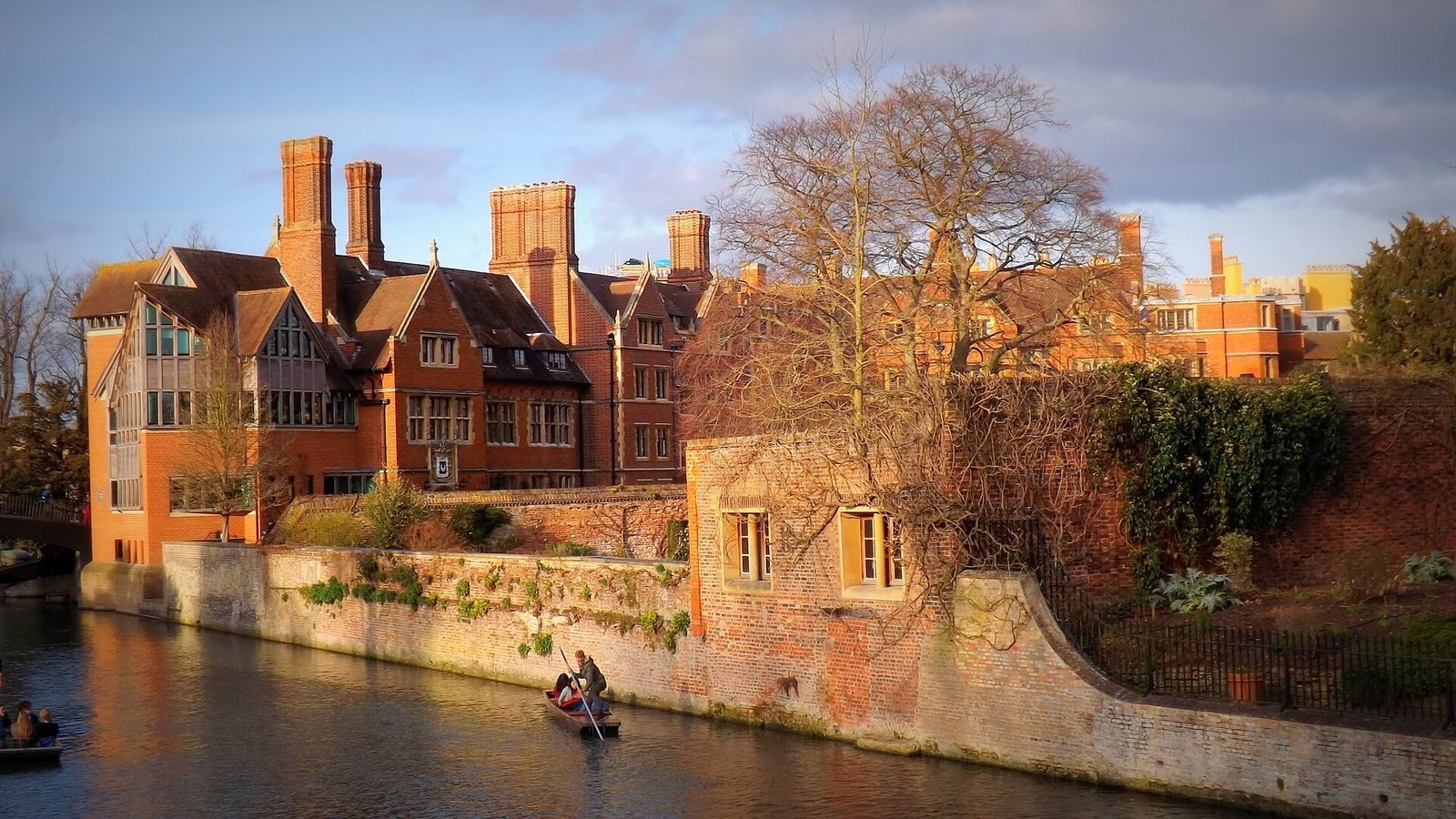
The principal complex occupies the east bank of the River Cam. Trinity College lies to its north, Gonville and Caius College to its east, and Clare College to its south. The Front Court forms the central four-sided court; its completed form was larger than earlier Cambridge college courts. The site brings together medieval buildings and later additions, including spaces beside the river.
Courts and riverside buildings
Front Court
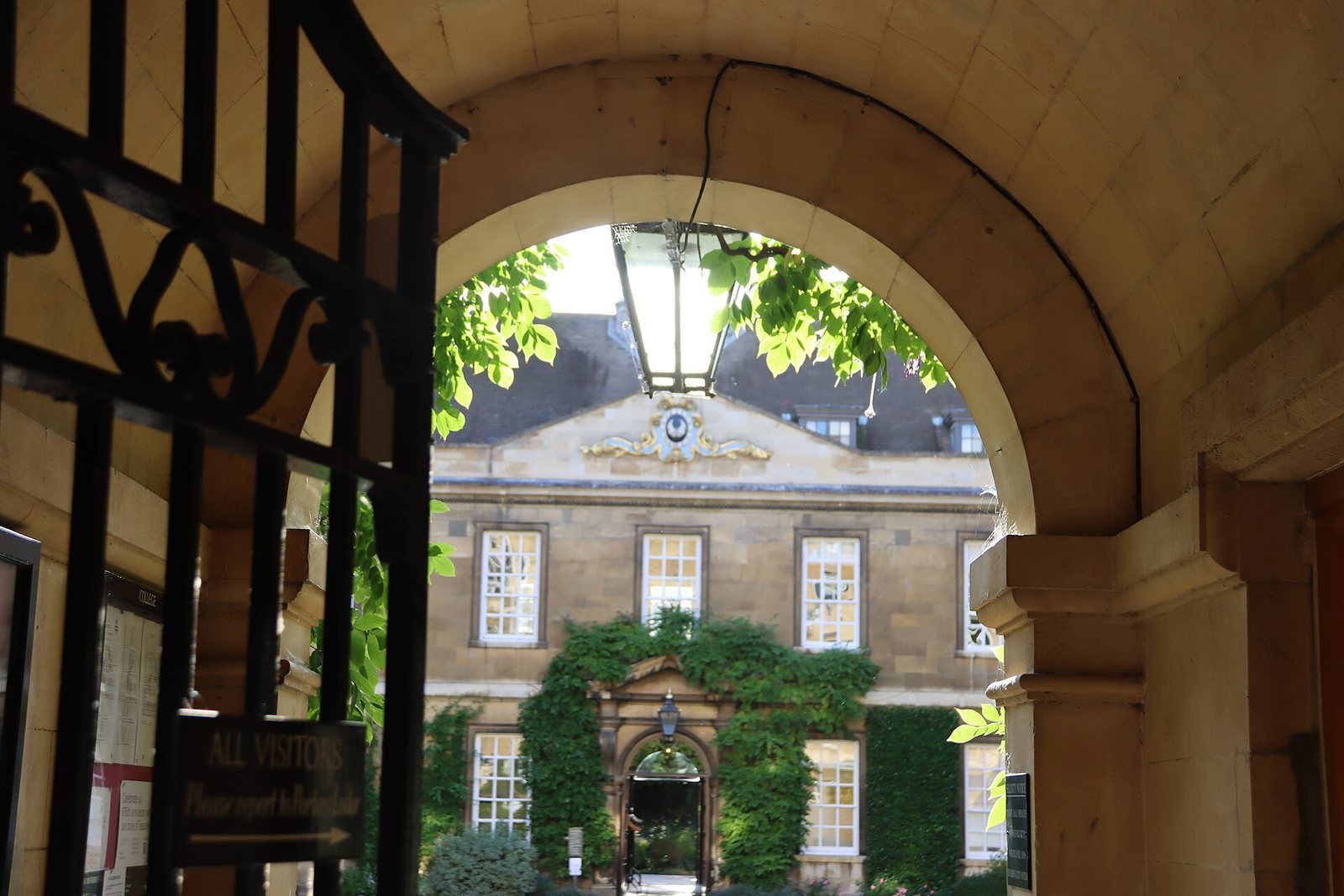
The court’s east side and its hall on the west side preserve parts of the medieval complex. The medieval buildings were later refaced in Portland and Ketton stone. The court’s completed scale distinguishes its layout from earlier college courts in Cambridge.
Jerwood Library
The Jerwood Library opened in 1999 in Latham Court, overlooking the River Cam beside Garret Hostel Bridge. It holds the college’s modern book collection.
Chapel and Dining Hall
Chapel
The chapel interior was renovated in 1729–30. Graves were moved into the ante-chapel, the adjoining space, the walls were fitted with wooden panelling, and the ceiling received the crests of former Masters. An extension eastward followed in 1864. During that work, a piscina, a basin for washing church vessels, was found and concealed behind a secret door.
Behind the communion table hangs Maso da San Friano’s Salutation, painted in 1560 and loaned by the Fitzwilliam Museum in 1957. It replaced an earlier painting attributed to Giacomo Stella. The chapel organ dates from 1922.
Dining Hall
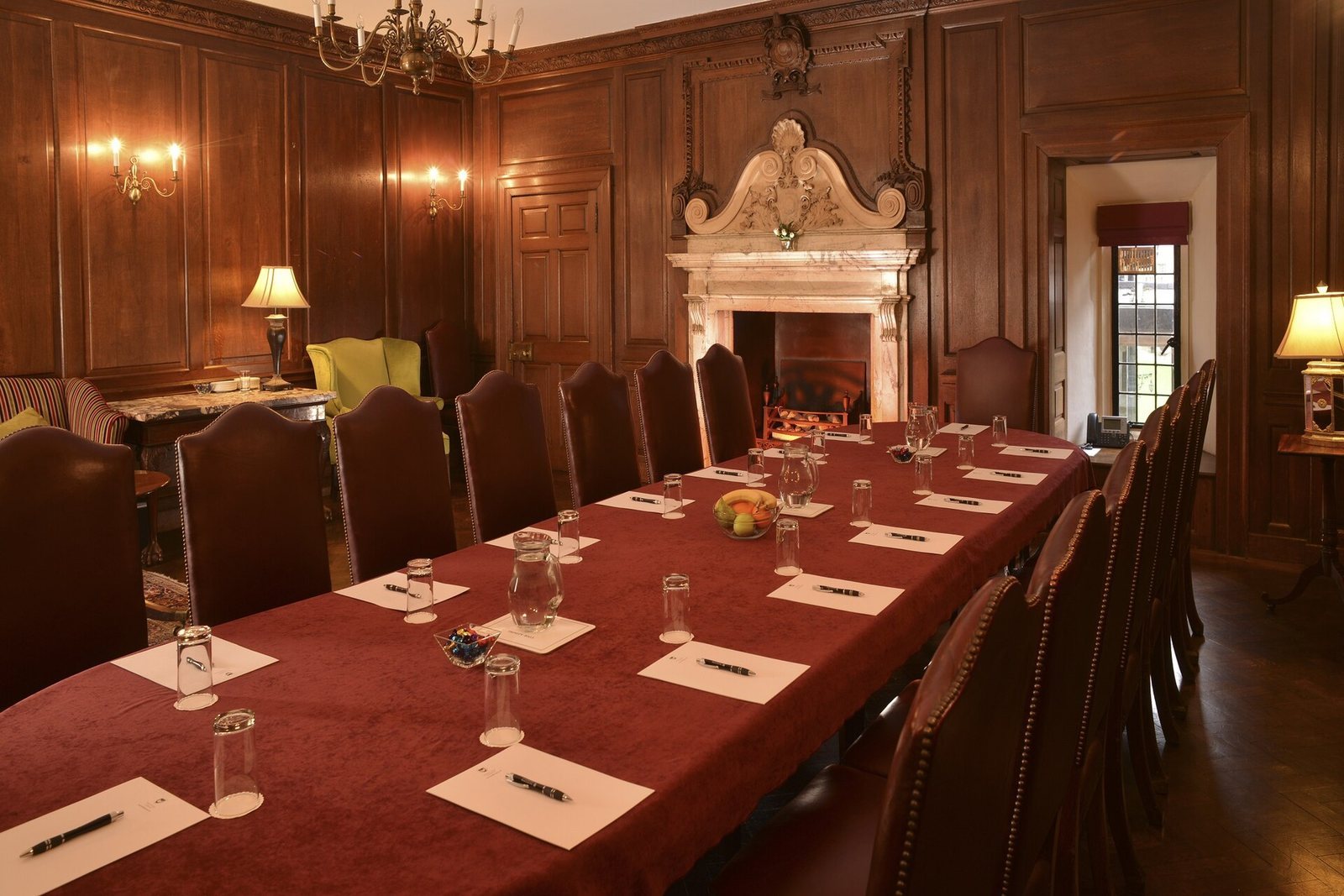
Wooden panelling replaced the Dining Hall’s rendered walls, and Baroque carvings took the place of its medieval beams. A large portrait of Lloyd hangs behind the high table and is said to have been made irremovable from its panelled setting.
Libraries and later buildings
Old College Library
Built around 1590 with Elizabeth I’s permission, probably during Thomas Preston’s mastership, the old college library is one of the country’s surviving chained libraries. Its original fittings, including the chains securing books to desks or shelves, remain. The oldest manuscript in the collection, A Life of St Martin of Tours, dates to about 1050. The library is now used mainly for manuscripts and rare books.
Residential buildings
Wychfield House, built by botanist Francis Darwin, was purchased by the college in 1948. Later additions included Dean House in 1963, Boulton House in 1968, Herrick House in 1972, Launcelot Fleming and Walter Christie Houses in 1992, and New Build in 2006.
Bridgetower Room
The Bridgetower Room is associated with the college’s essay prize named for George Bridgetower.
Sports grounds and rowing facilities
Playing fields
At Madingley Road, the college’s playing fields occupy land first rented from St John’s College in 1892 and purchased in 1923. Work on the grounds and a pavilion began soon after the purchase. The college has also owned land off Huntingdon Road since 1674.
Boathouse
The college’s boathouse stands beside the River Cam. Built in 1905, it commemorates Henry Latham.